

A lead time in this category behaves less like a duration and more like a queue. The manufacturing part of it is frequently the shortest part. What stretches a programme between a purchase order and a shipped carton is the set of decisions that have to land before a line can start: a configuration that has to be frozen, artwork that has to be approved, a firmware build that has to be accepted, destination details that have to be completed. Each of those waits on a person, and a person without a deadline is the delay. Responsiveness is the discipline of putting a date against every one of those decisions before they are needed.
Smart glasses lead time: separating the queue from the clock
The short answer on smart glasses lead time responsiveness
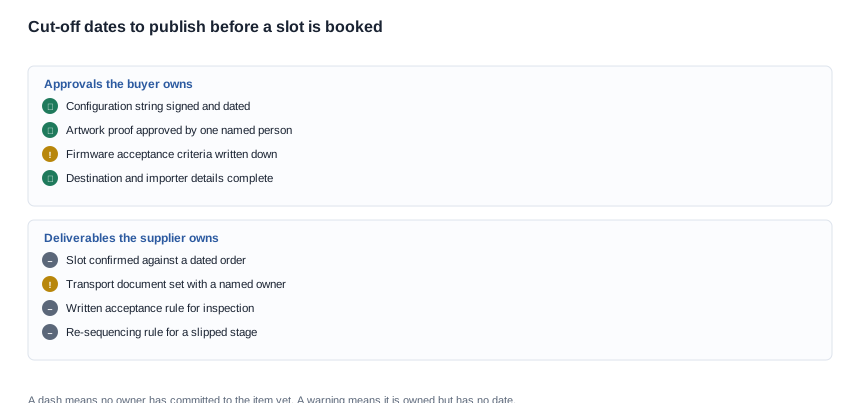
You cannot shorten a smart glasses lead time by asking harder, and you cannot shorten it by moving money forward. What you can do is make every decision-dependent part of it happen without waiting for a meeting, and the mechanism for that is a published cut-off: put a date and a named approver against each item the buyer owns, state in the purchase order that a late approval is treated as the buyer's delay, and give the supplier a written re-sequencing rule for any stage that slips. That converts an argument in month three into a scheduled task in week one.
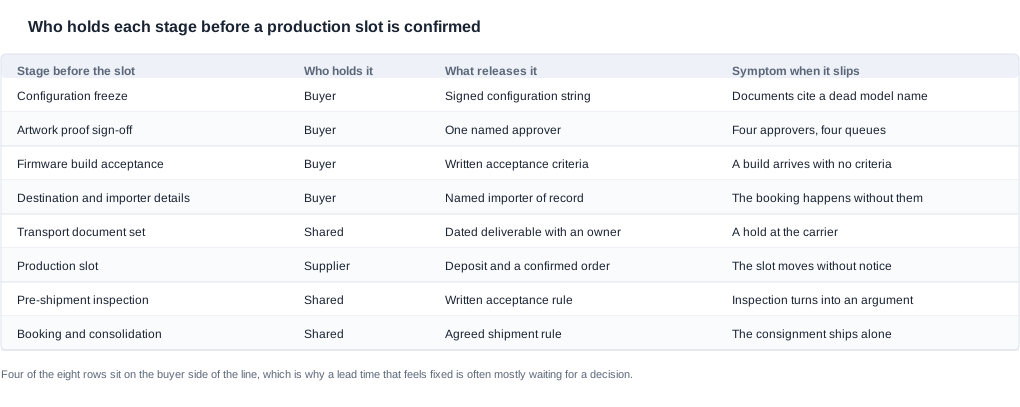
Four of the eight stages between a purchase order and a confirmed production slot sit on the buyer's side of the line. A supplier who quotes you a stage-by-stage duration without a configuration, a quantity and a start condition has given you a number rather than a schedule, and the number will be right in the sense that the assembly line does move at a fairly predictable pace once it starts.
Two conclusions follow, and they are the whole article. If you have a fixed date, the highest-value action available to you before the order is placed is to publish your own cut-off dates with named approvers — not to negotiate the factory's speed. And if the configuration is still open, no amount of supplier-side scheduling will move the date, because every stage downstream of the configuration is currently being planned against a product that does not exist yet.
The buyer behind this question and the date they are managing
The reader is a brand-side procurement lead, a channel buyer or an importer who already holds quotations and now has to choose between them, or who is opening a programme with a date that was set somewhere else and is now their problem. The date usually comes from a launch window, a retail slot, a seasonal campaign or a container arrival that has already been booked around. It is a hard constraint with a soft supplier.
What this buyer is managing is not the gap between two prices. It is a date that can move without anyone being able to diagnose why it moved. Four things frighten them, and they map exactly onto the four failure modes described later in this article: a production slot that shifts without notice and without a re-sequencing rule; a consignment that turns up other than the sample that was approved because the configuration was never formally frozen; a documentation question that surfaces at the border and stops a container; and the discovery in week six that the quoted date silently assumed an artwork approval nobody had scheduled.
Their real question is therefore not "how long does it take". It is "which part of this is mine, which part is the supplier's, and who has to have decided what by when". A supplier who answers that question well has effectively given the buyer a schedule they can manage. A supplier who answers "it depends" has not, and the buyer now has to manage the risk of not knowing.

Why two suppliers quote the same smart glasses lead time and only one of them is right
Where the elapsed time actually accumulates in a wearable programme
A quoted lead time is a function of at least five inputs, and they are not equally visible from outside. The first is the state of the configuration: whether the model, the colourway, the charging case and the packaging are decided. The second is the quantity, because a quantity determines the material set and therefore whether the order shares a setup with other work. The third is the state of the artwork: an approved print file and a packaging proof are long-lead items that sit outside the factory's control. The fourth is the destination documentation state, which for a battery-equipped product includes a transport file with its own lead time. The fifth is the slot pattern — a single release, a split delivery, or a rolling release against a forecast.
Change any one of those five and the date changes, even though the factory, the line and the people on it are identical. That is the entire reason two quotations of "six weeks" are not comparable, and it is why a buyer who compares two lead times without first aligning those five inputs will conclude that one supplier is faster when in fact they are being quoted for different products.

The second reason a lead time looks negotiable is that the factory absorbs buyer-side rework without charging for it. Re-prints, re-builds, re-document loops and the time a factory spends answering a question that a specification should have answered are all visible inside the factory and completely invisible in a quotation. The quoted date and the experienced date therefore diverge, and they diverge most for buyers with the most internal approval layers. The lesson is uncomfortable but useful: a buyer who removes their own rework is not negotiating harder, they are removing work from someone else's schedule, which is the one kind of schedule change that a factory will accept without argument.
The commercial background that makes a lead time look negotiable
Buyers believe a lead time is negotiable because the factory's binding constraint is invisible from outside the gate. A buyer who assumes the constraint is the assembly line negotiates on the one thing that is rarely binding. The constraint might be a component on allocation, an artwork approval, a testing route for the destination market, or a queue for the one person who signs off firmware. Only one supplier knows which of these is binding on a given week, and the buyer cannot derive it from a price list.
The published position on our own operation is deliberately blunt about this. Production capacity, line count, shift pattern, standard lead time and stage-by-stage durations are not published for our factory. The reason is not secrecy; it is that a duration without a configuration, a quantity and a start condition is not a measurement, and a measurement that will be wrong by the time the order is scheduled is worse than no number. A buyer comparing two factories on the length of their quoted lead time is comparing two different products and two different sets of assumptions.
The third feature of the commercial background is that configuration choices reach further than the product page. The catalogue publishes, for example, that the L2 Utral is available with a 900 mAh or a 1400 mAh charging case, that L1 Pro and CY05, and the CY03 carry a 1400 mAh case, that the MT6 ships with a 1200 mAh folding case, that the KY06 and MT5 have a case whose capacity is not published, and that the V03 Pro has no charging case at all. Each of those is a supply line, and each supply line is a scheduling item rather than a catalogue detail. The same applies to charging interface, and here the published rows are uneven: magnetic charging is published on seventeen models, Type C on seven, and four camera models — the CY03 and the CY05, and the L1 Pro and the MT6 — publish no charging method row at all. A Type C configuration means there is no magnetic dock in the box, and a buyer who assumed one will find it in the accessory list rather than in the product. A quotation that lists magnetic charging for one of the four models with no published row, on the other hand, is describing a specification the catalogue does not carry.
The thresholds a smart glasses lead time has to clear before a date is accepted
How each line of a lead time quotation is measured, and what an optimistic one looks like
The table below is the working version of the thresholds. Each row states what the line has to say, how it is measured, and what an optimistic version of the same line looks like in practice. The third column is the part most quotations fail on, because the commonest optimistic quotation is not a lie — it is a scope statement that reads like a promise.
| Lead time line | How it is measured | The line it has to meet | What an optimistic version looks like |
|---|---|---|---|
| Configuration freeze date | Read the date in the order against the last artwork approval date | The freeze date precedes every date that depends on it | A date given with no configuration named |
| Artwork approval route | Ask who approves, in what order, and by what date | One named approver per item with a date | "Approved by the customer" with no person |
| Firmware acceptance | Ask for written acceptance criteria and a sign-off route | Criteria exist before the build is released to the line | A build delivered for comment with no criteria |
| Destination and importer details | Ask which details are outstanding and who owns each | A named importer of record before the booking | Destination details listed as a later step |
| Transport document set | Ask for the document list, the owner and the date | The set is attached to the schedule as a dated deliverable | "Documentation will follow" with no owner |
| Slot pattern | Ask whether the quote assumes one release or several | The pattern is stated and priced | A single figure with no pattern behind it |
| Re-sequencing rule | Ask what happens when a stage slips and who decides | A written rule with a named decision-maker | An assurance that the slot will be fine |
| Inspection window | Ask when inspection happens and what failure triggers | A window and a defined failure route | Inspection described as informal |
Two of these rows deserve a second reading, because they are where the two most common schedules actually break. The configuration freeze row and the transport document row both look like administrative detail until the first shipment, and then they turn out to be the two things that decided the date. The freeze date matters because every document in the programme is written against a configuration; move it and the documentation set has to be reissued, and nobody budgets that loop. The transport document row matters because for a battery-equipped product it is not a formality attached to the shipment, it is an item with its own preparation time that sits in front of the booking.
The published catalogue figures you can check a quoted date against
These are the facts that let you test a schedule rather than accept it. They are published, they are per model, and they are the same for every buyer.
-
Charge time is published for every model. Twenty-six of the twenty-eight models in the catalogue are listed at up to two hours, and the D17 and the ZH12 are listed at about one hour. What is not published is the starting state of charge and the termination criterion — how full the cell was when the clock started, and how full counts as finished. Without those two conditions, a charge time cannot be used to compare how long a shift interruption is, and it cannot be used as the turnaround time for a charging case in a distribution centre. Ask for the conditions and treat a bare figure as unverified.
-
Rated runtime is published for all eleven camera models. The V03 and the V03 Pro are listed at five to eight hours, the KY06 at six to eight, the MT5 at six to eight, MT6 and L1 Pro, CY05 and L2 Utral, and the CY03 at about seven, and the V06 and the S7 at five to eight. A band is not a point, so a model rated five to eight hours is not a substitute for one rated about seven hours in a programme where the shorter end of the band would break the use case.
-
Charging method is published on most models rather than all of them — magnetic on seventeen, Type C on seven, and no charging method row for four camera models. This decides whether a charging dock is inside the carton or inside an accessory order, which is a schedule question and a cost question at the same time, and on the four models with no published row it becomes a question rather than a specification.
-
Case configuration is published per model, including the two sizes on the L2 Utral and the absence of a case on the V03 Pro. It is the fastest way to tell whether two quotations are for the same product.
-
Bluetooth version is published for fourteen of the twenty-eight models, and for none of the eleven camera models. The K01 and K02 are listed at version 5.3; G07 and LC-105-2, YK12 and ZH12, D17 and YKC02, D12 and LC-105-1, and the D11 are listed at version 5.4, alongside the AR entry, the A07 and the electrochromic model. For the eleven camera models the catalogue does not publish a Bluetooth version. If your specification requires a stated radio version on a camera model, that is an open row, and an open row is a queue item.
-
The IP54 marking appears on two models only, the V06 and the S7, as a catalogue marking with no third-party report number published against it.
-
Weight is published for one model only. The MT6's published 158 g is the weight of the glasses body, including the 265 mAh cell and the camera, and it excludes the 1200 mAh folding charging case; the weight of that case is not published. For every other model the weight is not published and has to be requested.
-
Nothing about our factory's capacity is published — no daily output, no line count, no shift pattern, no standard lead time, no stage durations. Treat any supplier figure of that kind as an input to test, not a fact to cite.
One warning applies to every row above: these figures are not directly comparable between suppliers unless the conditions travel with them. A runtime quoted without its volume, source, ambient condition and starting charge state is not the same measurement as a runtime quoted with them, and a charge time quoted without a termination criterion is not comparable to one quoted with it. The catalogue condition is what makes the figure usable, and the absence of a condition is what makes a figure decorative.

Verifying a smart glasses lead time before the deposit goes out
Working through the lead time evidence in sequence
Verification here is a sequence rather than a checklist, because each step tells you which step to run next. Run it against the documents you intend to sign, not against a brochure, and run it before the deposit rather than after the first shipment.
- Ask for the slot in writing against a named configuration, quantity and start condition. The request itself is the first filter. A supplier who cannot state a slot without naming those three has not priced a slot; they have quoted a range.
- Ask which stages are inside the quoted duration and which sit outside it. Most quotations are built as a factory duration with a list of buyer-side and compliance-side items appended. The list is the interesting part, because everything in it has to be scheduled by somebody.
- Ask for the artwork approval route. Who approves, in what order, and by what date. Then compare their answer against your own internal approval chart, because the two are usually different and the difference is the delay.
- Ask for the configuration freeze date and for the consequence of moving it. A supplier with a reissue process will tell you what has to be reissued. One without will tell you the date is flexible, which means the documentation set is at risk.
- Ask for the re-sequencing rule in writing. What the supplier does when a stage slips, who decides, and how much notice you get. The rule is the difference between a slip and a surprise.
- Ask for the inspection window and the failure route. When inspection happens, how long it takes, what fails it, and what happens to the slot if it fails.
The questions to put to a supplier about a smart glasses lead time, and what completes each answer
Each question below has a completion test, because the point of asking is to end up with something you can put in the order. A verbal answer is not a completion.
- Which configuration is the quoted slot against? Completion: a configuration string, not a family name. If the answer is a family name, the slot is not a slot.
- What is the last date on which a change can still be absorbed? Completion: a date and a named consequence for a change after it.
- Who approves the artwork, and what is the approval deadline? Completion: one name per item and a date per item.
- What happens if the first sample does not pass? Completion: a written route, not a new quotation.
- Which documents must exist before the line starts, and who produces each? Completion: a list with an owner and a date against every entry.
- What is the slot pattern the quotation assumes? Completion: a stated pattern, priced, with the alternative priced too.
- How will I know the slot is confirmed? Completion: a document or a named trigger, dated.
Seven questions, asked in this order, convert a lead time from a figure into a schedule. That conversion is worth more to a buyer than any percentage of price, because a schedule that can be managed can be defended to a channel, and a price that is two percent better cannot.

Where a smart glasses lead time programme breaks, and how the numbers get there
Four smart glasses lead time failures that arrive as a surprise, and the control for each
The slot that moved because the artwork was never signed. The symptom is a date that was firm in month one and soft in month two, with no obvious cause. The root cause is an approval route with four people in it and no deadline in front of any of them, so the artwork sat in a queue that the factory could not see or expedite. The control is to publish one approver per item with a date, and to write into the order that an approval arriving after its cut-off moves the shipping date rather than the factory's plan.
The configuration that changed after the documentation was written. The symptom is a request, at the pre-shipment stage, for documents that cover a model designation which no longer exists on the unit in the box. The root cause is that the freeze was a verbal agreement and a change to a colourway, a case option or a packaging revision was treated as a small thing. The control is a dated freeze, a reissue rule attached to any change, and a configuration string repeated on the order, the artwork file and the packing list.
The charging case that was not on the order. The symptom is a first shipment of glasses with no way to charge them that is not the USB port, or a case quantity that does not match the unit quantity. The root cause is that the case is often treated as an accessory when it is a line in the bill of materials with its own lead time — as the published case options show, one camera model has two case sizes, one has a folding case, one has no case and two have a case whose capacity is not published. The control is to list every physical item that ships in the carton against the configuration string, and to check the count against the order before the booking.
The inspection that turned into a dispute. The symptom is a container held while two parties argue about a characteristic that was never written down with a method. The root cause is an acceptance rule agreed during the dispute instead of before the production run. The control is a written acceptance rule with a sample size and a limit, attached before the order, and a named remedy.
None of these four is a reason to change supplier. Each is a line to write down, and each is cheaper than the version where the programme discovers it after the money has moved.
The negotiation on lead time, item by item
The negotiation that has real movement is not over the factory's speed. It is over the edges around it.
What moves: the slot pattern, because a split delivery or a rolling release against a forecast is often easier for a factory to accommodate than a single large release in a peak week; the artwork rounds included in the price; the date on which the configuration freeze takes effect; the inspection window and its failure route; the split between the supplier's forwarder and your own, which changes the booking flexibility; and the re-sequencing rule, including who decides and how much notice you get.
What does not move: the cost and cycle of the regulatory route for the destination market, which is a fixed cost per model and per market; the tooling cost itself, though its amortisation across the first order is negotiable; the component supply position, which is a fact rather than a position; and the case configuration, which is a specification decision dressed up as a commercial one.
The clauses worth having in the order are short. A configuration string with a freeze date. Named approvers and dated cut-offs for every buyer-owned item. The re-sequencing rule with a named decision-maker. The acceptance rule with a sample size and a limit. The remedy for a stage that slips, including who bears the cost of the delay. And a statement that a stage slipping because of a buyer-side approval moves the shipping date — because that clause is what turns the argument in month three into a scheduled task in week one.
One smart glasses lead time scenario worked end to end, and where Cynrin stands
A scheduling scenario, reconstructed from the decisions a buyer has to take
The situation below is constructed rather than reported, and no customer, order or quotation is described in it. The configuration, the quantity and the shipping date are assumptions, chosen so that the order in which the decisions have to be taken can be examined. The value of the exercise is in the sequence, not in the outcome.
The scenario: a brand is opening an open-ear audio programme for a retail channel, two colourways, a fixed on-shelf date that was set by the channel rather than by the brand, and a first release in the low thousands of units. The buyer has two quotations, both of which say "six weeks from order", and has to choose.
Step one is to stop comparing the six weeks. The two quotations are not for the same product until the configuration is written down, so the buyer asks each supplier for the configuration string, the case line, the charging method and the colour split. One quotation turns out to include a magnetic charging dock in the carton; the other describes a Type C model with no dock in the box, which means the buyer has an accessory line that the second quotation did not price.
Step two is to ask what the six weeks contains. The first supplier's answer is a factory duration with a list of buyer-side items appended — artwork proof, firmware acceptance, destination details. The second supplier's answer is a stage breakdown with dates, because they have been asked to plan against a specific configuration before. The second quotation is now more useful despite being no faster.
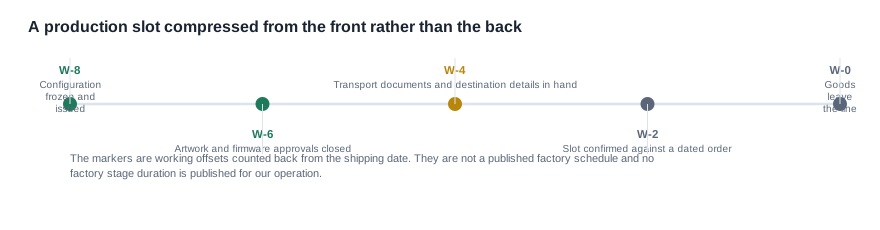
Step three is to publish cut-offs. The buyer dates artwork approval and names one approver, dates the firmware acceptance criteria, and puts a date on the destination and importer details. Each is given a week number counted back from the shipping date, and each has a late-approval clause attached.
Step four is to compare the two quotations on the remaining variable, which is the slot pattern. The brand's demand is not lumpy — it is a channel fill plus a promotion — so a rolling release against a firm forecast is a better fit than a single release, and one supplier prices that pattern better than the other.
Step five is to write it down: a configuration string, a freeze date, dated approvals, the re-sequencing rule, the acceptance rule and the pattern. The outcome is not a faster factory. It is a date that the buyer can explain to the channel, and a delay that, when it happens, has an owner.
Where Cynrin stands on lead time claims, and the next action
We will say plainly that we do not publish a standard lead time, a stage-by-stage duration, a daily output, a line count or a shift pattern, because a duration without a configuration, a quantity and a start condition is not a measurement, and a number that will be wrong by the time your order is scheduled costs you more than the absence of one. We do publish the model-level facts — cell capacity, charge time, rated use, charging method, Bluetooth version where the catalogue carries it, case configuration, colour availability — because those are the figures a schedule can be tested against.
What we will do is take your configuration, quantity and required date and name the stage that binds first, mark which of the stages are yours to schedule, and put your cut-offs and our re-sequencing rule into the order so that when a date moves, the conversation is about a stage rather than about who should have done something sooner. What we will not do is quote a date against a configuration you have not frozen, or let a document reference a model designation that the unit in the carton does not carry.
Send us the models, the quantities, the target date and the destination, and we will tell you which configurations exist, which documents each one needs, and which stage binds the schedule first. The lead time and production schedule section sets out the full sequence.
Related reading
- Lead time negotiation — how the conversation is structured
- Mistakes that add weeks — the avoidable delays
- Stage comparison table — comparing suppliers on the same inputs


