

A lead time is usually quoted as one number, and one number cannot be compared with another because the two numbers rarely start at the same place. The workable alternative is a table: six stages, each with an owner, the evidence that shows it happened, and the thing that moves it. Once the stages are separated, two quotations can be set side by side and the comparison becomes real — including the comparison that matters most, which is between buying direct from a factory and buying through a route that puts some of those stages in somebody else's hands.
The reader is a buyer working for the brand, a channel buyer or an importer comparing two or three quotations. The situation is always the same shape: the quotations differ, the differences are not obviously about the product, and the buyer has to decide which difference is worth paying for. The fear is not being overcharged. It is discovering that two quotations that looked comparable were measuring different spans of time, and that the cheaper one was cheaper partly because it was quoting a shorter interval.
Smart glasses lead time: six stages compared by owner, not date
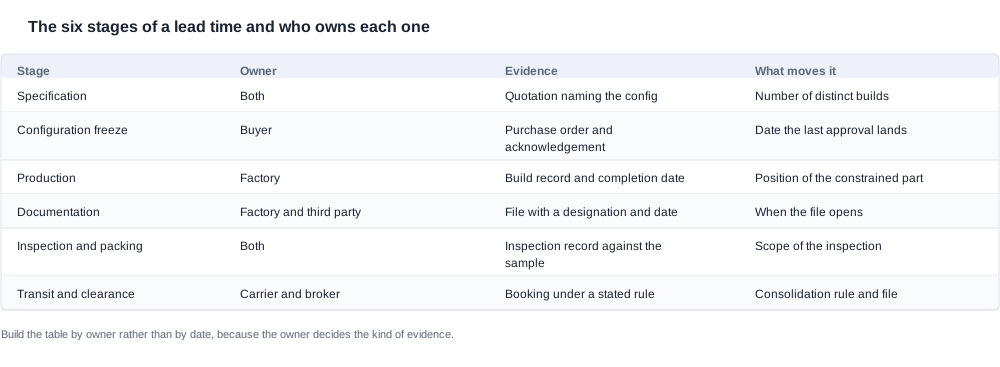
Six stages cover the whole span from an enquiry to goods in a channel. They are the same six regardless of the product, and they are worth naming precisely because the stages have different owners and different failure modes, which is what makes a stage table more useful than a date list.
Stage one: specification and quotation. The buyer describes the configuration, the supplier prices it and states a date. Nothing has been committed and nothing is at risk, but this is where the start point of the interval is chosen, and a choice made here tends to persist.
Stage two: configuration freeze and purchase order. The configuration string is fixed, the purchase order is issued, and the payment node that triggers production is set. This is the stage at which the buyer's options narrow, because a change after this point is a change of order rather than a change of preference.
Stage three: production. The build, the assembly and the in-process checks, ending in units that exist. This is the only stage that is unambiguously the factory's, and the one a buyer has the least direct visibility of.
Stage four: documentation and compliance. The market-access route for each destination, and the transport documentation for the shipment. In Europe the market-access instrument for a radio-equipped product is the Radio Equipment Directive (EU) 2014/53/EU. This stage is usually underestimated because it is invisible, and it is usually the one that has been running since before the order.
Stage five: inspection, packing and handover. The goods are checked against the approved sample, packed, labelled for the destination, and handed to the carrier. It is short and it is where a configuration mismatch finally surfaces.
Stage six: transit and clearance. The consignment travels, under a consolidation rule, and clears at destination. The part of the interval a buyer controls least and the part a channel feels most.
The reason the table is built by owner rather than by date is that the owner determines the kind of evidence the stage produces. A stage owned by the buyer produces a buyer-side record — an approval, a dated artwork, a named sign-off. A stage owned by the factory produces a factory-side record — a build record, an inspection report. A stage owned by a third party produces a document with a number on it. A buyer comparing two quotations stage by stage is therefore comparing their evidence, which is comparable, rather than their totals, which are not.

The stage table: owner, evidence, and what moves it
The table below is the working version. It is designed to be filled in from a supplier's answers and then read across two rows, which is where the comparison actually happens.
| Stage | Who owns it | The evidence it produces | What moves it | A red flag in the answer |
|---|---|---|---|---|
| Specification and quotation | Both | A quotation naming the configuration | The number of distinct builds in the order | A model name instead of a configuration |
| Configuration freeze and purchase order | Buyer | A purchase order and an order acknowledgement | The date the last approval arrives | A start point that was never named |
| Production | Factory | A build record and a completion date | The position of the constrained part | A total with no stages behind it |
| Documentation and compliance | Factory, with a third party | A file with a model designation and a date | When the file opens | The word handled in place of a duration |
| Inspection, packing and handover | Both | An inspection record against the sample | The scope of the inspection | A full check with no defined scope |
| Transit and clearance | Carrier and broker | A booking under a stated consolidation rule | The consolidation rule and the file | A transit figure with no rule attached |
Two rows in that table repay a second reading, because they are the two where a buyer's answer is usually missing rather than a supplier's.
The configuration freeze row is the buyer's row, and it is the one most often left blank. A buyer who has not decided when the configuration freezes has not decided when the interval starts, and a supplier asked to quote against an undefined freeze will quote from whichever end is easier for them. The remedy is a date, and the date has to be one the buyer's own approval process can actually hit.
The transit row is where two quotations most often diverge without either being wrong. One supplier consolidates and one does not, and the transit figures are therefore not comparable at all. The question to ask is not "how long is transit" but "under what rule", and the answer belongs in the order acknowledgement.
The comparison that the table is built to support is between two quotations on the same configuration. Once both are written stage by stage, three things become visible: which stage differs most, who owns that stage, and whether the difference is a difference in the plan or a difference in the start point. A difference in the start point is a definitional problem and it is resolved by a sentence. A difference in a factory-owned stage is a real difference in capability. A difference in a buyer-owned stage is a problem the buyer has to solve before comparing anything.
The same six stages under three buying routes
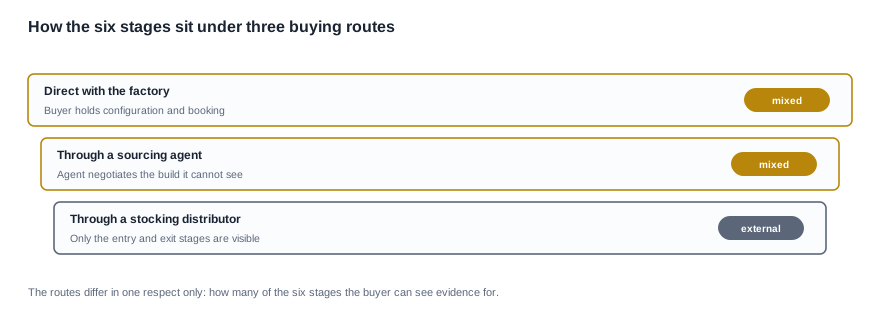
The stage table becomes far more useful when it is applied to the buying route rather than to a single supplier, because the routes differ in exactly one respect: how many of the six stages sit with the factory and how many sit somewhere else.
Route one: direct with the factory. The factory holds stages three and four, and usually stage five as well, because the inspection and the packing happen on its site. Stages one, two and six sit with the buyer and its forwarder. The consequence is that the buyer has direct access to the build record and the documentation file, and direct responsibility for the configuration, the approvals and the booking.
Route two: through a sourcing agent or a buying office. The agent holds stages one, two and five on the buyer's side, and negotiates stages three and four rather than owning them. The buyer's visibility into the factory's own records drops to whatever the agent passes on, and the stage table's middle row — the evidence column — becomes the most important column, because everything now has to travel through a second channel before it reaches the buyer's file.
Route three: through a distributor who holds stock. The distributor holds stages three, four and five internally and presents a single delivery date. The buyer's specification still enters at stage one and the buyer's approvals still matter at stage two, but the interval between them is no longer visible at all. The comparison the buyer can make is a price and a delivery date, and nothing else.
The reason this matters for the lead time question specifically is that the three routes produce three different-looking schedules for what may be the same physical build, and only one of them is the buyer's to plan against.
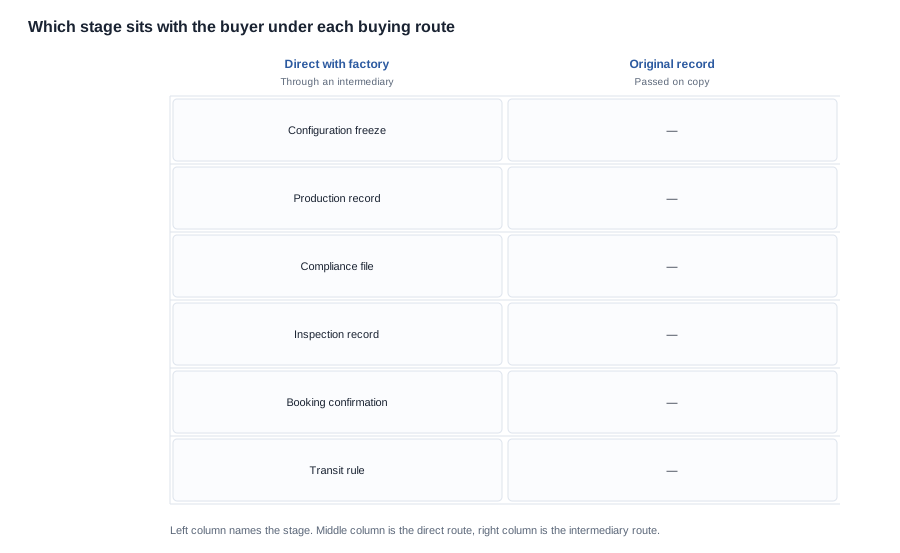
Read the matrix by column. The first column names the stage, the second says who holds it when the buyer buys direct, and the third says who holds it when an intermediary sits between the two. The stages that move are the ones where an intermediary is working from information the buyer did not supply and the factory did not hand over directly.

The comparison that actually decides it: which stage sits with you
For a buyer in this category the decisive question is not which route quotes the shortest date. It is which route leaves the buyer holding a stage they cannot control.
Three of the six stages are worth examining in that light.
The configuration stage. Under every route this is the buyer's, and it is the stage that most often decides whether the rest of the interval means anything. A one-line configuration string — model, pixel tier, case configuration, colourway, packaging configuration, destination markets — is the thing every route depends on and the thing nobody formalises. In this catalogue the string has real content: eleven of the twenty-eight models carry a camera, split eight at 8 MP and three at 13 MP; the L2 Utral's case comes at 900 mAh or 1400 mAh while the CY05 and the CY03, and the L1 Pro carry a 1400 mAh one; the MT6 carries a 1200 mAh folding case; the KY06 and the MT5 have a case whose capacity is not published; the V03 Pro has no case at all; the V03 Pro is published in three colours and the V06 in four; and the charging method is published for twenty-four of the twenty-eight models and for none of the four camera models the CY05 and the MT6, and the CY03 and the L1 Pro.
The documentation stage. This is the stage that changes most under an intermediary route, and the reason is that its evidence is a file. A file that is held by the factory and passed through a second party is still a file, but the buyer's copy is a copy, and a copy is what a buyer has to rely on when the destination asks a question. The published rows that support the file are the charge time and the rated use band, published for every model, and the charging method and case configuration, published for most. Those are the rows the file has to carry.
The transit stage. Under every route this is the buyer's own forwarder, and it is the stage where the consolidation rule matters most. A buyer who compares two quotations on a transit figure without knowing the rule has not compared anything.
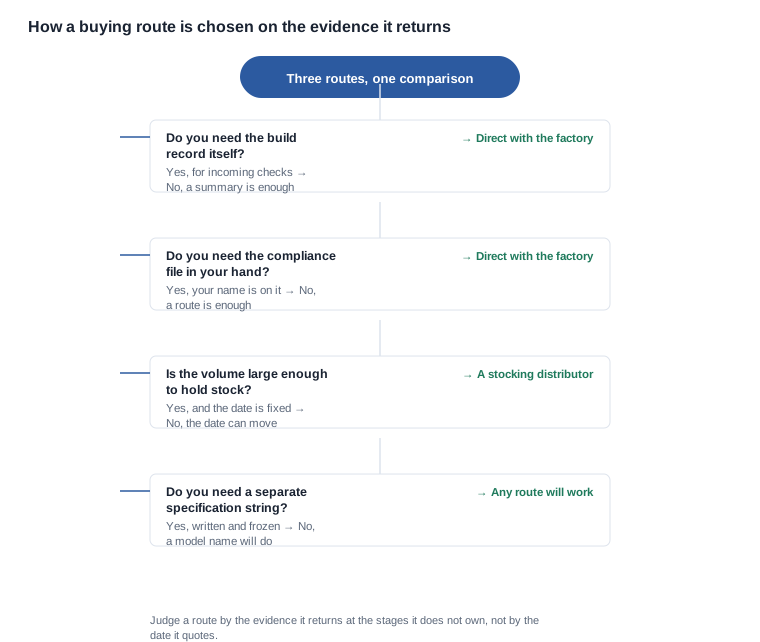
The general principle is that a buying route should be judged by the evidence it gives the buyer at the stages it does not own, not by the date it quotes. A route that returns a clear file, a clear build record and a clear order acknowledgement is worth more than one that quotes a shorter interval, because a shorter interval is only meaningful if somebody can show the buyer which stage it shortened.
What the published catalogue data can and cannot fill into this table
The table has a row for the configuration stage and the published data fills it well. It has a row for production and the published data fills it not at all.
What the catalogue publishes for every one of the twenty-eight models is a battery capacity, a charge time and a rated use band, and for the eleven camera models it also publishes the pixel tier. The charging method is published for twenty-four models, the case configuration for most of the camera models, the colour options for the models that offer a choice, and the IP54 marking for two — the V06 and the S7 — and for no others.
| Camera model | Pixel | Cell | Charge time | Rated use | Charging case | Charging method |
|---|---|---|---|---|---|---|
| V03 | 8 MP | 220 mAh | Two hours or less | 5~8 h | Not listed | Magnetic |
| V03 Pro | 8 MP | 220 mAh | Two hours or less | 5~8 h | No charging case | Type-C |
| KY06 | 8 MP | 260 mAh | Two hours or less | 6~8 h | Capacity not published | Magnetic, with case |
| CY03 | 8 MP | 290 mAh | Two hours or less | About 7 h | 1400 mAh | Not published |
| CY05 | 8 MP | 290 mAh | Two hours or less | About 7 h | 1400 mAh | Not published |
| L1 Pro | 13 MP | 290 mAh | Two hours or less | About 7 h | 1400 mAh | Not published |
| L2 Utral | 13 MP | 290 mAh | Two hours or less | About 7 h | 900 or 1400 mAh | Type-C |
| MT6 | 8 MP | 265 mAh | Two hours or less | About 7 h | 1200 mAh folding | Not published |
| MT5 | 8 MP | 220 mAh | Two hours or less | 6~8 h | Capacity not published | Magnetic, with case |
| V06 | 8 MP | 260 mAh | Two hours or less | 5~8 h | Not listed | Magnetic, IP54 |
| S7 | 13 MP | 260 mAh | Two hours or less | 5~8 h | Not listed | Magnetic, IP54 |
Read that table as a specification, not as a schedule, and note the two columns that are doing the most work. The cell column contains four different values across the eleven models, so a capacity cannot be assumed from a model family. The rated use column contains three bands, and the two models with the shortest band — the G07 and the YK12 in the audio range, at approximately 6 h — are the two with the slim and detachable temple, so the band tracks a design decision rather than a component one.
What is not in the catalogue is the production stage. We publish no lead time, no monthly output, no line count and no minimum order quantity, and the reason is that a number which does not hold for a specific configuration, quantity and date range is the number a launch window gets built on and then fails. The lead time section sets out the whole published position, and it is deliberately narrower than the stage table: the catalogue fills the configuration row and the unit-behaviour rows, and the production row has to come from the supplier against a specific order.
How to use the table when two quotations do not line up
When two quotations do not line up, the table gives a procedure rather than an opinion, and the procedure is short.
First, align the start points. Check that both intervals begin at the same event. If one begins at the order and the other at the configuration freeze, the difference is a definition, not a capability, and it is resolved by a sentence in the order acknowledgement.
Second, find the largest stage difference. Read across the six rows and find where the two columns diverge most. That row is the argument worth having; the other five are usually noise.
Third, establish who owns that stage. If the buyer owns it, the difference is a process difference and the buyer can usually close it. If the factory owns it, the difference is a capability difference or a difference in what was quoted, and it needs a reference build to settle.
Fourth, ask what evidence stands behind the shorter stage. The question is not "can you do it faster" but "what do you have that the other one does not", and the answer for a factory is usually a specific process, a specific component position or a specific piece of equipment. A factory that cannot name one of those has quoted an aspiration.
Fifth, price the difference as a total, not as a date. The stages do not all cost the same per week. A week lost in the approval stage is a week the buyer's own process caused and can recover. A week lost in the documentation stage is a week a third party controls and cannot be recovered by moving the order. A week lost at the transit stage is a week the channel feels. A buyer who prices all weeks identically will negotiate the wrong one.
There is one more thing to check before the table is used for a decision, and it is the row most buyers leave blank: what the shorter stage actually replaces. A quotation that is shorter at the documentation stage has not necessarily found a faster route; it may have moved the documentation after the shipment, which converts a schedule advantage into a clearance risk at destination. A quotation that is shorter at the inspection stage may have moved the inspection after the booking, which converts a schedule advantage into a defective-unit risk in the channel. A quotation that is shorter at the transit stage may simply be assuming a consolidation rule that will not apply to the quantity you are ordering. The questions to ask are always the same pair — what moved, and what did it move onto — and a supplier who answers only the first has described a saving rather than a plan.
The red flags in a stage table are consistent: a stage with no owner, a stage whose evidence is a verbal assurance, a stage that appears in one quotation and not in the other, and a total that appears without the stages that produce it. Those four are enough to disqualify a comparison, and checking for them takes about two minutes once the table is filled in.
The total cost of a schedule is the unit price plus the cost of the documentation route plus the rework the inspection catches plus the returns reserve plus the working capital held against a later launch, and it is worth arriving at that conversation with a number rather than with a request. The negotiating guide covers what can and cannot be moved once the table is filled in.
What we will do is fill in the rows we can for the models a programme actually selects, and answer the rest in writing. Send us the models, the quantities, the configuration and the destination markets, and we will tell you which rows the published data closes, which ones we will confirm for you, and which ones are yours to close with your own suppliers.
Related reading
- A guide for first-time buyers — the order of operations
- A cost breakdown of a schedule — pricing the stages
- Lead time and production capacity — the constraint behind a slot
- Lead time and your margin — the commercial consequence


