

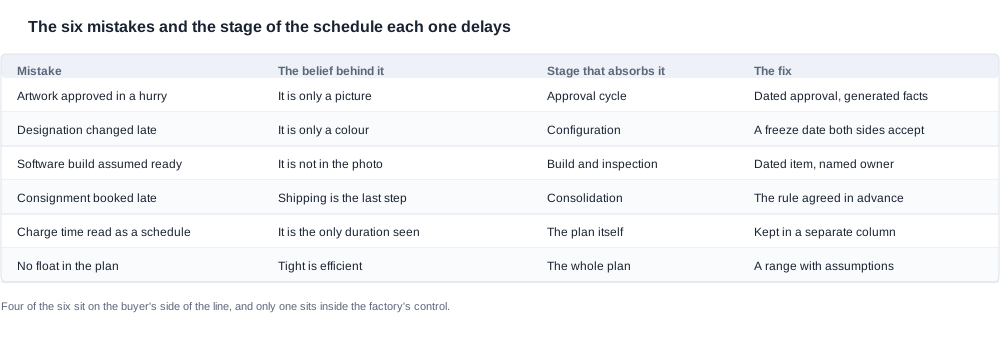
These are the six mistakes that actually appear in delivery disputes. None of them is exotic, all six are avoidable before the order, and each one costs a full cycle somewhere in the schedule rather than a small delay that can be absorbed. The list is organised by the stage each mistake delays, because that is the only useful way to look at them: a buyer who knows which stage a mistake sits on can see it in the plan, and a buyer who does not can only see it in the outcome.
The reader is a procurement manager at the brand, a channel buyer or an importer who has either just experienced a date that moved or is about to. The situation is a programme with a launch date that somebody promised, and a supply chain in which every stage belongs to a different party: the artwork to the buyer's agency, the build to the factory, the compliance file to a third party, the transport file to the broker, the shelf to the channel. The fear is not that the factory is slow. It is that a week disappeared and nobody can say where it went.
Smart glasses lead time: six mistakes and what each one costs
The reason to organise these six by stage rather than by severity is that severity is subjective and stage is not. A week lost in the artwork approval is a week the factory can absorb by working to a different order of the same work. A week lost in the configuration freeze is a week of paid material that is about to be the wrong material. A week lost in the consolidation window is a week at the end of the schedule, where there is no more schedule to absorb it.
Each mistake below is written the same way: what the buyer believes, what actually happens, which stage absorbs the loss, and what prevents it. The last part is the part that matters, and in every case it is a decision or a document rather than an instruction to a supplier. That is deliberate. A buyer cannot instruct a factory to be more efficient, but a buyer can decide to freeze a configuration on a date, or can put a column in the order acknowledgement that says what is not yet approved.
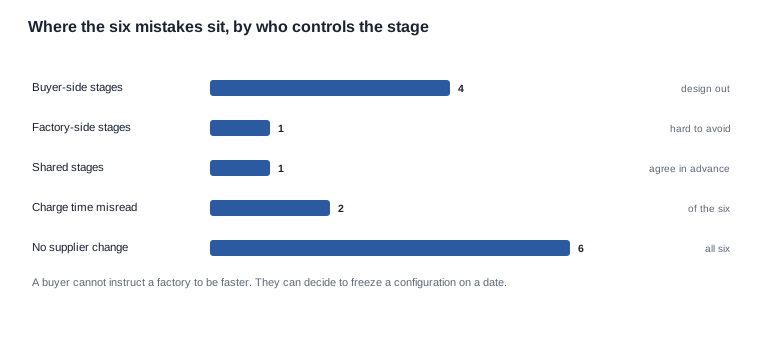
The distribution in the chart above is the argument of this article in one picture. Four of the six mistakes sit on the buyer's side of the line, and only one sits inside the factory's own control. A buyer who has spent their negotiating effort on factory efficiency has been working on the one mistake they could not have avoided, and has left five that they could have designed out.

Mistake one: approving the artwork in a hurry
What the buyer believes. That the artwork is a formality, because the artwork is a picture of a product that already exists and whose specification is already settled. Once the model is chosen, the packaging is a matter of taste and can be approved in a day, so it can be approved in the week before the order rather than in the month before it.
What actually happens. The artwork carries more than a picture. It carries the retailer's mandatory content, the market-specific label text, the regulatory statements the market requires, the carton markings, the packing quantity, the barcode, the importer's address block, and a set of product claims. Every one of those is a fact that has to come from somewhere, and the facts that have no published source are the ones that get typed in by whoever is closest to the artwork.
Which stage absorbs it. The approval stage, and it absorbs a full cycle — the length of the round trip the buyer set, not a day. The characteristic version of this mistake is not a slow approval; it is a fast approval followed by a slow correction, because the artwork was approved before the facts it asserts had been confirmed, and the correction is a second cycle with a print date already missed.
What prevents it. Put the artwork on the critical path deliberately. Name one approver and one deputy for it, set a completion date for the artwork rather than a start date, and require that the artwork asserts nothing about the product that is not in the buyer's own configuration file. That last rule is the one that pays: a packaging panel that states a charging method, a capacity or a runtime has to be generated from a confirmed source, not typed. The catalogue is complete enough to support most of those assertions for most models, and where it is not — four camera models publish no charging method at all — the answer has to come from the supplier in writing before the artwork claims it.
Mistakes two and three: changing the designation and assuming the software build is ready
Mistake two: changing the model designation late. A buyer who has ordered a camera model and then decides, during the build, that a different colour or a different case configuration would sell better, is not changing a preference. They are changing a bill of materials, and the cost of that change is not only the material already committed but the documentation that was written for the earlier build and the artwork that was approved for the earlier build.
Which stage absorbs it. The configuration stage, and the loss is paid twice: once in the material that has to be scrapped or reworked, and once in the documentation route, because a conformity file written for one configuration does not automatically cover another.
What prevents it. Freeze the configuration on a date and let the date be the same on both sides. In this catalogue the configuration is genuinely worth freezing, because there is more of it than a model name: eleven of the twenty-eight models carry a camera, split eight at 8 MP and three at 13 MP; the L2 Utral's case comes at 900 mAh or 1400 mAh; the V03 Pro is published in three colours and the V06 in four; and the charging method is published for twenty-four models and for none of the four camera models the CY05 and the L1 Pro, and the CY03 and the MT6. A freeze date that comes before those four answers exist is a freeze date that will move.
Mistake three: assuming the software and app build is ready. A camera model in this range is not only a lens and a cell. It has a companion application, a firmware baseline, and a retailer's expectation that the listing will work on the day it goes live. A buyer who assumes the software side is ready, because the software side is not visible in any factory photograph, is assuming a deliverable that somebody has to own.
Which stage absorbs it. The build and pre-shipment stage, and the loss appears at the worst possible moment: after the units are made, when a software problem is discovered late, because the units are finished and the shelf date is fixed.
What prevents it. Put the software deliverable in the order as a dated item with a named owner on the buyer's side, and make the version that ships in the first order the version that was tested. The catalogue does not publish firmware versions and we do not claim that it should; what matters is that the buyer's own file states which version was approved, and that the approval happens before the units are built rather than in the same week they are inspected.

Mistake four: booking the consignment at the last minute
What the buyer believes. That shipping is the last step and therefore the step that can be handled last. The goods will be ready, the booking will take an afternoon, and the transit time is the same whatever the booking date is.
What actually happens. Transit is one of the least flexible stages in the whole chain, and it is flexible in exactly one direction. A consignment that travels with a consolidation is faster and cheaper than one that travels alone. A consignment booked on the day the goods are ready is a consignment that travels alone. And a consignment that needs a market-clearance route needs the documentation ready before it is booked, not while it is in transit, so a late booking is also a late document.
Which stage absorbs it. The transport and consolidation stage. The loss is the difference between the consolidated and the unconsolidated transit, plus the clearance delay that follows an incomplete file.
What prevents it. Fix the consolidation rule before the first order, and write it into the order acknowledgement. "Consolidated unless the quantity does not support it" is a rule that names a condition; "shipped within X days" is a rate that assumes a condition. The related rule is the one about the documents: the file that covers the units has to exist before the booking, not after the carton is sealed, and the model designation on the file has to match the model designation on the unit. In a category where four camera models do not publish their charging method and no camera model publishes its radio version, those two matching checks are the ones that fail silently, because nothing about the shipment looks wrong until a broker asks.

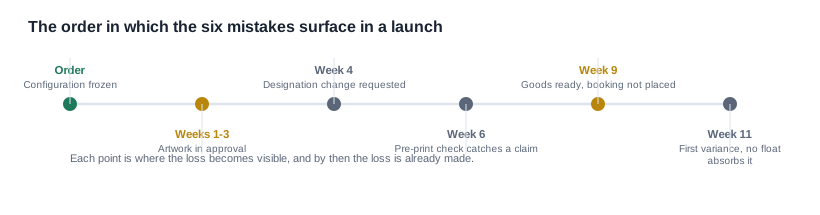
The sequence above shows when each mistake becomes visible rather than when it is committed, and the ordering is the useful part. The configuration mistake is visible at artwork proof, which is late. The artwork mistake is visible at pre-print, which is later. The booking mistake is visible at the dock, which is later still. The pattern is that a mistake made early on the buyer's side is discovered late, and the discovery point is the one that determines whether it can still be fixed.

Mistakes five and six: reading a charge time as a schedule, and building a plan with no float
Mistake five: treating the charge time as a lead time. The catalogue publishes a charge time for every one of the twenty-eight models — two hours or less across the range, with the D17 and the ZH12 at roughly one hour on Type-C — and it is a genuinely useful published fact. It is also the single most misread number in the category, because it is the only duration most buyers have ever seen attached to this product.
Why it misleads. A charge time says how long a device takes to refill, and it comes with a starting state of charge that is not specified and an end criterion that is not specified. A unit charged from an unknown state to an unknown endpoint does not take a defined time, and the charge time in the catalogue is the figure for the nominal case. A buyer who has only ever seen a duration for this product will anchor on it, and will then find that their plan has no production stage in it at all.
The related misreading is the rated use band. It is published for every model too — approximately 5 to 8 h for several of the camera models, approximately 6~8 h for the KY06 and the MT5, approximately 7 h for the CY03 and the L2 Utral, the L1 Pro and the CY05, and the MT6, and approximately 6 h for the G07 and the YK12 — and it is the figure that determines how long a unit sits on a charge during a service loop. It is not a schedule either, and it is more dangerous to misread than the charge time, because it looks like a specification and answers a question nobody asked.
What prevents it. Keep the two electrical durations in a separate column of your plan, labelled as unit behaviour, and never let them be the input to a date calculation. The only production-related fact in the published data is the configuration itself: the model, the pixel tier, the charging method where it is stated, the case configuration where it is stated, the colour options, and the IP54 marking on the two models that carry it.
Mistake six: building the plan with no float. A plan that assumes every stage takes exactly the time the supplier quoted has no capacity to absorb anything, and the first ordinary variance consumes it. The plan that has no float is not a tight plan; it is a plan that will be late in an unremarkable month.
What prevents it. Ask for the schedule as a range with its assumptions attached, and keep a log of what actually happened against each stage. Then use the log. A first order that records the real duration of each stage against the planned duration is the only thing that turns a quoted date into a plan you can rely on for the second order, and most buyers discard that log at the end of the first shipment, which is precisely the point at which it starts to be worth something.
How to design these six out before the first order
The six mistakes have something in common that makes them easier to prevent than most categories of procurement error: each one is a missing item in a document rather than a missing capability in a supplier. Nothing here requires a better factory, a faster factory or a more cooperative factory. It requires a buyer to make four decisions — freeze the configuration on a date, name the approvers and set their dates, fix the consolidation rule, and keep the float visible — and to write them down.
The sequence for doing it is short. Before the order: write the configuration string, name the artwork approver and deputy, set the artwork completion date, and confirm the open rows in writing. Before the deposit: compare the two configuration strings, confirm that the schedule is written rather than described, and check that the payment node and the slot are consistent with each other. Before the goods are booked: confirm the consolidation rule and that the document file covers the units. Before the shipment: confirm the inspection scope against the approved sample and the software version against the approved version.
The questions to ask, in the order that disqualifies fastest
Before you order, the questions below are the ones worth putting in the first message. They are ordered by how quickly a bad answer disqualifies a supplier, not by how important the answer is, because a supplier who cannot answer the first two clearly will not answer the rest clearly either.
- Which stage is binding for this configuration, and what is the float on each of the others? Ask for the schedule as a chain of stages with dates rather than as a total, and treat a total as an average rather than as a plan.
- What in the schedule is already booked ahead of our order, and what would happen if our position slipped by a week? This is the question that converts a quoted date into a position you can rely on.
- What has to arrive from us before your clock starts, and by what date? The answer tells you whether the artwork approval, the sample approval and the software sign-off are inside the supplier's interval or inside yours.
- Which of these rows does your published data already close for the model we have selected, and which ones will you confirm in writing? For most camera models the answer is the charge time, the rated use band, the pixel tier, the colour options and the charging method. For four of them, the charging method is the exception.
- What is the total cost of the schedule to us — the unit price, the documentation route, the rework the inspection catches and the reorder that follows? A buyer who arrives with a total cost rather than with a request for a shorter date negotiates on the thing that can actually move.
- What would make you re-quote, and what would not? A trade-off that is named in advance is a trade-off; one that surfaces at the second order is a dispute.
The red flags in the answers are consistent enough to be worth naming. A total with no stages behind it. A binding stage that is always the production slot, whatever the configuration. A slot that is described as "reserved" with no date. A supplier who quotes the charge time when asked for a production interval. And a schedule whose assumptions are not written down, because a schedule without assumptions is a schedule that has not been thought about.
The due diligence that this list cannot replace is the part that has to be checked on the operation itself, and the supplier verification guide covers that separately. What this list does is make sure that the first conversation establishes which supplier is being evaluated for what, so that the on-site work is checking a claim rather than starting a search.
We publish the configuration surface and the electrical rows, and we do not publish a nominal lead time, a monthly output figure, a line count or a minimum order quantity — a number that does not hold for a specific build is a number a launch window gets built on and then fails. What we will do is confirm in writing which rows the published data already closes for the models a programme selects, and which ones we need to answer for you. The lead time section sets out the whole published position, and the supplier verification guide covers the part that has to be checked on site.
Related reading
- Six common mistakes — the beliefs behind them
- Red flags in a supplier's schedule — what to watch for
- A stage-by-stage comparison — who owns each stage
- A guide for first-time buyers — the order of operations


