

Increasing smart glasses pricing is not the same exercise as raising a quoted unit price, and in this category the first is mostly available while the second is mostly not. The unit price is set by the factory against a configuration, a quantity and a payment schedule, and it is the one number the buyer has the least authority over. Realised price — what the channel actually pays, and what survives freight, duty, the returns reserve and the cost of capital — is assembled from decisions the buyer controls.
That reframing is the whole argument. If you treat pricing as a number to be pushed, you will negotiate the hardest on the one term the supplier values least. If you treat it as a mix to be designed, you have seven levers in front of you, six of which need nobody else's agreement.
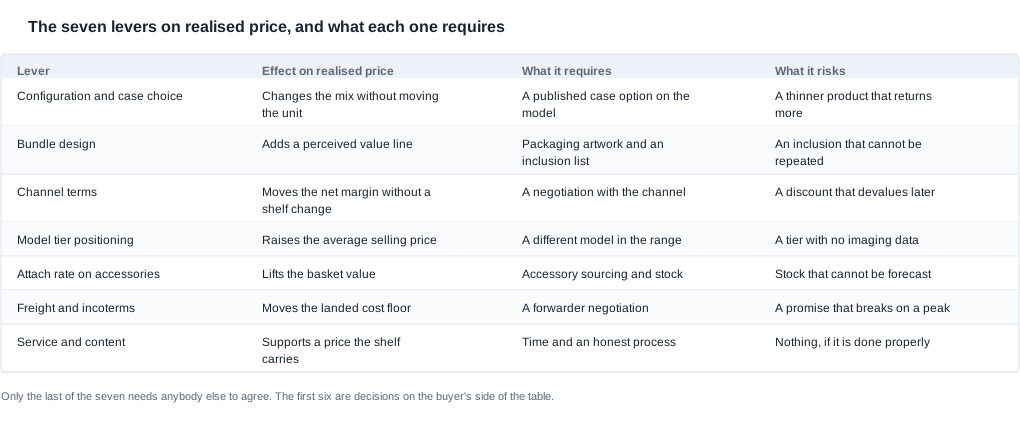
Smart glasses pricing: realised price is not the quoted unit price
The short answer on smart glasses pricing
Realised price rises when the product mix, the bundle and the channel terms move, and it falls when freight, duty, returns and the cost of the capital sitting in stock are added. The quoted unit price does the opposite: it is the part that moves slowest and is hardest to change, because it is the factory's own number and it moves with volume, configuration, customisation and payment terms rather than with your sales pressure.
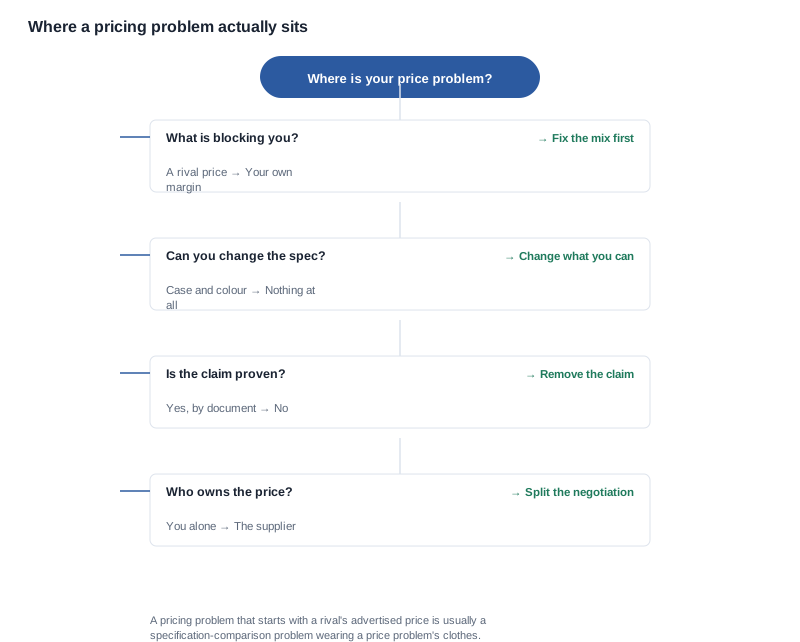
Two consequences follow. A buyer who matches a competitor's advertised price without first checking what is in the bundle has compared two different products and concluded that one supplier is cheaper. And a buyer who defends a price with a claim the documentation does not support has created a refund exposure that costs more than the price gain.
The buyer behind this question and the margin they are defending
The reader is a brand-side procurement manager, a channel buyer or an e-commerce buyer who has a landed-cost model to hit and a price the shelf will not carry. Typically they are comparing two or three quotations that do not describe the same product, or they are looking at a competitor listing and trying to work out why it sits below their own.
What they are defending is a margin that has more components than the unit price. A unit price of the same number can produce very different margins depending on the case configuration, the freight method, the duty treatment, the return rate and the time the money is held. The buyer who knows their own margin structure can see immediately that the fight over the unit price is usually the smallest fight available, and the buyer who does not will spend the negotiation there.
The other thing they are managing is the listing. In this category the listing is where the price becomes real, and every claim in the listing is a commitment. A price defended by a claim that cannot be evidenced is not a price at all — it is a liability with a marketing budget.
The commercial background behind a smart glasses pricing comparison
Why two listings at the same price are not the same product
This category has a wide published spread to sell into, and the spread is where the pricing opportunity and the pricing trap both live. The camera range alone covers eight models at an 8 MP resolution tier — the V06 and the V03, the KY06 and the CY05, and the V03 Pro and the MT6, and the CY03 and the MT5 — and three at a 13 MP tier: the L2 Utral and the S7, and the L1 Pro. Alongside that sit the audio range with its Bluetooth versions, a sport tier, a children's tier, a photochromic configuration on the V03 Pro and an electrochromic model, and an AR entry whose disclosed electrical parameters are identical to a plain Bluetooth audio model.
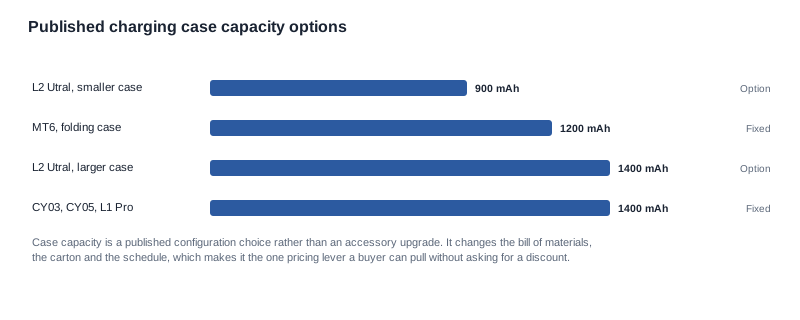
Two listings at the same headline price can therefore sit at completely different points in that spread. One may carry a 1400 mAh charging case and the other a 900 mAh one on the same model. One may be an 8 MP camera and the other a 13 MP one. One may include a case in the carton and the other may not, because the V03 Pro has no charging case while the KY06 and the MT5 ship with one whose capacity is not published and the MT6 ships with a 1200 mAh folding case. When a buyer compares on headline price, they are comparing a configuration against a wish.
Where the price actually sits in this category
Three structural facts shape what can be negotiated, and all three come from the published position rather than from opinion.
The first is that unit prices, price bands, minimum order quantities and production lead times are not published for our operation. That is not opacity for its own sake; it means a buyer cannot construct a reference price for any configuration, so a "market rate" comparison is not available to either side. What a buyer can construct is a configuration comparison, which is more specific and more defensible.
The second is that the factory's cost structure is not public either. Production capacity, line count and shift pattern are not published, so the internal weight of any cost line is unknown to the buyer. A buyer who assumes a cost structure is negotiating against a guess — and guesses about cost structure are usually wrong in the direction that makes the buyer over-confident.
The third is the published specification set itself. The catalogue carries cell capacities from 40 mAh in the children's models through 290 mAh in the camera models, charge times for all twenty-eight models, rated use for all eleven camera models, the charging method for most of the range, and the Bluetooth version for the audio models. None of that is a price, but it is enough to determine what a configuration is, and therefore enough to tell whether two quotations are comparable.
The thresholds a smart glasses pricing comparison has to clear
How each lever is measured
The table below is the working criteria set for a pricing comparison. Each row states how the lever is measured, the line it has to meet, and how an inflated version of it shows up in a programme. The right-hand column is where most pricing conversations go wrong, because the inflated version usually looks like a saving on the spreadsheet and a loss in the returns line.
| Lever | How it is measured | The line it has to meet | How inflation shows up |
|---|---|---|---|
| Configuration mix | List the model, tier, colour and case of every line | Every line is a published configuration | A line that cannot be ordered as described |
| Case option | Read the case capacity against the model | The option appears in the published set for that model | A case quoted as an upgrade at no cost |
| Bundle contents | Compare the inclusion list against the carton | Every inclusion is supplied on repeat | A bundle that only exists on the first run |
| Channel terms | Read the margin against the shelf price | The net is calculated after the channel takes its share | A gross margin quoted as a net |
| Freight and incoterms | Read the landed cost against the quote | The incoterm appears in the purchase order | Freight excluded from the comparison |
| Returns reserve | Compare the reserve against the category's return profile | The reserve is written into the model | A margin calculated before returns |
| Claim substantiation | Check each listing claim against a document | Each claim is either supported or removed | A protection claim with no report number |
| Cost of capital | Compare the margin against the cash cycle | The cycle is in the model, not in a footnote | A margin that assumes instant turnover |
Two rows deserve a second reading. The case option row is the one most often ignored, because it looks like a minor specification choice and it is not: a 900 mAh case instead of a 1400 mAh one is a genuine configuration difference with a genuine cost difference, and it is published, which means it can be documented. But it also changes the endurance story the customer experiences, and the camera models already publish about seven hours of rated use on the larger configurations. A reduced case does not improve the product, and a product sold on price with a thinner bundle is precisely the product that comes back.
The published facts a pricing comparison has to stay consistent with
- The resolution tier is published and it is the first price axis. Eight models at 8 MP and three at 13 MP. Two configurations at the same price and different tiers are not comparable, and the 13 MP tier is a genuine mix upgrade rather than a marketing one.
- Cell capacity is published per model. The camera models run at 220 mAh on the V03 and the V03 Pro, and the MT5, 260 mAh on the KY06 and the V06, and the S7, 265 mAh on the MT6, and 290 mAh on the L1 Pro and the CY03, and the L2 Utral and the CY05. A 220 mAh camera model with a five-to-eight-hour published band and a 290 mAh model with a 1400 mAh case are different products with different cost structures.
- Rated use is published for all eleven camera models — five to eight hours on V06 and S7, and the V03 and V03 Pro, six to eight on the KY06 and the MT5, and about seven on the CY03 and L1 Pro, MT6 and L2 Utral, and CY05.
- Case options are published, and so are their limits. The L2 Utral is available at 900 mAh or 1400 mAh; L1 Pro and the CY03, and CY05 carry a 1400 mAh case; the MT6 has a 1200 mAh folding case; the KY06 and MT5 have a case whose capacity is not published; the V03 Pro has no case at all.
- Charge times are published for all twenty-eight models — up to two hours on twenty-six of them, and about one hour on the D17 and the ZH12 — but without a starting state of charge or a termination criterion, so a charge time cannot be used to compare shift interruption or a case turnaround.
- Bluetooth version is published for fourteen of the twenty-eight models. The K01 and K02 are listed at version 5.3 and the remaining audio, sport, AR and lens entries at version 5.4. No camera model publishes a radio version, so a comparison that depends on the radio has to be handled as an open row.

Verifying a smart glasses pricing claim before it reaches your channel
Working through the pricing evidence in sequence
- Rebuild both quotations as configuration strings. Model, resolution tier, colour, case option, charging method, packaging and what is in the carton. If the two strings differ, the price comparison is invalid and there is nothing to negotiate yet.
- Add the landed cost to each. Freight method, incoterm, duty and clearance treatment, importer of record. A comparison that stops at the factory gate is a comparison of two different products delivered to two different places.
- Add the returns reserve to each. Use the buyer's own return profile, split by reason rather than as a single number, because a single number hides whether the problem is an expectation failure or a fault.
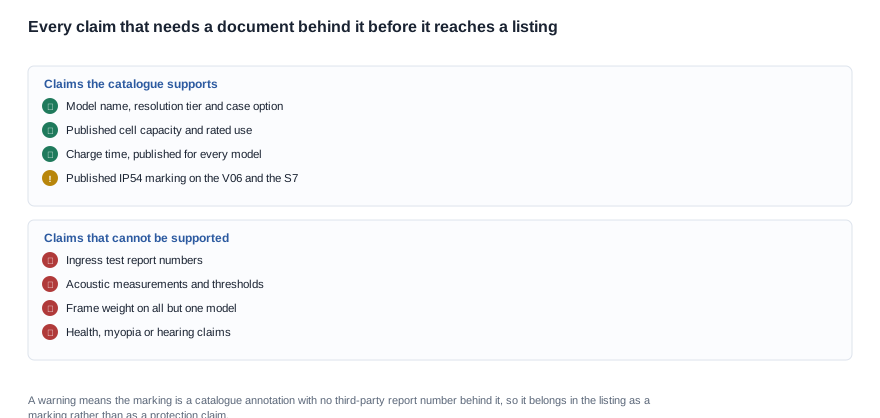
- Check every listing claim against a document. Anything that cannot be evidenced is removed from the listing before the price is defended on it.
- Model the cash cycle. A margin calculated on a product that sits in the channel for ninety days is not the same margin as one that turns in thirty, and the difference belongs in the comparison.
The questions to ask about a smart glasses pricing comparison, and what completes each answer
- What exactly is in the carton, in writing? Completion: an inclusion list that can be repeated on the next run.
- Which case option is quoted, and what does it change? Completion: a published case capacity and a configuration reference.
- What is the incoterm, and where does risk pass? Completion: a term in the purchase order, not a side letter.
- Who is the importer of record? Completion: a named party, on the quotation.
- Which claims in the listing are backed by a document? Completion: a list, with the unsupported ones removed.
- What does the margin look like after the returns reserve? Completion: a number with the split by reason attached.
- What would move the price, and by how much? Completion: the threshold quantities and the configuration changes, in writing.
Seven questions, asked in this order, turn a price comparison into a margin comparison, which is the only version of it that can actually be defended to a channel.

Where smart glasses pricing assumptions break
Four smart glasses pricing failures that arrive as a surprise, and the control for each
The rival listing that was not the same product. The symptom is a buyer concluding that a competitor is undercutting them by a wide margin, when the comparison was between an 8 MP model with a 1400 mAh case and a 13 MP model with a smaller case, or between a bundled carton and a bare device. The root cause is that price was compared before configuration. The control is to rebuild both as configuration strings before any number is discussed, and to refuse the comparison until they match.
The discount applied to the wrong line. The symptom is stock that will not move and a margin that has already been spent. The root cause is that a discount was used to clear a configuration whose problem was that it was the wrong configuration for the channel. The control is to fix the mix first and discount second, and to check reorderability before any volume is committed.
The price defended by an unsupported claim. The symptom is a refund dispute or a listing withdrawal after launch. The root cause is that the price was built on a claim the documentation does not support — an ingress result, an acoustic threshold, a weight, or a health implication. The control is to remove the claim rather than to defend it, and to rebuild the price on the configuration and the bundle.
The margin that excluded the stock cycle. The symptom is a programme that is profitable on paper and cash-negative in practice. The root cause is that the model did not carry the time the money sits in the channel or the cost of funding it. The control is to put the cash cycle into the margin model, where it belongs, before the price is set.
Pricing conversations cover this ground as a matter of course, and no part of it is a reason to change supplier. Each is a line to write down, and each is cheaper than the version where the buyer discovers it in the channel.
The negotiation on price, item by item
What moves. The configuration mix, because a buyer who can reorder a case option or a colourway is negotiating against a smaller change than the buyer who cannot. The packaging and artwork scope, because the supplier can redesign it to fit a budget rather than defend it as a cost. The delivery pattern, because a rolling release against a firm forecast is worth more to a factory than a single larger order. The payment terms, because a factory's working-capital constraint is a real cost and an earlier balance is worth more than a percentage reduction. And the freight and incoterm structure, which is often a larger absolute number than the unit-price difference being argued over.
What does not move. The cost and cycle of the regulatory route for the destination market, which is a fixed cost per model and per market. The factory's cost of capital. The component supply position. And the cost of the tooling itself, though its amortisation across the first order is negotiable.
What must not be traded. The specification, because a configuration negotiated down to a price produces units that come back. The quality commitment, because a weakened test plan moves the cost to the customer. And the documentation scope, because a claim dropped from the file is a claim the listing cannot make.
One smart glasses pricing scenario, and the position Cynrin takes
A margin scenario, taken from a rival price back to the mix
No real account is given here. The brand, the channel, the rival listing and the landed-cost figures that follow are assumptions, put in place so that the sequence of decisions can be examined. What the scenario traces is how a price comparison ends up being a mix problem, and why the mix is the part the buyer can actually move.
The scenario: a brand is launching an open-ear audio line and is quoted a landed cost that leaves a thinner margin than the channel will accept. A rival listing sits visibly lower. The buyer's instinct is to go back to the factory for a price reduction.
Step one is to rebuild the rival listing as a configuration. It turns out to be a different model with a different radio generation and a different bundle, so the comparison that triggered the whole conversation was not a comparison at all. That does not solve the margin problem, but it stops the buyer from spending the negotiation on the wrong target.
Step two is to rebuild their own quotation as a configuration string and check the mix. Two of their three lines sit on a model whose published case option differs from the configuration they actually wanted, and one of the lines is a case configuration that costs more than the alternative published option on the same model. Swapping that one line is a mix decision they can make themselves, and it moves the average margin more than the price conversation would have.
Step three is the landed cost. The current quotation excludes clearance and import handling, and the buyer's own forwarder quote on the same volume is different from the supplier's assumption about the shipment method. The incoterm was never written into the purchase order. Fixing that is worth more than the unit-price argument and costs nothing but a clause.
Step four is the claims. The listing copy defends the price with two statements that the catalogue does not support. One of them is removed, the price is rebuilt on the configuration, and the second is replaced with a claim the documentation does carry. The removal costs nothing, because the claim was never evidence — it was a promise.
Step five is the negotiation that remains, which is now small and specific: a rolling release against a firm forecast in exchange for an earlier balance, and the packaging scope. Those are the two items on the table that are actually worth negotiating.
Where Cynrin stands on price, and the next action
We will say plainly that the pricing power in this category sits in the configuration, the bundle and the channel terms rather than in the negotiation over the unit, and that a buyer who negotiates only on unit price is negotiating on the one term the supplier values least. We publish the configurations, the resolution tiers, the charging methods, the endurance figures, the colour availability and the case options, and we do not publish unit prices or price bands — which means the comparison across suppliers has to be made on the terms themselves rather than on a number nobody can verify.
We will also say that we would rather quote a configuration that is honest about what it is than quote a low price for a bundle that generates returns. The pricing practical advice covers the negotiation sequence, the pricing myths article is worth reading before a first quote comparison, and the pricing negotiation guide covers the unit-price side of the conversation. The wider framework is in pricing tiers and cost structure.
Send the configuration, the quantity and the market, and we will tell you which configurations exist and which parts of your landed cost are ours to move.


