

Smart glasses production capacity cannot be increased on the basis of a number, because in our published material there is no number to increase. The catalogue gives cell capacities, charge times, rated use, charging methods and case capacities. It does not give daily output, line count, shift pattern, or the number of weeks a production slot sits in front of a buyer. Capacity figures and lead times are not published for our factory, and we are not going to invent a plausible one here.
So the honest question is not "how do we raise capacity". It is "which constraint is actually binding on my date, and what does each available lever cost me". That is a better question anyway, because a buyer who negotiates on the wrong stage ends up with a concession on something that was never the constraint.
Smart glasses production capacity: what can and cannot be measured
The short answer on smart glasses production capacity
There are four levers on a production schedule and only one of them is a factory lever. You can reduce the number of distinct builds in your order, you can smooth the release pattern instead of spiking it, you can move the front of the queue upstream by starting the artwork and document work earlier, and you can insist that the supplier name the binding stage. The first three are decisions you can make before the order; the fourth is a question that determines whether the other three are worth making at all.
None of them increases the factory's physical capability. What they do is stop you from asking a factory to do something it can already do, and from mistaking a queue for a shortage.
The buyer behind this question and the schedule they are defending
The reader is a procurement manager on the brand side, a channel buyer or an importer who has been told a date and does not believe it, or who has been told a date and believes it but cannot verify it. Often they arrive with a plan that has already slipped once, and the question is whether to press for a faster date, change the order, or change the shape of the order.
What they are managing is a schedule with a fixed point on it — a launch, a retail window, a container arrival — and a plan whose shape they partly control. The thing they are afraid of is more specific than "the supplier is slow". It is that they will negotiate hard on a stage that was never binding, and that they will discover the real constraint after the order is placed, when they have no leverage left.
The second fear is the one that costs the most. A buyer who compresses a schedule by agreeing to a configuration that has not been frozen is buying a date with a specification risk, and specification risk in this category arrives at the pre-shipment stage as a documentation question that stops the goods.

The commercial background that makes smart glasses production capacity a negotiation
Why the binding constraint is invisible from outside the factory
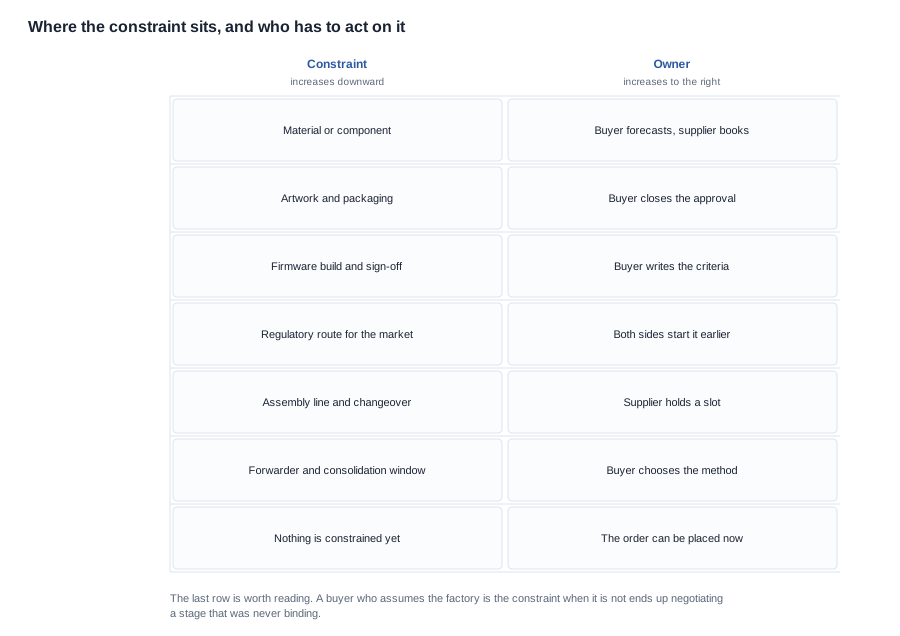
A factory's constraint is a function of the week, the configuration and the order book, and it moves. It might be a component on allocation this month and a changeover the next. It might be a person who signs off firmware. It might be the regulatory route for one destination market, which is frequently longer than the assembly path and is rarely on the factory's own critical path because it does not occupy the line.
Buyers consistently assume the constraint is at the assembly line, because that is the most visible thing to imagine and because "the line is full" sounds like a capacity problem and therefore feels like something to negotiate against. A supplier who answers "we can do it in three weeks" while your artwork is still in review has not solved your problem; they have given you a number about a stage that was not binding.
The published position is deliberate about this. Production capacity, line count, shift pattern and standard lead times are not published for our factory, and the reason is that a capacity figure without a configuration, a quantity, a start condition and a date range is not a measurement. A buyer comparing two factories on a raw capacity number is comparing two different products, because capacity is a property of a configuration and a week, not of a building.
What the published specification set does and does not tell you about capacity
The catalogue tells you more about capacity pressure than most buyers realise, because every configuration choice you make is a setup you create.
The camera range alone spans eight models at an 8 MP tier — the V03 and the MT5, the CY05 and the MT6, and the V06 and the CY03, and the V03 Pro and the KY06 — and three at a 13 MP tier: the L1 Pro and the S7, and the L2 Utral. Cell capacities across the camera models run from 220 mAh on the V03 and the MT5, and the V03 Pro, through 260 mAh on the S7 and the KY06, and the V06 and 265 mAh on the MT6, to 290 mAh on the L1 Pro and the L2 Utral, and the CY03 and the CY05. Case options add another axis: the L2 Utral is available at 900 mAh or 1400 mAh, the CY03 and CY05, and L1 Pro carry a 1400 mAh case, the MT6 has a 1200 mAh folding case, the KY06 and MT5 have a case whose capacity is not published, and the V03 Pro has no case at all.
On top of that sit the published configuration options — three colourways on the V03 Pro, four on the V06, and the two case sizes on the L2 Utral — and the fact that AI functionality is published on twenty of the twenty-eight models in the range. Each of those is a separate material set, a separate firmware build, a separate approval and a separate set of documentation. A buyer asking for "four configurations" is asking for four setups, and no amount of assembly capacity removes that.
Two further published facts bear on a capacity conversation. Charge time is published for every model — up to two hours on twenty-six of them and about one hour on the D17 and the ZH12 — but without a starting state of charge or a termination criterion, so it cannot be used to compare how long a shift interruption is or how fast a charging case turns over in a distribution centre. And Bluetooth version is published for fourteen of the twenty-eight models, with no camera model publishing a radio version; an unresolved specification row is not a paperwork detail, because each unresolved row is an open item in the queue.
The thresholds that show where the real smart glasses production capacity constraint sits
How each constraint is identified
The table below is the working set for locating a constraint. Each row states how the constraint is identified, the line that has to be met before you treat it as the binding one, and what it looks like when it has been mistaken for something else.
| Candidate constraint | How it is identified | The line it has to meet | What it is usually mistaken for |
|---|---|---|---|
| Component allocation | The supplier names the part and the expected recovery | A named part with a booking against it | A shortage of assembly capacity |
| Artwork and packaging approval | The buyer's own approval dates against the plan | Dated approvals with named approvers | A slow supplier |
| Firmware build and sign-off | Whether acceptance criteria exist in writing | Written criteria before the build is released | An assembly delay |
| Regulatory route per market | Which document is missing and who produces it | A named document with a producer and a date | A factory capacity limit |
| Changeover and setup | How many distinct builds are in the order | One build, or a stated setup count | A shortage of capacity |
| Forwarder and consolidation | The shipment method the quote assumes | The method written into the order | A factory problem |
| Slot position in the order book | Whether a slot is reserved or queued | A reservation with a mechanism | The only possible constraint |
The last two rows are the ones buyers forget. A forwarder window is entirely outside the factory and is frequently mistaken for a production delay, and a slot position in an order book is often the actual constraint while the conversation is about the line. Both are cheap to distinguish and expensive to confuse.
The published figures that decide how much setup a configuration creates
Every published specification row that varies by configuration is a potential setup, and a buyer can count them before the order rather than discover them after it.
- Model and tier. Eight models at 8 MP and three at 13 MP. Two tiers in one order means two firmware builds and two document sets, whether or not the buyer thinks of them as one product.
- Case configuration. Four distinct published case positions exist across the camera models — 900 mAh, 1200 mAh, 1400 mAh, and a case whose capacity is not published — plus one model with no case at all.
- Colour. Three colourways on the V03 Pro and four on the V06.
- Charging method. Magnetic charging on seventeen models and Type C on seven, with four camera models publishing no charging method row at all, which changes whether a dock travels in the carton or in a separate accessory line.
- Battery capacity. Four distinct capacity groups across the camera models alone, from 220 mAh to 290 mAh.
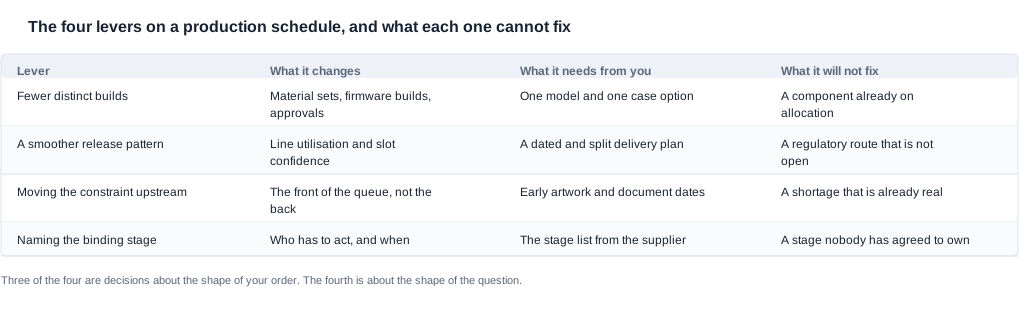
The right way to use this list is as a setup count. Take the order you intend to place, write each line as a configuration, count the distinct lines, and ask what the supplier's changeover looks like for that number. It converts a vague worry about capacity into a specific question, and the answer to a specific question is the beginning of a negotiation that can actually conclude.

Verifying a smart glasses production capacity claim
Working through the capacity evidence in sequence
- Ask which stage is binding, and get it in writing. Not "we are busy" but the named stage. A supplier who will not name a stage is not ready to have the conversation, and the answer tells you whether to keep pressing.
- Ask what the quoted figure assumes. Configuration, quantity, start condition and date range. A capacity number without those four is a range of possibilities presented as a fact.
- Count the setups in your own order. The distinct configuration lines, the print runs and the firmware builds. If the count is high, the lever is in your order and not in the factory.
- Ask what would move the date, and by how much. A change in quantity, in pattern, in configuration or in start condition. A supplier who cannot say which would move the date is describing a queue rather than a constraint.
- Ask what happens to the date if the order is split. This is the single most useful question in the whole sequence, because it tests whether the constraint is a slot, a material or a document.

What a tested capacity answer sounds like
A capacity claim that has been tested has a specific shape, and it is worth recognising because it is unusual. It names the stage. It states the four assumptions the figure rests on — the configuration, the quantity, the start condition and the date range. It says which single change would move the date and by how much. And it says what does not move it, because a supplier who can tell you that splitting the order will not help has told you where the constraint is not.
The untested version has a different shape entirely: a number without assumptions, a refusal to say what it depends on, and an assurance that the slot will be fine. The two are frequently delivered in the same conversation, because the second is what a supplier reaches for when the first is not available. A buyer who knows the difference between them can keep asking the first question until the first answer appears.
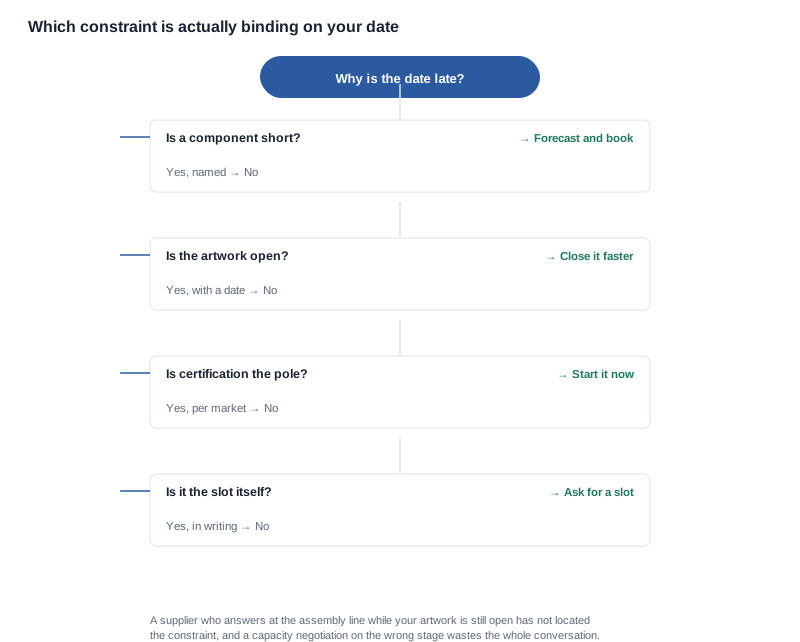
The other practical point is what to do with a stage name. A stage name is a routing instruction, not a solution. "Artwork" means the buyer's own approval queue, and the remedy is to date the approvals and name the approvers. "Certification" means the regulatory route for one destination market, and the remedy is to open the document set and attach a producer to each entry. "Component" means a forecast and a booking. "Slot" means a reservation mechanism. "Forwarder" means the shipment method. Only one of those five is a factory capacity problem, and it is the one a buyer is least likely to be able to fix.
The questions to ask about smart glasses production capacity, and what completes each answer
- Which stage is binding on my date? Completion: a named stage, in writing.
- What does your figure assume about configuration and quantity? Completion: all four assumptions stated.
- How many distinct builds does my order create? Completion: a count from the supplier, compared against yours.
- What would move the date, and by how much? Completion: a specific change and a specific effect.
- Does the date change if the order is split into three releases? Completion: a yes or no with a reason.
- What do you need from me, and by when, to release the slot? Completion: a dated list with named owners.
- What happens if the configuration changes after the slot is booked? Completion: a reissue or re-quote rule.

Where a smart glasses production capacity conversation goes wrong
Four smart glasses production capacity failures that arrive as a surprise, and the control for each
The capacity that was a queue all along. The symptom is a buyer negotiating hard on a date that moves anyway, while the real blocker was a signature that nobody had been asked for. The root cause is that the conversation started at the assembly line because that is where the pressure felt most natural. The control is to ask for the named binding stage before any negotiation, and to accept the answer even when it puts the burden on the buyer.
The order that fragmented itself. The symptom is a schedule that was fine on paper and that slowed as the order was split for commercial reasons after the slot was booked. The root cause is that a configuration split became a release split, and each release carries its own setup. The control is to count setups after every commercial change, not before it.
The slot that was a queue position. The symptom is a large order that was treated as important and then waited behind smaller ones. The root cause is that size implies priority without any mechanism behind the implication. The control is a named reservation with a cost or a condition, written into the order.
The regulatory route that started after the line was booked. The symptom is goods finished and unable to move because a document set for one destination market was not open. The root cause is that the regulatory route is not on the factory's critical path and therefore never appears on the factory's plan. The control is to attach the document list to the schedule, with a producer and a date against every entry, and to start the route before the slot is confirmed.
Nothing here is unusual, and every one of them is cheaper to prevent than to explain afterwards.
The negotiation on capacity, item by item
What moves. The release pattern, because a rolling release against a firm forecast or a quarterly split is usually the easiest thing on a factory's plan to accommodate. The configuration count, because consolidating colourways and case options inside one order is worth more to a factory than the volume itself. The slot reservation, and what it costs to hold one. The start condition, because a slot held against a frozen configuration is a different proposition from a slot held against an open one. And the artwork rounds included in the price, because each round is a setup the supplier absorbs.
What does not move. The cost and cycle of the regulatory route for the destination market, which is a fixed cost per model and per market. The component supply position, which is a fact rather than a position. The factory's capital equipment. And the cost of the tooling itself, though its amortisation across the first order is negotiable.
What must not be traded. The configuration freeze, because a capacity date bought with an unfrozen configuration is a date with a specification risk attached. And the inspection rule, because a schedule compressed by removing the check on the goods is a schedule that will fail somewhere other than the factory.
One smart glasses production capacity question, answered as a worked example
A capacity scenario, where the binding stage turns out not to be the factory
The situation below is deliberately fictional: the brand, the configurations, the market and the quoted duration are assumptions chosen to make the diagnosis legible. No production order and no supplier relationship is described. What it sets out is a way of locating a constraint rather than a story about a launch.
The scenario: a brand has a camera programme opening in a European retail channel, with a fixed on-shelf date. The supplier has quoted a duration and has declined to say whether it can be shortened. The buyer has three configurations in mind and has already asked once for a faster date.
Step one is to stop asking for a faster date and ask which stage is binding. The answer is that the artwork is open and that two approvals have no dates on them. The stage is not the factory's, which reframes the entire conversation.
Step two is to look at the three configurations against the published setup count. Two of the three share a model and differ only by colour, and the third differs by case option. That is two material sets and two firmware builds rather than three, which is one setup the buyer had not counted.
Step three is to check the regulatory route, because the destination market is on the critical list and the factory's plan does not include it. The document set for the ordered configuration has to be opened before the slot is confirmed, not after.
Step four is to ask the question that tests the slot: does the date change if the order is split into three releases? The answer is that it does not, because the constraint is the artwork rather than the slot. That is a useful negative result, because it means the buyer's instinct to ask for a reserved slot would have bought nothing.
Step five is to write the plan: two configurations, dated artwork approvals with named owners, the document route opened first, and a cut-off date after which changes are quoted again. The date does not move much. The programme simply stops having an unknown in it.
Where Cynrin stands on capacity, and the next action
We will say plainly that a capacity conversation without a published baseline is a conversation about beliefs, and we would rather tell you the baseline is not published than hand you a number that will be wrong by the time your order is scheduled. We hold the product-level facts — the model set, the cell capacities, the charge times, the tiers and the case options, the rated use — and we will tell you which of the four levers we can act on and which ones are yours.
We will also be direct about the sequence. Most delays in a first production order are not the factory's line; they are artwork, documentation and the date the configuration was frozen. If you want the answer to "can you increase my capacity", start by freezing your configuration and your document list, then ask which stage is binding. The production capacity planning framework sets out the structure, and the factory audit worked example shows what to look at when you visit.
Send the configuration lines, the quantities and the date, and we will tell you how many setups your order creates and what has to be closed before a slot is worth booking.


