

The composite smart glasses factory audit below, and why it is written the way it is
An audit checklist tells you what to inspect. A worked example tells you what a good answer sounds like, what a bad one sounds like, and which of the two you are actually facing in front of you. That is the value of what follows: a single composite smart glasses factory audit, run area by area, with the finding that came out of each area and the action the buyer should have taken. No customer, no factory name and no order from any real account appears in it, and the figures inside it are assumptions made in order to make the reasoning followable.
The composite is built around a specific configuration rather than around a generic factory, because that is what makes it useful. The scenario is a European eyewear brand considering a first order of 13 MP camera glasses with a 1400 mAh charging case, private branding on the retail box, and delivery into three distribution centres. The brand's engineering lead has two days and a supplier list, and the audit below is the shape we would run. The configuration matters because it fixes what the audit has to check: a 13 MP tier, a charging case of a stated capacity, a case that is a separate line on the bill of materials, a private-label carton, and more than one destination market.
The assumptions inside the scenario are worth stating so that the reasoning can be checked rather than admired. The quantities, the markets, the delivery pattern and the two-day limit are all assumed, because a worked example without a shape is an abstraction. What is not assumed is the behaviour of the factory, and that is the part that matters: the six findings below are the findings that the published position of this category makes likely, not the findings that make a dramatic story. A factory in this category has a published specification to build against, a document chain to describe, and a configuration list that is easy to get slightly wrong. Those three things produce exactly these six findings, and they produce them whether or not anybody is dishonest.
The same logic explains why one of the findings is about a cell arriving through a distributor rather than from a cell maker. That is not a failure of character; it is a normal procurement structure, and in a category where the camera module, the main board and the charging case are also separate line items, it is a predictable place for the traceability chain to thin out. The buyer's task is not to find villains. It is to find the places where the chain is thin and put a control on them.
What each area of a composite audit is designed to establish
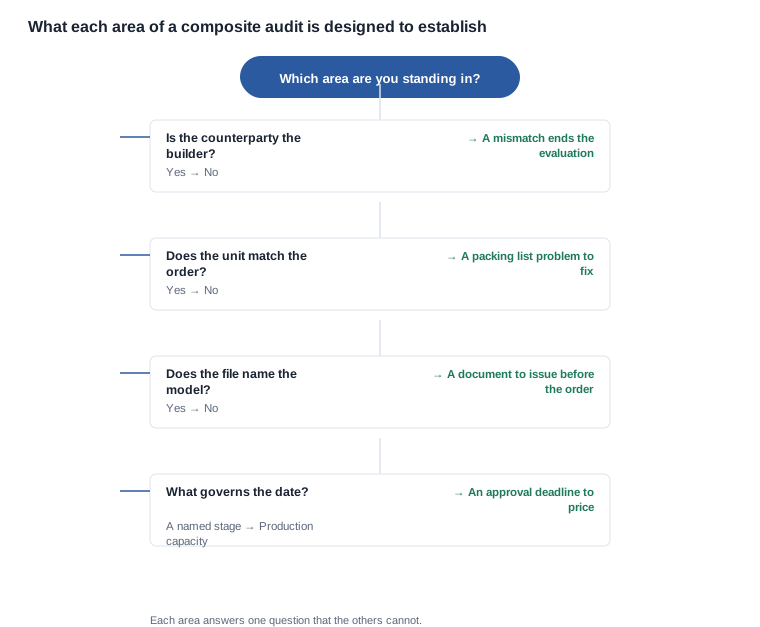
The structure of each area is the same every time, and the structure is the point. What you check. What a good answer looks like. What came out of the composite audit. What to do. A good answer is stated before the finding so that the reader can decide for themselves whether the finding is a real gap or an unreasonable standard, which is a judgement the buyer has to make and which a narrative format tends to hide.


Areas one and two: the entity, and the unit on the line
1. Verify the entity before anything else
What you check. The company registration document, the business name, the bank account, the export registration and the economic operator registration number. All five should be the same legal entity, or there should be a written explanation of the relationship between them.
What a strong answer contains. Five documents, all in one name, dated within the last year, with the account details on the pro forma invoice matching the registration document character by character.
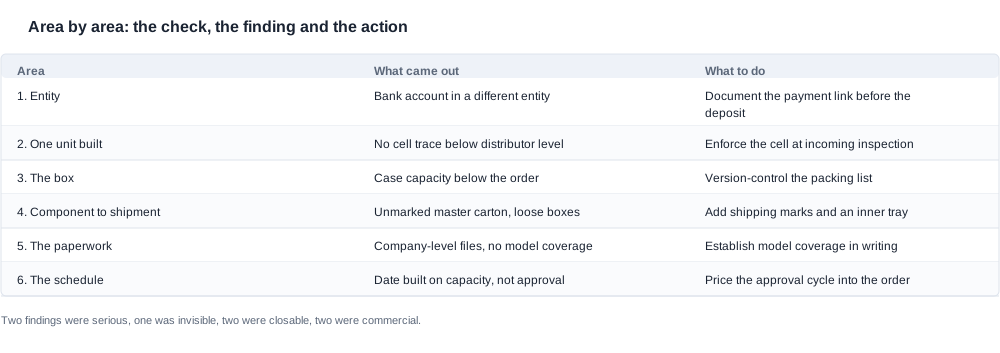
What came out of the composite audit. The bank account was in a different entity from the one named on the pro forma invoice, described as a group treasury arrangement. That is not disqualifying, but it needed a letter from the group, a tax residency position, and the reason it appeared at all is that nobody had asked. The buyer also found that the export registration was held by a fourth name entirely. That is legitimate in some structures and unworkable if the customs paperwork ends up naming an entity the buyer has no contract with, because the importer of record would then be a party the buyer does not control.
What to do. Get the payment relationship documented before the deposit, not after it, and check the name on the export registration against the name on the pro forma invoice rather than against the brand. The minimum order quantity verification article is where the commercial half of the same check sits, and it is the point at which a payment relationship that does not match the order becomes a pricing problem rather than a formality problem.
2. Watch one unit being built
What you check. One unit, start to finish, with the operator's normal work and no special effort. Then find that same unit in the warehouse.
What a strong answer contains. A traceability sheet with the cell batch, the camera module batch, the firmware build and the date, all of which resolve to a specific unit.
What came out of the composite audit. The traceability existed for the main board and for the charging case, and not for the cell. The line supervisor explained that cells come through a distributor rather than directly from the cell maker, so the batch was recorded at distributor level. That is a real finding, and it is one that changes what has to be written: a cell problem cannot be traced back to a supplier batch, so the cell specification in the order has to be enforced at incoming inspection rather than assumed from the purchase order.
What to do. Write the cell requirement into the purchase order and the incoming inspection checklist, or accept that the cell tier is a request rather than a specification. It is worth being precise about why this matters in this configuration: the brand is buying a 13 MP camera model with a 1400 mAh case, and the cell is the one component on the bill of materials where the factory cannot tell you which lot it came from. That single gap is enough to move the cell from a specified item to a checked item, and the check takes minutes at goods-in.
Areas three and four: the box, and the paperwork
3. Open the box and compare it to the specification
What you check. A production unit against the published specification for the model: camera tier, cell capacity, charging interface, case presence and capacity, Bluetooth version, colour.
What a strong answer contains. The unit matches, and the supplier can produce the specification sheet the catalogue entry came from.
What came out of the composite audit. The unit matched on camera tier, cell and interface. The case in the box was a different case from the one in the catalogue entry, with a lower capacity. Nobody had done this deliberately; the catalogue entry had been updated and the packing list had not. The buyer was buying a 1400 mAh case and would have received a 900 mAh one, in a private-label carton, which is the combination in which a configuration error is least likely to be noticed and most expensive to discover, because the retail packaging hides the part that changed.
What to do. Ask for the packing list to be the version-controlled document, check a unit from the finished batch against it, and confirm the case capacity on the unit against the order rather than against the box label. The cost of the check is a few minutes. The cost of missing it is a returns episode in three distribution centres, with a complaint rate that is hard to explain because the unit appears right in the carton.
4. Trace a unit from component to shipment
What you check. The route from a component in a box to a carton on a pallet, and what the factory actually controls at each step.
What a strong answer contains. A documented route, a controlled packaging area, and a shipping area that matches the packing list.
What came out of the composite audit. The packaging area was controlled and the shipping area was not. The master carton on the pallet was a generic carton with no printed shipping marks, and the retail boxes inside it were loose. Nothing was wrong with the units themselves. The risk was that a carton arriving at a distribution centre could not be identified without opening it, which for a three-warehouse distribution model is a receiving problem on every delivery rather than an occasional one.
What to do. Require printed shipping marks and an inner tray or divider, both of which are inexpensive, and check the freight basis against the packed carton dimensions rather than against the unit dimensions. A private-label programme that ships into three distribution centres will pay for the tray and the marks many times over, and it will pay for them once rather than on every delivery.

Areas five and six: the files, and the schedule and the close
5. Read the paperwork
What you check. The test reports, the declaration files, the certification scope, and whether the models in the catalogue are the models in the files.
What a strong answer contains. Certificate numbers, model coverage that matches the order, and a scope that covers every destination market.
What came out of the composite audit. This is where most of the risk sat. The conformity documentation was organised around the company rather than around models, and the model coverage was not established in the file. The IP54 marking on the sport tier appeared in the catalogue as a catalogue marking with no third-party test report number behind it, and the children's line had no conformity position established at all. The buyer was planning to list in two markets, and one of them was not covered by anything in the file.
What to do. Do not proceed to a purchase order until the model-level coverage is established in writing for every model and every destination. It is the one finding in the whole audit that could have stopped the shipment at the border, and it is the one finding that cannot be fixed quickly, because issuing a document against a model is a matter of weeks rather than days. The how to verify a factory article covers the desk-side half of this check.
6. Test the schedule against a constraint
What you check. Which stage is binding, what is booked ahead of this order, what happens if a stage slips, and who owns the recovery. Then the commercial close: what the findings do to the quotation and to the contract.
What a strong answer contains. A written schedule with a named owner for each stage, and a quotation that reflects the configuration and the documentation scope actually agreed.
What came out of the composite audit. The factory produced a delivery date and no schedule, and when asked which stage was binding, the answer was the artwork approval — which was correct, and which nobody had written down. The date in the quotation had been built on production capacity rather than on the approval that was actually going to govern it, so the quoted date was optimistic by an approval cycle that nobody had priced.
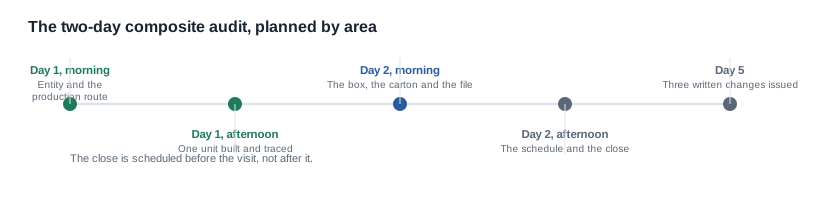
What to do. Put the artwork approval deadline and its owner into the order, make the delivery date conditional on it, and reprice the risk of the delay rather than assuming it away. Then close the audit with the three written changes: the price change, the term change, and the document request with a date against each item. The factory audit checklist is the item list for the close, and the camera and audio range is where the published configuration details behind this scenario sit.
The commercial close is the part of the audit that most often gets left informal, and in the composite it was the part that would have mattered most, because the two findings from the first four areas — the entity structure and the conformity scope — both had commercial consequences that nobody had priced. The bank account question raised a cost: a payment routed through another entity has a tax and a compliance dimension that somebody has to carry, and if the buyer is not carrying it explicitly then the buyer is carrying it implicitly. The conformity question raised a schedule cost, because a file that has to be issued after the order is placed is a file that pushes the delivery date. Neither of those belongs in a conversation about the factory. Both belong in a revised quotation with the assumptions written down.

What the composite audit cost, and what it was worth
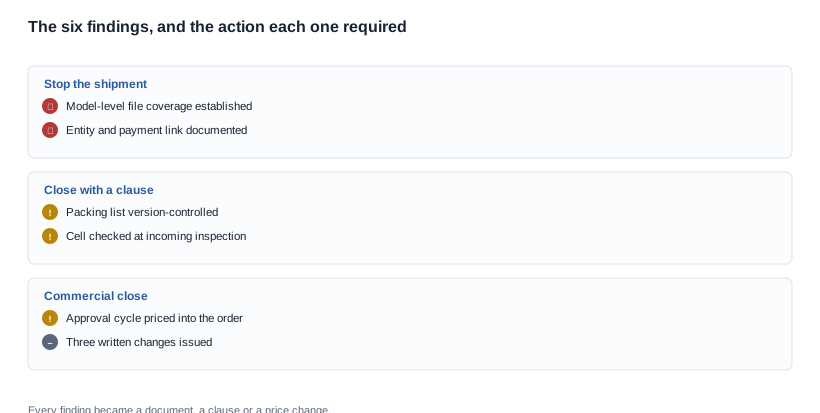
Two days on site, one person, and six areas producing six findings. Two of them — the entity structure and the conformity scope — were serious enough to have been expensive later, and the conformity one could have stopped the shipment at a border. One — the case configuration in the packing list — was the kind of mistake that is invisible until a customer complains about battery life. One — the cell trace that stopped at the distributor — was a documentation gap that could be closed with a purchase order line and an incoming inspection step. Two were commercial: the date that did not know what it depended on, and the price that had not priced the approval cycle.
None of them was the thing the buyer expected to find. That is the argument for running the audit rather than running a checklist, and it is also the argument for writing it down area by area: the findings that are worth acting on are the ones that arrived from a different direction than the one you were facing.
There is a second lesson in the composite that is easy to miss, and it is about the buyer's own documentation rather than the factory's. The brand arrived with a written configuration that named the camera tier and the case capacity, and that document was the reason four of the six findings were found at all. Where the buyer's own description had been vague, the audit would have produced findings of a different and much less useful kind — a general sense that the documentation was not what was expected, rather than a specific line in a purchase order. The written specification is the instrument that makes an audit actionable, and it is worth writing properly before the visit rather than during it.
The cost comparison is worth stating in one line. The audit consumed two days of one engineer's time. The two serious findings — the entity structure and the conformity scope — were both capable of stopping or badly delaying a first shipment, and both would have been discovered in a customs queue or a payment dispute rather than in a planning meeting, which is the least useful place to discover either of them.
There is also a figure the composite deliberately does not state, and its absence is instructive. It does not state what the findings would have cost had they been discovered late, because there is no honest basis for such a number. A held shipment has a detention cost that depends on the destination, the carrier and the length of the hold; a configuration error has a returns cost that depends on the channel and on how long it takes to identify; and a payment dispute has a cost that depends on the relationship. What can be said is that all three are larger than the cost of two days, and that the one which is hardest to price is the one a buyer cannot quote to their own management.
What the composite is, and what it is not
It is worth being explicit about the status of the material above, because a worked example that reads like a case study is a commercial risk on both sides. This is a composite: a scenario assembled to make the reasoning followable, with assumed figures and no customer, no factory and no order behind it. It is not a description of a real engagement, and no part of it should be read as a claim about a real factory.
What it is useful for is the reasoning, and the reasoning generalises: check the entity before the product, trace a unit rather than a description of a unit, compare the box against the configuration rather than against the brochure, read the file against the model rather than against the company, and test the date against the constraint that actually governs it. Those five moves are worth doing on any programme, and each of them costs minutes on the floor.
The working rule we apply: we publish the per-model specifications and we mark the rest as Not published, and we would rather a buyer found a gap in an audit than in a customs queue. Our own documentation is explicit about what is company-level and what is model-level. If you are auditing us, ask for the file rather than the summary, and the factory audit section covers the documentation to request and the way to verify it.
Related reading
- A supplier verification view of the same ground — minimum order quantity verification
- The desk-side verification sequence — how to verify a factory
- The item list to carry into the close — factory audit checklist
- The published configuration behind the scenario — camera and audio range
Send us the model, the configuration, the destination market and the annual volume, and we will tell you which of these six areas would produce the findings on your particular programme.


