

Smart glasses for ecommerce: the returned unit is the product
Smart glasses for ecommerce have a second product, and it is the one that decides the margin. The first product ships in a box; the second comes back in one, and it arrives with the buyer's reason attached, sometimes with the accessories missing, sometimes with a case, and always as a lithium cell that has to be moved again. Most ecommerce teams treat a return as a logistics event, and that is exactly why returns end up as a margin line nobody can explain: the cost of handling a returned unit is not the postage, it is the grading time, the wrong charger at the bench, the accessory that was never in the box, and the decision about whether a unit can be resold, refurbished or scrapped.
The catalogue makes that cost unusually calculable, because it publishes rows a bench can act on and refuses to publish rows it cannot. It publishes the charging interface on most models — and a bench that does not know which of Type C, magnetic or unreported a unit uses cannot put a returned unit back on charge. It publishes the charging-case row in four different ways across the camera tier, which determines whether a returned unit carries a second cell into the warehouse. It publishes a removable inner frame on the V06 and the S7, which decides whether a damaged unit is scrapped or repaired. And it publishes no lens material, no coating, no frame weight, no storage capacity and no per-model certification row, which means the grading criteria have to be written by the seller rather than inferred from a supplier's page.
Who this is for and what is being bought. The reader is an ecommerce buyer, a marketplace brand owner, a product manager or an operations lead running a direct-to-consumer smart glasses line, and the task is to specify the returns process, the accessory set that makes a return gradeable, and the bench consumables and spares that decide what happens to a unit after it comes back. The risk being managed is a contribution-margin drift: a return rate that rises quietly, a bench that cannot match a unit to a charger, and a refurbishment decision made by whoever happened to be free when the parcel arrived.
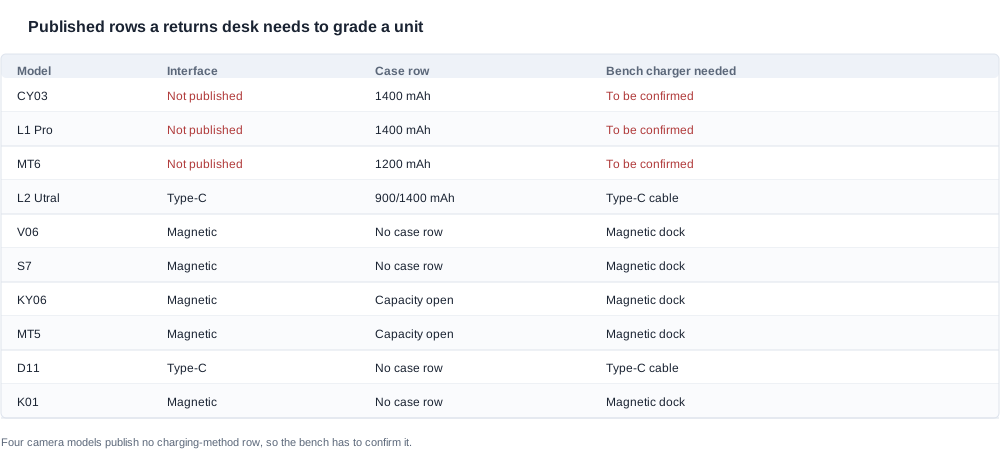
The published rows a returns desk needs to grade a unit.
| Model | Interface | Case row | Bench charger needed |
|---|---|---|---|
| CY03 | Not published | 1400 mAh | To be confirmed |
| L1 Pro | Not published | 1400 mAh | To be confirmed |
| MT6 | Not published | 1200 mAh | To be confirmed |
| L2 Utral | Type-C | 900/1400 mAh | Type-C cable |
| V06 | Magnetic | No case row | Magnetic dock |
| S7 | Magnetic | No case row | Magnetic dock |
| KY06 | Magnetic | Capacity open | Magnetic dock |
| MT5 | Magnetic | Capacity open | Magnetic dock |
| D11 | Type-C | No case row | Type-C cable |
| K01 | Magnetic | No case row | Magnetic dock |
What this table changes at the bench. Four camera models publish no charging-method row at all — the L1 Pro and the MT6, and the CY03 and the CY05 — so a bench that stocks one cable and one dock will find four models it cannot put back on charge without a phone call. Three of those four carry a published charging-case capacity, which means a returned unit from them is a two-cell return. And two models publish a removable inner frame, which means a cosmetic grade can end in a part replacement rather than a write-off, provided the spares are on the shelf rather than on an order.

What the grading decision actually turns on
Accessory attribution, because the accessory set is what a return is argued about. A unit that comes back without the case is not the same return as a unit that comes back with everything. The catalogue publishes the case row per model and it differs in four ways — a published capacity on the CY03 and the L1 Pro, and the L2 Utral and the CY05, a 1200 mAh folding case on the MT6, a case of unpublished capacity on the KY06 and the MT5, no case row at all on the V03 and the S7, and the V06, and an explicit absence of a case on the V03 Pro — so a returns desk needs a per-model accessory expectation before it can attribute a missing item. That expectation has to match the outbound listing exactly, because a customer who was told the case was included and received a unit without it is making a different complaint from a customer who expected one and never had one.
Charge state, because the return is a battery movement. A unit that has been used and returned is a lithium cell in transit, and the reverse movement has its own documentation. The requirement is set out at battery transport, and the buyer's question is narrow: does the file cover the return movement as well as the outbound one, and does it cover the configurations that include a case. A second cell in a returned parcel is a different declaration from a single cell, and the difference is exactly the kind of thing that is discovered at a carrier's counter.
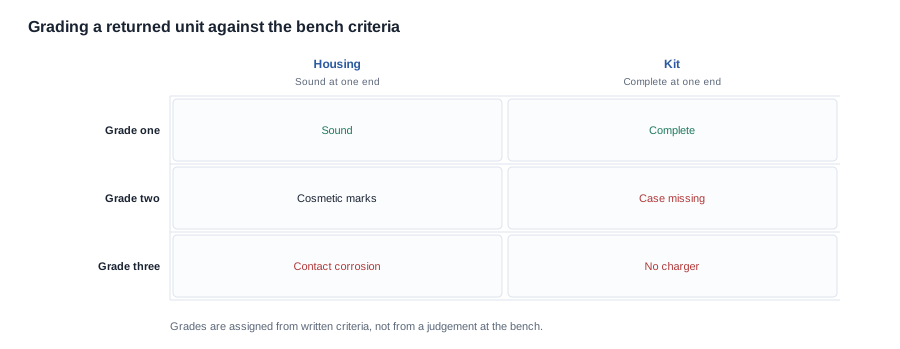
Lens and surface condition, because no material is published. There is no lens material and no coating published for any model in the range, which means the bench cannot judge a scratch by material. The grading criteria therefore have to be written in observable terms — the lens under a stated light at a stated angle, the frame alignment, the contact face — and they have to be written by the seller, because no supplier row exists to copy. A bench working from a rule of thumb will produce two different grades for the same unit in two different weeks, and the second grade will be the one that gets challenged.
Model identity, because the refurbishment path depends on it. A returned unit that cannot be identified cannot be graded, cannot be matched to a charger and cannot be claimed under warranty. The designation table therefore belongs at the bench, printed, not on a screen in an office.
Brand assets, because a refurbished unit is a listing. A direct-to-consumer line that resells a returned unit has to decide what it is reselling: the original packaging, the original insert, the original artwork, the warranty card. That decision is cheap to make in advance and expensive to make per parcel. It is also the point at which a refurbishment becomes a repack rather than a repair, and the labour cost of repacking is larger than most sellers expect.
What no published row can help with. No storage capacity, no recording format and no runtime test condition are published for the camera models, so a returned unit that is alleged to have a storage fault cannot be diagnosed from a specification. No ingress marking exists for most models and no test report sits behind the two that carry it, so a returned unit described as water-damaged cannot be assessed against a published figure. The seller's route in both cases is the same: a written incoming and grading criteria set, and a defect taxonomy that does not need a specification to apply.
Grading a returned unit against criteria a bench can apply
The procedure below is written for a small bench doing this alongside other product, because that is where most ecommerce returns actually land.
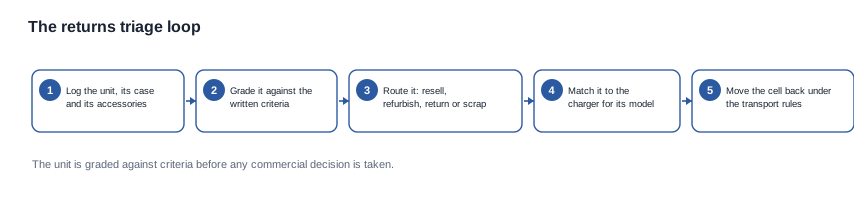
- Log the unit before anything else. Designation, configuration, case presence, accessory presence, charge state and the buyer's stated reason. The log is what turns a return into evidence rather than an opinion.
- Grade the unit against written criteria, not against a judgement made on the bench. The three criteria that matter most are the lens and surface condition under a stated light, the frame and temple alignment, and the contact face.
- Decide the route: resell as new, resell as refurbished, refurbish and re-grade, return to the supplier, or scrap. Each route has a named owner, and the criteria that assign a unit to a route are written down before the first parcel arrives.
- Match the unit to its charger using the designation table, and treat an unidentified unit as ungraded until the supplier confirms the interface.
- Replace the consumables before a unit goes back on sale. The wipe material, the contact treatment and the protective film, if the configuration uses one, are the cheapest inputs in the process and the ones that decide whether a refurbished unit produces the same complaint a second time.
- Replace the serviceable parts before scrapping a unit, for the models that publish a removable inner frame, because the part is cheaper than the unit and the bench already has it open.
- Re-grade after refurbishment, against the same written criteria, so the refurbished grade is not a lower standard invented at the bench.
- Track the return reason by grade, because the ratio of "did not charge" returns to the total is the cheapest measurement in the category, and it is the one that decides whether the consumable and the interface rows are worth changing in the next order.
- Check the certificate register for every model designation the bench handles, at certification checklist, and confirm the model designation on the unit against the paperwork at incoming inspection.
- Confirm the sample unit is the production configuration using the procedure at samples, including the insert and the accessory set, because the accessory set on the sample is the accessory set the buyer will compare the parcel against.
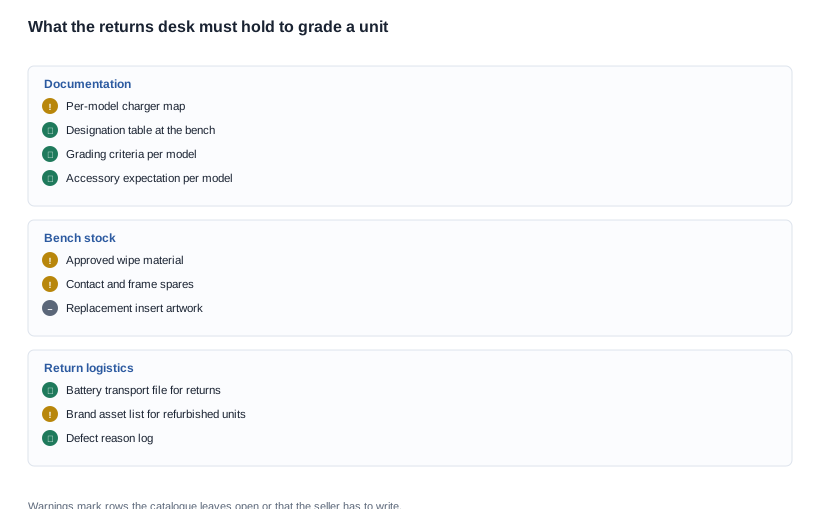
The checklist a returns operation should not run without. The per-model charger map, the designation table printed at the bench, the grading criteria per model, the accessory expectation per model, the consumable and spare-parts stock list, the return-movement battery transport file, the brand asset list for refurbished units, the defect taxonomy, the defect-reason log, and the incoming inspection criteria. The commercial structure of a first order is at pricing and the clause language is at contract terms. The platform and listing questions sit at OEM-ready platforms and the charging plan for this family is at charging for ecommerce.
An ecommerce returns operation built from the published rows
Take a direct-to-consumer brand selling two camera configurations and one audio configuration through its own store and two marketplaces, with a return rate that has crept up over two quarters and a bench that is currently rebuilding its charger stock every time a parcel arrives. The first step is the charger map, and it is the step that immediately exposes the problem: four camera models publish no charging-method row, so the bench stocks a cable and a dock and calls the supplier when one of those models comes back. The second step is the accessory expectation per model, written to match the outbound listing exactly, so that a missing case is a documented fact rather than an argument. The third step is the grading criteria, written in observable terms because no lens material or coating is published, with three criteria and a stated light. The fourth step is the refurbishment route: the two models with a removable inner frame get a part replacement where the grade calls for it, the other configurations go through consumable replacement and re-grading, and only the units that fail the written criteria are scrapped. The fifth step is the return movement, where the second cell changes the declaration for the configurations that include a case. The sixth step is the brand asset decision, so a refurbished unit is packed to a stated standard rather than improvised per parcel. The seventh step is the measurement: the defect reason is logged per unit, and the first report the brand asks for is the ratio of no-charge returns to total returns, which is both the cheapest diagnostic available and the one that decides whether the interface choice should change in the next order. The result is a returns desk that can grade a unit in minutes, a bench that can put any unit back on charge, and a defect log that produces the evidence for the next purchasing decision rather than a monthly number.

The ecommerce failures that arrive as a margin line
A return that cannot be graded. The unit arrives without a designation and is put aside. The symptom is a growing pile of ungraded stock that is neither sold nor written off. The root cause is no designation table at the bench. The prevention is a printed table and a rule that an unidentified unit is ungraded.
A bench charger that fits most models and not the rest. Four camera models publish no charging-method row. The symptom is a bench that calls the supplier for a charger before it can assess a unit. The root cause is an assumption built from the neighbouring model. The prevention is a per-model charger map and a written confirmation for the four open rows.
A refurbished unit resold with the original insert. The insert describes an accessory set the buyer no longer has. The symptom is a second complaint about a missing accessory on a unit that was already returned once. The root cause is no brand asset rule for refurbished units. The prevention is a refurbishment packing standard.
A missing case argued as a customer fault. The customer returns the unit without the case and the seller treats it as a loss. The symptom is a deduction from a refund that a policy prevented. The root cause is that the accessory expectation was never written down against the published case row. The prevention is a per-model accessory list on the returns form.
A grading standard that drifts. Two graders give two grades to the same unit. The symptom is a refurbishment rate that cannot be explained by any product change. The root cause is criteria written in judgement rather than observation. The prevention is the written criteria and a periodic re-grading audit.
A returned cell shipped without the right paperwork. The reverse movement of a lithium cell is treated like ordinary post. The symptom is a carrier refusal or a delay at a depot. The root cause is that the return movement was never requested from the supplier separately. The prevention is a transport file that covers the return direction and the configurations with a case.
A scrapped unit that could have been repaired. The models with a removable inner frame are written off for a damaged frame part. The symptom is a scrap rate that does not reflect the published architecture. The root cause is that the bench has no spares. The prevention is a spares stock list and a replacement rule.
A no-charge return that was a consumable issue and was counted as a defect. The unit was returned with a dirty contact and logged against the product. The symptom is a defect rate that blames the supplier for something the accessory would have prevented. The root cause is no defect taxonomy separating consumable causes from product causes. The prevention is the taxonomy, and the consumable in the box.

Where an ecommerce order has room to move and where it does not
The elements of an ecommerce order that are fixed before the price conversation. The cell configuration and the runtime ceiling. The charging interface, once confirmed. The charging-case architecture, because it determines the accessory set and the return declaration. The certification cost and its lead time. The tooling element, spread across the first order and shown apart from the unit price.
The elements where the commercial room sits, in the order an ecommerce buyer should spend it.
- The accessory set in the box. It is the single biggest driver of gradeable returns, because it is what the buyer compares the parcel against and what they send back. Whether the case is included and at which capacity, whether a wipe item and a contact item are included, and whether a protective film ships factory-applied are all commercial decisions with a direct margin consequence.
- The consumable line inside the box, which on an ecommerce range is worth more than on any other channel because the alternative is a customer-facing support contact rather than a workshop technician.
- Whether the supplier provides a per-model charger map and a designation table. A supplier who can hand over a complete map saves the seller a week of bench work and removes the calls.
- Minimum order quantity tiers across the configurations, and whether the camera and audio configurations share a purchase order. Sharing an inbound inspection matters more here than anywhere else, because the inspection is per configuration and the configuration count multiplies the work.
- Splitting the first run into two deliveries against a staged payment, which for a direct-to-consumer line usually maps onto a first production run and a restock, and which gives the buyer the first defect log before the restock is committed.
- The return window, the warranty term and the defect attribution rule as one commercial package. For an ecommerce seller these three interact, and negotiating them separately produces a policy that costs more than the device.
- The refurbishment cost as a quoted line. If the supplier will quote a refurbishment or part-replacement price per unit, the seller can price the refurbished channel; if not, the seller is guessing at the second product's cost.
- The trade-off between a wider configuration range and a simpler bench. More configurations means more accessory expectations, more charger rows and more grading paths, and for a seller with a small team that trade-off is usually worth making explicitly rather than by default.
What we will substantiate for an ecommerce programme, and what we will not
We publish the rows an ecommerce buyer can operate from: the rated runtime, the cell capacity, the charge time, the charging interface where the catalogue publishes one, the charging-case capacity where it appears, the pixel class on the camera models, the structural features where they are published, and the Bluetooth version on the audio models. We publish the absence of a lens material, of a coating, of a frame weight for most models, of a storage capacity, of a runtime test condition and of a per-model certification row with the same prominence as the rows themselves.
What we will not do is fill a charging-method row for the models that leave it open, because an interface guess at the bench produces a unit that cannot be assessed. We will not name a wipe material we cannot confirm. We will not state that any product is tested to IP54, and we will not extend the marking to the models that do not carry it. We will not quote the one weight figure in our catalogue as an ecommerce figure — it belongs to the MT6, a camera model with a 1200 mAh folding case, it is the weight of the glasses body including its battery and camera and excluding the case, and the case weight is not published. And we will not publish a refurbishment grade for a unit we have not seen.
What we will do is take the configurations, the channels, the accessory intent, the price band and the volumes, and return the rows that support a grading operation, the per-model charger map, the accessory expectation per configuration, the consumables and spares the bench needs, and the documents to settle in writing before a purchase order is raised.
Send us next. Send the configurations, the accessory set you intend to ship, the channels, the price band and the volumes, and we will return the per-model charger map, the accessory expectation list and the bench consumable list for the operation you described. The scenario entry point is smart glasses for ecommerce.
Related reading
- The entry point for this scenario — smart glasses for ecommerce
- The charge schedule — charging for ecommerce
- The platform and listing questions — OEM-ready platforms
- The compliance route — certification checklist
Send the configurations and the accessory set you intend to ship, and we will return the per-model charger map and the bench consumable list.


