

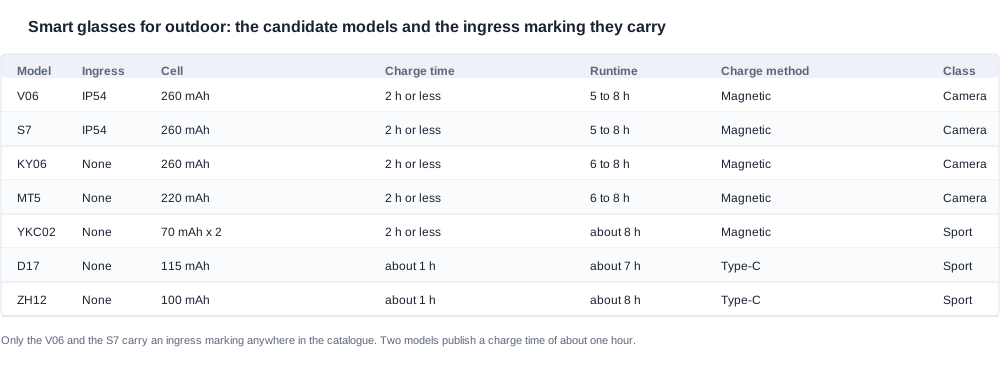
Smart glasses for outdoor products divide into two tiers that have almost nothing in common except the category they sit in. Two models in our catalogue publish an ingress marking — the V06 and the S7, both at IP54 — and no other model in the range publishes one at all. For those two, the outdoor service regime is a question of what the marking permits a listing to say. For every other candidate, it is a question of how a channel manages a unit that has no environmental claim behind it. A buyer who treats the whole outdoor range as one product decision ends up with a claim set that two models can carry and the rest cannot, which is the fastest route to a returns rate that no supplier can explain.
Smart glasses for outdoor: the case where only two models are marked
The reader is a brand owner, a channel buyer or an e-commerce seller putting an outdoor product on a roadmap, and the decision in front of them is which model the outdoor SKU is and what it is allowed to promise. The risk that follows from getting it wrong is unusually legible to a customer: an outdoor listing that says a device is protected against water and a device that stops working in rain are both one review apart, and the review is written by the person who was holding it when it failed.
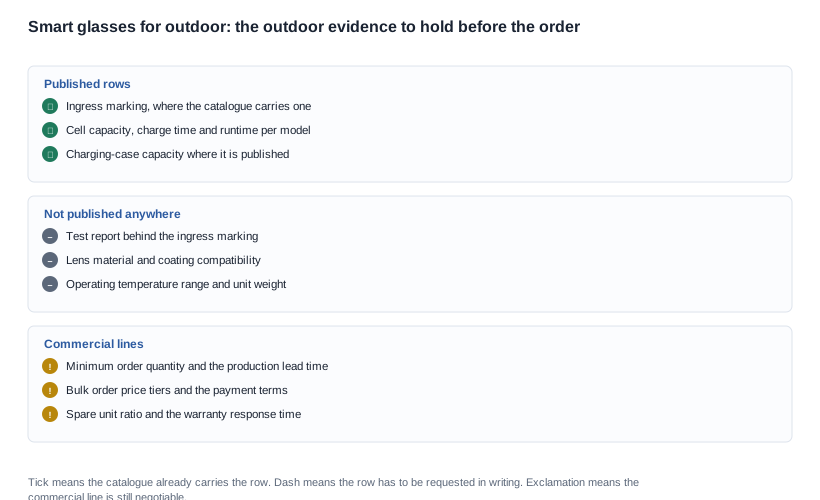
The published rows make the two-tier structure explicit. The V06 and the S7 both publish an 8 MP or 13 MP camera, a 260 mAh cell, a rated runtime of five to eight hours, a charge time of two hours or less and magnetic charging. They are also the only two pages in the catalogue that carry the IP54 marking. The other camera models — the L1 Pro and the CY03, the CY05 and the V03, the V03 Pro and the MT6, and the KY06 and the MT5, and the L2 Utral — publish cell, runtime, charge time, charging interface and accessory rows but no ingress marking. The sport models and the audio models publish no ingress marking either.
The conclusion for a procurement team is short. Decide the claim tier before the model, because the claim tier excludes nine camera models and two sport models from the shortlist before price is discussed. If the channel's listing has to carry an environmental protection claim, the V06 and the S7 are the only candidates in the catalogue that can carry one as a published attribute. If the listing can work with condition-based wording — a dust and water caution, a storage rule, a season limitation — then the shortlist opens up and the selection is driven by runtime, charge time and accessory instead.
What IP54 permits a listing to say, and what it does not
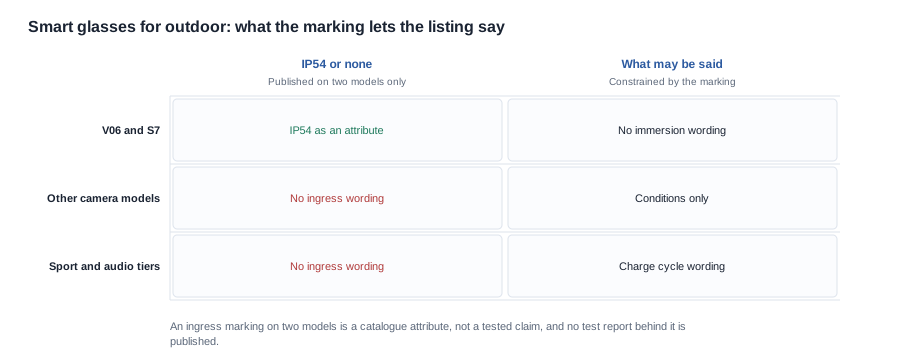
The digit reading matters, because most outdoor disputes in this category are reading disputes. IP54 denotes a dust-protected level and a water level that covers splashing; it does not denote immersion, it does not denote a sustained downpour, and it does not denote a pressure jet. The catalogue states the marking as an attribute on two product pages. It does not publish a test report behind that marking, and a marking without a report is a catalogue attribute rather than a demonstrated result — which means the listing can describe the marking and its meaning, and cannot describe a test.
That boundary produces three usable sentences and a set of unusable ones. A listing may say that the model is published with an IP54 ingress marking, that IP54 denotes dust protection and splash resistance, and that no immersion rating is published. A listing may not say waterproof, rainproof, submersible, or anything that turns a splash level into a continuous-exposure claim. The distinction between the two sets is not pedantry: the second set is the one that generates a customer complaint when the expectation is met by a downpour, and it is the only kind of complaint in this category that a warranty clause cannot absorb.
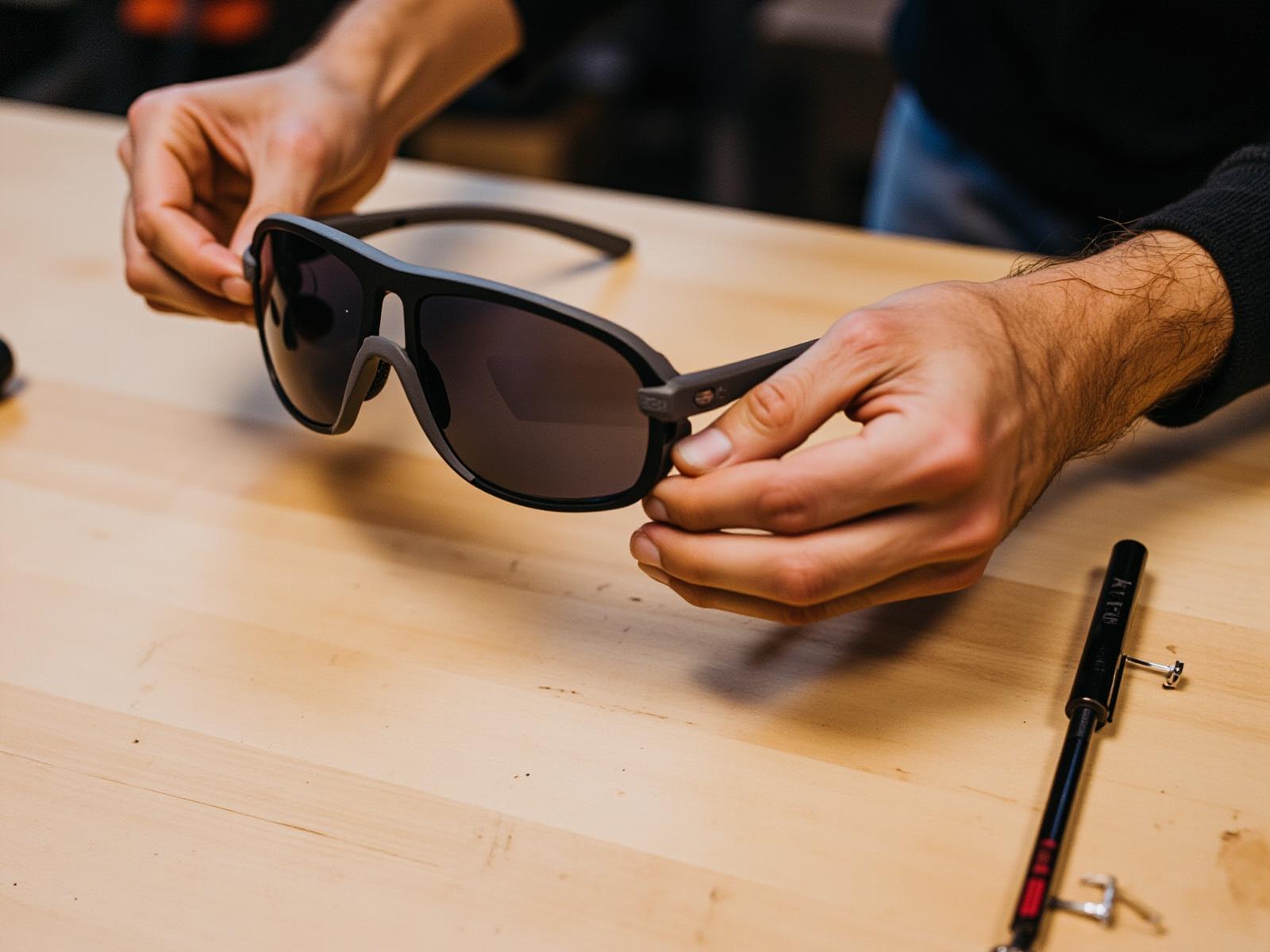
The second thing the marking does not do is cover the surfaces that actually get damaged. Ingress is about the enclosure; the optical surface is a different question, and the catalogue publishes no lens material, no coating and no abrasion figure for any model. That is why the storage rule — not the ingress marking — is the document the packaging has to carry. A unit that lives in a pack against a strap, a zipper and a dusty panel has an abrasion exposure that no IP marking speaks to, and the only published weight in the whole catalogue, the 158 g of the MT6 glasses body including its battery and camera and excluding its folding case, tells the buyer nothing about how that body survives contact.
So the outdoor service regime has two halves and they are governed by two different facts. The enclosure half is governed by a marking that two models publish and nine camera models do not. The surface half is governed by nothing published at all, and it has to be established by the buyer with a storage rule that comes out of a test rather than out of a datasheet. The marking is explained at IP ratings.
A model with no published marking is not a model with no environmental position. It is a model whose environmental position the supplier has to state, and there is a form of answer that is worth more to a procurement file than a rating would be: a supplier who is willing to write down that the unit was operated in stated conditions for a stated number of hours and that the pass lines still held has given the buyer a defensible observation, whereas a rating with no test behind it has given a buyer a number with no conditions. The wording discipline for the second case is to describe the test rather than the marketing term, because a description can be audited and a marketing term can only be repeated. A supplier evaluation that asks the second question gets a much more useful answer than one that asks only for the rating.
The field refresh model: why the sport tier's charge time is the outdoor one
There is one other published fact that matters more outdoors than it does anywhere else, and it is easy to miss because it sits in a column nobody looks at. Charge time is published for every model in the catalogue: two hours or less for twenty-six of them, and about one hour for exactly two — the D17 and the ZH12, both sport models charging over Type C. An outdoor deployment is the one place where a shorter charge cycle changes the service model rather than the convenience, because in the field the charging window is the gap between two stops, and a two-hour cycle does not fit inside most of those gaps.
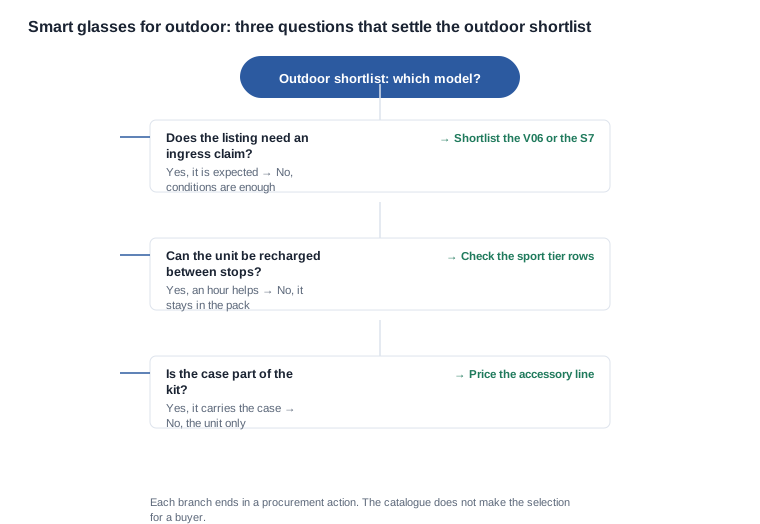
The comparison has to be made carefully, because the published charge time carries no starting state of charge and no completion criterion. About one hour is therefore a ceiling as well, and it cannot be turned into a turnaround the way a two-hour figure cannot be turned into a shift-interruption figure indoors. What it can do is separate two candidate service models: a unit that can plausibly return to service inside a typical stop, and a unit that cannot. That is a scheduling decision, and it is the buyer's decision rather than the catalogue's.
Not every outdoor SKU is camera-led, and an audio-led one changes the procurement file rather than simplifying it. The eight audio models publish runtimes of about eight hours on the K01, the K02 and the LC-105 pair, about seven hours on the D11 and the D12, and about six hours on the G07 and the YK12; the K01 and the K02 publish Bluetooth V5.3 and the rest publish V5.4, and no model in the catalogue publishes a touch row. None of them publishes an ingress marking, none publishes a charging-case row, and none publishes a camera row. An audio-led outdoor product therefore has no enclosure claim, no accessory position and no capture tier to negotiate — it has a runtime, an interface and a charging method, and the outdoor question for it is the same one as for every other unrated model: how it survives the environment it is sold into.
The other half of the outdoor accessory question is the charging case, and here the catalogue splits three ways in a way that has to be stated precisely. Five camera models publish a case capacity — the CY03 and the CY05, and the L1 Pro — each at 1400 mAh, the L2 Utral at 900 or 1400 mAh, and the MT6 with a 1200 mAh folding case. Two more, the KY06 and the MT5, publish a case but no capacity for it. Four camera models, the V03 and the V06, and the S7 and the V03 Pro, have no charging-case row in the catalogue at all, which is an absence of information rather than a stated absence of a case, and what the box actually carries for them is a question the supplier has to answer. The V06 and the S7 sit in the third group, which means the two models that carry the ingress marking are also the two whose case position the catalogue does not state — a fact a buyer should establish before the packaging design is frozen.
A field protocol that produces a storage rule the packaging can print

An outdoor service regime is only finished when it produces two documents: a claim set the listing can carry and a storage rule the packaging can print. Six steps, each with a completion standard:
- Ask for the ingress position of every candidate in writing. Which models publish a marking, which publish none, and whether a test report exists behind any marking. The completion standard is a written reply per model. A supplier who cannot answer for a model is telling you something that belongs in the shortlist.
- Ask for the charge time, charge method and case position per model. Published rows plus the accessory line that will appear on the quotation. The completion standard is one accessory line per model, so the field kit can be costed.
- Fix the field protocol before the first reading. Dust exposure, water exposure, ambient temperature, the carry pattern, the storage container and the charging window. The completion standard is a written protocol a colleague could re-run from the sheet alone.
- Run two units from one batch through a day in the real environment. Two units separate a design characteristic from a unit fault, and a real day separates an outdoor product from a desk product. The completion standard is a log with the conditions recorded next to each observation.
- Write the storage rule and the claim set. What the unit rests against, what the packaging prints, and what the listing says about the environment. The completion standard is a one-line rule per surface and a claim set with no wording the documentation cannot carry.
- Write the acceptance criteria into the purchase order. The measured figures with their conditions, the spare-unit ratio, the warranty response time and the accessory position per model. The clause language is at contract terms and the price structure is at pricing.
The two-unit rule is the step that outdoor buyers most often compress, and compressing it produces a specific failure: an ingress or retention problem appears on one unit, the team cannot tell whether the design is at fault or the unit is, and the conversation with the supplier becomes about a single sample. Two units with one protocol turn that into either a process correction or a model question, and both of those can be acted on before production starts.
The carry pattern is the outdoor-specific part of step three and the part that most often gets skipped. A unit in a rucksack pocket presses against a fabric seam for eight hours; a unit on a desk presses against nothing. The test that reproduces the first condition is cheap and the storage rule that comes out of it is the document that prevents the abrasion complaint — which, unlike an ingress complaint, is not covered by any marking and is not recoverable by any warranty clause. The charging-side of the same routine is at charging for outdoor use and the lens-side procedure is at the lens procedure for outdoor units.

Where an outdoor programme breaks commercially
The listing claimed a protection the catalogue does not publish. The symptom is a complaint that the unit failed in the rain, on a product whose page never carried an ingress marking. The root cause is a marketing line written from a category convention rather than from a catalogue row. The prevention is a claim set approved before publication, and an approval that a named owner signs.
An ingress marking was read as a test result. The symptom is a specification that promises a tested protection level the supplier never demonstrated. The root cause is that the marking was quoted without its absence of a report. The prevention is to ask for the report and to treat its absence as a fact about the file rather than a detail.
The case position was assumed. The symptom is a field kit with no way to recharge because the case was never quoted. The root cause is that four camera models publish no case row at all and the assumption was made in the buyer's favour. The prevention is a per-model accessory line on the quotation.
The surface was not tested. The symptom is a scratched or hazy optic returned after a season of normal use, with no warranty response available because no wear figure was ever agreed. The root cause is that lens material and coating are not published for any model. The prevention is a carry-pattern test and a storage rule that goes into the packaging.
The charge window did not fit the route. The symptom is a unit that is out of service at the second stop of the day because the cycle is longer than the gap. The root cause is that two hours or less was read as a duration rather than as a ceiling with no start state. The prevention is to measure the cycle in the field and to choose the model on the measured figure.
The storage rule was never written. The symptom is a channel whose returns show the same lens complaint repeated across units. The root cause is that the rule was assumed to be obvious to the user. The prevention is to print it, because the only person who does not read it is the person who already knows it.
An assumed scenario shows the sequence. A channel buyer for an outdoor equipment brand is planning a spring range and has to choose between one camera-led model and one sport-led model for a walking and cycling programme sold to enthusiasts. The first move is the claim set, because the listing cannot carry an ingress statement unless the model publishes one, and only the V06 and the S7 do. The second move is the accessory line, because the field kit depends on whether the model ships with a case and what its capacity is. The third is the carry-pattern protocol on two units, because the abrasion exposure is the one risk no marking covers. The fourth is the order, in which the claim set, the storage rule and the measured criteria appear as lines. The outcome is a listing that a customer in the rain cannot contradict, a packaging rule that removes the most common field complaint, and a specification that says which model it is rather than which category it belongs to.
What we publish for the outdoor range and where we stop
It is worth being precise: we publish the rows a buyer can specify against and we do not convert a marking into a claim. For the outdoor candidates that means the charging-case capacities, the cell capacities, the charge methods, the rated runtimes and the charge times where they are published, and the IP54 marking on the V06 and the S7 stated as a catalogue attribute.
We do not publish a test report behind the ingress marking, because none is published behind it, and we will not describe any model in the range as tested to a protection level. We do not publish lens material, coating, abrasion resistance, an operating temperature range, a cycle-life rating, or a per-model unit weight beyond the single 158 g figure for the MT6 glasses body, which excludes its folding case and includes its battery and camera. We do not publish a per-model certification scope, because the catalogue carries a company-level export certification page rather than model rows, and the catalogue text contains no CE, no FCC and no RoHS reference at all.
What we will do is take your environment, your season, your route profile, your channel and your target market, and tell you which published rows apply, which models carry a marking, which claims the documentation supports, which gaps a protocol on samples has to close, and which criteria belong in the purchase order. The commercial side of an outdoor channel deserves one more word, because it is structured differently from an indoor one: outdoor failures cluster at the season boundary rather than in the first month after delivery, which means the spare-unit ratio and the warranty response time have to be sized against a seasonal peak rather than against a monthly average, and a warranty that only responds on a next-shipment basis behaves very differently in a market where the product is bought at the start of a season. The product family is at sport smart glasses, the scenario entry point is at outdoor, the endurance detail is at battery life, and the transport requirements for the shipped configuration are at battery transport.
What to send us next. Send the environment, the season, the route profile, the price band and the quantities, and we will return the published rows that cover the range, the claim set the documentation supports, the accessory position per model, and the acceptance criteria to write into the order. The evidence list for a supplier evaluation is at certification checklist, and the questions to put to a supplier before the sample order are the starting point for most of the steps above.


