

Supplier verification in the children's category is not harder than in any other category, but it differs in one respect that changes the order of the work: the certification position is usually weaker, not stronger. Toys and children's products in Europe and North America attract additional regimes — the toy safety work referenced by EN 71 in the European Union, and ASTM F963 with the CPSC rules in the United States. Whether any of those reach a given device depends on how the product is classified, on the intended age range, and on where it is sold. That determination is not the supplier's to make and it is not ours.
That is the frame for everything that follows. A buyer running due diligence on a children's smart glasses line is not looking for a factory that has been audited. The factory is rarely the party that holds the answer. The answer sits with the platform owner and with the test laboratory, and the buyer's job is to establish whether either of them has done the work — and to find out before a deposit is paid.
Kids eye protection glasses technology: supplier file proof
A buyer running this kind of due diligence is usually a procurement manager or a brand product lead, and they typically arrive holding four things: a sample unit, a quotation, a market list and a target price. What they do not hold is the classification position, and the classification is what determines the size of the documentation pack, the label set and the lead time of every document in it.
The published rows of the category tell you why this matters. Our catalogue lists three children's models. The A05 and the A06 publish a 40 mAh cell, a charge time of two hours or less, a rated use of roughly twenty hours, magnetic charging, a lens-based electronic fogging arrangement, and posture and viewing-distance detection. The A07 publishes a 70 mAh cell, the same charge time, the same rated runtime, magnetic charging and Bluetooth V5.4 — and no atomiser and no sensors. Simple electronics, small cells, and a cost base that is not where a children's programme goes wrong.
The A05 and the A06 publish identical rows. That is the single most consequential fact in this tier for a verification exercise, and we will come back to it. For now it is enough to note that a buyer cannot use the specification sheet to tell the two models apart, which means the model string on the box artwork is doing all of the identification work, which means every document in the file has to be checked against that string character by character.
The verification problem, then, is not acoustic and it is not electrical. It is that the buyer is trying to establish three things at once, and each one has a different failure mode:
- Does a document exist that covers this exact model in this exact market? This fails quietly, because a family-level document looks like a model-level one until somebody compares the strings.
- Does the device do what the supplier says it does, in a way that can be written into an acceptance criterion? This fails visibly, usually at the pilot stage, and it is expensive because it arrives after the listing is live.
- Does the claim the buyer intends to publish stay inside what the device is allowed to claim? This fails publicly, and it is the most expensive of the three because it reaches the customer.
A verification path that treats these as one activity does all three badly. The sequence below separates them, and it separates them because each one closes on a different artefact: a document, a measurement, and a written position.


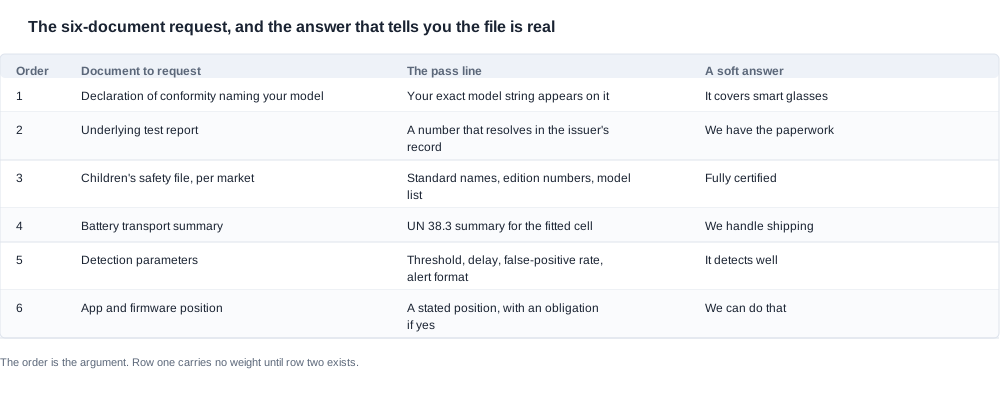
The six-document request and the answer that tells you the file is real
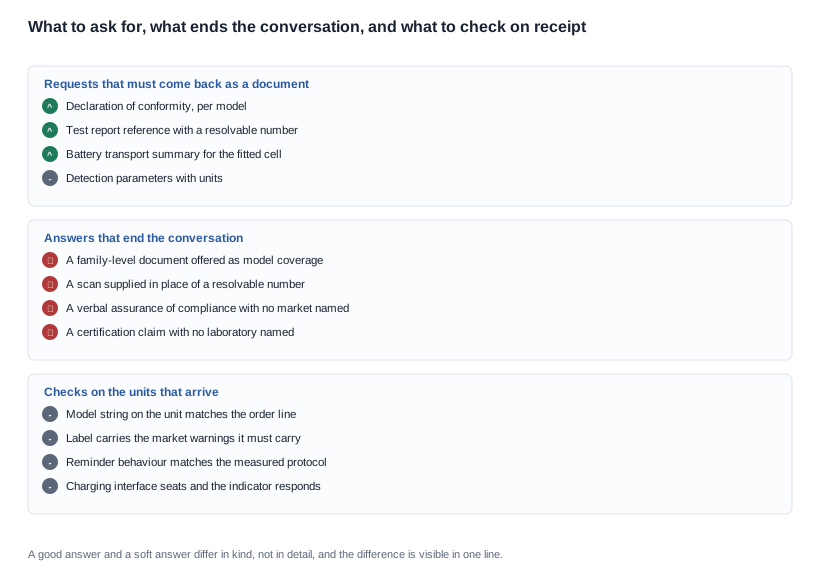
The request is six documents. The right-hand column of the table above tells you what a good answer looks like and what a soft one sounds like, and the distinction is usually visible within one line of the reply. A soft answer is not a lie — it is an answer to a slightly different question, and it is what you get from a supplier who has a process for one market and is extrapolating to yours.
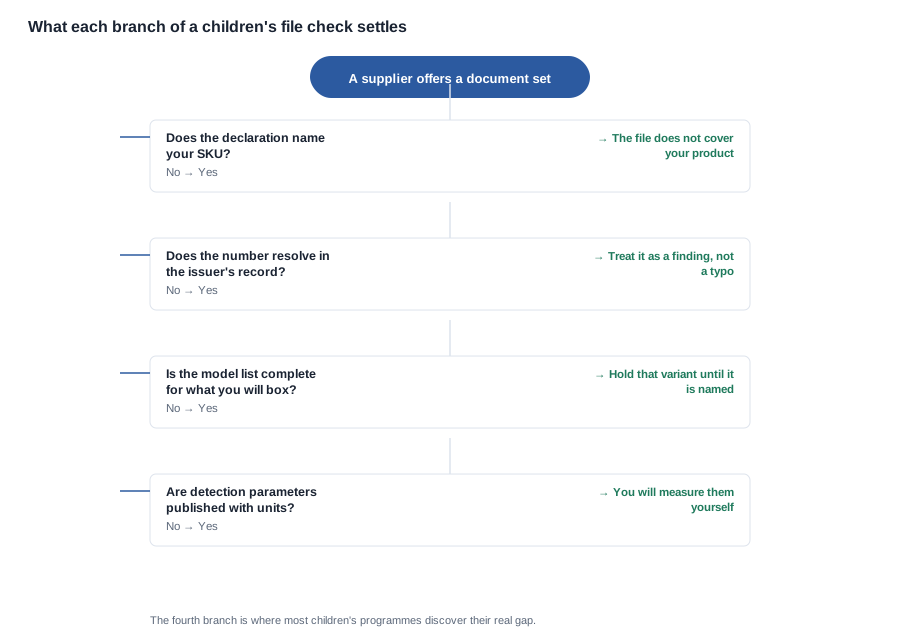
The declaration of conformity naming your exact model designation. In the European Union this is the manufacturer's own declaration, and there is no authority that issues a certificate number for it. A supplier who offers you a "CE certificate" with a certificate number is either referring to something else or has misunderstood their own document set. Ask instead for the signed declaration, and check the model string on it before you read anything else.
The underlying test report, with a reference that resolves. A reference is the only part of a document a procurement officer or a marketplace reviewer can check later. Ask which body issued it, over what date range, and for the model list printed on it.
The children's safety file, per market. Standards with their edition numbers, the model list, and the laboratory. "Fully certified" is not an answer, because fully certified for which market, against which edition, for which model.
The battery transport documentation for the fitted cell. Lithium cells shipped on their own require a UN 38.3 test summary, and carriers check for it. If a charging case ships alongside the product, the case assembly is a second cell and needs its own coverage. This is the most common gap in shipping documentation, and it is checked by the freight forwarder rather than by customs, which means it surfaces as a held container rather than as a rejected product.
The detection parameters. Threshold, delay, false-positive rate and the alert format, each with a unit. A supplier who can produce these has measured the device. A supplier who says "it detects well" has a feature, not a specification.
The app and firmware customisation position. A stated position — confirmed or not — with a maintenance obligation attached if it is yes. This is the document that saves the most money later, because an unspecified firmware position turns every copy revision into a negotiation.
One of these six is not the supplier's to answer. The classification question — whether a given device falls under a toy safety regime, and against which edition — depends on intended age, product type and destination market. It belongs to the buyer's own compliance function, in writing, before the samples are approved. A supplier who offers an opinion on it is being helpful in a way that creates risk, because an informal classification opinion will not protect the brand when a reviewer disagrees with it.
Matching model designations character by character across the A05 and the A06
Most of the practical work in this category is a string comparison, and it is worth doing properly, because the catalogue makes it unusually easy to get wrong. Two models in the children's tier publish identical electrical rows and identical published functions. The buyer knows there are three models. The supplier knows there are three models. The only thing that tells them which physical unit is which is a designation, and if the designation differs by one character — a zero and an O, a hyphen and a space, a suffix dropped in artwork — then a file that covers one model does not cover the other.
The procedure is unglamorous and it takes an afternoon:
- Extract the model string from every document in the file and write it out in a list, exactly as it appears, with no normalisation.
- Write the model string that will appear on your box artwork and on the purchase order line.
- Compare the two lists character by character, including the suffix, the separator characters and the case.
- Where the lists differ, find out whether the difference is a naming convention or a genuine coverage gap. Do not assume the first.
The last point is where the cost sits. A common pattern in this category is that the platform owner runs a single certification under one designation, and a brand owner orders under another. Nothing is fraudulent in that; the platform's document simply does not cover your unit. But it means that when the customs authority or the retailer's technical team asks which file covers the goods in the carton, the honest answer from the buyer is that the brand's designation is not on the platform's list. The remedy is a request to the platform owner to add the designation to the model list, and that request has a lead time of its own. Discovering it after the artwork is printed costs a reprint.
There is a second, related trap in the same exercise, and it is a private-label trap rather than a document trap. A branding change that touches the enclosure — a printed logo, a different temple finish, an anodised colour — can move the product out of the existing test report. A change that touches the software or the packaging does not. The distinction between a cosmetic change and a re-qualification is the difference between a project and a programme, and it is settled in the same place as everything else in this file: in writing, before the first order, with the model designations attached to the purchase order rather than living in an email thread.

Resolving certificate numbers against the issuing body's record
A reference that resolves is worth more than a scan, and the check takes about a minute per document. The reason it is worth doing is not suspicion. It is that the record and the document can disagree, and the record is the one that survives an audit.
The resolution itself has four steps:
- Identify the issuing body. Not the name of a laboratory on a logo — the body that maintains the public record against which the reference can be looked up.
- Look the reference up in that body's record. Confirm that it exists, that it is not withdrawn, and that the dates on the document fall inside the validity period the record shows.
- Read the model list from the record rather than the document. A record sometimes carries a wider or narrower model list than the certificate PDF, and where the two differ, the record is the one the reviewer will see.
- Confirm the covered functions. A report can cover the radio and the charging system while leaving the detection function outside its scope.
What a resolved reference proves is narrow and it is worth stating precisely: it proves that a report exists, that it is current, and that it lists your model. It does not prove that the unit in your sample was built from the configuration the report describes, and it does not prove that the production lot will match the sample. Those are handled by the batch and configuration records, which is why the sample itself needs to carry an identity — a unit identifier and a build reference — that the inspection instruction can point at.
There is a second reason to run this check that has nothing to do with the supplier's competence. In this category, the buyer is frequently the party who will be asked for the file, not the supplier. A retailer's technical team, a marketplace compliance reviewer or a school procurement officer may ask the brand for the document, and the brand is the one who has to produce it. A buyer who never resolved the references has no way of producing them later, and has to go back to the supplier at the moment when the supplier has the least incentive to move quickly.
We are explicit about our own position here. Our catalogue's export-certification page carries ten patent certificates, eight appearance-design patents and two utility-model patents, names no CE, FCC or RoHS marking, and publishes no per-model certificate numbers — and the catalogue publishes no certification position for the three children's models either, so their conformity documents are written material to request before the order rather than rows a buyer can read off a catalogue page. That is a real gap and we would rather state it than let a buyer discover it in a compliance review. The relevant background is in medical device boundary and the standards question is set out in kids industry standards.

Testing the reminder function when no threshold has ever been published
The A05 and the A06 publish posture and viewing-distance detection. Neither publishes a threshold, a delay, a false-positive rate, an alert format, or a behaviour on a repeated trigger. The buyer therefore has to create the specification, and the only honest way to do that is to measure first and write the criterion afterwards.
Write the protocol before the first reading. A protocol for this function has five parts:
- A fixed trigger distance, measured from the eye rather than estimated, so that "too close" means the same thing on every run.
- A fixed delay before the alert fires, in seconds, because a reminder that fires immediately and one that fires after five seconds are different products.
- A fixed number of repeated triggers — ten is usually enough to separate a workable device from an aggressive one.
- A stated room, with the lighting, the background noise and the number of people present written into the record.
- A stated pass condition, agreed before the run: how many of the ten triggers should be correct detections, and how many false alerts are tolerable in a household.
The reason for the protocol is not laboratory rigour. It is that the number of false alerts a parent will tolerate in a real room is not the number that a quiet test room will produce. A device that fires once in ten interruptions in a silent room may fire on every kitchen conversation, every school corridor and every television in the background. That is what makes the difference between a product that is worn and a product that is switched off in the second week, and it is invisible on a bench.
The measurement closes three things at once. It gives you a false-positive rate you can put in the purchase order. It gives you a trigger distance and a delay you can describe honestly on the product page — as a detection and reminder function, not as an eyesight, health or eye-protection claim. And it gives you the alert format, which is the thing your customer support script and your leaflet both need and which no catalogue row will ever tell you.
The fogging arrangement deserves its own short test, because it is a published function on the same two models and its behaviour is entirely unpublished. Ask what it consumes, how it is replenished, whether it can be disabled by a parent, and what the wearer experiences when it activates. A lens that fogs and clears on a timer is a different proposition from one that fogs in response to a condition, and the copy for each is different.
One last check belongs here, and it is a scoping check rather than a test: the A07 publishes no sensors and no fogging arrangement. If the model you are verifying is the A07, none of this applies, and your verification effort should go to the radio version it does publish — Bluetooth V5.4 — and to the battery transport documentation instead.
Where children's supplier verification breaks, and what it costs
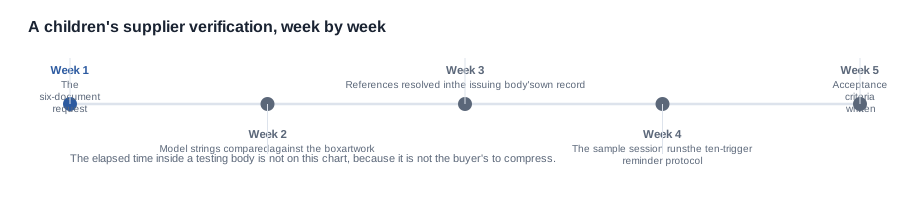
Six failures recur in this category, and they are worth naming individually because each one has a distinct root cause and a distinct prevention.
A declaration that does not name the model the buyer is ordering. The symptom is a customs query, a marketplace rejection, or a school that will not accept delivery. The root cause is that the string was never compared character by character against the artwork. The prevention is the comparison described above, performed before the purchase order is released.
A container held by the carrier for missing transport documentation. The root cause is that the battery documentation was not requested, because it does not appear on the product and nobody thought of it. The prevention is to request it with the other five documents and to treat it as a lead-time item on the schedule rather than as a shipping formality.
A certificate number that does not resolve. The root cause is that a document was accepted rather than a record. The prevention is to resolve every reference and treat an unresolvable one as a finding rather than as a formatting problem.
The reminder is switched off during the pilot. The symptom is a pilot that ends quietly, with no complaint and no return. The root cause is that the false-positive rate was never measured, so the default was too aggressive for a real household. The prevention is the ten-trigger protocol above, run on a sample in a real room, with the pass condition agreed before the run.
A claim on the listing that exceeds what the device does. The root cause is that the copy was written before the parameters were established, which in practice means it was written from the category name. The prevention is to write the copy from the measured behaviour and to have it reviewed against the file before the artwork is approved.
The classification question answered after the artwork is signed. The root cause is that the determination was treated as a formality. The prevention is to settle it with your own compliance function in writing, with the reasoning recorded, before the samples are approved.
What our published rows do and do not settle
We publish what our catalogue holds and we mark the rest as open. For the three children's models we publish a 40 mAh cell on the A05 and the A06, a 70 mAh cell on the A07, a charge time of two hours or less, a rated use of roughly twenty hours, magnetic charging, a lens-based electronic fogging arrangement with posture and viewing-distance detection on the A05 and the A06, and Bluetooth V5.4 on the A07.
We do not publish, and will not estimate: the detection thresholds, the delays, the false-positive rate, the alert format, the behaviour of the fogging arrangement, the certification status, the frame weight, the frame dimensions, the ingress marking, or the size range. We publish no ageing data for the seal or the battery, and we will not estimate a service life for something we have not tested.
We make no claim covering eye-protection, vision or health results for any of our products, in any market, and no hearing-related claim either. A device that detects a position or a distance and reminds is not a clinical device, and if your channel's proposition is an eyesight concern, this is the wrong category — which we would rather say before the first order than after the packaging is printed. The claims to be careful about are collected in kids myths, and the category overview is in kids eye protection glasses technology.
Four requests to send this week
Send the classification question to your own compliance function, in writing, naming the three models and the three destination markets. Send the six-document request to the supplier as one numbered list, with the market list attached, and allow a week without a chase. Send the ten-trigger protocol to the supplier as an attachment with the sample order, so it arrives with the units rather than after them. And send us the models, the markets and the customer profile, and we will mark each of the six documents as one we can answer today, one that has to come from the platform owner, and one that needs a week in a household.
The range is on the kids smart glasses page, and the technical background sits under kids eye care technology.
Where the due diligence path comes from
Send us the six documents and we will tell you which of them do not cover the model you are buying.


