
Smart glasses for cycling is the one outdoor scenario in this catalogue where the published figures are comfortable and everything around the device is undocumented. A ride lasts two to five hours, and every camera, audio and sport model in the range publishes a rated use that comfortably covers it. Endurance, which decides most of the other scenarios in this category, is simply not the constraint here. The constraints are the two things the catalogue says nothing about at all: how the device is held or mounted in a moving environment, and whether open-ear audio can be heard over road noise without becoming audible to everyone else at the lights. There is no mounting accessory row, no vibration rating, no operating temperature range, no volume figure and no leakage figure for any model in the range.
Smart glasses for cycling: battery fits the ride, no mount exists
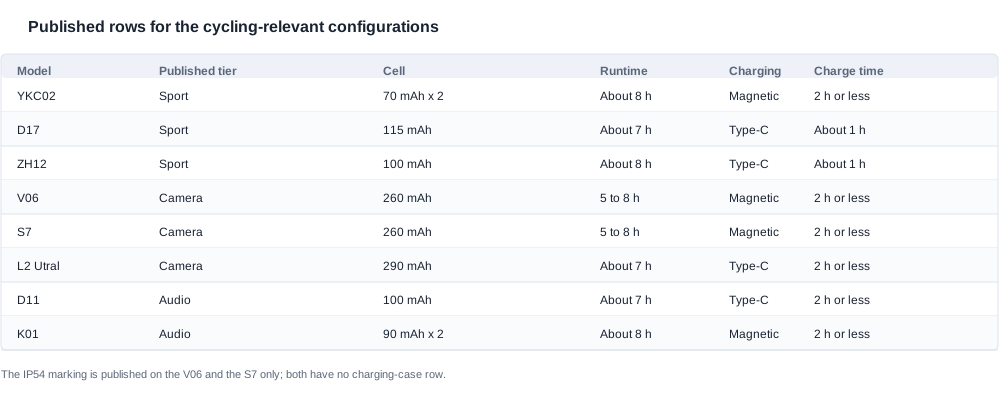
The published runtime band is what removes the obvious worry. The sport models publish about eight hours on the YKC02, about seven hours on the D17 and about eight hours on the ZH12. The audio models publish from about six hours on the G07 and the YK12 to about eight hours on the K01, the K02 and the LC-105 pair. The camera models publish five to eight hours at the top and about seven hours in the middle. A rider can finish a long ride on a single charge with room to spare, and a buyer who specs this segment on endurance will find that every configuration passes and none of the work is done.
What is left is harder, and the catalogue is silent on all of it.
Mounting. A cyclist is not going to use a device the way a desk worker uses one. It goes on a helmet, on a stem, in a pocket, or on a face — and the catalogue publishes no mounting interface, no adaptor row, no accessory list and no retention specification for any of the three sport models or any of the eleven camera models. The published structural features are a detachable inner frame on the V06 and the S7, the ultra-slim detachable temples on the G07, the slim detachable temple on the YK12, flexible temples on the V03 Pro, and nothing that attaches to a bicycle.
That silence has a direct commercial consequence. A cycling line whose accessory list is empty is a device line, and a device line is sold to the rider who will hold it. A cycling line with a mount is a kit line, and a kit line sells to the rider who will actually record the ride. Which of those two businesses a channel is in is decided by whether the mount exists, and the mount is a supplier question, not a catalogue question.
Vibration and temperature. Road vibration, handlebar damping and a hard tarmac are a different mechanical environment from a desk, and the catalogue publishes no vibration or shock rating and no operating temperature range for any model. A buyer who cannot obtain those two figures has a channel in which the first hot ride or the first cobbled section produces a return that nobody can diagnose, because there is no specification against which to diagnose it.
The three parties and the three things each one owns
A brand owner is deciding whether the line is a device line or a kit line, and that decision is worth more than the model choice, because it decides the accessory list, the documentation burden and the minimum order quantity on two separate order lines.
A procurement manager is deciding which published rows are enough to write a specification and which four answers have to be obtained from the supplier before the first order.
A channel buyer is deciding what the listing promises about a moving environment, and the answer is that it can promise a runtime and a marking and very little else.
Traffic noise sets the audio requirement, and no figure sets it
Open-ear audio on a bicycle has an unusual two-sided requirement, and neither side is documented.
The first side is audibility. Road noise at riding pace masks a low-volume signal, so the rider needs enough level to hear the device over the environment. No model in the range publishes a volume figure, a sensitivity, a frequency response or an active noise cancellation figure, so the rider's requirement cannot be compared against any published row.
The second side is privacy. A cyclist at a junction is standing next to other people, and an open-ear design that is audible at riding volume is audible at the lights. No model publishes a leakage figure at any distance either. The acoustics questions are set out at will others hear my music and is it loud enough for calls.
The catalogue does publish the structural rows that bear on the second side, and they are worth naming because they are often left out of the specification. The D11 publishes a surround-sound configuration, the YK12 publishes surround sound with a slim temple, the D17 publishes surround sound, and the G07 publishes ultra-slim detachable temples. Those are feature names, not acoustic measurements, and a listing may state them and may not derive a privacy promise from them.
There is a third, quieter consequence. Microphone pickup in wind is unpublished for every model. A cyclist making a call at speed faces a wind-noise problem that a desk worker never meets, and the catalogue publishes no microphone specification, no pickup characteristic and no speech-to-noise ratio for any of the eight audio models or the three sport models. For a channel whose use case includes hands-free calls on the move, that is a supplier question with a commercial answer attached, and it should be asked in the first round rather than discovered in the reviews.
Where the charging item becomes a cycling decision
Cycling is the segment where the charging interface stops being a desk preference. A magnetic-charged configuration needs a charging base, and on a bicycle the base is either mounted on the bike — where it is exposed, weight-bearing and a target — or carried to a socket after the ride. A Type-C configuration needs a cable, and the rider's phone is already on a cable.
The catalogue makes the trade explicit, because it publishes both the interface and the charge time for every model. The D17 and the ZH12 publish Type-C charging and a charge time of about one hour, the only roughly one-hour charges in the range; everything else publishes two hours or less. Both of those sport models also publish a remote-control capture feature, which is a more useful answer on a bicycle than almost anywhere else, because the rider's hands are on the bars and the device is not in reach.
The published case positions complete the picture for the camera side, and they point in one direction: the two models with the ingress marking, the V06 and the S7, publish no charging-case row at all, and the L2 Utral publishes both a Type-C interface and a case at a choice of 900 or 1400 mAh. A rider recording a long ride who also wants a power reserve has to choose the configuration that has a case, which is not the configuration that has the marking.

Recording a ride: two marked models, no case row, no mount row
Two models in the entire catalogue carry an IP54 marking: the V06 and the S7. Both publish a 260 mAh cell, a five-to-eight-hour rated use, magnetic charging, a two-hour-or-less charge time, an ergonomic design and a detachable inner frame. The V06 publishes 8 megapixels and four published colours — orange, ice blue, black and a black-ice-blue option. The S7 publishes 13 megapixels and no colour row. The digit reading is at what does the second digit mean.
For a cycling channel, the pair is a clean two-rung structure on the published rows: same cell, same runtime band, same interface, same structural feature, different pixel tier, and — the commercially awkward part — no charging-case row on either of them. The rider recording a long ride is therefore relying on the published runtime band alone, or carrying a second unit, or accepting a case from another platform that will not be part of the documented configuration.
The detachable inner frame deserves the same attention it gets in the wider range, for a cycling-specific reason. It is a size-range mechanism rather than a cosmetic accessory, and on a bicycle the size range that matters includes helmet accommodation as well as head shape. A channel that sells to a wide range of riders and does not specify that row will find the returns are concentrated in one size band, and it will find out from the return notes rather than from the specification.
What the two models do not publish is the whole of the moving-environment question: no mounting interface, no vibration rating, no operating temperature range, no field of view, no video resolution, no frame rate, no sensor model, no low-light behaviour, no storage or overwrite behaviour, no weight and no ingress test report behind the marking. The only published weight in the catalogue is 158 grams for the MT6 camera glasses body, including the cell and the camera and excluding its foldable charging case, and that configuration carries neither a marking nor a camera position a cyclist would use in the same way.
Qualifying a cycling configuration on the bike, not at the desk
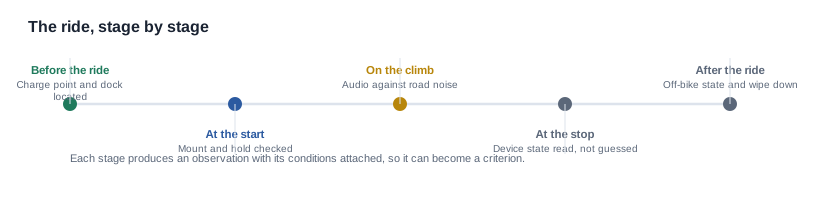
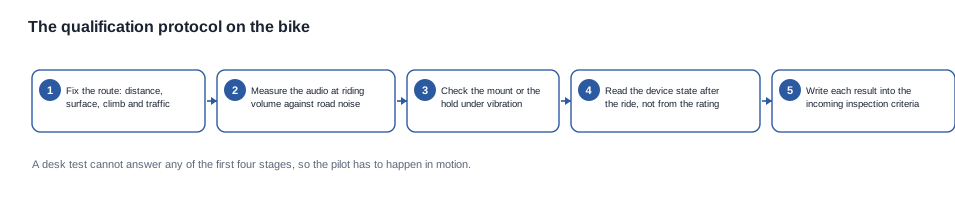
A cycling evaluation that happens at a desk measures the wrong thing. Five stages, each with a completion standard, and each of them performed in a moving environment:
| Criterion | How it is read from the published row | The line it has to meet | What a soft answer looks like |
|---|---|---|---|
| Runtime against the ride | The rated figure on the model's own row | A condition stated, or a measurement on the route | A rating quoted as a ride guarantee |
| Charging item | The charging method row for that model | A cable the rider already carries | Both interfaces claimed for one model |
| Mounting position | No row published for any model | A written answer from the supplier | A mount implied by the photography |
| Environment tolerance | No vibration or temperature row published | Two figures, or an explicit absence | Silent on vibration and heat |
| Acoustic behaviour | No volume, leakage or microphone row | A measurement with conditions attached | "Loud and clear" with no figure |
| Ingress position | The IP54 marking, and the absent report | A report number, or a written absence | "Waterproof" |
| Weight of the configuration | The published weight, where one exists | A measurement per configuration | A category average carried across models |
- Fix the route. Distance, surface, climb profile and traffic density, written down before the first ride. The completion standard is a written route profile, because the same model behaves differently on a smooth commute and on a rough climb.
- Measure the audio at riding volume. With the device in the position it will actually be used from, on the same route, against real road noise, and with the leakage observed at a fixed distance at a junction. The completion standard is an observation with the conditions attached, because an observation without conditions cannot be turned into a claim.
- Check the mount or the hold under vibration. On the same route, at the same pace, including the roughest section. The completion standard is a written statement that the device stayed where it was put, for each position tested.
- Read the device state after the ride. The runtime actually achieved, the state of the charging contacts and, if a camera model is being tested, the state of the stored files. The completion standard is a recorded end-of-ride state rather than a rating read off a catalogue.
- Write the results into the incoming inspection criteria. A measurement nobody writes into the purchase order is a demonstration, and a demonstration is a document the buyer cannot enforce on a delivery.
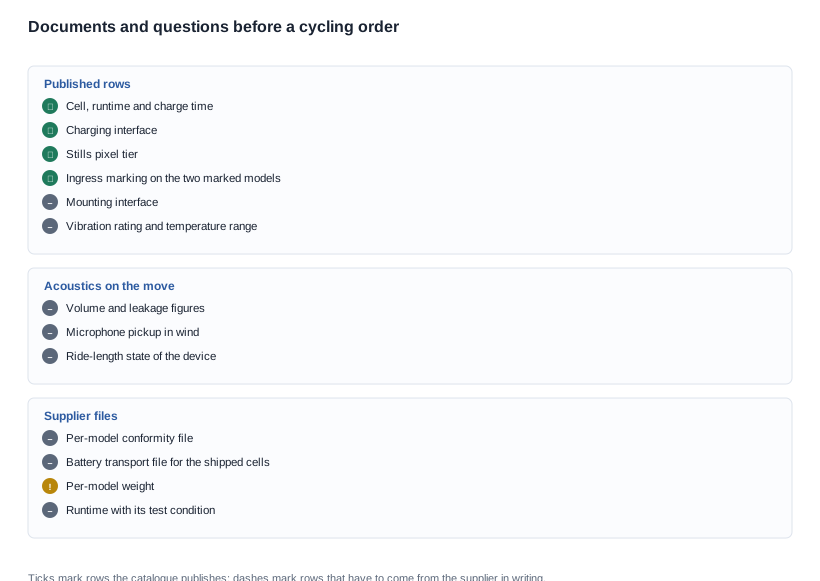
The documents to request before a deposit are the mounting and accessory position, the vibration and shock position, the operating temperature range, the runtime with its test condition, the per-model weight, the ingress test report or a written statement that none exists, the model designation table, the per-model conformity file, the battery transport file for the cells actually shipped, and the agreed inspection criteria. The compliance route is at certification checklist, the sample stage is at procurement samples, the battery requirement is at compliance battery transport, the clause language is at contract terms, and the commercial structure of a first order is at pricing. The charging plan for this segment is at charging for cycling, the adjacent endurance case is at running product recommendations, and the product families are at sport smart glasses, AI camera glasses and Bluetooth audio glasses.
Most of what matters is covered by four questions in a first enquiry. Which model designation the supplier has quoted, and what that model's published row carries. What is the published charging interface, and what has to be carried to charge it. Does a mounting interface exist for this configuration, and is it in the documented configuration. What are the vibration rating, the operating temperature range and the per-model weight.
The red flags in this segment are recoverable if they are caught early. A listing that claims a mounting method the catalogue does not publish. A listing that extends the ingress marking from the two models that carry it to the sport models that do not. A specification that quotes a runtime as a ride guarantee. A weight carried across from the MT6. A pilot that was ridden once, in good weather, on a smooth route. And a case promised for a configuration whose case row is absent or unpublished — the distinction between the two that a buyer has to get right, and the reason the V03 Pro's explicit no-case position is a different statement from the V06 and the V03, and the S7 having no case row at all.
The commercial structure of a cycling channel
Cycling channels in this range sell to two buyer types with different economics, and the catalogue supports both from different parts of the range.
The device line is the audio-only configuration with a magnetic or Type-C interface and no accessory requirement. Its economics are ordinary: unit price, minimum order quantity tiers, packaging, the colour count on the configurations that publish one, and the share of units taken at the pilot tier. The published rows for this line are complete enough to quote without a pilot, with the four gaps of this segment — mounting, vibration, temperature and acoustics — handled as supplier answers.
The kit line is the camera configuration with a mount, and it is worth more per unit and worth more to the channel, because the mount is the thing that makes the recording possible and because the rider who buys a mount buys the accessory again. The L2 Utral is the configuration that can carry this line on the published rows, because it is the only camera model that publishes a Type-C interface together with a case at a published capacity choice. Its minimum order quantity is worth negotiating on its own, since it is an accessory line and an accessory line with a high minimum is a line a channel cannot start small with.
Two further blocks behave unusually here. The pilot is worth paying for, because a supplier who will run the ride test on production units and supply the recordings so a result can be re-judged converts a demonstration into an acceptance criterion, and the mounting question in particular cannot be settled by a desk test. Tooling and certification are quoted apart, because certification cost and lead time take their shape from the programme and from whoever certifies the build, and a buyer who cannot see the split cannot model the break-even volume of a channel with a long compliance lead.
Concretely, we publish the resolution tiers, the cell configurations, the charging methods, the charge times, the rated runtimes and the charging-case capacities and positions, the structural feature rows and the colour counts exactly as the catalogue states them, and we publish the absence of a mounting interface, a vibration rating, an operating temperature range, a volume figure, a leakage figure, a microphone specification, a runtime test condition, a per-model weight beyond the MT6's 158 grams glasses body excluding its foldable case, and a per-model certification with the same prominence. We will not state that any product is tested to IP54, we will not extend the marking beyond the two models that carry it, and we will not present a rated runtime as a ride guarantee.
What we will do is take the route profile, the recording requirement, the audio requirement, the channel and the price band, and tell you which published rows cover the configurations that fit, which answers have to come from the supplier in writing, which claims the documentation supports, and which criteria belong in the purchase order.
What to send us. Send the route profile, whether the ride is recorded, whether calls are part of the use, the channel and the price band, and we will return the shortlist, the four answers to obtain in writing, and the pilot criteria to write into the order.
Related reading
- Where the scenario starts — smart glasses for cycling
- The families in the range — sport smart glasses, AI camera glasses and Bluetooth audio glasses
- How charging is arranged — charging for cycling
- The adjacent endurance case — running product recommendations
Tell us the route profile and whether the ride is recorded, and we will return the shortlist and the four answers to obtain in writing.


