

An outdoor deployment is not measured against a specification; it is measured against a set of conditions the buyer writes down before the first run, and the conditions are the measurement. The distinctive risk in this category is not a poor unit or a late shipment. It is a claim. The moment a listing says a device is waterproof, the seller has taken on the outcome of a customer's rain test, and the only defence is a claim that the documentation behind it can carry. That is why the ingress marking has to be treated as a commercial exposure rather than as a feature, and why the protocol exists at all: it is the document that decides which words may be printed.
Smart glasses for outdoor: the case where a claim outruns the marking
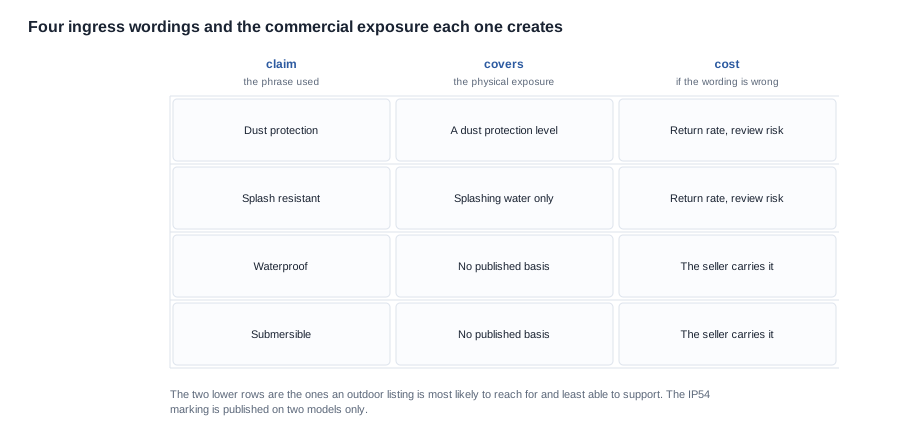
The catalogue publishes an IP54 marking on two models out of twenty-eight, the V06 and the S7, and on no other model in the range. The marking covers a dust protection level and splashing water. It does not cover immersion and it does not cover a sustained downpour, and no test report behind the marking is published anywhere in the catalogue. That is a narrow fact, and it carries a wide commercial consequence: the four wordings an outdoor listing is most likely to reach for sit at four different points on the risk scale, and two of them are entirely unsupported.
This is the point at which most outdoor listings go wrong, and it goes wrong quietly. The product page says the published marking, which is defensible. The box artwork says "water resistant" in a way a customer reads as "waterproof", which is not. A review then says the device failed in the rain, and the review does not distinguish between a product defect and a claim defect — and the brand is named either way. The measurement programme cannot stop a customer from testing the product in the rain. What it can do is make sure the seller's own words never promised anything the rain could disprove.
Three conclusions follow, and each of them belongs in a contract rather than in a marketing plan. First, the ingress wording has to be fixed in the configuration, because a claim that travels across a range inherits the exposure of the weakest model in it — one model with a published marking and the rest of the range without it produces a range claim, and a range claim is the most dangerous kind. Second, the protocol's purpose in this category is not primarily to qualify the product but to qualify the claim, which means the environment run has to produce a statement with its conditions attached rather than a pass or a fail. Third, the buyer should expect to write the claim set before the artwork rather than after it, because artwork is where a claim becomes a promise and artwork is expensive to change once it is printed.
Who is reading this. The reader is a brand-side buyer, a channel buyer or a product lead specifying an outdoor line, either for a consumer channel or for a professional deployment. The task in front of them is to write the measurement protocol the first order is judged against, to decide which results are pass lines and which are observations, and to fix the claim set that the listing is allowed to carry. The fear underneath it is a claim that the protocol does not support, arriving as a public review from a customer who tested the product in the rain rather than in a laboratory.
What the catalogue publishes for an outdoor configuration. The sport family publishes a charge time, a cell capacity, a resolution class, a rated runtime, a charging interface, a colour count and the structural features, and the IP54 marking on the two camera models. The published rows for the models an outdoor range is most likely to compare are set out in the table below. The catalogue publishes no sensor part, no field of view, no video specification, no low-light behaviour, no storage behaviour, no per-model frame weight, no operating temperature range, no cycle-life rating and no runtime test condition for any model, and it publishes no ingress test report at all. The charging interface splits three ways across the camera range: magnetic on the V03 and the MT5, the V06 and the S7, and the KY06, Type-C on the V03 Pro and the L2 Utral, and not published for the CY03 and the L1 Pro, and the CY05 and the MT6, where the catalogue carries the pixel, battery, charge-time, runtime and case rows but no interface row.
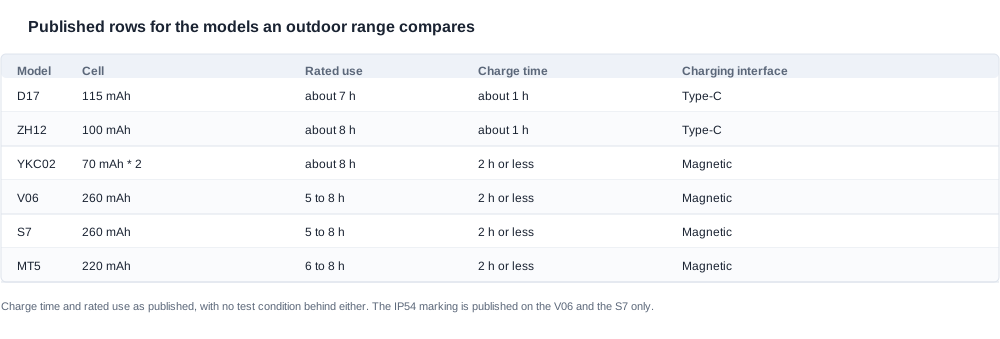
Why the charging interface decides the outdoor kit. A Type-C model recharges from a cable the customer already owns, which removes a second object from the pack and removes a failure point at the start of a trip. A magnetic model needs a dock or a case, and once the case is carried the spare cable stops being worth supplying. The D17 and the ZH12 are the two models in the range that publish a charge time of roughly one hour against two hours or less everywhere else, which is the published row that most changes an outdoor schedule: a full charge in the time it takes to eat.
The six measurements and the pass line behind each one
The protocol below covers an outdoor deployment end to end. The right-hand column is the part that is usually missing.
| Measurement | How it is run | The number it produces | Pass line or observation |
|---|---|---|---|
| Still capture in controlled light | One scene, one light level, one distance | A file set comparable frame by frame | Pass line, because it establishes the baseline for everything else |
| Coverage of what the camera sees | A known grid at a stated distance | A coverage figure | Pass line, because it decides the framing |
| Frame rate held under movement | Record while moving, replay, and read the rate | A sustained rate and a stated format | Pass line, because it decides whether the footage is usable |
| The same scene at a stated low light | Repeat the first scene at a defined low light level | A second set judged against the first | Pass line, because it decides the low-light claim |
| Endurance under the trip pattern | The workload the customer creates, including the gaps | A runtime with the condition stated | Pass line, because it decides the endurance claim |
| The environment exposure run | Dust, road film, water and temperature in the deployment conditions | Whether the earlier pass lines still hold afterwards | Pass line, because it decides the environment claim |
What the environment run can and cannot produce. A protocol that puts the device through dust, road film, water and temperature and then re-checks the other pass lines tells a buyer whether the product survives the environment. What it does not do is produce a waterproof claim. It can produce a statement of the form "held in conditions of X for Y hours, after which the pass lines were still met", which is a defensible observation with its conditions attached and which a support script can repeat without qualification. It cannot produce "IP54 tested" or "rainproof", because those assert something the documentation behind the marking does not support. The digit reading is at IP ratings and the product family is at sport smart glasses.

The trip pattern, and the standby question the catalogue leaves open
This is the measurement that is specific to an outdoor product and that no other category in the range has. A consumer outdoor device is used in bursts: a walk, a climb, a stretch of a trail, and then it goes into a bag or a pocket for an hour or two. The gaps are not idle time in the ordinary sense; they are part of the product's operating pattern, and a device that drains noticeably while it is in a bag is a different product from one that does not. The catalogue publishes no standby draw for any model, and it publishes no operating temperature range, so both are questions to put to the factory rather than numbers to plan from.
The protocol therefore has to state which pattern it is testing, and the two patterns produce different numbers from the same catalogue rows. A professional outdoor deployment charges at the end of a shift, in a vehicle or a site cabin, and the relevant number is the active-work runtime. A consumer outdoor deployment is measured across a day with gaps, and the relevant number includes what happens between the bursts. A buyer who runs the professional pattern and quotes the consumer number — or the reverse — will be wrong in the field, and the error will surface as an out-of-power complaint rather than as a formal defect claim.
The standby question is specific and cheap to ask: what is the draw while the device is powered and idle, how long does it take to reach that state, and does the behaviour differ between the models in the range. A supplier who answers those three has told a buyer whether the burst pattern is viable. A supplier who does not has left a real part of the outdoor product's operating envelope unmeasured, and the honest position is to treat that as an open row rather than to assume a typical figure.
The workload definition, which is the part that is usually skipped. Every measurement above only produces a comparable result if the conditions behind it are stated: the volume, the phone state, the light level, the distance, the movement, the storage state and the ambient temperature. A runtime measured at a fixed volume with the device connected is not comparable with one measured across a day of intermittent use, and the published runtime rows carry no test condition at all, so the buyer has to define one and fold it into the protocol. The published rows and what they leave out are at battery life, and the charging plan built on top of them is at charging for outdoor trips.
Running the protocol so the result is reusable on the listing
The protocol has to produce two outputs, and they are different documents: an internal result that settles the purchase, and a public statement that the listing and the support script are allowed to repeat.
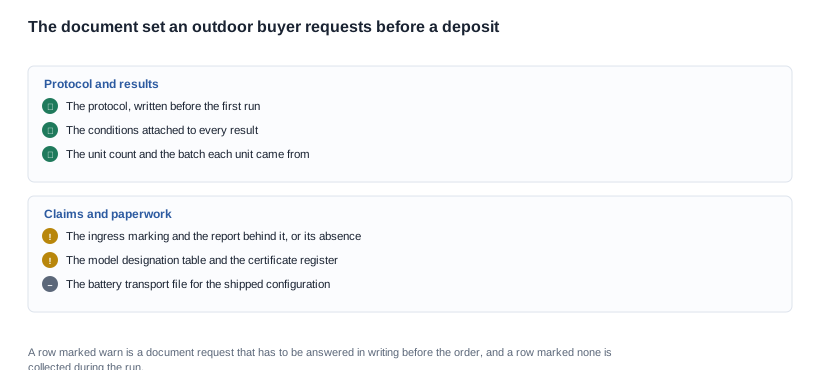
- Write the protocol before the first run, with the conditions fixed. Volume, phone state, light level, distance, movement, storage state and ambient temperature all go in, in writing. The completion criterion is a numbered document that a customer and a supplier could both execute independently.
- Run the measurement on two units from the same batch. One unit cannot separate a manufacturing inconsistency from a design characteristic. The completion criterion is that both units appear on the sheet with their results side by side, and that the batch each came from is recorded.
- Run the environment exposure last and re-check the earlier pass lines afterwards. The completion criterion is a sheet where the post-exposure results sit next to the pre-exposure results for the same measurement. The order is not a formality: running the exposure first destroys the reference set.
- Measure endurance under the trip pattern, with the gaps included. The completion criterion is a runtime with the pattern written next to it, so that the number can be quoted only in the context it was produced in.
- Ask for the sensor part, the field of view, the video format and the frame rate, with the method stated for each, and compare them against the measured results. The completion criterion is a comparison table with both columns populated, rather than a declaration accepted on its own.
- Fix the claim set and write it onto the artwork, the page and the support script in the same pass. The completion criterion is one document listing the permitted wordings, and the artwork proof attached to the order. The claim that is most often overreached is the ingress one, because the customer tests it in the rain.
- Confirm the model designation on the unit against the paperwork, look up every certificate number in the issuing body's public register, and request the battery transport file for the shipped configuration. The procedures are at certification checklist and battery transport, and the sample confirmation is at samples.
- Derive the incoming inspection criteria from the pass lines and attach them to the order. The completion criterion is a document an inspector can apply without asking the buyer what any of it means. Clause language appears at contract terms, and the commercial structure of a first order appears at pricing.
Five ways an outdoor result gets misread, and what each one costs. The first is a catalogue attribute repeated as a product guarantee: the marking was published, so the listing repeated it as a promise, and the promise outlived the documentation. The second is a rating quoted as a guarantee — a model published at five to eight hours is read as eight, and the customer measures from a full charge under a workload nobody specified. The third is the range claim: one model carries the marking and the rest do not, but the listing covers the range, so a failure on an unmarked model is read as a failure of the marked one. The fourth is the environment run done in the wrong order, which produces a result that cannot be compared with anything because the reference set was destroyed first. The fifth is a protocol that never made it onto the artwork, which is the most expensive of the five, because the claim that reaches the customer is then the one nobody reviewed. None of the five is a technical failure and none of them is fixed by a different model.
The result the buyer should want at the end is a signed measurement sheet — the protocol, the conditions, the results, the units, the dates and the number of units tested. That sheet is what the incoming inspection criteria are derived from, what a defect claim against a production batch is settled with, and what the listing copy is allowed to say. A sheet without conditions is not a sheet. A sheet with conditions but no unit count is a demonstration rather than a measurement, and a demonstration cannot be used to set an acceptance limit on a production run.
The commercial room and the commercial floor. The camera and audio architecture, the cell configuration, the charging interface and the ingress architecture are settled before a negotiation starts, and so are the certification cost and its lead time and the nature of the tooling cost, which is amortised across the first order and quoted as a separate line rather than folded into the unit price. Negotiating room sits in the order bands a supplier sets, in whether it will fund a baseline measurement on the batch that ships, in whether a charging case is included and what capacity it holds, in the protocol being run on production units instead of engineering samples, in whether the recordings are supplied so the result can be judged again, in the first run travelling as two deliveries against a staged payment, in what the incoming inspection checks, in the branding, the lens tint and the packaging, and in the quantity bought at pilot tier rather than at run tier. For an outdoor range, the two terms worth arguing for hardest are the case configuration and the claim set, because they are the two that determine what a customer's rain test costs.
What we publish for outdoor, and what we will not print on a box
The short answer: we publish the rated runtimes, the charging interfaces, the cell capacities, the resolution tiers, the charge times, the structural features and the colour availability exactly as the catalogue states them, and we publish the absence of a sensor part, a field of view, a video specification, a low-light behaviour, a storage behaviour, a per-model frame weight, an operating temperature range, an ingress test report, a standby draw and a runtime test condition with the same prominence as the rows we do publish.
We will not present a demonstration as a result, and we will not state that any product in our range is tested to IP54, because no test report behind that marking is published. We will also not extend the marking to the camera or audio families, where no rating is published at all, and we will not use a phrase like waterproof in a listing for a product whose only published marking covers splashing water and a dust protection level. We will not fill an open row with a typical value from a supplier's general data; a buyer who builds a claim on an estimated figure finds the error in a review rather than in a quotation, and the correction is more expensive than the original question.
What we will do is take a set of environments, a trip profile, a channel and a target market, and tell you which published rows apply, which measurements will decide the purchase, which wordings the documentation behind the ingress marking can carry, and which numbers have to be confirmed on a production unit before a volume is committed. The scenario entry point is outdoor.
What to send us next. Send the trip profiles, the environments, the channel, the price band, the markets and the models you are comparing, and we will return the measurement protocol, the pass lines, the claim set the listing can carry, and the documents that have to be attached to the order before the first shipment.
Related reading
- How to enter the scenario — outdoor
- The ingress standard and what the digits mean — IP ratings
- The models this range compares — sport smart glasses
- The charging plan the runtime rows support — battery life
Send the trip profiles, the environments and the price band, and we will return the protocol, the pass lines and the wording the documentation can carry.


