

Smart glasses charging: the sheet describes the charger
A charging datasheet has to answer four questions for a buyer, and it usually answers none of them properly, because it describes the charger rather than the charging. Smart glasses charging smart glasses how to read a datasheet is a read in four answers and four rows, and the four rows that most sheets carry instead — the input rating, the output rating, the cable and the plug — are the ones that decide whether the product works in the customer's hand.
Our published data in this category is substantial and specific, which makes it a good illustration. Charge times are two hours or less across most of the range, and around one hour on the two fast-charging sport entries. Interfaces are magnetic across the audio, camera and sport tiers, and Type-C on the L2 Utral and the D11, the ZH12 and the D17, and the D12 and the V03 Pro. Cell configurations run from 220 mAh to 290 mAh in the camera tier, with 55 mAh cells in the audio tier and a 1400 mAh case on several camera models.
That is a real specification. It is also an incomplete one, because not one of those rows says what happens when the battery is flat, and that is the row a powered feature in this category turns on.
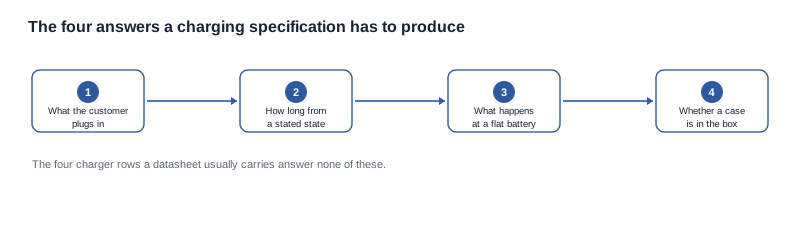
What a charging read has to produce
The interface decision, in channel terms rather than engineering terms. Type-C means the customer carries one cable for the glasses, the case and their phone. Magnetic means a proprietary cable and a case that is part of the proposition. Both are defensible; they are simply different businesses.
A charge time with a condition attached. A figure measured in a factory at twenty-three degrees from a flat cell is a different number from one measured in a warm warehouse from a half-charged cell, and the difference is not small. Two hours and ninety minutes are not comparable numbers.
The behaviour at a flat battery. This is the question that is never asked and always matters. If the lens is electrochromic, the behaviour at a flat battery depends on whether the lens is powered, and our catalogue entry for the light-responsive product publishes a 100 mAh cell, magnetic charging and electrochromic lenses without saying what the lens does at the end of the charge.
Whether a case is part of the proposition. 900 mAh, 1200 mAh and 1400 mAh appear in our range, and a customer with a case lives a different day from one without. A case that is in the box and absent from the specification is a product that has been half described.
The buyer choosing an interface for a product line
A brand product manager choosing an interface for a range is making a decision that will outlive the product, because the interface determines the cable in the box, the case, the instructions, the complaint about lost cables and the accessory programme for two years. Their exposure is the accessory and the review, not the electronics.
A channel buyer checking a supplier's charge time against a customer's expectation is usually working with a marketplace listing and a target market, and their exposure is the complaint. "It takes forever to charge" is a common review in this category, and it is almost always a condition problem or a charger-in-the-box problem rather than a product problem.
A procurement manager asked to reduce cost has a specific temptation here, which is to change the charger. The charger is a real line item, and the lower-output unit is cheaper. It is also the unit that quietly makes the published charge time longer, and the difference between shipping a charger and shipping nothing at all is a packaging and freight decision with a direct effect on the customer's first ten minutes with the product.

Where the charging decision actually costs money
The four cost layers in a charging decision
The charging path in the product. The interface, the contacts, the charge controller and the thermal behaviour. This is design work, it is decided early, and it is effectively fixed once the platform is chosen. It is also the layer that determines whether a magnetic interface on a sealed frame is physically possible, which is a question that has to be asked before the frame is designed rather than after.
The cell and its documentation. The cell configuration determines the transport file. That makes a cell swap a change to the conformity position and to the transport paperwork, and it is why the change control procedure matters more in this category than in most.
The accessory programme. The cable or charger in the box, the case, and the spare units a customer buys in year two. This is where the recurring revenue and the recurring complaint both live, and it is decided at the packaging stage.
The support cost of a bad charge experience. A customer who cannot work out how to charge the product will try the case, then the wall socket, then a colleague's cable, and then contact support. That call costs money whether the product is faulty or not, and the majority of charging complaints in this category are usage failures rather than defects.
Why the interface is a channel decision first
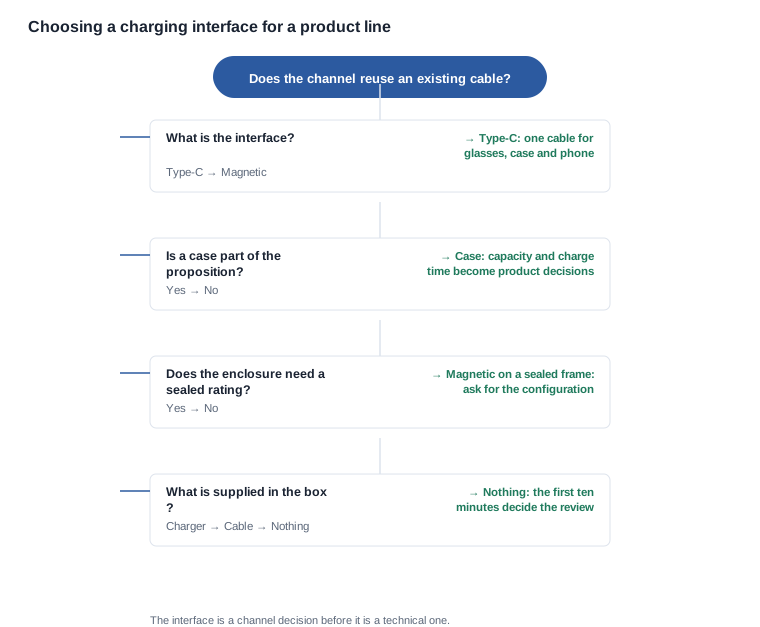
The chart above is a decision tree rather than a comparison, and the reason is that the interface question is not primarily a technical one. A Type-C product inherits the customer's existing cable ecosystem, and in a market where phones and laptops have converged on one connector, that removes an accessory from the box, from the packaging and from the customer's mental checklist. A magnetic product creates a proprietary ecosystem: the cable has to be included, the case becomes the primary charging method, and the spare-part business becomes part of the range.
Neither is better. They are different propositions, and the mistake is choosing the interface on the electronics and discovering the packaging consequences afterwards. The second branch in the chart is the one that catches programmes: a case in the box turns the product into a two-device charging proposition, and the case then needs its own capacity, its own charge time and its own place in the transport file.
The third branch connects the two decisions together. A deliberate opening in the enclosure, for the contacts of a magnetic interface, is a sealing decision, and it is the reason an ingress marking on a magnetically charged product is worth asking about specifically. If a sealed configuration is a requirement for your market, that requirement has to be on the table when the interface is chosen, not when the certification file is assembled.
The eight-row request that pins down a charging specification
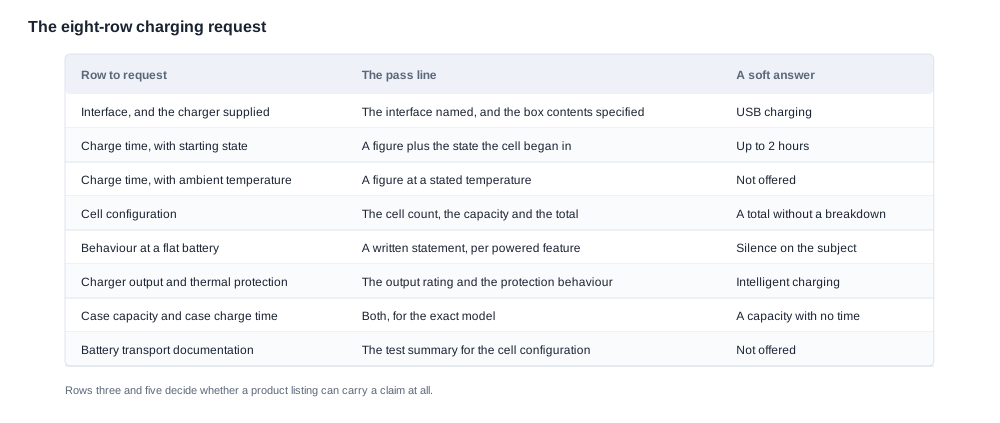
Send the table in the form given. The right-hand column separates a supplier who has measured the product from one who has copied a charger's label.
The thresholds that make a charge time usable
The interface, and what is actually in the box. A named interface and a stated box content. "USB charging" is a category rather than an answer, because it covers a dedicated magnetic cable as readily as it covers Type-C. The threshold is that the buyer can write, without hesitation, what the customer has to find in the box.
The charge time with its starting state. A figure plus the state the cell started in. A flat cell and a half-charged cell produce different times, and "up to two hours" is a statement about a worst case rather than a typical one. A buyer who needs a marketing claim needs the typical figure with the condition attached; a buyer who needs a logistics figure needs the worst case.
The charge time with its ambient temperature. A figure at a stated temperature. This is the row that catches a programme shipping into a market with a hot summer, and it is the row that a test in a temperate laboratory will never produce. Our own range shows the range of charge behaviour: two hours or less across most entries, and around one hour on the D17 and the ZH12, which are the two fast-charging sport models. Those figures are published without conditions, which means they are not comparable with a competitor's two-hour figure.
The cell configuration. The cell count, the capacity per cell and the total. A total without a breakdown is a number a buyer cannot use for anything, because the transport file and the charging architecture both hang on the count.
The behaviour at a flat battery. A written statement, per powered feature. Silence on the subject is itself the finding, and a supplier who has not thought about it will not have an answer to give.
The charger output and the thermal protection behaviour. The output rating and what the unit does if the charge is interrupted or the cell is hot. "Intelligent charging" is a phrase; the output rating is a number, and the thermal behaviour is a safety question that a compliance reviewer will ask.
The case capacity and the case charge time. Both, for the exact model. A capacity with no time is half a row, and it is the half that tells you whether the case is overnight or all-day.
The battery transport documentation. The test summary for the cell configuration you are actually buying, not for a similar cell.
Why charge times from two suppliers are not comparable
Three conditions, and the first one is the one that catches most buyers.
The starting state. Two hours from flat is not two hours from half, and the ratio between them is much larger than most people expect on a slow taper at the end of the charge.
The ambient temperature. The charge controller in a wearable is usually thermally limited, and a cell at thirty-five degrees in a parked vehicle does not charge at the same rate as a cell at twenty in a laboratory. A distributor in a hot market will receive complaints that a laboratory test would never have predicted, and the fix is to measure at more than one temperature rather than to argue with the customer.
The endpoint. "Full" is not a point on the curve for a charger that tapers into a maintenance voltage, it is an asymptote. Two suppliers timing to "full" and timing to a defined state of charge will report different numbers for identical hardware.

From a supplier's answer to a timed measurement on your own unit
Five steps, each with a completion standard you can record.
1. Ask the four questions the datasheet does not answer. The ambient temperature and the starting state for the published charge time. The cell's charge profile and the charger's output rating. The behaviour at a flat battery, particularly for any powered lens or sensor. And the thermal protection behaviour, including what the unit does if the charge is interrupted.
2. Check the charger in the box against the specification. The output rating on the supplied charger is the number that matters, and a supplier who ships a lower-output charger than the sheet assumes has quietly made the charge time longer. This is a one-minute check on the sample and it catches a mistake that is otherwise invisible until the returns arrive.
3. Check the battery transport documentation against the cell configuration. Where a cell has been substituted for supply reasons, that is a change to the product's conformity position and to the transport documentation, and it belongs in the change control procedure with a notice obligation attached. The check is cheap now and expensive at the freight forwarder.
4. Verify the interface on the unit you received, including the contacts. Look for wear, oxidation or debris on the magnetic contacts, and confirm the mating surface is clean. A worn contact produces a longer charge time on a product whose specification says otherwise, and it produces a support call that reads as a manufacturing defect.
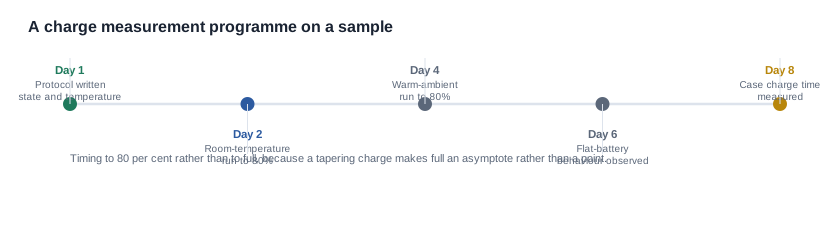
5. Measure the charge on a sample with a fixed protocol. State the starting state, the ambient temperature and the charger, and time to a defined state such as eighty per cent of rated capacity rather than to "full". Run it at more than one ambient temperature if the product will be sold into a market with a real seasonal range, and keep the record with the unit's model designation and firmware build.
The document set for the purchase order file
The interface, and the charger supplied, with the output rating. The charge time with the starting state, the ambient temperature and the charger named. The cell configuration, per cell and in total. The UN 38.3 test summary for the cell configuration. The case capacity and the case charge time for the exact model, where a case is supplied. The behaviour at a flat battery, in writing, per powered feature. The certificate numbers with the issuing body and the validity dates. The model designation written on the quotation.
Under the European battery framework in Regulation (EU) 2023/1230, the obligations attach to the battery and to the documentation that travels with it, which is a reminder that the cell and the paperwork are a single package in this category rather than two separate items.

Where a charging programme fails, and what can still be negotiated
Five failure modes, and what each one costs
A charge time is compared across two products with different starting conditions. The symptom is a competitor comparison in a listing that cannot be reproduced. The root cause is that the condition was never asked for, so the comparison is between two unstated workloads. The prevention is to write the starting state, the temperature and the charger into the request and into the comparison table.
The product is slow to charge in a warm market and the complaint arrives from a distributor. The symptom is a seasonal cluster with no obvious cause, because nothing in the chain changes. The root cause is that the temperature dimension was never part of the test. The prevention is to run the measurement at more than one ambient temperature and to publish the range rather than the best number.
The lens or the assistant does something unexpected at the end of the charge. The symptom is a customer who describes the product as broken at the exact moment the battery dies. The root cause is that the flat-battery behaviour was never asked for, because the sheet had a cell capacity and a charge time and appeared complete. The prevention is to ask it in writing and to put the answer in the quick start guide and the customer service script.
A cell is substituted during supply pressure and the transport paperwork is now wrong. The symptom is a shipment held at the forwarder, or a compliance query in the destination market. The root cause is that the substitution was treated as a purchasing decision rather than as a change to the conformity position. The prevention is to put cell and interface changes into the change control procedure with a clause requiring notice, and to name the firmware branch in the purchase order.
The case is in the box and nobody knows how long it takes to charge. The symptom is a customer who charges the case overnight and the glasses overnight, and runs out of both by mid-afternoon. The root cause is that the case was treated as an accessory rather than as part of the charging system. The prevention is to measure and publish the case's own charge time alongside its capacity, and to write both into the listing.
The commercial terms, including the one everybody forgets
The most overlooked negotiation in a charging package is what is actually supplied in the box, and it carries a packaging, a freight and a compliance consequence at the same time. The minimum order quantity is negotiable, and the charger in the box is negotiable in a way that is often overlooked: whether the supplier ships a charger unit, a cable or nothing at all is a packaging and freight decision with a direct effect on the customer's first ten minutes with the product. It also carries a compliance dimension, because what is in the box determines what the customer is expected to have available in every market you sell into. Packaging and insert design, including the market labels and the language of the documentation pack, is a low-cost negotiation with no tooling implication. Delivery splitting against a sample-approval milestone is often granted more easily than a price concession. Payment scheduling sits in a standard area: an upfront deposit on the order, a balance payable once inspection is signed off, and a retention released against the documents protects the buyer on the failure that costs most, which is a product that arrives with a charge time nobody can evidence. The accessory minimum should be negotiated separately from the frame minimum, because the case and the spare cable have their own lead times and their own break points.
The charge path in a product is a fixed design decision rather than a commercial variable, and a supplier who will not move the interface, the contacts or the power management is telling you the charge behaviour cannot be bought. Certification cost and certification time are not a commercial lever; the cost is per product family and the elapsed time is set by the test laboratory and the review queue. The one-off tooling cost is usually amortised across the first order, and the questions worth asking are over what volume it is amortised and what happens to the tooling, and to the charging contacts, if the programme is discontinued. Also not negotiable is the charge path: a supplier who will not change the interface, the contacts, the charger or the power management is telling you the charge behaviour is fixed, and the programme should be built around that fact.
A charging purchase order needs a notice clause that names the interface, the contacts, the cell and the firmware branch, because all four can change the charge time without changing the outside of the product. The charging interface and the charger as line items, with the box contents specified. A clause requiring notice before any change of interface, contact, charger, cell or power-management firmware. A clause naming the firmware branch, because the charge behaviour lives partly in it. The acceptance criteria for the sample, referencing the charge protocol, the starting state, the temperature and the endpoint. And a clause on who bears the cost when a sample does not meet the acceptance criteria.
A sports line shipping into a hot summer market
The scenario and the interface decision
This is a hypothetical scenario, written to show the decision sequence rather than to report an outcome. No customer, project or order is being described.
Assume a brand-side product manager launching a sports line into three markets, one of which has a hot summer and a cold winter, with a decision pending on the charging interface and on whether a case ships in the box. The binding constraint is not the charger cost. It is that the brand has no idea what the product does when the battery reaches zero, and the product has a light-responsive lens option that is powered.
Step one, the market reality. The manager writes the exposure per market: a hot summer with a parked vehicle, a cold winter, and a channel where the product is used for long outdoor sessions. The requirement that falls out is a charge time that holds across a temperature range, which immediately makes the temperature row decisive and the single laboratory figure irrelevant.
Step two, the interface decision. The manager looks at the interface in the context of the channel. The target customers already carry a Type-C cable for their phone, the product ships with a case in two of the three markets, and the brand does not want to run a proprietary cable accessory programme. The decision is Type-C with the case retained, and the cost of the decision is that the case now has to earn its place in the box on its own merits.
Step three, the flat-battery question. The manager asks what the lens does at the end of the charge. The answer is a written statement covering the lens state and the unit's behaviour, and it goes into the quick start guide, the care instruction and the support script, because a powered lens that behaves unexpectedly at the end of the charge reads as a fault to a customer who has never seen the product before.
Step four, the measurement. The manager writes the protocol: flat start, one measurement at room temperature and one at a warm ambient, timing to eighty per cent rather than to full, with the charger output recorded, the model designation recorded and the firmware build recorded. The warm-ambient run is the one that changes the plan, because it produces a number noticeably worse than the published figure and therefore worse than the figure the listing had planned to use.
Step five, the claim. The listing states the charge time as a range with the conditions attached, rather than as a single number, because a single number in a hot market is a complaint waiting to be filed.
Step six, the commercial structure. The manager negotiates the charger in the box explicitly, negotiates the case minimum separately from the frame minimum, and puts the cell, interface and firmware notice clause into the purchase order before the deposit.
The result is a product that is described accurately in the two markets where the charge experience is hardest, and a charge claim that survives the first hot month. The decisive step was the warm-ambient measurement, and the step that made it possible was deciding to run one.
What our catalogue publishes about charging
We publish the charge time, the interface, the cell configuration and the case capacity exactly as the catalogue states them, and we publish the fact that the catalogue states no test condition for any of them. We will not supply a starting state, a temperature or a charger that the catalogue does not state, because a condition we invent is a condition nobody tested.
We will also be direct about the boundary on transport. The UN 38.3 test summary covers a specific cell, and a cell substitution invalidates it regardless of whether the finished product is unchanged. That is a change to the conformity position and to the transport documentation, and it belongs in the change control procedure rather than in a quality conversation after the first shipment.
Where we can be precise, we are. The V03 Pro and the ZH12, the D11 and the D17, and the D12 are Type-C; the K02 and the G07, the YK12 and the YKC02, the LC-105-1 and the K01, and the LC-105-2 are magnetic, as are the camera and sport entries that carry a magnetic interface, along with the electrochromic and AR models. Charge times are two hours or less across most of the range and around one hour on the D17 and the ZH12. The L2 Utral publishes both a 900 mAh and a 1400 mAh case, and the MT6 publishes a 1200 mAh folding case.
What we can do is tell you which of the four answers our documentation already produces and which are open, check your measurement against the published rows for that model, and tell you what a flat-battery behaviour question should contain for a product with a powered feature. The charging architecture is under charging solutions, the comparison method is in how to compare smart glasses charging, the regulatory dimension is in how regulations affect charging, and the power side is under battery life and power.
Three requests to make before the first shipment
Send the eight-row request before the sample order, not after the first shipment. Four of the eight rows are the ones that decide whether a listing can carry a claim at all, and all four cost one email.
Test the charger in the box against the sheet, and time the charge to a defined endpoint. Two checks on one afternoon, and they produce the two numbers a customer will actually quote back at you.
Ask the flat-battery question in writing for every powered feature. It is the row nobody prints, it is the row that generates the confusing support call, and it is a question a supplier can answer in a sentence if they have thought about it.
Where the reading method comes from
Send us the two sheets and we will tell you which of the four answers each one already produces.


