

Charging is the one function in a smart glasses product where the compliance question and the engineering question are the same question, and that is unusual enough to be worth understanding properly before a purchase order is written.
The reason is that charging brings a lithium cell into a product through the back door. A cell shipped inside the product is subject to transport rules as well as to product rules. A cell shipped separately as a spare is subject to them in a different way. A charging case is a second cell that most buyers treat as packaging. And a charging interface in a temple is an opening, which interacts with the ingress question. Four objects, three regulatory systems, one purchase decision.
Our catalogue covers a lot of charging configurations — magnetic charging on seventeen model rows, Type-C charging on seven, four rows that publish no interface at all, charge times of ≤2 h on twenty-six rows and ~1 h on the D17 and the ZH12, and charging cases published at 900, 1200 and 1400 mAh. The cell configurations run from 40 mAh in the children's models up to 290 mAh in the camera tier, with dual-cell arrangements at 55, 70 and 90 mAh per side.
So the question worth answering is not "is this product certified" but "which document attaches to which part of the charging arrangement, and what happens to that document when the arrangement changes."
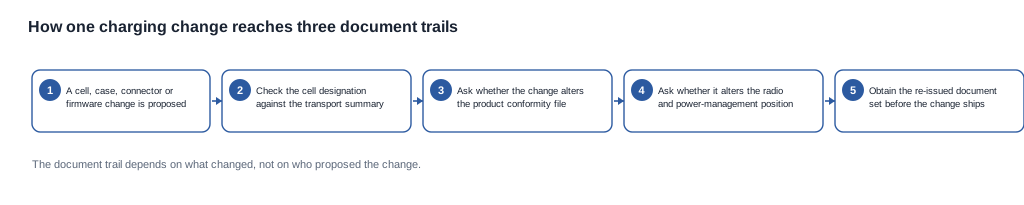
Smart glasses charging: three regulatory systems converge
Transport rules for the lithium cell. The practical instrument is the UN 38.3 test summary, which covers a specific cell. The consequence that catches buyers out is that the summary covers the cell and not the product: substituting a cell invalidates the summary even when the finished product is unchanged in every other respect. This is the single most important charging-adjacent fact in a compliance file, because cell substitution is also the cheapest way for a supplier to solve a supply problem. It is not a hypothetical — it is a routine purchasing decision taken under time pressure, and it is usually taken without a compliance review.
Product conformity, which reaches the cell indirectly. A change of cell can change the product's conformity position, and in the European Union a Declaration of Conformity has no expiry date — what invalidates it is a change to the product. A different cell with a different chemistry, a different protection circuit or a different thermal behaviour is a change to the product, and the compliance file has to be reviewed rather than assumed to carry over. The same logic applies to a changed charging case, a changed connector and a changed firmware power-management profile.
Market obligations on packaging, labelling and waste. A product that contains a cell and ships with a charger carries battery and electronic-waste obligations, packaging obligations and shipping documentation in the destination market. These are not attached to the electronics; they are attached to the commercial unit as it is sold. A buyer who adds a charging case to a line has changed the packaging and the waste profile of that line, whether or not anyone said so in the quotation.
The cell substitution that quietly invalidates a transport summary
The red flag to watch for is a supplier answering a question about a cell with a model family rather than a designation. Ask for the cell designation that appears on the transport summary, then ask for the cell designation in the current bill of materials, and compare the two strings character by character. A family-level answer is not an answer.
Two further points belong in the same paragraph. First, the summary covers the cell as an article, so a second cell type in the same product — the dual-cell arrangements in this range, where the catalogue publishes 55 mAh × 2, 70 mAh × 2 and 90 mAh × 2 — means two cell designations to reconcile rather than one. Second, a carrier checks for the document at the point of booking, so a missing or stale summary costs a sailing cycle rather than a freight difference, and it costs that cycle at the worst possible moment in a launch schedule.

The cell, the case and the charger carry three different document trails
Most charging compliance problems come from treating the charging arrangement as one object when it is three. Each has its own trail, and each has its own failure mode when it is missed.
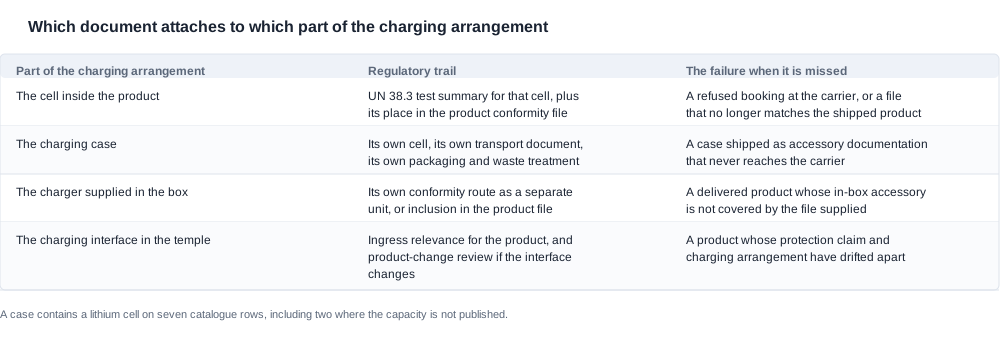
| Part of the charging arrangement | Regulatory trail | The failure when it is missed |
|---|---|---|
| The cell inside the product | UN 38.3 test summary for that cell, plus the cell's inclusion in the product's own conformity file | A refused booking at the carrier, or a conformity file that no longer matches the shipped product |
| The charging case | Its own cell, its own transport document, its own packaging and waste treatment | A case shipped as "accessory" documentation that never reaches the carrier |
| The charger supplied in the box | Its own conformity route if it is a separate unit, or an inclusion in the product's file if it is a supplied accessory | A delivered product whose in-box accessory is not covered by the file the buyer was given |
| The charging interface in the temple | Ingress relevance for the product, and any change-of-product review if the interface changes | A product whose protection claim and charging arrangement have drifted apart |
The case is a second compliance object, not an accessory. This is where the category most often goes wrong. Our catalogue publishes case arrangements on seven rows: the CY03 and the CY05, and the L1 Pro — each at 1400 mAh, the L2 Utral published as 900/1400 mAh, the MT6 at 1200 mAh in a foldable case, and the KY06 and the MT5 which are published as magnetic charging with a charging case but whose case capacity is not published. In every one of those cases the case contains a lithium cell. That cell is not covered by the product's own transport summary, and a buyer who treats the case as packaging will discover the gap at booking rather than at evaluation.
The charger is a fourth decision, not an assumption. Whether a cable or an adapter ships in the box is a commercial choice with a compliance tail. A unit supplied with the product has to be inside the product's file. A unit sold separately has its own route. Neither of those is expensive to settle at quotation, and both are awkward to settle after the packaging artwork is approved.
"We will handle the certification" is not an answer to any of these questions. The phrase is common because it is true in a narrow sense — a factory does hold a conformity file — and useless in the sense that matters, because it tells the buyer nothing about what is in the file, which model designation it covers, or what would have to be re-issued if the charging arrangement changed. A due diligence request that accepts this phrase has been answered with a commitment rather than with a document. The three items worth asking for are the transport summary for the cell designation, the file covering the exact model designation being ordered, and a written statement of what the supplier treats as a change to the product. A supplier that can produce those three has a document management process; a supplier that cannot has one person who knows where the folder is.
The second of those three is where the four rows in our catalogue that publish no charging interface become a compliance question as well as a specification one. On the CY05 and the CY03, and the L1 Pro and the MT6, a buyer cannot tell from the catalogue whether the charging interface is magnetic or Type-C, and a document review therefore cannot confirm that the file describes the product that will ship. The interface question has to be closed before the document question can be.

Where the Radio Equipment Directive meets the charging design
Two directive numbers are swapped often enough in this category to be worth correcting explicitly, because the correction usually arrives late. The Radio Equipment Directive is (EU) 2014/53/EU. The EMC Directive is (EU) 2014/32/EU. They are different instruments with different scopes, and the EN 301 489 series belongs to the EMC side as a harmonised standard rather than to the radio directive itself. A compliance file that cites the wrong number is a file your own reviewer will bounce, and a buyer who cannot tell the two apart cannot tell whether a supplier has actually read their own documentation.
Charging reaches the radio side of the file for a reason that is not obvious from the outside: the radio's behaviour is a function of the power budget. The cell's discharge characteristic determines what the firmware is allowed to draw, how it behaves when the cell is depleted, and what the radio does while the product is on charge. A cell with a different discharge characteristic is therefore not only a transport-document question; it is a firmware question, and the EN 18031 series of harmonised standards cited into the radio directive are relevant to aspects of how a connected product behaves.
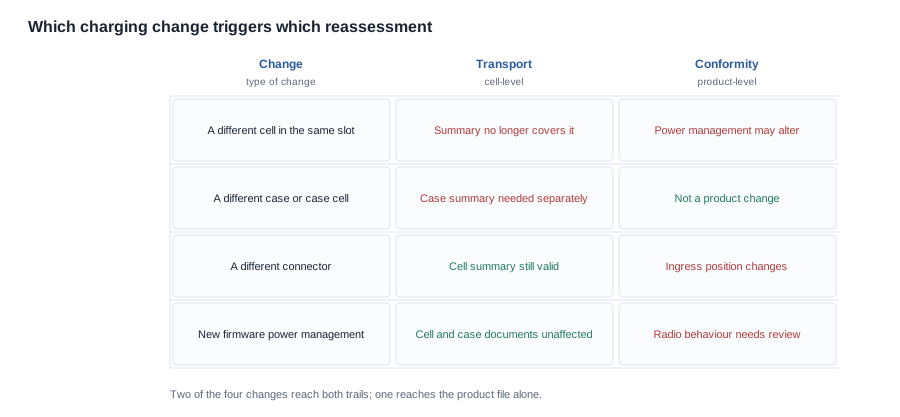
The practical trigger to write into a supply agreement is therefore broader than "notify us before you change the cell". It should cover the cell and its protection circuit, the charging case and its cell, the connector or contact arrangement, the firmware power-management profile, and the charger that ships in the box. Each of those is a change that can invalidate a document the buyer is relying on.
A third dependency is the artwork. Packaging that describes a charging case as a storage accessory rather than as a unit that carries a battery creates a labelling problem in markets that treat the shipped package as battery-containing. Our catalogue publishes the case capacity in milliamp-hours on five rows, and that number is the one that belongs on the packaging and on the product description. The L2 Utral row publishes 900/1400 mAh, which means the packaging has to carry one number or the other rather than a range, and that choice is a configuration decision rather than a copy decision.
The order in which the documents have to exist
Compliance work is sequenced by dependency, and in this category the sequence runs the opposite way to the way most buyers plan it. The documents do not wait for the product; the product waits for the documents, and the shipment waits for both.
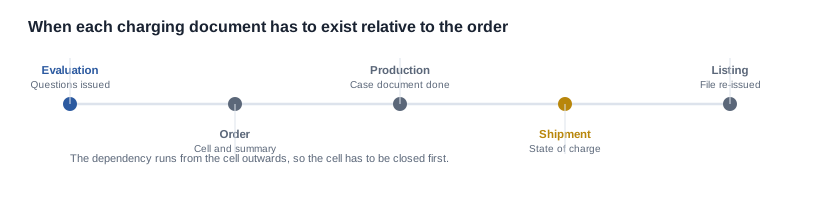
The dependency that catches people is the cell. A transport summary is issued against a cell, and it takes time to obtain. If the cell is not fixed when the purchase order is placed, the summary sits behind the cell selection, and the cell selection sits behind a supply problem that will not wait for the paperwork. Every week the cell is open is a week the transport document cannot start.
The second dependency is the case. A case-equipped product adds a second cell type to the programme, and a second cell type adds a second document and a second set of artwork. Programmes that add a case after the artwork is approved routinely move the launch by a month, and the cause is a document rather than a factory.

The compliance questions to add to a charging quotation
The questions below are the ones that settle the charging side of a due diligence review. They are written to be sent as a list, because a supplier who answers all of them has a documentation habit and one who answers two is telling you something useful before the deposit.
-
What is the cell designation covered by the UN 38.3 test summary, and is that the designation in the current bill of materials? Compare the two strings rather than accepting a family name.
-
Does the charging case contain a cell, and if so what is its designation and its own test summary? Ask this on every case-equipped model, including the ones where the catalogue publishes the case capacity but no case document.
-
Does a charger or cable ship in the box, and which conformity file covers it? If it is supplied as part of the product, it belongs inside the product's file.
-
Which charging interface does the model use, and what does a change of interface or connector trigger in your own file? Our catalogue publishes no interface for the CY05 and the CY03, and the L1 Pro and the MT6, so this question is not optional on those rows.
-
What is the recommended shipping state of charge, and what happens to the product's compliance position if the cell ships at a partial charge? A partial shipment state is a change to how the product arrives, and it should be written into the order.
-
Which change-control obligations would you accept in the supply agreement, and over what period do they remain open? A supplier that will not accept a change-notification clause on the cell, the case and the connector is telling you how the programme will be run.
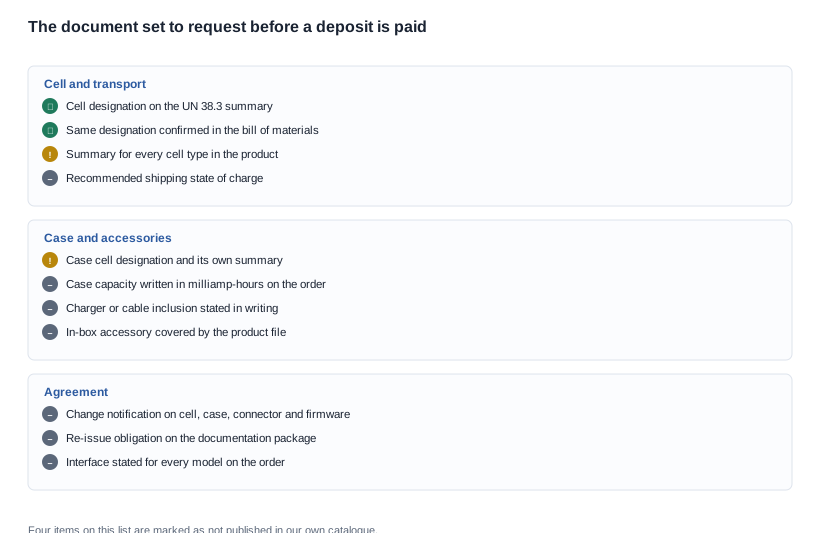
The sixth question is the one most often skipped, and it is the one that determines whether the other five remain true for the life of the programme.
A worked scenario: a European distributor adding a charging case to a camera line
This is a worked case rather than a buyer enquiry. That order is the point of it.
Assume a European distributor already shipping a camera glasses line into three markets, now adding a case-equipped variant to meet a retailer requirement for a bundled charging accessory. The constraint is not the unit price; it is that their previous line was held up once at a carrier for a transport document, and the stock arrived three weeks after the promised date.
Step one: the cell. They ask for the transport summary and the cell designation for the candidate models. The model they want — the L2 Utral, which publishes a 900/1400 mAh case and a Type-C charging interface — has a 290 mAh cell, and the summary names a designation. They confirm that designation against the bill of materials before anything else moves, because a summary issued against a different cell is a document they cannot use.
Step two: the case. They discover that the case is a second cell and ask for its own document. The answer is that the case cell is covered by a separate summary, which is the correct position and not something they had expected to have to check. Because the case capacity is published as two options, they write the capacity in milliamp-hours on the order line, which converts one model designation into two configurations with two artwork versions and two minimums, and they accept that cost because the retailer asked for a bundled accessory rather than a choice.
Step three: the file. They check the radio side and find the correct directive cited in the product file. They also check whether the charging interface appears anywhere in the file as a described characteristic, and they write a change-control clause covering the cell, the case, the connector and the firmware power-management profile. The supplier accepts the clause, which tells them something about how the programme will run.
Step four: the schedule. They move the transport document to the front of the timeline, because it is the dependency with the longest lead time and it depends on a cell selection that will otherwise be left open. They also fix the shipping state of charge in the order, at a partial charge, because the goods will sit in a warehouse before the retail launch and a full charge held for weeks is a return they do not want.
Step five: the commercial terms. They accept that certification cost and certification time are fixed per product family and are not the place to negotiate. They do negotiate the configuration count, the per-configuration minimum, the artwork round count and the accessory list, and they tie the case document to the case configuration so that the two cannot be separated in production.
The result is a programme with one identified long-lead document, placed at the front of the schedule, and a set of questions that were answered before the deposit rather than after it.
What our charging documentation settles, and what it does not
Concretely, we publish the rows we hold. For the charging function that means the interface where the catalogue states it — magnetic on seventeen rows, Type-C on seven, and nothing at all for the CY05 and the L1 Pro, and the MT6 and the CY03 — together with the charge time for every row, the cell capacity for every row, the rated runtime for every row, and the case capacity where the catalogue publishes it.
We do not publish certificate numbers for individual models, and we want to be precise about why. The catalogue's export certification is a company-level capability rather than a per-model row, so a model-level certificate cannot be inferred from it, and we would rather say that than let a buyer assume one exists. We publish no test report data, no cycle life, no cell chemistry, no charge efficiency and no safe charging temperature range, because none of that appears in our published material. Where a model publishes no charging interface, we publish no interface for it either, and we would rather show the empty row than fill it with an engineering expectation.
We also make no vision, health or eye-protection claim for any product in any market, and none of our charging arrangements changes that.
The terms we would write. Put the cell designation and the transport document on the order line. Put the case capacity in milliamp-hours, and put the case document next to it. Put the shipping state of charge in the order. Put a change-notification obligation on the cell, the case, the connector and the power-management profile, with a re-issue obligation on the documentation package. And treat the certification cost and the certification lead time as fixed per product family, because they are, and spend the negotiating capital on configuration count, minimums, artwork and accessory inclusion instead.
The next step. Send us the models, the quantities, the destination markets and whether a case is in the box, and we will tell you which charging arrangements exist for that requirement, which rows our documentation answers today, and which rows you will have to obtain from the cell and case suppliers directly. The charging arrangements themselves are described under charging solutions, the transport document route is covered under battery transport, and the surrounding battery facts are set out under battery life and how to compare charging options.


