

An audit is a negotiation with an unusual shape: you are asking for access to information you will use to decide whether to spend money, and the party with the information has every reason to present it favourably. The framework below is about where the leverage actually is, which is rarely where buyers go searching for it. Three things decide whether a smart glasses factory audit is worth the day it costs: the position you hold when you ask, the scope you agree in writing before you arrive, and the question about the factory's boundaries that separates a controlled operation from a reactive one.
What a smart glasses factory audit is really negotiating
Three leverage positions, and what each one buys
The leverage in an audit is not a fixed quantity that the buyer accumulates. It is set by where the order stands, and the same request produces a completely different answer in each of three positions.
In the first position there is no order, so the order itself is the lever. In the second there is an order in production, so the remaining volume and the next payment milestone are the lever. In the third there is a live quality dispute, so the evidence the buyer already holds is the lever and asking for an audit at this stage weakens the position rather than strengthening it. Buyers who treat the audit as a single move, rather than as a function of their own position, routinely pick the wrong posture for the moment they are in.
That position also decides what the audit is for. Before an order, the audit is a due diligence step whose output is a shortlist decision. During production, it is a control step whose output is a set of agreed criteria. During a dispute, it is almost never the right instrument, because a dispute is settled on records that already exist and on criteria that were or were not agreed in advance.
Where the audit sits relative to the layers you actually own
An audit is a request for access to one layer of a chain that the buyer does not control. The factory is one layer, and a busy one, but the configuration a buyer receives depends on at least three others: the components that arrive, the test and conformity work, and the transport and destination clearance that happens after the goods leave.
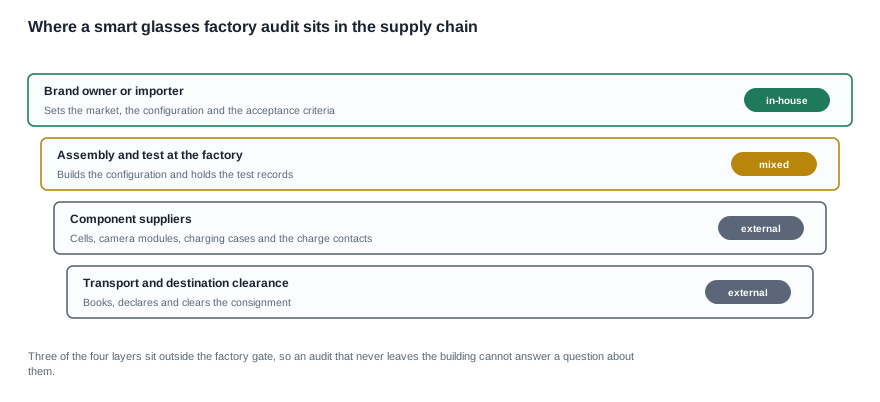
This matters because buyers often arrive with a checklist written for a different industry. They want to see the assembly line, the test bench and the warehouse, and they leave with a tour and a good impression. The questions that decide the order — whether the cell in the unit is the cell on the bill of materials, whether the case in the box is the case in the photograph, whether the file that travels with the goods covers the configuration that was ordered — are answered by documents and by comparisons, not by a walk.
What the buyer is trying to establish
Behind every audit request is a short list of decisions. Whether the configuration on the quote can actually be built. Whether the compliance position claimed at range level covers the model in the order. Whether the quality process produces the same unit in the tenth batch as in the first. Whether the factory holds a boundary, and what that boundary is. Each of those is a decision, and each needs evidence rather than an impression.
The reader this is written for is a brand-side procurement manager or an importer who has to defend a sourcing decision to someone else. That is the real reason for the audit: not suspicion, but the need to have something in hand that can be shown to a colleague, a customer or an auditor later. An audit that produces a written record serves that purpose. An audit that produces a memory does not.
The three positions set the leverage, and the leverage sets the output. That relationship is worth writing down before the visit, because it determines what you can reasonably ask for and what you have no right to expect.
| Position | What the leverage is | What the visit is for | Output you can actually use |
|---|---|---|---|
| Before any order | The order itself | Due diligence on the shortlist | A decision to proceed or to drop the supplier |
| An order in production | Remaining volume and the next milestone | Agreeing criteria for the next run | A written criteria set both sides have signed |
| A live quality dispute | Records already in your possession | Not the right instrument | The absence of written criteria is itself the finding |
What an audit is worth relative to what it costs
An audit day is one of the more expensive days in a sourcing programme once travel, the factory's own preparation time and the buyer's own people are counted, and it is rarely the day that decides the supplier. The decision is usually made by the document set and by the answers to the questions listed further down, most of which can be obtained without travel at all.
That is the reason to sequence the audit after the documents rather than before. Send the request list. Read what comes back. If the answers close the open questions, the visit may only need to confirm three or four physical points, and it becomes a half-day of sampling rather than a day of demonstration. If the answers do not close them, the visit becomes worth its cost, because you now know exactly which questions are worth asking in person.
The buyers who get the least from an audit are the ones who treat it as a symbol of diligence and schedule it first. It is cheaper and more informative as the last step in a sequence, and a factory that has already sent its documents in advance has usually already told you how it will behave on the day.

The three branches of a smart glasses factory audit
When no order has been placed yet
Your leverage is the order. Say what you are evaluating and what you would buy at what volume, and ask for the audit as a condition of proceeding rather than as a precondition to talking. Most suppliers in a competitive situation will agree, because the audit is cheaper for them than the alternative of you auditing a competitor.
What you cannot do is demand unusual access before any relationship exists. That reads as an audit you intend to fail, and it invites exactly the response a supplier would choose: a polished demonstration. Instead, make the audit conditional on a real programme and make the scope conditional on something the supplier values, such as a defined volume band or a place in the evaluation schedule.
When an order is already in production
Your leverage is the remaining volume and the next payment milestone. This is the moment to ask the harder questions, because the cost of getting it wrong is higher and the supplier knows it. Frame the audit around the next run rather than around doubt about the current one. A factory that has an order to protect has a reason to answer carefully and a reason to write things down.
The most productive scope at this point is the comparison between the current run and the next: which components will change, which test records will carry over, and what will need to be re-done. That question is cheap for the supplier to answer, it is directly relevant to the next order, and it produces the kind of record that survives the visit.
When a quality dispute is live
Your leverage is the evidence you already hold, and asking for an audit at this stage usually weakens your position by implying you need it. Use the records you kept instead. If the acceptance criteria were never written down, that absence is the finding, and no audit will replace it. A factory that produced a unit that does not match an unwritten standard has not broken a contract, and a buyer who tries to convert that into a contractual claim through an audit will be told so politely and at length.
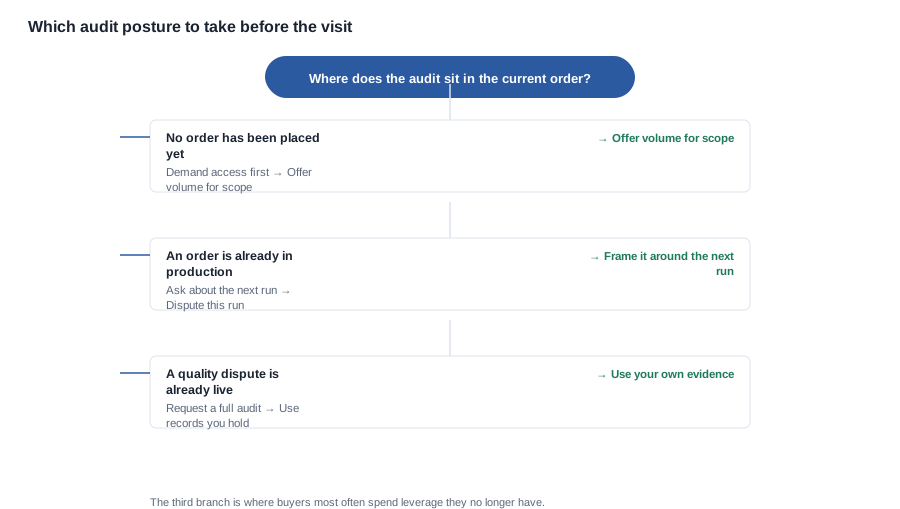
The third branch is where buyers most often spend leverage they no longer have, because an audit feels like escalation. It is the opposite: it signals that the buyer cannot yet name what went wrong.
What to trade for audit access without paying twice
The trades that work
The trade that works is small and specific: agree audit scope in exchange for something you want anyway. Earlier artwork approval. A sample of the next batch. A written answer on the specific question you could not resolve remotely. Each of these costs the supplier little and buys you a defined piece of evidence, which is worth more than an open-ended afternoon that produces impressions.
The wording of the trade matters more than its size. "We will sign the order at your quoted volume if you give us the bill of materials version and the change log for the model" is a trade. "We will consider a larger order if you let us look around" is a request dressed as a trade, and it invites the supplier to price the inspection rather than to answer the question.
The trade that quietly costs you the next audit
The trade that does not work is trading commercial concessions for audit access. Once a supplier believes the audit is worth a price reduction, every future audit is a negotiation again, and the first one will produce a scripted tour with a shortlist of pre-approved answers. The cost is not the discount; it is that the mechanism which would have produced evidence has been converted into a mechanism which produces paperwork.
The way to avoid it is simple and worth stating in the agreement itself: audit access is granted as a standard part of the supply relationship at no commercial charge, with the scope agreed in writing in advance. Put it in the contract rather than in the negotiation, and it never becomes a bargaining chip for either side.
Building an audit scope that returns evidence rather than impressions
A request list to send before the visit
Send the document list before you travel, and ask for the documents in advance of the date rather than on the day. A supplier who has to gather them on the morning of the visit will give you whatever is close to hand; a supplier who prepares them will give you the version that governs.
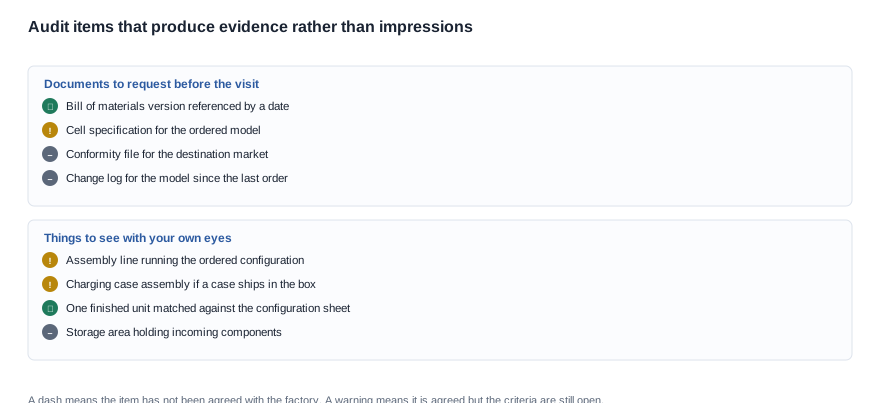
The checklist above separates documents, which can be read before the visit, from physical observation, which needs to happen on the floor. That separation is worth keeping, because it tells you in advance which parts of the visit are evidence collection and which are orientation.
What to put in the written summary you leave with
Ask for a written summary from the visit and read it before you sign it. The summary should carry the configuration that was running, the bill of materials version referenced, the observation about the finished unit against the configuration sheet, the items that could not be answered on the day, and the date of any document that was promised rather than produced. That last category is the valuable one, because it converts an open question into a dated commitment.
Read it for two things. First, whether anything in it asserts a figure that the factory has not measured — a capacity number, a defect rate, an employee count. Second, whether the items you listed as required actually appear. A summary that quietly omits a line is a signal about the visit, and it is cheaper to notice it in writing than three months later in a dispute.

What a smart glasses factory audit can and cannot establish
The questions an audit can settle
There is a set of questions that an audit genuinely closes, and they are worth separating from the rest because they are the reason to do the visit at all. The configuration can be confirmed against the order by reading the bill of materials and the version reference. The finished unit can be compared against a signed sample. The cell part number can be established. The certificate scope can be read against the model designation. The regulatory position for a destination market can be confirmed as a document rather than a claim.
Each of these is settled by a comparison between two artefacts — one on the factory side and one on the buyer's side — and each leaves a record.
Questions to ask on the floor
These eight questions work in a camera-model audit because each one closes on an artefact rather than on an opinion.
- Which configuration is on the line right now, and against which bill of materials version? Completion test: a version number with a date, read from the document rather than from the operator.
- Which cell part number is inside the unit in front of you? Completion test: a part number that can be compared with the one named in the order.
- Is the charging case in this order assembled in-house or bought in? Completion test: a yes or a no with a supplier named, since a case bought in and a case assembled here carry different risk.
- Which test record is produced for each finished unit? Completion test: a named record, not a description of a practice.
- Who signs the release of a unit, and against what criteria? Completion test: a role, and a criteria sheet that carries a signature.
- What happens when a component arrives that differs from the bill of materials? Completion test: a written answer naming who is told and how quickly.
- Which documents travel with the consignment, and who assembles them? Completion test: a list and a name, because an unowned document set is the gap that appears at the port.
- What would you refuse to build, and why? Completion test: a specific answer with a reason behind it. A factory that builds anything has no boundary, and its compliance decisions happen after the order rather than before it.
The questions an audit will never settle
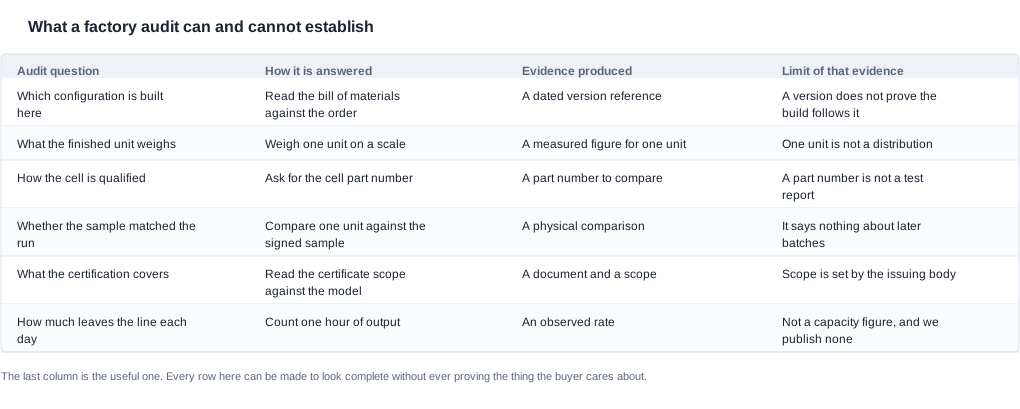
The table above is the honest version of an audit. Notice how often the limit of the evidence is the same: a single observation cannot establish a rate, a version reference cannot establish that the build followed it, and a certificate scope is set by the issuing body rather than by the factory.
Some of the questions buyers most want answered are structurally unanswerable on a site visit. How many units leave the line each day cannot be established by counting an hour, because the answer changes with the mix. What the defect rate is cannot be established by inspecting finished goods, because the denominator is the batches you did not see. What the whole run will weigh cannot be established from one unit, because weight varies with the components that were fitted that week.
Knowing which questions sit on which side of that line is what stops an audit from being mistaken for verification. A first visit is built to settle the questions that can be settled with a document and a physical comparison. A second visit, once an order exists, should sample the things a first visit could only ask about: a finished unit matched against the signed sample, a component pulled from the store against the bill of materials, and the paperwork that actually travels with a consignment. The factory audit section covers what to check once access is granted.
How we host a smart glasses factory audit
What we will show and what we will not invent
We will host an audit, we will not obstruct one, and we will agree the scope in writing before the visit so that neither side is surprised by the agenda. We will show the assembly line running the ordered configuration, we will produce the bill of materials version for the model under discussion, and we will let you weigh a finished unit against the configuration sheet.
We will not present undocumented figures to smooth the visit. Factory size, employee count, daily output and defect rates are not published in our documentation, and an audit is exactly the situation where a convenient estimate would do the most harm. We will not show you a production capacity number, because we do not publish one, and the reason we do not publish one is the same reason we will not improvise one during a site visit.
There is a practical limit on how much of the floor we can open up on any single visit, and we will say so in advance rather than let it become a surprise during the day.
Where our own boundaries sit
Ask what we would refuse to build, and ask why. Every factory has a boundary — a customer type, a specification, a market, a compliance position it will not cross. A factory that has one can tell you what it is. A factory that says it builds anything is telling you that its compliance decisions are made after the order rather than before it, and that is the risk the audit was supposed to measure.
Ours is a boundary against unmeasured claims rather than a boundary against orders. We will not sign a clause that asserts a specification our source material does not contain, and we will not sign a conformity claim for a model that is not on the covered list. Both refusals cost us orders, and both are cheaper than the alternative.
Our preference is a buyer who arrives with a written scope and leaves with a written summary. It is faster for us and better for the decision than an afternoon of questions with no record.
Related reading
- Negotiating access specifically — the site-visit mechanics
- Documents to request first — arrive with paper requested
- Advanced audit guide — what a second visit should sample


