

A stated minimum order quantity is usually a number the factory found convenient rather than a number the process requires, and that distinction is the whole negotiation. The second thing a buyer needs to understand is that the levers available to move a minimum do not remove risk, they relocate it. A buyer who negotiates a lower number without knowing where the risk went has not saved money; they have moved it to their own balance sheet without pricing it. Four levers open almost every minimum order conversation in this category, and each of them has a consequence that belongs in the same sentence as the concession.
Smart glasses MOQ: what it is actually attached to
Who is negotiating this and what the minimum is really about
The buyer at this point is usually a channel buyer testing a category, a brand-side procurement manager opening a new line, or an importer consolidating several small orders into one to reach a threshold. The decision underneath is not simply how few units to buy. It is how much cash to commit before the sell-through data exists, and whether the minimum the factory quotes is a manufacturing constraint or a commercial preference that has never been tested.
The thing such a buyer is managing is not the size of the order. It is the size of the inventory risk that comes with it, and the schedule exposure if the configuration has to be changed later. A minimum that is genuinely attached to a camera module order cannot be negotiated away without changing the configuration. A minimum that is attached to a print run can usually be negotiated because a print run can be split, and a factory that will not distinguish between the two is asking the buyer to guess.
That is why the first question in this negotiation is not "how low can you go" but "what is this number attached to". The answer determines which of the four levers is even available, and it is the single most useful sentence in the whole conversation.
There is a second reason this negotiation is worth doing carefully. A minimum is the point at which a buyer's inventory risk becomes visible to the rest of the business — the finance team sizing the commitment, the sales team planning the launch, the distributor deciding whether to place an order at all. A minimum quoted without a reason behind it is hard to defend internally, because the internal question is always why this number, and the honest answer is usually that the factory asked.
The second reason is that the minimum is the one term in this category where a buyer can often improve the outcome without spending any additional money. A configuration that reuses an existing component, a standard box instead of a custom one, or a two-lot delivery against a single print run all reduce the commitment without touching the unit price. Those are the moves worth spending negotiating effort on, and they are considerably more attainable than a discount.
The four constraints behind every quoted minimum
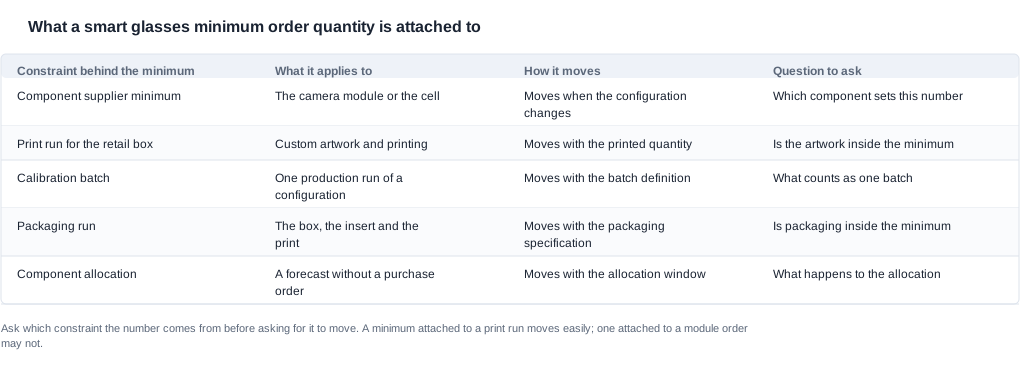
The five rows in this table are the constraints that actually generate a minimum in this category. Each one has a different answer to the question of whether it can move, and each one has a different consequence when it does.
The component supplier minimum is the hardest and the most important, because it sits underneath the cost rather than on top of it. A factory that quotes five hundred units because the camera module arrives in a lot of five hundred has quoted a number it cannot move without changing the model. The print run and the packaging run are the softest, because a print quantity can be split across two production runs or a neutral box can be substituted. The calibration batch sits in between, because the batch definition is a quality-control decision rather than a purchasing one. The component allocation is the most negotiable of all, and it is the one most buyers never ask about.

Separating the unit minimum from the order minimum
Two numbers that are quoted as one
Factories frequently quote one number when there are two. The unit minimum is the smallest run the electronics line will take for a single configuration. The order minimum includes packaging, calibration, documentation and artwork, and it is usually higher.
Ask for both, then ask what happens if the order takes the unit minimum in one configuration and the packaging minimum across two deliveries. On a first order this often halves the commitment without changing the unit price at all, and it is the single cheapest concession available in this category because it uses capacity that is already committed.
The remaining variable is timing. Some factories will hold a component allocation against a forecast without a purchase order, which lets the buyer defer the binding commitment by a month. Ask whether that is available and what happens to the allocation if the date passes without an order.
The camera-model capacity tiers behind the minimum
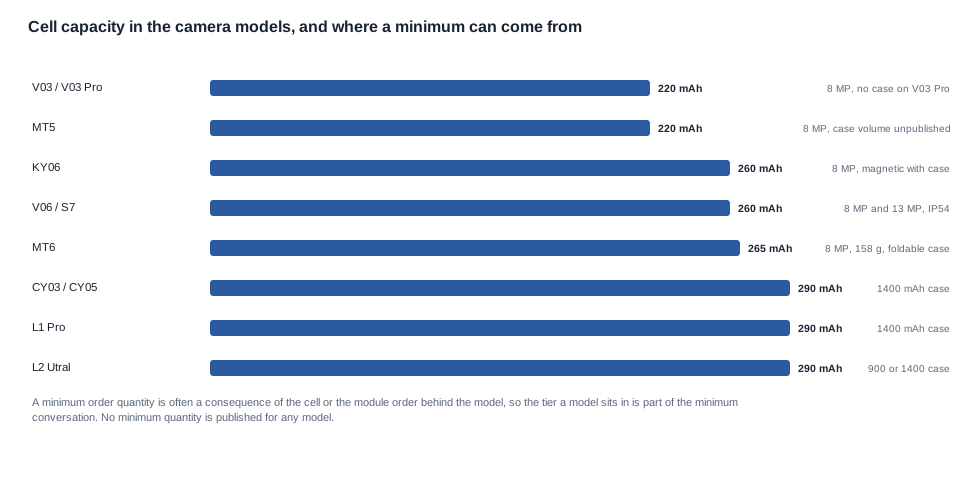
The chart above is the published cell capacity for the camera models, and it is the reason a minimum is often a component order rather than a factory policy. Three models sit at 220 mAh, three at 260 mAh, one at 265 mAh and four at 290 mAh. A camera module and a cell are ordered against a batch, so the batch size in the supplier's schedule is the origin of the number the factory quotes to the buyer.
The practical consequence for a negotiation is that the minimum often changes when the configuration changes, and not always upward. A buyer who accepts a lower minimum by moving from a 290 mAh model to a 220 mAh model has traded a component constraint for a different product, and that trade should be evaluated on its own terms rather than presented as a concession.
The four levers that move a minimum, and where each one puts the risk
Mixing configurations and neutral packaging
Mixing configurations raises the total order but lowers the per-configuration minimum, which suits a channel testing two or three variants. A neutral packaging box lowers it further and costs the buyer the artwork approval cycle. Both are legitimate moves, and both are frequently granted.
What both moves cost is delay and complexity. A neutral box means a second packaging decision before the first production run, and a mixed order means a schedule that has to be queued as more than one run. Neither is free, and neither is visible in the quoted number.
Splitting the delivery and committing to a forecast
Splitting the delivery into two lots leaves the unit price intact but doubles the per-consignment freight lines, and in this category the freight lines for a small consignment are not a trivial addition. A forecast commitment lowers the minimum furthest and puts the shortfall risk entirely on the buyer.
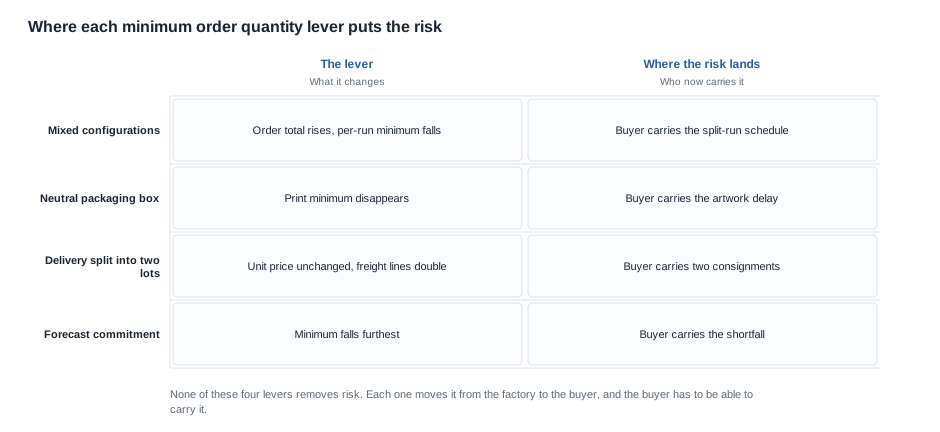
The matrix above is the part of this negotiation most buyers skip, and it is the part that prevents an expensive mistake. None of the four levers removes a risk; each one moves it from the factory to the buyer. The buyer who negotiates all four at once will eventually discover that the risk moved rather than disappeared, usually when a forecast shortfall arrives or a split run lands on two different dates.
| Lever | What it changes | Where the risk lands | What to ask for in return |
|---|---|---|---|
| Mixed configurations | Order total rises, per-run minimum falls | Buyer carries the split-run schedule | One queueable production lot |
| Neutral packaging box | Print minimum disappears | Buyer carries the artwork delay | A standard box for the first run |
| Delivery split into two lots | Unit price unchanged, freight lines double | Buyer carries two consignments | A booking plan covering both |
| Forecast commitment | Minimum falls furthest | Buyer carries the shortfall | An allocation window and a lapse rule |
What happens at the minimum, and why the first run costs more
Two things happen at the minimum that the buyer rarely sees. The first is a first-article check: the first units off a line are inspected against the specification before the run is released, and that inspection is a gate rather than a formality, so the front of the schedule is longer than the back. The second is that the order minimum is where the documentation is finished — the configuration frozen, the artwork approved, the conformity file written for the market — and the cost of that work is spread across the order.
Both of those are arguments against a minimum set by a print run rather than by a component order, and both are arguments in favour of keeping the configuration stable. A configuration change after the order is placed reopens the documentation and requeues the setup, which is the changeover cost that a factory prices as a changeover and a buyer often discovers as a delay.
What a smaller order costs at the unit price level
The minimum and the unit price are the same negotiation viewed from two ends, and a buyer who treats them separately gets quoted twice. At the minimum, the factory recovers the fixed costs of the run — setup, calibration, first-article inspection, the packaging run and the documentation — across a small number of units, and those unit economics are visible in the price. Below the minimum the number does not move, because there is not enough volume behind it to cover the run.
This is why the request that always works is not "give me a lower minimum" but "give me the price at three quantities". A factory with a real tier structure will produce three numbers without being asked to concede anything, and the spread between them shows exactly where its own cost steps sit. A factory whose price barely moves across a wide range of quantities is telling the buyer that the quantity is too small to matter and that the configuration is the lever worth working.
The second half of the answer is what happens to the order if it is split. Splitting a run into two smaller runs does not halve the fixed cost; it adds a second copy of it. That is the arithmetic behind the refusal to queue a mixed order as separate runs, and it is the reason a neutral box and a mixed configuration are often the better pair of levers.

Which combinations of MOQ levers a factory can actually schedule
The combinations that work and the one that does not
Two combinations work well. Mixed configurations plus neutral packaging suits a channel that wants three variants on shelf but no print commitment. Split delivery plus a forecast commitment suits a channel with real sell-through data and a distributor who will not place a large single order.
Taking split delivery alongside mixed configurations produces a schedule that cannot be queued sensibly, and the delivery date quietly becomes three dates. This is not a policy decision; it is a factory-floor fact, because the same components, the same calibration step and the same inspection have to be sequenced three times.
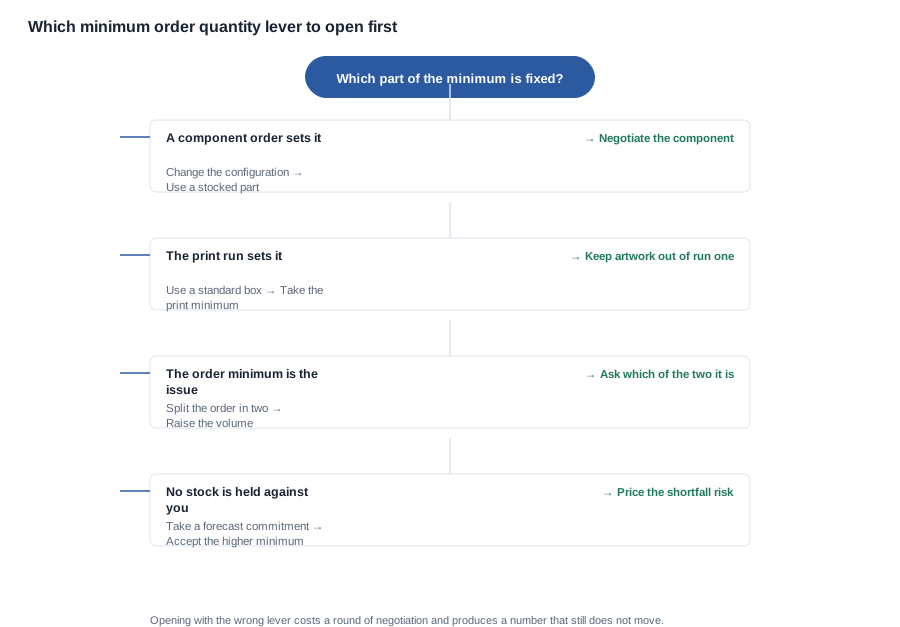
The decision tree above is the order in which to open these conversations, and the order matters more than the individual moves. Opening with the wrong lever produces a concession that does not change the number, and a buyer who has spent goodwill on that is in a weaker position for the lever that would have worked.
The four answers that reveal a soft minimum
Not every minimum resists, and the ones that move have a signature. The first signature is a price that stays flat across a wide range of quantities. The second is a supplier who quotes the minimum in terms of something the buyer controls — the artwork, the packaging, the delivery split, the number of configurations. The third is a willingness to discuss the minimum before the configuration has settled, which signals that the minimum follows the configuration. The fourth is an offer to stage the commitment, which means the underlying constraint is a component order rather than a quality gate.
The signature of a hard minimum is the opposite: a price that steps sharply at one number, a component order that cannot be split, a calibration batch that the factory cannot define differently for a smaller run, and an answer to the attachment question that names a part number rather than a process.
Ask the attachment question early and the rest of the negotiation arranges itself around which kind of minimum is in front of you.
How to ask for a lower minimum without breaking the schedule
Six questions that get a usable answer, each with a completion test.
- What is this minimum attached to — a component order, a print run, a calibration batch, packaging, or an allocation? Completion test: a named constraint, not "the line".
- What is the unit minimum for a single configuration, and what is the order minimum across configurations? Completion test: two numbers with different reasons.
- What happens to the unit price if the minimum is reached in one configuration rather than three? Completion test: a stated tier, not a range.
- Can the packaging minimum be met across two deliveries without changing the unit price? Completion test: yes or no, in writing.
- Can a component allocation be held against a forecast without a purchase order, and for how long? Completion test: an allocation window and the consequence of letting it lapse.
- Can the order be queued as one production lot with staged deliveries, or does a split delivery create separate runs? Completion test: a scheduling statement, because this is the question that decides whether a split delivery is free.

A worked example of a first order in two configurations
What follows is a worked illustration rather than a customer account. Nothing here describes a real buyer or a real order, and no quantity or unit price is claimed; a channel testing two variants of one camera model, one with a charging case and one without, is assumed, so that every question can be followed through to a decision.
Suppose a channel buyer is opening a wearable device line with a first order, testing two variants of a camera model, one with a charging case and one without, for sale into a single market through one distributor who will not place a large single order.
The first move is the attachment question. The answer is that the unit minimum comes from a camera module order and the order minimum comes from the packaging print. That immediately narrows the available levers: the module order is not going to move, so mixing configurations across the module will not lower the per-configuration figure, and the packaging is the soft constraint.
The second move is separating the two numbers. The unit minimum and the order minimum come back as separate figures with different reasons attached, which confirms that the packaging print is the part of the commitment the buyer can actually influence.
The third move is the combination question. Split delivery alongside mixed configurations would create separate runs, so it is ruled out before it is asked for. What remains is mixed configurations with a neutral packaging box for the first run, which lowers the packaging minimum, accepts a later artwork cycle, and keeps the order queueable as one production lot with staged deliveries.
The fourth move is the allocation question, and the answer is that a component allocation can be held against a forecast for a stated window without a purchase order, with the consequence of letting it lapse stated in writing. The buyer defers part of the commitment by a month against a known cost.
At the end of that sequence the buyer has a lower total commitment, one production lot instead of three, and a decision about artwork that has been made deliberately rather than by default. The number is smaller, but the more important change is that every risk has an owner.
Two points are worth drawing out of the walkthrough. First, none of the four questions produced a better unit price; the improvement came entirely from the structure of the order. Second, the buyer spent most of the negotiation on the packaging and the delivery pattern, because those were the constraints that could move, and left the camera module order alone because it could not. A negotiation that had opened on the module order would have produced a discount attempt, a refusal, and no change to the commitment the buyer actually cared about.
How we state a minimum and what we will not quote
Three numbers with a reason attached to each
We will state a minimum order quantity as three numbers rather than one: the electronics minimum, the packaging minimum, and the combined order minimum, with the constraint that produces each one attached to it. Our per-configuration and per-order minimums are not published in a fixed form, because they move with the component and packaging mix on the order and a published figure would be wrong for most of the orders it appeared against.
What we will not do is quote a low minimum to win the conversation and recover it through the unit price or through a fixture charge that appears after the deposit has been paid. That pattern is easy to detect afterwards and impossible to defend.
We will also give you the attachment reason before we give you the number, because a minimum without its constraint is a number you cannot plan against, and a buyer who plans against it will plan wrongly.
We will also decline a mixed-configuration order that cannot be scheduled as one production lot, because the queueing cost of a split run lands on the delivery date the buyer was promised. The MOQ section covers how the minimum interacts with the unit price.
Related reading
- What affects it — the four underlying constraints
- Hidden costs — what sits outside the quoted number
- Pricing how it works — why MOQ moves unit price


