

A minimum order quantity is not one number. It is the sum of whichever of four floors happen to bind for your configuration, multiplied by the number of distinct configurations you are ordering — and the floor that binds on a first order is rarely the floor that binds on the fourth. That lifecycle is the part most minimum-order conversations miss, and it is where the expensive surprises live: a programme that negotiated its first order well can still end up carrying a minimum it never saw coming, because a fifth demand appeared after the fourth shipment.
The practical method this produces is straightforward. Before negotiating the number, find out which floor produced it. In most cases the answer is a design decision rather than a purchasing condition, and a design decision can be changed in an afternoon. In a minority of cases it is a component the factory has already ordered, and in that case the conversation is about whether the product is viable at your scale, not about the minimum.
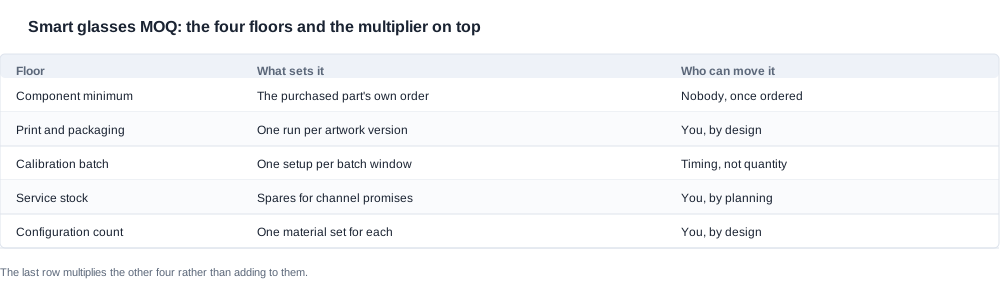
The table is the whole model. Four floors, and a multiplier that multiplies them. The reason the multiplier sits on top rather than in the list is that a configuration count does not add one floor to another — it multiplies all of them, which is why a programme that adds a second colourway does not double its minimum, it quadruples it.
Smart glasses MOQ: the order the four floors start to bind
A minimum order quantity in this category is the point at which four separate commercial arrangements start to bite at once, and each of the four is set by a different mechanism with a different owner.
The purchased component minimum comes from a sub-supplier's own order quantity and propagates upward through a purchase order the factory has already placed. The print and packaging run is set per artwork version and is the softest of the four. The calibration batch is a setup cost that behaves as a timing window rather than as a quantity. And service stock does not exist at the start of a programme at all; it is created by a promise made to a channel rather than by an order placed with a factory.
Each floor has a different owner, which is the useful part. The component minimum belongs to nobody the buyer can negotiate with. The packaging run belongs to the buyer, because it is a design decision. The calibration batch belongs to the schedule. And the service stock belongs to the buyer's own commercial commitments, which is why it is the floor that arrives without warning.
The second feature of the model is the multiplier. Minimum order quantities in this category apply per model code and per configuration, so the number a buyer is given is rarely a number of units — it is a number of units multiplied by the number of distinct material sets in the order. The catalogue makes the size of that multiplier concrete: the V03 Pro publishes three colourways, the V06 publishes four, and the L2 Utral publishes two charging-case capacities at 900 mAh and 1400 mAh. A programme carrying one model with one colourway has one material set. The same programme with four colourways has four, and the print run, the packaging run and the order minimum all follow.
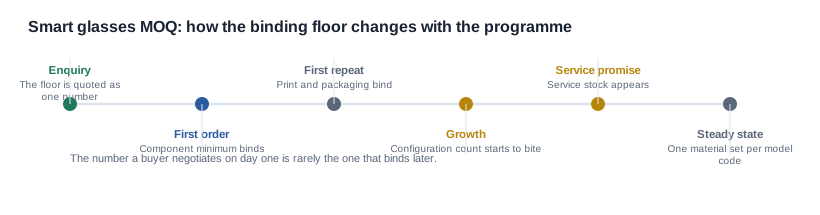
The third feature is the lifecycle, and it is the one that produces the expensive surprises. The floor that binds on a first order is usually the component minimum, because the buyer's quantity is small and the factory is buying to standard quantities anyway. On the first repeat, the component minimum is comfortably cleared and the print run becomes the binding floor, because the artwork is being reissued. As the programme grows, the configuration count becomes the multiplier that hurts. And once the brand has promised channel availability, service stock appears as a demand that no purchase order contained.
The result is that the number a buyer negotiates on day one is frequently not the number that binds in month six, and a negotiation conducted against the wrong floor produces a headline that looks good and then constrains the programme. How to evaluate a quoted minimum is therefore to ask which floor produced it, before asking whether it can move.

Floor one: the purchased component minimum, which the factory cannot move
The first floor is the minimum the factory's own supplier imposes. A camera module, a specific cell variant or a particular charging case is bought from a sub-supplier that has its own order quantity, and that quantity propagates upward. It is not a factory policy and it is not negotiable by the factory, because it corresponds to a purchase order the factory has already placed. A buyer who negotiates this number is negotiating with a purchase order that has already happened.
This is the constraint worth identifying earliest, because it decides what kind of conversation you are having. Where the ordering configuration shares a module with an existing catalogue configuration, the floor is effectively fixed and the only question is whether your quantity clears it. Where a different configuration avoids the module entirely, that substitution is a larger lever than any discount the factory could offer.
The published data helps here in a specific way. The camera models in this range run on 8 megapixels across eight of them and 13 megapixels on the L1 Pro and the S7, and the L2 Utral, and the frame cell capacities run from 220 mAh through 260, 265 and 290 mAh. A change of module or a change of cell is a change of material set and therefore a change of floor, and a buyer who can state the module tier and the cell capacity in the enquiry gets a more precise answer than one who asks for "the camera model".
The two rows that propagate furthest
Two purchased items carry a floor further than the others, and both of them are visible in the published catalogue.
The camera module is the first. The resolution tier of eight megapixels covers eight of the eleven camera models and thirteen megapixels covers three, and a module order is large enough that the factory's purchase quantity is set by the module supplier's own terms rather than by anything about your order. The consequence for a buyer is that the tier is a strategic decision rather than a specification detail: moving between tiers changes the floor, while changing anything else about the configuration does not.
The frame cell is the second, and it is more often overlooked because a cell is usually assumed to be generic. The camera models publish 220, 260, 265 and 290 mAh, and each of those is a distinct purchasing line. A 265 mAh cell is the MT6's, and the MT6 is the only model in the range with a published weight at all — 158 g for the glasses body including its 265 mAh cell and its camera and excluding the foldable 1200 mAh charging case whose own weight is not published. A buyer who has specified a model by its marketing position rather than by its cell and module has not specified the purchased items, and therefore has not specified the floor.
The third item worth naming is the charging case, which is a separate purchase from the frame and carries its own minimum. The published case capacities are 900 mAh and 1400 mAh for the L2 Utral, 1200 mAh for the MT6's foldable case and 1400 mAh for the CY05 and the L1 Pro, and the CY03. The KY06 and the MT5 ship with a case whose capacity is not published, and the catalogue publishes no charging-case row at all for the S7 and the V03, and the V06 — the last group being an absence of information rather than an absence of a case. Each of these is a second purchase order, and each carries a floor that the frame's floor does not cover.
Floor two: print runs and packaging, which move when you let them
The second floor is the print and packaging run. Artwork preparation, the printed carton and the insert materials are produced per artwork version and, in most factories, per order. This is the softest of the four floors and the one a buyer can usually move without any supplier concession at all.
Two mechanisms do the work. A neutral box removes the artwork cycle entirely for the first order, because there is nothing to print. A common carton across colourways collapses several runs into one, so a programme carrying the V06 in all four of its published colourways — orange, white ice blue, black and black ice blue — has four material sets behind one carton design, and one print run instead of four.
The cost of these levers is the packaging you wanted, and for a first order that is usually a good trade. A buyer who is validating a configuration and has not yet confirmed the channel's packaging requirements is optimising a number they will renegotiate anyway. A buyer who is building a long programme around a specific presentation is optimising the wrong number, because the artwork cycle is not what binds once the programme is running.
Why the packaging floor is the one to spend last
The packaging floor is the most movable of the four and therefore the one most often spent too early.
A buyer who reduces the print run to one shared carton before the programme is stable has bought a smaller minimum and given up the ability to change the presentation later. When the channel then asks for a different carton — which is the normal sequence of events in a launch — the artwork cycle returns, and it returns inside a programme that has already grown past the point where a new run is cheap. The cost of the second artwork cycle is therefore not the printing; it is the printing plus the schedule delay plus the fact that the second run has to be approved by a team that has moved on.
The better sequence is the opposite one. On the first order, use the simplest packaging that meets the regulatory and handling requirements, and treat the presentation as a variable. On the first repeat, once the configuration and the channel are both stable, invest in the artwork properly. The floor that matters in the middle of that sequence is the print run, and the print run is the floor you should be arguing about at exactly that point.
There is a qualification worth making, because the advice above does not hold for every programme. If the presentation is the differentiator — if the packaging is why the channel chose the product rather than a feature the product happens to have — then the artwork is not a variable and the sequencing advice inverts. The question to ask your own team is whether the packaging would still be acceptable if it were plain, because that answer tells you whether it is a variable or a commitment.

Floor three: the calibration batch, which is a timing arrangement rather than a quantity
The third floor is the one buyers never think to ask about. Calibration is a batch operation with a setup cost, and the setup is what creates a minimum rather than the measurement itself. Two orders of the same configuration placed inside one batch window can sometimes share that setup, which halves the effective minimum for one of them.
The reason it is worth asking about is that it is rare, and rare arrangements are usually available to a buyer who asks and unavailable to one who assumes. The questions are specific: is batching available for this configuration, how long is a batch held open before it closes, and what is the cost of holding it open. The answer can be worth more than a percentage point of unit price, because it converts a quantity floor into a timing window.
There is a second timing element in the same family. Where a first article has to be built and approved before production, that approval can be shared with a neighbouring run of the same configuration. A buyer who can schedule their order alongside an existing batch is in a materially stronger position than one who cannot, and that position is created by the request rather than by the negotiation.

Floor four: service stock, which appears only after you promise availability
The fourth floor does not exist on a first order, and this is precisely why it is dangerous. Spare parts and service stock create a minimum that appears once the programme is established, because the trigger is not a purchase order — it is a promise. When a brand commits to channel availability, to a warranty period or to a replacement guarantee, it has created a demand for units that never appeared in any order form.
The failure pattern is familiar and expensive. The programme runs smoothly for three shipments. The channel then asks for spare stock, the factory builds it from the next production run, and the next production run's capacity is consumed by units that were never in the commercial plan. The order that follows is smaller than expected and carries a minimum the buyer has never seen quoted.
The question to ask before the programme is established is whether service units are built with the production batch or separately. If they are built with it, they consume the batch and the reorder has to account for them. If they are built separately, they have their own minimum, which is smaller but permanent. Either answer is workable; not asking is what turns it into a surprise.
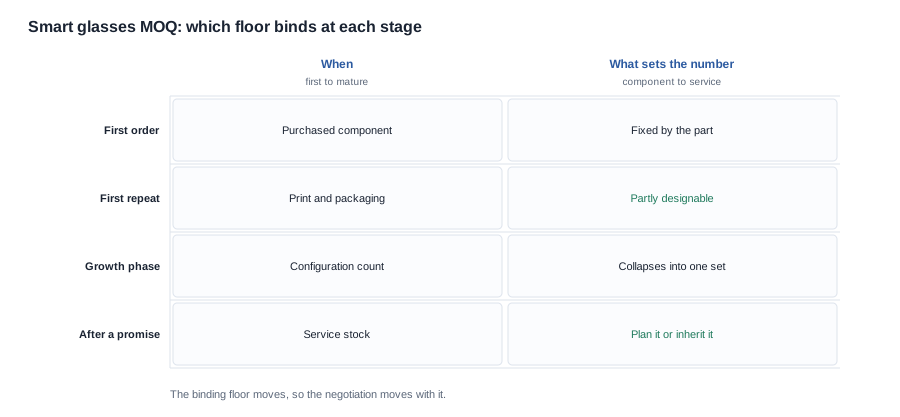
The matrix above is the lifecycle in one picture, and it is the part worth memorising. The binding floor moves from the purchased component, to the print run, to the configuration count, and finally to service stock. A negotiation conducted against the wrong floor produces a number that looks better and binds harder.
Working with a number you have already been given
If a supplier has quoted a single minimum, the fastest way to improve it is to ask which floor it comes from, and to ask in a specific order. Most of the time the answer identifies a lever that is available immediately. A minority of the time it identifies a product decision that has to be made before any negotiation is worth having.
- Ask which purchased part sets the floor, and whether the floor applies per model code or per configuration. The second half of the question is the one that produces surprises.
- Ask what the print and packaging runs are, and whether a neutral box or a shared carton would reduce the count. This is a design question and the answer is usually yes or no.
- Ask whether calibration batching is available for this configuration, and how long a batch stays open.
- Ask how service stock is built — with the batch, or separately — and what it does to the reorder.
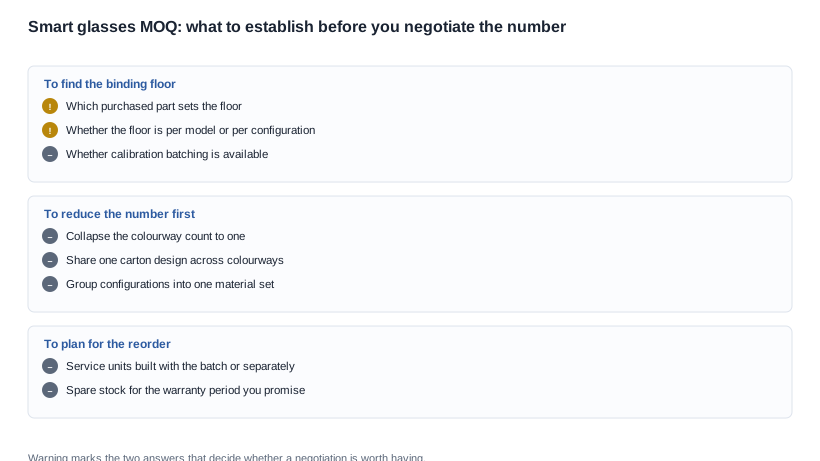
The questions to ask are these four, and they are worth putting in the enquiry rather than in the negotiation, because each one either identifies a lever or establishes that there is none. The red flags are specific: a minimum quoted without a configuration, a minimum that changes when the colourway count changes, and a minimum that is quoted as a single figure while the supplier's own process treats it as several.
The multiplier: why a second colourway is not a second order
The most common miscalculation in this category is treating a configuration as a detail rather than as a multiplier, and it is worth working through an example so that the arithmetic is unambiguous.
Take one camera model. With a single colourway and no case option, the order contains one material set: one print run, one packaging run, one order minimum. Now add a second colourway. Nothing about the frames has changed, and nothing about the factory's assembly capacity has changed, but the order now contains two material sets, so the print run is two, the packaging run is two, and the order minimum is two. The third colourway on the V03 makes it three, and the fourth published colourway on the V06 makes it four.
The consequence for a buyer is that colourway decisions are quantity decisions, and they should be made with the minimum in the room rather than with the product range in the room. A brand that wants four colourways on the V06 is making a decision about how many material sets it is willing to carry, and the honest way to make that decision is to price the four sets, not to choose the palette and discover the cost afterwards.
There is a second multiplier that is less visible: the destination market. A unit built for a market with one set of documentation requirements is not always interchangeable with a unit built for another, and where the factory treats them as separate builds, the market multiplies the material set in the same way the colourway does. This is a question to ask rather than a rule to assume, and the answers to ask are how many markets share a build and how the factory would treat an order that covers two of them.
The same logic applies to the reverse operation. When a programme has accumulated more configurations than it needs, the cheapest reduction is usually to consolidate the artwork and the carton rather than to abandon a colourway, because the packaging work is per artwork version while the material set is per configuration. Reducing artwork versions reduces the printing; it does not reduce the sets.
Where we stand, and what we will not quote
Our minimum order quantity is not published in our documentation as a single figure, because it is the sum of these floors for a specific configuration, multiplied by the number of configurations in the order. We have seen how misleading a single number becomes when quoted without the reason attached, and a buyer who builds a launch plan on a minimum they cannot trace will find the reason at the worst moment.
What we will do is state the floors separately for the configuration you are asking about — the electronics minimum, the packaging minimum and the combined order minimum — each with the constraint that produces it. That makes clear which part of the total is yours to move and which part is not, and it lets the conversation start from the floor that actually binds.
What we will not do is quote a low minimum to win a conversation and recover it through a fixture charge or a unit price adjustment that appears after the deposit. We will also not publish a model-by-model minimum table, because the table would be wrong for every configuration that has more than one colourway or more than one case option, and a table that is wrong in the direction of a lower number is worse than no table.
The MOQ section covers how the minimum interacts with unit price.
Related reading
- How to negotiate — the four levers
- Hidden costs — what sits outside the quoted number
- Pricing how it works — why quantity moves price


