
Most quality negotiations in this category stall because both parties are negotiating the wrong thing. The buyer argues for a tighter defect rate, the supplier offers a lower sampling rate, and neither addresses the question that actually determines consistency: which specification is being held constant, and what happens when it changes. This is a guide to what is genuinely negotiable, what is not, and how to phrase the ask so it gets a yes.
Smart glasses quality consistency: what the agreement has to hold constant
Who is negotiating this and what has gone wrong before
The reader here is a brand-side purchasing manager, a channel buyer or an importer who has either received a batch that did not match the sample, or who is opening a programme with a supplier they have not yet worked with and want the consistency question settled before the first shipment. What they are managing is not a dispute. It is the risk that the tenth batch is not the first batch, and that nobody will notice until it is in the channel.
The reason this risk is difficult to price is that the specification is usually an implicit agreement rather than a written one. Everyone knows what the product is supposed to be, and nobody wrote down what happens when the battery changes, when the camera module comes from a second source, or when the firmware build differs from the one that was approved. The negotiation is therefore less about quality than about converting an implicit agreement into an explicit one, which is why it stalls when both sides are discussing sampling rates.
What a buyer really wants from this negotiation is a mechanism rather than a number: a statement that the specification is frozen, a statement that a change is notified before it reaches a batch, and a definition of what happens to a batch that arrives without the notice.
The distinction the negotiation is actually about
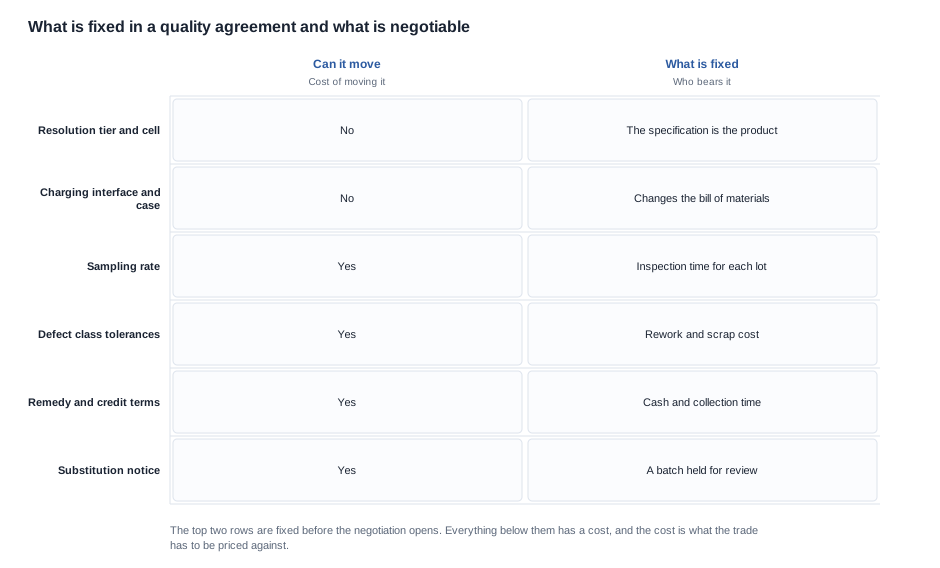
The matrix above separates the elements that are settled before the negotiation opens from those that are available for trade. The resolution tier, the cell capacity, the charging interface and the case configuration are not variables. A negotiation that treats them as variables will produce a product nobody specified, and it will do so while both sides believe they have won something.
Everything below that line is genuinely negotiable and carries a real cost that the trade has to be priced against. A sampling rate costs inspection time for each lot. A defect tolerance costs rework and scrap. A remedy hierarchy costs cash and collection time. These are the items that make a quality negotiation worth having, and they are the items a buyer who leads with a defect rate never gets to.

Why AQL is a number and not a quality system
The sentence that has to sit behind the figure
AQL 2.5 is not a quality system. It is a number that becomes meaningful only when the defect classes, the lot size, the sample size code, the drawing method and the action at the threshold are all defined. A buyer who asks for a lower number gets a supplier who agrees to a lower number, and neither of them has agreed on what is being counted.
Ask instead for the sentence behind the number. It is more work to refuse a defined sentence than to refuse a figure, and the sentence is what survives a dispute. An inspection regime described as critical, major and minor defects, with each class defined against the specification, with a stated sample size code and a stated action at the threshold, can be operated by an inspector who has never met the buyer. A bare number cannot.
The same logic applies to the terms. Severity, occurrence and detection are the three parts of a rating system, and each of them describes something different: how bad the defect is, how often it appears, and how reliably it is caught. A quality conversation that mixes them produces a single score that appears objective and settles nothing.
The three mistakes that waste a quality negotiation
Treating a bare number as a quality system. Covered above, and it is the most common. The cost is a figure that appears to be a commitment and produces no evidence at the goods-in gate.
Offering concessions that cost nothing to the supplier. A buyer who offers to accept a higher cosmetic allowance in exchange for a golden sample has swapped a real concession for a symbolic one. The golden sample costs the supplier almost nothing and protects the buyer for the life of the product. The reverse trade — a tighter sampling rate in exchange for a defined defect class — costs the supplier real money. Trade for things that are real to the other side, because that is the whole technique.
Letting the negotiation be about the sample. The sample is one unit. A buyer who spends the negotiation on the sample and returns to the table without a change-notification clause has secured the smallest possible piece of the outcome. The consistency risk lives in the batches that come after the sample, where nobody is watching.
The figures that are published and the ones that are not
What a published figure covers and what it leaves open
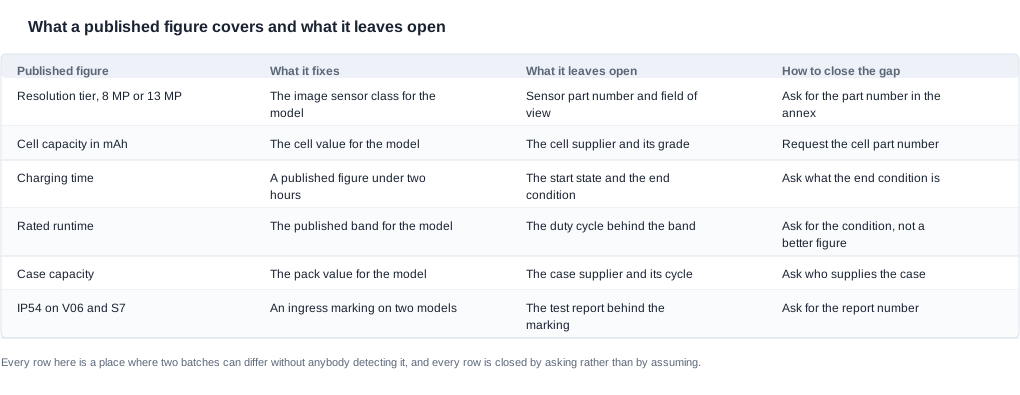
The catalogue in this category publishes more than buyers expect and less than they need. Eleven models carry a camera, eight at 8 MP and three at 13 MP, and that tier is a model-level fact rather than a per-batch variable. Cell capacities are published per model, charging times are published for all twenty-eight models, and case capacities are published where a case exists — 1400 mAh on three camera models, 900 or 1400 mAh on one, and a 1200 mAh foldable case on another.
Each of those figures closes one question and opens another. A published cell capacity does not tell you which cell it is, so two batches can differ in the cell and still match the published figure. A published charging time does not tell you the starting state or what counts as complete, so the same published number can describe a fast charge and a slow one. A published runtime does not carry the duty cycle behind it, so two batches can differ in real endurance while quoting the same band.
The buyer who knows this stops asking for better figures and starts asking for the missing conditions. That is a much shorter conversation, and it is the one that produces clauses rather than numbers.
Where the published catalogue stops and the negotiation starts
Weight is the clearest example of the distinction. The catalogue publishes a total unit weight of 158 g for one model only, MT6, and that figure includes the 265 mAh battery and the camera while excluding the foldable 1200 mAh charging case; the weight of the case itself is not published, and no bare frame weight is published anywhere in the range. A buyer who treats 158 g as a frame weight will build a packaging and shipping model on a number that was never a frame weight.
Everything in this category that is not published follows the same pattern. Sensor part numbers, field of view, video resolution and low-light behaviour are not published for the camera models. Ingress test report numbers behind the IP54 marking on V06 and S7 are not published. The certificate numbers, model coverage, issuing bodies and validity dates are published for no model: the catalogue carries a company-level export-certification page with no per-model certification row. The photochromic response figures, the acoustic figures and the detail of the AI feature implementations are not published.
Every one of those is a place where a batch can vary without anybody detecting it, and every one of them is a place where a written number would have prevented a conversation.

The change-notification clause and the configuration freeze
Notice before the batch, not after it
The single most valuable clause in a quality agreement is a change-notification requirement. In substance it reads like this: if a component affecting the published specification is substituted, we would like notice before the change reaches a production batch, and the right to reject that batch.
The distinction between notice before the batch and notice after it is the whole value of the clause. Notice after the batch gives the buyer information about goods that have already been paid for and shipped; notice before it gives the buyer a choice. The clause costs the supplier nothing when nothing changes, which is most of the time, and it is the reason a buyer can sleep at night without auditing every consignment.
The companion clause is the configuration freeze. In substance: we would like the configuration, including the firmware build, to be recorded in the order and treated as fixed for the duration of the contract, with any change treated as a new order. That is how a buyer gets a retooling charge to be visible rather than absorbed, and it is how a mid-production substitution becomes a commercial event that both sides have agreed how to handle.
The golden sample and what it is actually for
The golden sample is one unit agreed between the parties, retained by both, and referred to for any later dispute. It is a mechanism rather than a specification, and it settles appearance questions that a written description settles badly: finish, shade, texture and the like.
Its value is in the words retained and referred to, not in the unit itself. A sample that is described but not retained settles nothing; a retained unit that was never signed for cannot be shown to have been agreed. Write the clause so that the sample is identified by a serial or batch reference, retained by both parties, and referenced by the acceptance criteria.
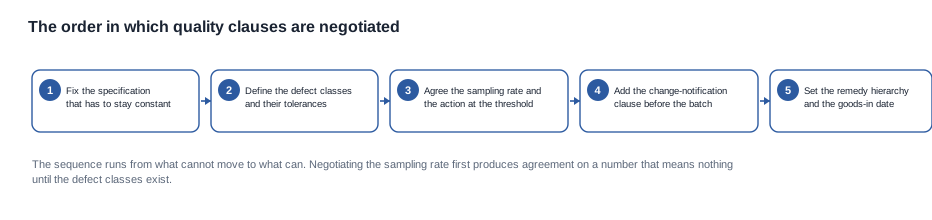
The sequence in this flow runs from what cannot move to what can, and the order of the first two steps is the part buyers usually reverse. Agreeing the sampling rate before the defect classes exist produces a number that will be interpreted differently at the goods-in gate than it was at the table.

Building the acceptance criteria before the inspection day
What to collect before the negotiation starts
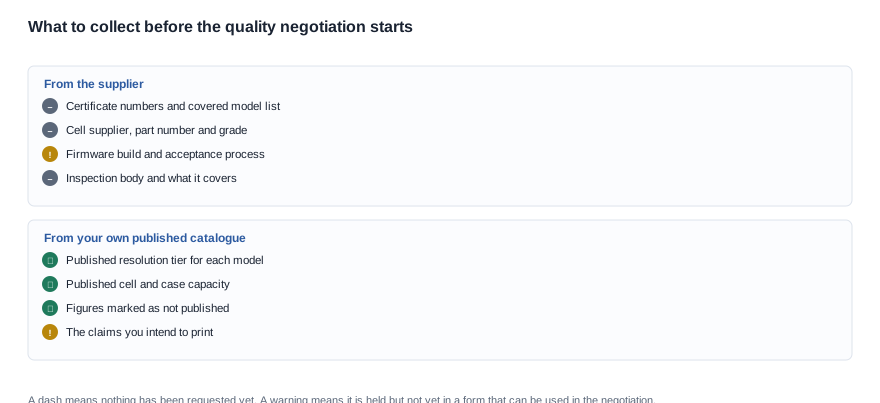
The checklist above divides the preparation into two columns. The left column is what the supplier has to produce, and it is worth collecting before the negotiation rather than during it, because the answers change what the buyer is negotiating for. The right column is what the buyer already holds, and it is worth reading once carefully, because it tells the buyer which questions matter unusually much in this category.
A useful exercise for the buyer is to mark every published figure they intend to print or claim, and then mark every published figure the supplier intends to rely on. The two lists rarely match, and the gap between them is where the quality disputes in this category come from.
Eight questions to ask a supplier about its quality system
- Which defect classes do you inspect against, and where is each one defined? Completion test: a definition for each class, not a severity word on its own.
- What sample size code applies to a lot of our size? Completion test: a code and the table it comes from.
- What is the action when the sample fails a class? Completion test: one of reject, rework or use-as-is, decided in advance rather than on the day.
- Which tests are run on every unit and which on a sample? Completion test: two lists, with the sampling basis for the second.
- Which cell part number is used for our model, and who grades it? Completion test: a part number, not a brand name.
- Who signs the release of a lot, and against which criteria sheet? Completion test: a role and a signed criteria sheet.
- What happens when a component is substituted without notice? Completion test: a written procedure, and a statement of who is told.
- How long is the production record retained, and who can produce it after shipment? Completion test: a retention period and an owner.
Questions five and eight are the ones most likely to be answered with a reassurance rather than a document, and they are the two that determine whether a batch can be compared with the sample.
The remedy hierarchy and the goods-in gate
Remedies are listed without a decision rule more often than not. Credit, replacement, rework and return are four outcomes with four different cash and logistics consequences, and a clause that offers all four without a hierarchy will be resolved by whoever is more impatient at the time.
The decision rule worth writing splits on the nature of the failure. A documentation or configuration mismatch is resolved by credit or replacement at the buyer's election, because the goods are not the goods that were ordered. A physical defect inside the agreed defect classes is resolved by rework or replacement, because the goods are the ordered goods with a fault. Anything outside the agreed defect classes is not a defect dispute at all and should be handled as a specification change with its own notice and its own price.
The goods-in gate needs a date and a role, not an intention. Write the inspection date as a calendar day and name the role rather than the individual, because roles survive reorganisations and individuals leave at exactly the moment the clause is needed.
A worked example of a consistency clause in a camera-model order
This is a reasoning walkthrough rather than a client story. No customer, order or figure is claimed; the model, the quantity and the market are assumed so that the reasoning can be followed.
Suppose a buyer is opening a repeat order for a camera model that shipped with a 1400 mAh charging case, after a first batch arrived with a case finish the buyer had not agreed.
The first thing the buyer does is separate the two problems. The case finish is a golden-sample problem, and it is settled by identifying the sample unit by reference, retaining it on both sides, and defining the finish against it. The variability the buyer is actually worried about is a different one: the case itself, and whether the next batch will contain the same case, because the catalogue publishes the capacity and not the supplier.
So the buyer asks for the case part number and the cell part number, and asks for both to be recorded as controlled items on the purchase order, with any substitution treated as a change that reopens the documentation and gives the buyer the right to reject the affected batch. The supplier can agree to this without difficulty, because in a steady state no substitution occurs and the clause never fires.
The buyer then asks for the defect classes to be written down, because the first argument about the case finish was really an argument about whether the agreed finish had ever been defined. Two classes are enough for this order: a case finish outside the agreed appearance, and a functional defect in the charging contact. The sampling rate is then agreed as a consequence of those two classes rather than in advance of them.
What the buyer ends up with is not a lower defect rate than the supplier would otherwise offer. It is a specification that is frozen, a notification clause that fires before a batch rather than after it, two defect classes that both sides can operate, and a remedy hierarchy that splits a configuration mismatch from a physical fault. The consistency risk did not disappear; it acquired an owner.
Where our own quality position stops
What we will put in the contract and what we will not
We publish the per-model figures the catalogue holds — resolution, cell capacity, charging time, the rated runtime with its caveat, the charging interface, the case configuration, the colour options and the customisation scope we support. We mark the rest as not published, and we will not substitute a typical value for any of it.
We will put a golden sample, a firmware baseline, a cell specification, a change-notification commitment and an acceptance rate into the contract, and we will tell you in writing which published figure each one is anchored to. We will not sign a clause that depends on a specification our source material does not contain, because the first time that clause is invoked is the worst possible moment to discover it.
We will also decline to commit to a defect rate as a percentage of goods shipped, because a percentage without a denominator, a defect classification and a sampling method is not a commitment and it reads as one. We will commit to the classification, the method and the action, and those three together are worth more than a percentage that cannot be reproduced.
Where the buyer's own marketing or channel commitments press against this, we will say which published figure supports the claim and which one does not exist. A claim that is only half-supported by the catalogue is the kind that becomes a complaint six months later, and it is much cheaper to withdraw it before the print run than after it. Ask us for the figure behind a claim and we will tell you exactly which line it sits on, or that there is no line for it.
The quality consistency section covers how the terms come together, and the glossary defines the vocabulary so a negotiation starts on the same words. If you want to see how the specifications behave in a camera-model order, the camera and audio smart glasses range lists the published baseline that every clause would be anchored to.
Related reading