

Quality conversations in this category fail on vocabulary. A buyer asks for a quality system, a supplier answers with the word AQL, and neither party is quite sure whether that means anything, so both move on. The terms below are the ones that carry a decision, what each one actually does, and the question to ask for it. Where a supplier cannot define a term for your model and configuration, that inability is the finding — and it is a more useful finding than a term, because it points at a row in the agreement that will fail when it is invoked.
The reader is a brand-side procurement lead, a channel buyer or an importer who is writing or reviewing a quality clause and needs to know which words are load-bearing and which are decoration. The glossary is written to be used rather than read: each term is followed by the question that turns it from a word into a commitment.
Smart glasses quality consistency: the terms to define before you order
A quality agreement is written in words, and the words are what a party will rely on when the relationship turns difficult. A clause that says "the supplier shall ensure consistent quality" commits nobody to anything, because there is no measurable content in it and therefore no point at which it can be said to have been breached. A clause that says "the supplier shall retain two units per lot, labelled with the lot identifier, and shall return them on request within ten working days" commits someone to something that can be checked in an afternoon.
The difference between those two sentences is the entire subject of this glossary. The first is a statement of intent, and intent is not adjudicable. The second is a specification, and specifications can be compared, audited and, if necessary, enforced.
There is a commercial reason the vocabulary matters as much as the arithmetic. A buyer who asks for a term in a supplier's own language gets an answer that reveals whether the supplier's process is documented, and an answer in the buyer's own language gets a translation. In this category, the moment a conversation turns into a vocabulary negotiation, both sides are writing their own definition of the problem, and the two definitions will not meet again until a claim is filed.
The four words that do the damage
Four pieces of vocabulary cause most of the failure in this category, and they are worth naming separately because each of them is a word that appears in a contract and is never defined.
"Consistent." It appears in almost every quality clause and in almost none of them with a method attached, so it becomes a claim that consistency exists rather than a statement of what it consists of. The fix is to replace the word with the specific rows it is standing in for, which in this category are usually configuration, component, firmware, artwork and accessory.
"Equivalent." It appears in substitution clauses, and it is the word that allows a same-class part to be swapped without a record. An equivalent part is one the supplier can argue is equivalent, and the buyer has no published tolerance against which to disagree. The fix is to change the word to "approved in writing by the buyer for the affected configuration".
"Representative." It appears in sampling clauses, and it is the word that permits a sample drawn from the top of the pallet to stand for the whole shipment. A sample is representative only if the drawing method says where in the shipment it came from, and a sample drawn from one carton is a statement about that carton.
"As required." It appears in delivery clauses and it is the word that makes a date unenforceable. The fix is a date, a consequence and a notice period, in that order.
Each of these four words is easy to replace and expensive to leave in, which is the argument for treating the glossary as an editing tool for the buyer's own documents rather than as a reference to be read once.


The eight terms that carry a decision
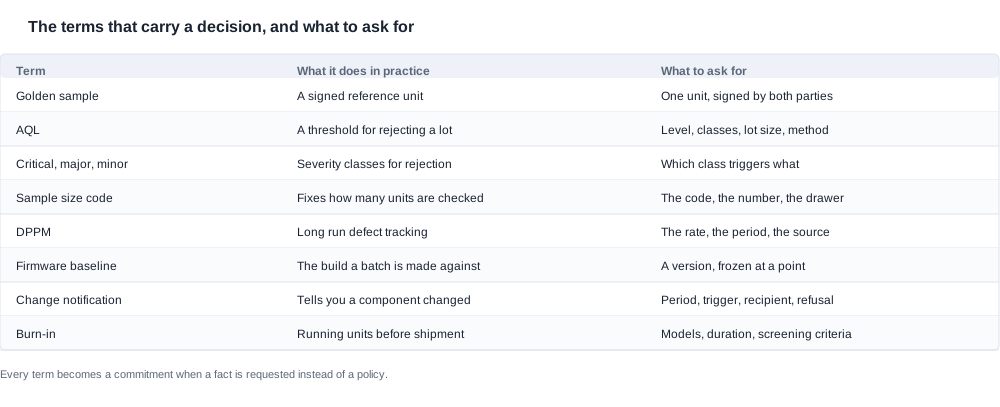
| Term | What it means in practice | What to ask for |
|---|---|---|
| Golden sample | A signed reference unit that defines what correct means | One retained unit, signed by both parties, identified by configuration and build |
| AQL | The defect rate above which a batch is rejected | A named level, the defect classes, the lot size it applies to, and the sampling method |
| Critical, major, minor | Severity classes that decide what a rejection means | Which classes trigger rejection, which trigger rework, which trigger a concession |
| Sample size code | The letter code that fixes how many units are checked | The code, the number it resolves to, and who draws the units from where |
| DPPM | Defective parts per million, used for long-run tracking | The rate you will be held to, the reporting period, and the source of the count |
| Firmware baseline | The agreed build a batch is produced against | A named version, frozen at a stated point, with a change trigger |
| Change notification | The process for telling you a component changed | Notice period, the trigger, the named recipient, and whether you can refuse |
| Burn-in | Running units before shipment to catch early failures | Whether it happens, on which models, for how long, and against what criteria |
Each row in that table has a property worth noticing: the third column is a request for a fact rather than for a policy. "What is your AQL?" produces a number that is meaningless on its own. "What is your AQL, for which defect classes, at which lot size, using which sampling method, and what happens when it is exceeded?" produces an answer a buyer can apply, and it produces one that a supplier can actually give.
The order of the rows is also a priority order, roughly in the sequence in which a programme needs them. The first four are the vocabulary of a shipment decision, the last four are the vocabulary of a programme, and a programme that has the first four and not the last four will still catch a bad batch, while a programme with the last four and not the first four will catch it once it has already shipped.
The three that matter most before a first bulk order
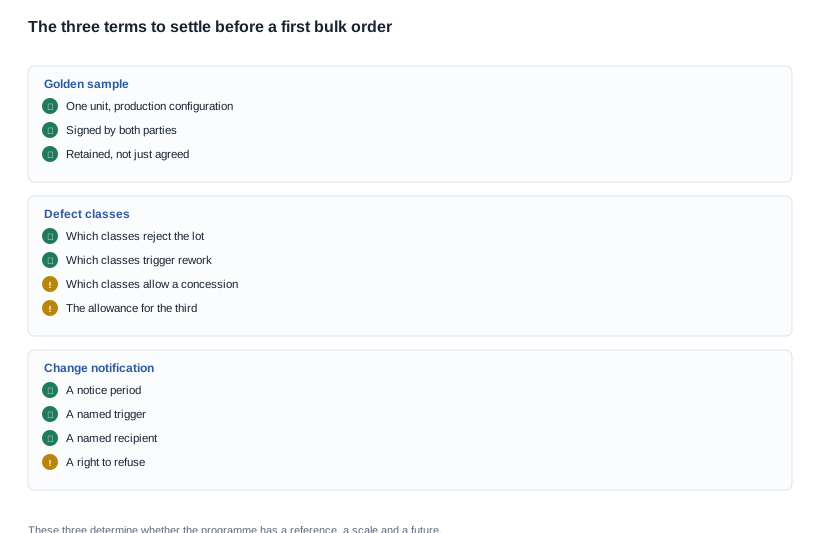
The golden sample is the cheapest quality system available. One unit, built to the production configuration, signed by both parties, retained. Every later argument — is this scratch a defect, is this colour within tolerance, is this firmware build the right one — becomes a comparison against a reference both sides agreed to. Without it, every dispute is a matter of opinion, and the more expensive the batch, the more the opinion is worth. A buyer who wants one control installed this week should install this one.
The defect classes decide what a rejection means. A cosmetic defect and a unit that will not charge in its case are both "defects", but only one of them justifies scrapping a shipment. Ask which classes trigger a rejection, which trigger rework, which trigger a concession, and what the allowance is for the third. A buyer who has not asked this will discover the answer in the form of a 3,000-unit batch with an agreed 2 per cent cosmetic allowance nobody discussed.
The change notification is what makes consistency durable. Components get substituted. Cell suppliers change, lens suppliers change, chip allocations move. None of that is misconduct, and all of it breaks a golden sample. A notice period and a right to refuse is a commercial conversation, and it is the one that determines whether the product in month nine is the product approved in month one.
The two terms that are most often misused
AQL is not a quality level. It is a threshold that a sampling plan uses to decide whether a lot is accepted. A buyer who writes "AQL 2.5" into an order and stops there has specified a number without specifying what is being counted, how many units are drawn, who draws them, which defect classes count, and what happens at the threshold. The number is the least interesting part of the sentence, and it is the part that gets quoted back at you in a dispute.
The fix is not to avoid the term. It is to complete it: the level, the defect classes, the lot size it applies to, the sampling method, the drawing point in the shipment, and the decision route on a failure. Six clauses, and each of them is a decision a buyer would otherwise have to make in the middle of a dispute.
Burn-in is a real process with a real cost. Running units before shipment to catch early failures catches exactly the failures that would otherwise appear in the first week of use, which is precisely why it is worth paying for and precisely why a supplier who does it should say so rather than let the buyer assume it. Ask whether it happens, on which models, for how long, and against what screening criteria. For a device with a lithium cell and a charging case, it also has to say how the units are returned to a known state before packing, because a burn-in cycle that ends at an unknown state of charge produces a battery that behaves differently from one that was shipped at a known state.
The terms that do not exist for most models
There is a set of quality terms that a buyer might reasonably expect to find in a smart glasses specification, and which our published source material does not cover. These are worth naming so that nobody builds a plan on them.
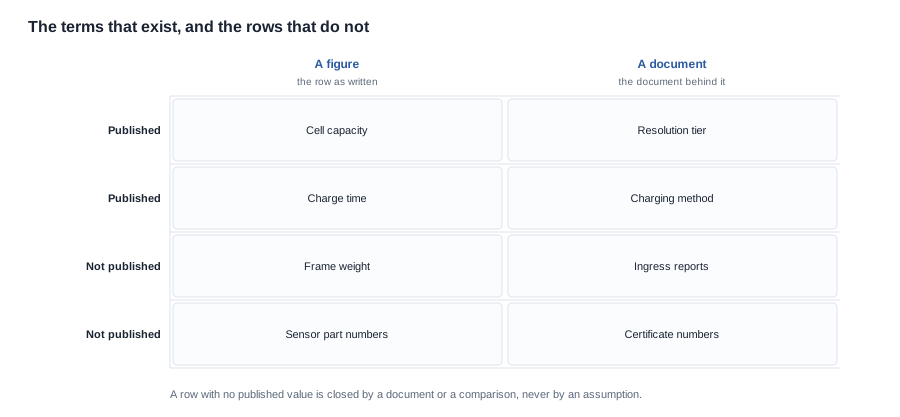
The frame weight is not published for any model in the range. The single published weight is the MT6 glasses body at 158 g, including its 265 mAh cell and its camera, and excluding the 1200 mAh folding charging case, whose own weight is not published; that is a whole-unit weight for one model, and it is not a frame weight for any model.
Sensor part numbers, field of view, video resolution and frame rate are Not published for the camera models, whose published resolution is a tier and nothing more. Ingress test report numbers behind the IP54 catalogue marking are Not published, and the marking itself appears on two models only, the V06 and the S7, as an annotation rather than as a report-backed result. Certification numbers are Not published: our catalogue carries no CE, no FCC and no RoHS marking and no per-model conformity row for any model, the children's models included, so the scope of any certification for a given model is a document to be requested from the supplier and not a term to be assumed. Cell grade and cell supplier are Not published.
Every one of these is a place where a batch can vary without any of the eight terms above detecting it. That is not an argument against the quality system. It is an argument for specifying the values rather than assuming them, and for asking the supplier to supply the document rather than for the buyer to infer the value from a marketing page.
How to close a row that has no published value
A row that cannot be closed from published data still has to be closed, and a glossary is the right place to record how it was closed, because the row will be read again in a dispute and the reader will need to know what was agreed.
Three routes exist, and choosing between them is a decision about how much of the buyer's own labour the programme absorbs.
Obtain the document. The test report, the certificate, the measurement record. This is the strongest route, it produces an artefact that survives a dispute, and it is the mandatory route wherever the destination market requires the evidence, because a market-access question is not a quality question and is not resolved by an internal comparison.
Convert the row into a comparison against the approved sample. A characteristic with no published value can still be held constant, provided the sample exists, the method is written down and the comparison is repeated on later runs. This is the route for acoustic and finish characteristics, and it is only available to a buyer who captured a baseline earlier — which is the argument for the whole of this glossary.
Move the row into a monitored list. This is the honest option for characteristics that vary between units by nature and that nobody is going to hold constant, and it is much better than leaving the row blank. A monitored row with a defined frequency and a defined consequence is a managed risk; a blank row is an unmanaged one that will be rediscovered in a dispute.
The three routes are not equivalent, and the glossary should say which one was chosen for each row. A specification that says "not published; compared against the approved sample, method X, every run" is complete. A specification that says "not published" is an open item that will be found at the worst time.

How to use the glossary in a supplier conversation
The quickest way to get value from this list is to ask which of these terms already appear in your contracts and which are missing. Most supply agreements in this category contain the word AQL and nothing else — a level with no defect classes, no lot size, no sampling plan and no sampling method, which is a sentence that cannot be applied to anything.
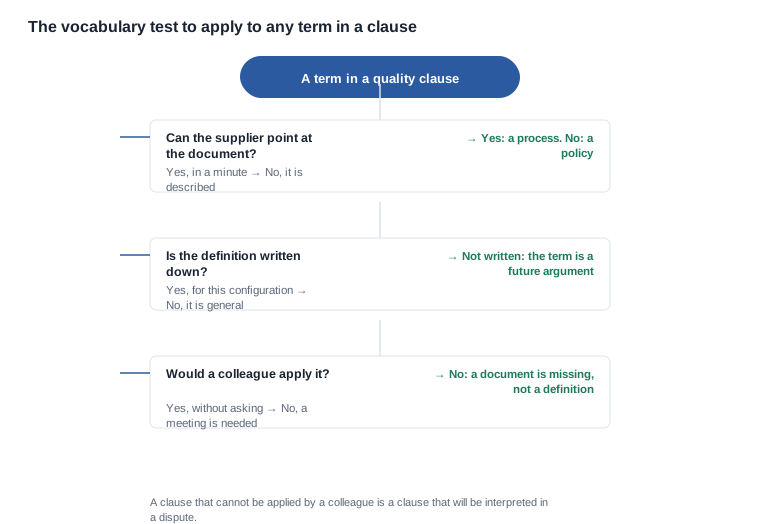
There is a test that works better than a checklist, and it is a single question asked about each term: can the supplier point at the document in which this term is recorded? Not "do you have a quality system", but "show me where the released firmware version is logged". A supplier who can produce the document in a minute has a process. A supplier who describes where it would be kept has a policy, and a policy is a statement about intentions rather than about what happened.
The second test is applied to the buyer's own documents rather than the supplier's: could a colleague who did not negotiate this agreement apply it? If the golden sample record is in a filing cabinet in one building and the retention rule is in a spreadsheet in another, the programme has a single point of failure and it is a person. A glossary that is used as a checklist against a contract produces a document. A glossary that is used as a reference produces a conversation.
Four decisions the vocabulary has to support
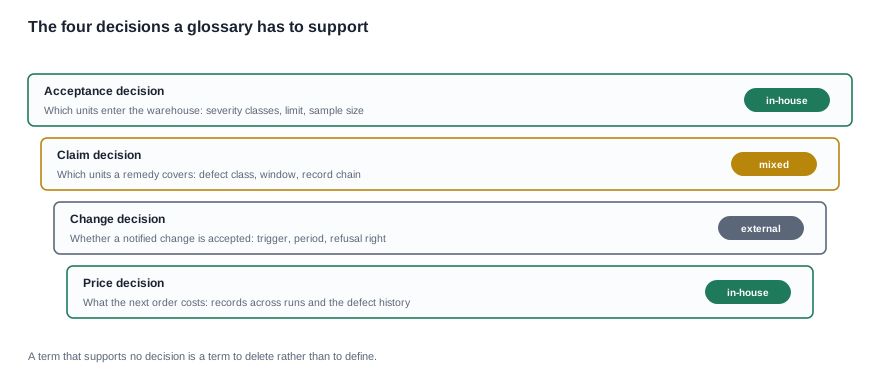
It is worth checking a glossary against the decisions it has to carry, because a term that supports no decision is a term to delete rather than to define.
The acceptance decision. Which units enter the warehouse. It needs the severity classes, the acceptance limit, the sample size and the drawing point. Without the severity classes the limit is meaningless, because a limit on what is not defined cannot be applied.
The claim decision. Which units are covered by a remedy. It needs the defect classification, the production window, the record chain and the remedy route. A claim answered without the chain becomes a general concession.
The change decision. Whether a notified change is accepted. It needs the trigger, the notice period, the affected configurations named in the notice, and a right to refuse. A notice that names only "a component" cannot be acted on.
The price decision. What the next order costs. It needs the inspection records across runs, the defect history, and the evidence that the programme is producing a stable output. This is the decision that a glossary supports least well in practice, because the terms needed to argue it are the ones nobody defined when the contract was written.
What Cynrin publishes, and the action to take
Here, a term which cannot be defined for a model and configuration is not a term the buyer can rely on, and the most useful thing a supplier can do with a glossary is refuse to define the ones that do not apply. We publish the per-model figures the catalogue actually holds: resolution tier, cell capacity, charging time, the rated runtime with its caveat, the charging interface, the case options, the Bluetooth version where the catalogue states it, and the available colours and configurations. We mark as Not published the frame weight of every model, the sensor part numbers, the field of view, the video specifications, the ingress test report numbers, the certification numbers, the cell grade and the cell supplier, and the tolerance around any published figure.
We will put a golden sample, a firmware baseline, a cell specification, a change-notification commitment and an acceptance rate into the contract, and we will tell you in writing which published figure each of them is anchored to. We will not sign a clause that depends on a specification our source material does not contain, because the first time that clause is invoked is the worst possible moment to discover it.
The quality consistency section sets out how these terms sit together, and what consistency actually costs covers the commercial consequences of getting them wrong. The AI camera glasses range lists the published baseline, the camera-side vocabulary is at smart glasses camera technology and key specifications, and the clauses worth checking are at red flags in a quality agreement.
The action to take now. Send us the models and the configurations you are writing clauses for, and we will mark each glossary term as available from our published material, available as a document we will provide, or not defined for that model. A glossary term that cannot be pinned to a figure is a term that will be argued about, and the argument is always more expensive than the document.
Related reading
- The published baseline — AI camera glasses
- The camera-side vocabulary — smart glasses camera technology and key specifications
- The clauses worth checking — red flags in a quality agreement


