

Freight negotiation for this category is mostly a question of what you are quoted per and what you are actually charged per. A rate per kilogram on a product that ships bulky is a rate that will move the moment the fuel surcharge moves, and a rate quoted on a single carton tells you nothing about what a container load costs. Both conversations are winnable once you know which one you are in, and the way to find out is to ask what the rate is based on before asking for a better one.
Smart glasses shipping: what a freight quotation is actually pricing
Who is buying freight and what the quotation leaves out
The buyer here is a procurement manager or an importer who has agreed a unit price and a delivery date and has now discovered that the freight quotation is a separate conversation with a separate set of numbers. The question underneath is which of four costs the quotation is pricing, because the answer determines what can be negotiated at all.
A freight quotation is usually presented as one line, and that line is almost never the whole cost. A quotation on an ex-works basis contains the carriage and very little else. A quotation on a delivered basis contains the carriage, the destination clearance, the tax handling and the last mile. The difference between the two is frequently larger than anything a buyer can win by negotiating the carrier rate itself, and it is the reason the delivery basis belongs in the request for quotation rather than in a later conversation with a forwarder.
There is also a documentation dimension. A lithium-powered product attracts a per-shipment handling fee and a set of transport documents, and the packaging that satisfies the transport rule is the packaging the carrier charges on. For the regulatory side, battery transport covers the packaging requirements that determine the fee.
Two further features of this category change how a freight quotation should be read. The first is that the goods are small and light enough that freight is a meaningful share of the landed cost rather than a rounding error, which is unusual for an electronic product and changes how much attention the freight line deserves. The second is that the freight cost depends on decisions made long before the quotation: the case configuration, the retail packaging, the consolidation pattern and the delivery basis. A quotation is therefore a snapshot of choices made earlier, and negotiating it is easier when those choices are revisited rather than when the rate is argued about.
The four costs and which one dominates
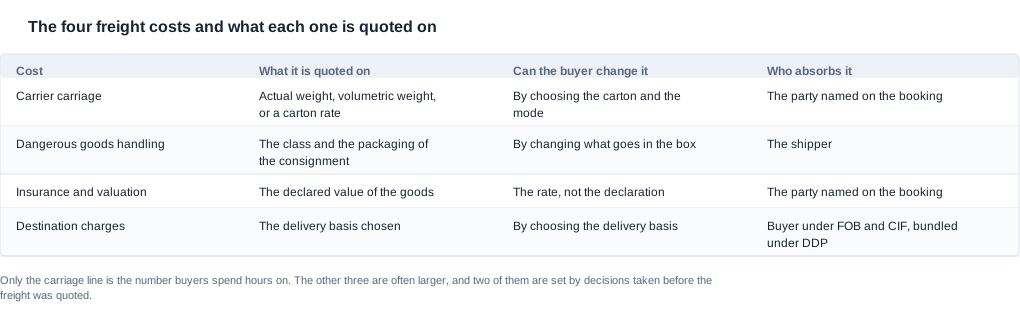
The four rows in this table are the costs a freight quotation can contain. The carriage is the one buyers spend hours on. The dangerous goods handling fee and the insurance premium are usually smaller and mostly fixed. The destination charges are the ones that decide the comparison between two suppliers, and they are set by a decision the buyer made about the delivery basis rather than by a negotiation with anyone.
Notice also the third column. Only two of the four costs can be changed by the buyer at all, and neither of them is the carrier rate. That is the single most useful thing to establish before spending an afternoon on freight negotiation.

Chargeable weight and the carton that decides it
Why a boxed consignment is usually charged on volume
Air freight is charged on the greater of actual and volumetric weight, and for boxed glasses the volumetric figure is usually the binding one. Get the shipping carton dimensions, not the retail box dimensions, and calculate the volumetric divisor your forwarder uses before you accept a rate.
This is where most freight negotiations are lost. A quotation built on the retail box dimensions will produce a rate that appears attractive and produces a bill based on the shipping carton, and the difference between the two is not a rounding error — it is the difference between a volume that fills a fraction of the cube and one that does not. Ask for the carton dimensions and the pallet configuration together, because a consignment that ships flat-stacked and one that ships in a rigid carton of the same products can differ by a factor.
The case is the item that sets the carton size
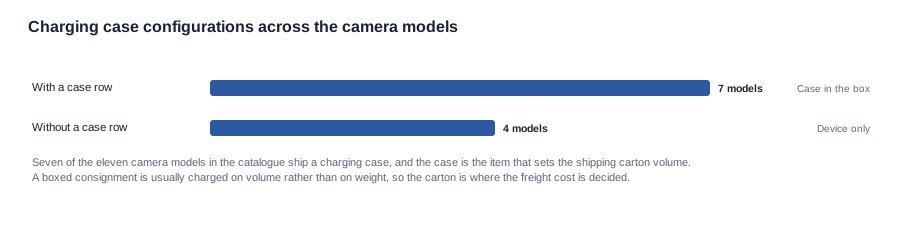
Seven of the eleven camera models in the catalogue ship a charging case, and the case is what sets the shipping carton volume. That makes the case decision a freight decision as well as a product decision, and it means the two conversations are not independent.
A buyer who decides on a case configuration for the channel and only afterwards asks about the freight has already made the freight decision. A buyer who asks for the carton dimensions for each case option can see which configurations cost more to move before the product is frozen, and can price the two against each other.
The lever that most buyers miss here is the carton itself. Halving the retail packaging volume often halves the chargeable weight, and that reduction is permanent across every future order, while a negotiated rate reverts the next time the carrier publishes a surcharge.
It is worth adding one point about the charging case specifically. A case is not simply an accessory added to the box; it is a separate battery pack with its own transport classification, and it is usually packed outside the retail box rather than inside it. That has two consequences. It affects the carton volume directly, and it means the consignment contains more than one cell, which changes the transport documentation and the declared figures.
This is why the case decision and the freight decision belong in the same conversation. A buyer who compares two case options on product grounds alone, and then asks for freight on the chosen option, has already committed to a freight cost without knowing it. The three published case capacities in the catalogue — 900 mAh, 1200 mAh and 1400 mAh — describe three different cartons, and a fourth option, shipping without a case, describes a smaller one.
Nine questions to put to a forwarder or a supplier logistics contact
- Is this rate per kilogram, per cubic metre, per carton, or per shipment? Completion test: one of the four, stated in the quotation.
- If it is per kilogram, is that actual or volumetric weight, and what divisor do you use? Completion test: a stated divisor and a stated method.
- What are the shipping carton dimensions and the pallet configuration? Completion test: numbers, not a photograph.
- Which components are in the carton — device, case, packaging, documents, accessories? Completion test: a list, because the case is what sets the volume.
- Is dangerous goods handling included, and what class and packaging is it assessed on? Completion test: a named assessment basis.
- What does the rate include beyond the carriage? Completion test: terminal handling, documentation, clearance and insurance each named or explicitly excluded.
- What is the validity window of this rate, and what is the surcharge mechanism? Completion test: a date and a named mechanism.
- What does the destination side cost under the delivery basis quoted, and what would it cost under the other basis? Completion test: both numbers.
- What is the declared value used for the insurance premium, and what changes it? Completion test: a stated basis and the rate applied to it.
Questions three and four are the ones most often skipped, and they are the two that decide the chargeable weight. A forwarder who cannot state the carton dimensions and the box contents cannot have calculated the rate accurately, however competitive it appears.
Dangerous goods handling and the part nobody can negotiate
What the fee is set by
A lithium-powered product attracts a per-shipment handling fee that does not scale with weight and cannot be negotiated at the carrier level, because it is set by the class and by the packaging rather than by the route or the volume. Every shipment carries it, whether the consignment is one carton or forty.
This is the clearest example in the category of a cost that is fixed in principle and only adjustable in scope. The fee responds to what goes in the box and how the box is packed, and to nothing else that the buyer can influence. A buyer who spends an hour negotiating the handling rate will be told, correctly, that the rate is set by the classification and the packaging.
What the buyer can still change
What the buyer can change is the scope of the consignment. A consignment that contains only one cell configuration and one case configuration has a simpler classification than one that mixes them, and a consolidation plan that keeps like with like is easier to declare than one that does not. That is a planning decision rather than a negotiation, and it belongs in the order rather than in the freight conversation.
It is also worth knowing which figures the rule set needs. The cell configuration, the charge state and the model designation all appear on the transport paperwork, and a consignment whose paperwork and carton disagree is a consignment that is held rather than moved. The battery transport framework sets out the documents and the packaging requirements that determine both the fee and the handling.
Insurance, declared value and the destination charges
Negotiate the rate, not the declaration
Declared value drives the insurance premium, and under-declaring to save on the premium is a decision that costs everything if the goods are lost. The negotiation available here is the rate for a given declared value, and it is a small negotiation because the premium scales with the value and the value is fixed by the order.
What the buyer should not do is ask the supplier to under-declare for a shipment destined for a market where the declared value affects the tax calculation as well as the insurance. That is a customs exposure rather than a freight saving, and it is the one item on this list that we will refuse to participate in.
There is a defensible middle position that buyers sometimes miss. The declared value used for the insurance premium can be set at the level the buyer's own commercial model requires, provided that the same figure is used consistently on the commercial invoice and that it is not set to a level that misstates the goods for customs purposes. Insurance valuation and customs valuation are not always the same number, and a forwarder who treats them as one number will either over-insure the consignment or under-declare it. Ask which is which.
The difference between delivery bases is often larger than the freight
For DDP terms the destination charges are bundled and largely fixed. For FOB and CIF they belong to the buyer. Get both, because the difference between them is often larger than the ocean freight rate negotiated over two hours.
The practical consequence is that a freight comparison between two suppliers is usually invalid until the delivery basis is aligned. One supplier quotes delivered and one quotes ex-works, and the gap between the two numbers is a difference in scope rather than a difference in efficiency. The logistics and shipping section sets out the full sequence, and the shipping cost breakdown shows where the money goes per unit.

Three questions that expose the landed rate behind the carriage rate
The script that produces most of the available concession
Three questions, in this order, produce most of the available concession.
What is this rate based on — actual weight, volumetric weight, or a flat carton rate? The answer tells you which of the four costs the quotation covers and whether the rate can move at all. A flat carton rate is a rate for a shipment of one size, and it says nothing about what a larger consignment costs.
What is included beyond the carriage — terminal handling, documentation, customs clearance, insurance? The gap between the quoted rate and the landed rate lives here, and it is usually larger than anything you can win on the carriage itself.
What happens to this rate at the next sailing? A rate with no stated validity window is a rate that resets in your favour sometimes and against you others, and asking removes the ambiguity permanently.
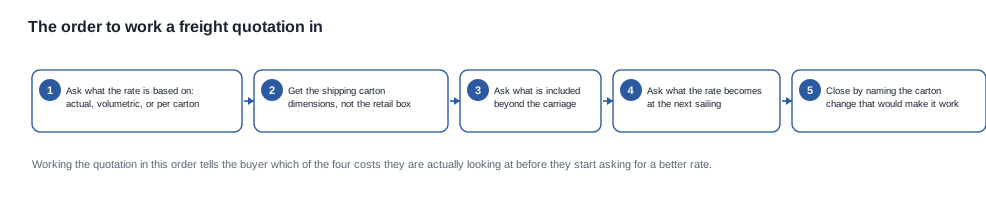
Working the quotation in this sequence tells the buyer which of the four costs the quotation covers before they start asking for a better rate, which is why the order of the questions matters more than their wording.
The one thing the buyer actually controls
Close with the one thing the buyer actually controls. If the carton can be smaller, say what smaller carton would make the rate work. Suppliers can change packaging, shipping mode and consolidation; they cannot change the carrier's rule set, and a conversation that recognises this is shorter and produces a better answer.
There is one more lever that a first-time buyer rarely finds, and it is the consolidation plan. A factory that ships weekly, or a buyer that can hold a shipment to align with an existing sailing, removes a fixed cost per consignment rather than reducing a variable one. On a small programme that is the difference between a freight cost worth optimising and one worth accepting.
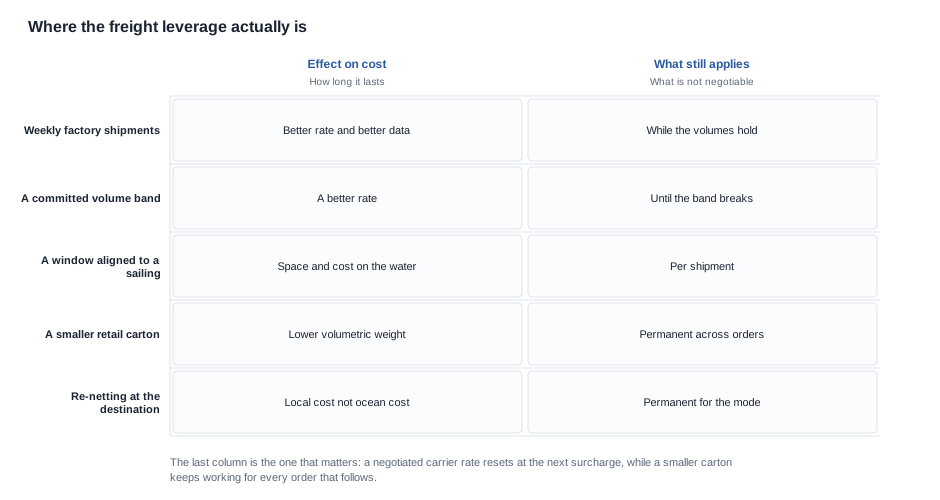
The last column in this matrix is the part that decides a long-term freight position. A negotiated carrier rate resets at the next surcharge. A smaller carton, a consolidation plan that ships weekly and a re-netting decision at the destination keep working for every order that follows, which is why they are worth more attention than the rate itself.
A worked example of a freight comparison that was not comparable
The comparison below is built on assumed inputs rather than on an account we have worked on. No buyer, carrier, order, rate or weight is claimed; one camera model, one order quantity, one destination, and two freight quotations on different bases are assumed, so that the reasoning behind each line can be followed.
Suppose a buyer has two freight quotations for the same camera model order at the same quantity, and the first is substantially lower. The first quotation is on an ex-works basis and quotes a rate per kilogram. The second is on a delivered basis and quotes a rate per carton.
The buyer works the three questions in order. The first answer is that the ex-works rate is per kilogram on volumetric weight, so the buyer asks for the shipping carton dimensions. They arrive, and the carton holds the device, the 1400 mAh charging case, the retail box and the documentation, which is a materially different volume from the retail box the buyer had been assuming. The buyer recalculates and finds that the apparent advantage on the ex-works quotation is largely a difference in what is being measured, not a difference in efficiency.
The second answer is that the delivered quotation includes terminal handling, documentation, clearance and insurance, and the ex-works one includes none of them. Once those four lines are priced onto the first quotation, the gap narrows to a figure that is inside the range of a normal commercial difference.
The third answer is that neither quotation has a stated validity window, so the buyer asks for one. A rate with no window is a rate that will move at the next surcharge, and the buyer now knows that a negotiated rate is a temporary instrument while a smaller carton is a permanent one.
The buyer ends the negotiation with two decisions rather than a rate: the carton specification is reviewed for volume, because that reduction carries into every future order, and the delivery basis is aligned across the two suppliers so that the next comparison is a real comparison. The when you can skip freight optimisation article covers the case where even this is not worth the effort at low volume.
How we itemise a smart glasses shipping quotation
When to optimise a freight carton, and when to leave the tooling alone
We will quote shipping terms itemised — the goods value, the freight basis, the destination charges and the tax treatment — so you can see what each line is and which of them is negotiable. We will tell you the shipping carton dimensions rather than the retail box dimensions, because a rate quoted against the retail box is not a rate the buyer can use.
We will not under-declare customs value, and we will not split consignments to move a shipment below a reporting threshold. Neither of those is a freight negotiation; they are decisions that move a risk from the freight conversation to a customs one, and they are the wrong trade.
There is a third thing we will not do, which is quote a rate without the carton it applies to. A freight rate detached from a carton specification is a number that cannot be checked against anybody else's number, and a comparison built on numbers that cannot be checked is not a comparison. We will also say when a smaller carton is not worth engineering, because at a low volume the tooling and the setup cost of a new carton can exceed the freight it saves on every order that follows.
Our unit prices, MOQ figures and lead times are not published, and a freight quotation is only as good as the specification it is attached to. Send us the model, the configuration, the quantity, the carton specification and the destination, and we will quote the freight against that specification rather than against a generic unit. And if the volume is small enough that freight optimisation is not worth the effort, we will say so rather than send you a rate that will not move the total.
Related reading
- Shipping cost breakdown — where the money goes per unit
- When you can skip freight optimisation — when the volume is too small to bother
- AI camera glasses range — published configurations to quote against


