

A freight quotation is unusable for planning unless it is decomposed per unit, because the carrier's invoice is not what determines a landed cost. The landed cost is the goods value, plus five shipping-related lines, plus the cost of everything that goes wrong. This article sets out those lines, the one that never appears in a quotation, and the arithmetic that lets a buyer rebuild the number independently — which is the only reliable way to tell a complete quotation from an incomplete one.
Smart glasses shipping cost: which six lines a buyer rebuilds
The short answer on the cost breakdown
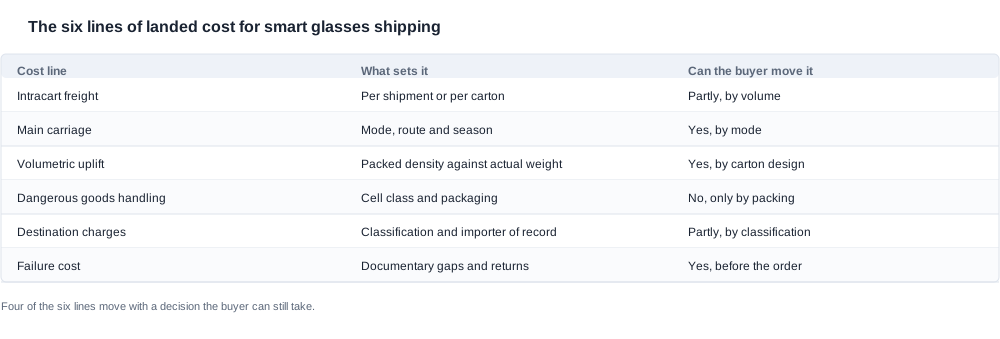
Four of the six lines move with a decision the buyer still controls, and two are fixed by a third party. That split is the useful part of the breakdown, because it tells a procurement manager where the negotiating effort belongs.
The four movable lines are the chargeable weight uplift, the main carriage mode, the destination charges treatment, and the failure cost. The two fixed lines are the dangerous goods handling charge, which is set by the cell class and the packaging rather than by anything commercial, and the intracart leg from the factory to the consolidation point, which is normally the smallest line in the structure.
The practical instruction is short. Take the quotation and decompose it into these six lines before you compare it with anything. If a line cannot be named, it is the line to ask about, and an unnamed line is a cost that will arrive later as an overage on the first invoice.
The buying task behind the breakdown
The reader is a brand-side buyer, a channel buyer or an importer, and the reason this article exists is that the number in the quotation is the wrong number for the decision. A buyer comparing two suppliers is comparing a quoted freight line against a quoted freight line and drawing a conclusion about the supplier, when what they are actually comparing is two different scopes of shipment.
Three situations produce that error. A buyer comparing a delivered price against an ex-works price and concluding that one supplier is expensive. A buyer building a margin model from a landed cost that stops at the port. And a buyer who has shipped once, found the invoice larger than the model, and rebuilt the model with a correction rather than with a cause.
What the reader is actually managing is a number that has to survive a quarterly review, and a number survives a review only if every line in it can be traced to something. A quoted freight rate cannot be traced, because it depends on a carton the buyer has not seen; a declared duty rate cannot be traced, because it depends on a classification nobody has confirmed. The cost of a line that cannot be traced is not the line itself — it is the second quarter in which somebody has to explain it.
The six lines, and what sets each one
| Cost line | What sets it | Can the buyer move it |
|---|---|---|
| Intracart freight | Per shipment or per carton | Partly, by volume |
| Main carriage | Mode, route and season | Yes, by mode |
| Volumetric uplift | Packed density against actual weight | Yes, by carton design |
| Dangerous goods handling | Cell class and packaging | No, only by packing |
| Destination charges | Classification and importer of record | Partly, by classification |
| Failure cost | Documentary gaps and returns | Yes, before the order |
The cost stack between the factory and the shelf
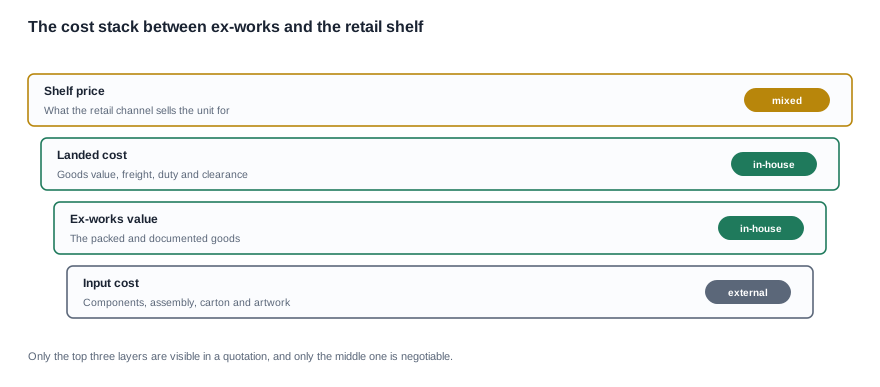
The stack above is the part of the structure buyers usually hold in their heads: the input cost becomes the ex-works value, the ex-works value becomes the landed cost, and the landed cost becomes the shelf price. Freight sits between the ex-works value and the landed cost, and it is the smallest band in that stack for most orders in this category — which is the single most useful thing to understand about freight procurement, because it means that the freight conversation is rarely where the money is.
What the freight line is, is where the schedule risk sits, and it is also where the trade-offs are sharpest. That is why the breakdown below spends more words on the two lines that are hardest to control than on the one that is easiest.

The cost line that never appears in a quotation
The failure cost, and why it is not optional
A held shipment, a re-labelling run, a returned batch of retail-ready units that cannot be sold in the destination market — none of these appear in a freight quotation, and all of them are real costs in this category. They are usually caused by documentation rather than by the goods, which is what makes them so hard to budget: the trigger is a decision somebody else makes, on a day nobody planned for.
The failure cost has three components, and a buyer who prices one of them is under-pricing the line.
The first is the direct cost of the event: the re-tender, the storage, the re-labelling, the return freight, the duties that have already been paid and cannot be recovered. This is the smallest of the three and the easiest to estimate.
The second is the schedule cost: the launch window that closes while a consignment is held, the stock-out in the channel, the campaign that has to be re-run. In most programmes this is larger than the direct cost, and it is the one a buyer is most able to avoid, because the mitigation is free at quotation stage.
The third is the channel cost: retail-ready units that arrive, cannot be sold in the destination market, and come back. This one compounds, because the units that come back are not the same value as the units that were shipped — they have lost their market, and a second channel at a lower price is not a neutral outcome.
The mitigation that costs nothing
The mitigation is to confirm two things before the goods are packed rather than after: that the model designation on the test evidence matches the model on the carton artwork, and that the battery transport documentation exists for the cell that is actually in the box. Both are free, both take an email, and between them they cover the majority of the failure events that reach a buyer as a surprise.
Note what this mitigation is not. It is not a stricter supplier, a more careful factory, or a larger sample order. It is a document check performed by the buyer before a payment milestone, and it is the only cost-reduction lever in this article that costs nothing at all.
Rebuilding the landed cost from a supplier's own numbers
This is the part of the article that a procurement manager can use immediately, and it takes about fifteen minutes per configuration. Do it once per configuration, save the working, and the second order does not require the arithmetic to be reconstructed.

The six steps of the rebuild
Step one: take the packed carton dimensions and apply the forwarder's volumetric divisor. Ask for the forwarder's divisor in writing rather than assuming the common one, because the divisor is a carrier rule and it changes the answer materially. This step produces a volumetric weight in kilograms.
Step two: take the actual weight from the packing list. This is the gross weight of the packed unit — the device, the case where there is one, the retail carton, the cable and the insert. Not the device weight. The catalogue publishes a device weight for one model only, at 158 g for the MT6 glasses body including the battery and the camera and excluding the foldable charging case, and the case weight is not published at all, so a buyer cannot derive the packed weight from the catalogue and must ask for it.
Step three: use the greater of the two as the chargeable basis. This is the rule the carrier applies, and it is the point at which the volumetric uplift appears as a line. If the two figures are close, the carton is well designed for the product. If the volumetric weight is several times the actual weight, the carton is a shelf carton being used as a freight carton, and that is a design decision available to the buyer.
Step four: add the dangerous goods handling line as quoted. This line is set by the cell class and by the packaging arrangement, and it is not negotiable with the carrier. It can only be influenced by how the goods are packed and consolidated, and by the cell configuration itself.
Step five: add destination charges from a broker's estimate rather than from the supplier's quotation. Terminal handling, documentation, customs clearance, duty and tax. The reason for the broker rather than the supplier is that a supplier has an incentive to bundle these into a single delivered price, and a bundled price cannot be compared with an itemised one.
Step six: compare the rebuilt figure against the quoted landed cost. If it lands within a few per cent, the supplier is quoting carefully and their numbers can be relied on at the next reorder. If it lands twenty per cent away, the buyer now knows exactly which line to interrogate — and that is worth considerably more than the discount that pressing on price might have won.
Why the rebuild is worth the fifteen minutes
A buyer who rebuilds the number once learns three things that are not in any quotation. First, how much of the quoted freight is volumetric, which tells them whether the carton is right. Second, how much of the quoted landed cost is destination handling, which tells them whether the two quotations are even in the same terms. Third, whether the supplier's own numbers can be reproduced, which is the single most reliable indicator of how the rest of the file will behave.
The rebuild also changes the negotiating posture. A buyer who arrives with a rebuilt number is not asking whether the price is fair; they are asking which line differs and why. That is a much stronger position, and it is why a supplier who has seen a buyer do this once tends to quote more carefully afterwards.

What the published data can and cannot settle
A cost breakdown is only as good as the inputs a buyer can actually obtain, and this is the point where a buyer has to know which figures are published and which are not. The distinction matters because the published figures are free and immediate, and the unpublished ones are the ones worth spending a supplier relationship on.
The published figures that feed the breakdown
Cell capacity, which sets the transport class and therefore the dangerous goods line. Our catalogue publishes cell capacities across the range: 40 mAh for the A05 and A06 children's protection models, 70 mAh for the A07 children's audio model, 55 mAh times two and 90 mAh times two and 100 mAh and 115 mAh for the audio and sport models, and 220 mAh, 260 mAh, 265 mAh and 290 mAh for the camera models. The battery transport section is where the document route behind those figures is set out.
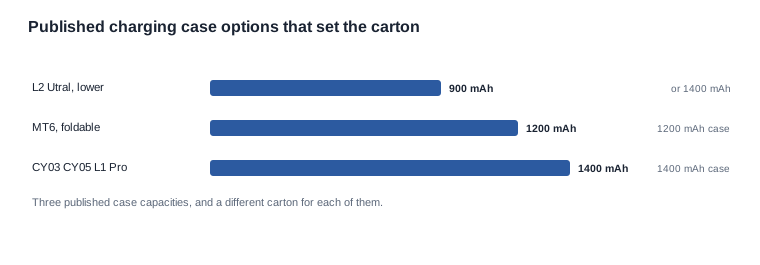
Case capacity, which sets the carton and therefore the volumetric line. Three case capacities are published for the camera models: 900 mAh, 1200 mAh and 1400 mAh, with the L2 Utral published at both 900 and 1400 mAh, the MT6 at 1200 mAh in a foldable case, and the CY03, CY05 and L1 Pro at 1400 mAh.
Charge time, which sets the working-capital line. The charge time is published for every model in the range: at or under two hours for twenty-six of them, and around one hour for the D17 and the ZH12. That figure is useful and it is also routinely over-read, which is the subject of the next paragraph.
Bluetooth version and interface, which set the configuration count and therefore the picking risk. The catalogue publishes the version for the audio and sport models and does not publish it for the camera models, which is worth knowing before a buyer compares two camera configurations on a data sheet.
The charge time, and the three ways it is misread
The published charge time is a real number and it is one of the more useful figures in the catalogue, because it is the only published measure of how long a unit is out of service. It is also routinely misread in three ways, and each misread leads to a cost.
It is not a shift-interruption figure. The catalogue publishes a charge time but not a starting state of charge, and it publishes no end criterion — nothing states what level of charge counts as complete. A buyer who plans a shift around a two-hour charge time has assumed both a start point and an end point that the data does not contain.
It is not the charging case turnaround time. For the models that ship with a case, the case is a second cell with its own capacity — 1400 mAh on the CY03, CY05 and L1 Pro, 900 or 1400 mAh on the L2 Utral, 1200 mAh in the foldable MT6 case — and the catalogue publishes no charge time for any of them. The number on the product page is the device's, not the case's.
It is not a freight input. The charge time does not appear anywhere in the cost breakdown. It appears in the working-capital line, because the time a unit is unavailable is time the programme is carrying stock.
The figures that are not published, and what to ask instead
- Packed carton dimensions, gross weights, units per master carton and freight weights. These follow the final retail packaging and the destination rather than the device, so they are per configuration and per order. Ask for them.
- The volumetric divisor. It is a carrier rule, and the forwarder states it. Ask the forwarder.
- Freight rates, transit times, minimum order quantities, production lead times and production capacity. These are commercial positions that move with volume, season and market, and they are not specifications.
- Certificate numbers, issuing bodies and validity dates, and any per-model certification line. The catalogue carries a company-level export certification page and no per-model row, and we will not infer one from a company-level capability. For a buyer, that is a question to send rather than a figure to request.
- Weight for every model except one. The only published weight in the catalogue is the MT6 glasses body at 158 g, which includes the 265 mAh battery and the camera and excludes the foldable charging case, whose weight is not published.
The commercial levers, in the order to pull them
The six lines break down into levers, and the levers are not independent. Pulling them in the wrong order wastes the effort, because the first lever usually changes the number that the second lever is measured against.
Lever one: the packing density
The cheapest improvement available in this category, and the one most often left alone. The number of retail units per master carton is a decision that changes the volumetric basis without changing the product, the tooling or the artwork. It is the only lever in the breakdown that requires nobody's permission. Agree the density at specification stage, record it, and re-derive the chargeable weight from the new carton.
Lever two: the mode, and the trade-off behind it
Ocean is generally viable for a lithium-powered product once the dangerous goods paperwork is in place, and air is faster and materially more expensive. The trade-off is schedule against cost, and it is a decision about the launch window rather than about the freight rate. A buyer who has not fixed the launch date cannot price the mode, which is why this lever sits below the packing density rather than above it.
Lever three: the duty treatment and the classification
The destination charges line moves with the declared classification and the identity of the importer of record, and both of those are negotiable in the sense that they are open to a documented position. The part that is not negotiable is the cost of a classification dispute, which is why the clause assigning it to the party that wrote the technical file is worth more than a few points of duty rate. The negotiating freight rates article covers the questions that actually move a rate, and the skipping freight optimisation article covers when the volume is too small for any of this to be worth the effort.
Lever four: the failure cost
Cheapest to pull, largest in the tail, and the one most often left out of the model entirely. It is pulled by putting the document checks in front of a payment milestone rather than by spending money.
What is fixed, and what that means for the conversation
The dangerous goods handling charge is set by the cell class and the packaging arrangement, and the testing and registration work behind a market file is per product family and per market. Neither falls with volume, neither falls with a longer contract, and neither can be amortised across orders using a different configuration. The useful question about that work is not whether it can come down but whether the scope is right, because an unnecessary market in the quotation is a cost the buyer chose.
Where our numbers stop, and what to send us
Stated plainly: a buyer should be able to take our itemised quotation and rebuild the landed cost independently, and if any line cannot be rebuilt, it is the line to ask about. We can tell you the published battery capacities, case capacities, charge times, interfaces and colour availability per model, and we will quote freight itemised for a given configuration, quantity and destination. We will not publish a standard freight rate per unit, because a rate without a carton, a destination and a mode is not a rate.
We will also not quote from a photograph, and we will not fill a specification gap with a number that cannot be traced to a document. What we will do is take a use case, a configuration and a market, and tell you which parts are settled, which are open, and which have to come from a forwarder or a broker. The Bluetooth audio glasses range is the lighter end of the configuration space, where packing density and mode choice matter most.
Related reading
- How to negotiate freight rates — the questions that move a rate
- When you can skip freight optimisation — when the volume is too small to matter
- Battery transport — the documents behind the dangerous goods line
- Logistics and shipping — the sequence from carton planning to booking
Give us the destination, the quantity and the configuration, and we will send a freight quotation you can rebuild line by line.


