

Freight optimisation is worth an afternoon when the order is large enough for the saving to matter and structured enough for the saving to be real. It is close to a waste of a day when it is not, and for a meaningful share of buyers in this category the answer is to skip it — because the component of the freight bill that they can actually change is usually not the component they assume it is.
There is one exception that is worth doing whatever the order size, and it is the exception most often skipped. It is the carton.
Smart glasses shipping: separate the permanent saving from the per-shipment saving
Almost every freight saving in this category is per-shipment, which means it resets to zero on the next order. One saving is not, and it is the one that compounds.
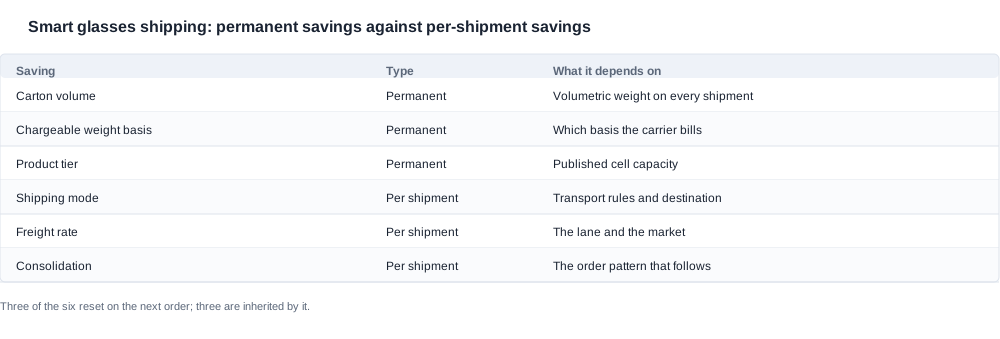
The permanent saving is the shipping carton. Volumetric weight binds before actual weight for a boxed product, so the freight bill on a small unit is a function of the volume it occupies rather than of what is inside it. Halving the carton volume halves the freight on every future order of that configuration, and it also reduces the storage the goods occupy at every step after the factory door. It is a product decision dressed as a logistics one, and it is taken once.
The per-shipment savings are the mode, the rate, the consolidation and the paperwork. A better rate on this shipment has no value on the next one. A consolidated shipment has to be re-negotiated every time the order pattern changes. A mode change saves money on this load and then has to be re-justified against the transport constraints of the next one, because the mode is not a free variable — for a lithium-powered product the mode is constrained by the transport documentation and the destination rules rather than chosen on price.
The reason this distinction matters is that buyers tend to spend their optimisation time on the per-shipment items because those are the ones that produce a visible number this quarter, and skip the permanent one because it produces no saving this quarter. The arithmetic usually says the opposite. A carton that is thirty per cent larger than the goods require costs more on every shipment and costs more in storage, and it is fixed once.
The third permanent item is the pallet and carton standard used at the factory end. A carton that does not stack with the others in a warehouse does not just cost freight; it costs handling, and the handling cost is paid at every step including the ones inside the buyer's own distribution centre. That is a packaging decision made once and inherited forever, and it is worth naming alongside the other two because buyers who check only the shipping carton often miss it.
There is a fourth item that is permanent and is usually thought of as temporary, which is the case configuration. A product that ships with a charging case and one that ships as a bare device are two different transport products even when the device inside is identical, and the difference affects the carton, the declared weight and the classification question. In this catalogue the camera range makes that visible: some models carry a charging case with a published capacity, some carry one whose capacity is not published, and the V03 Pro has no charging-case row. Each of those is a different transport product, and the choice is made once in the product definition and then inherited by every shipment.
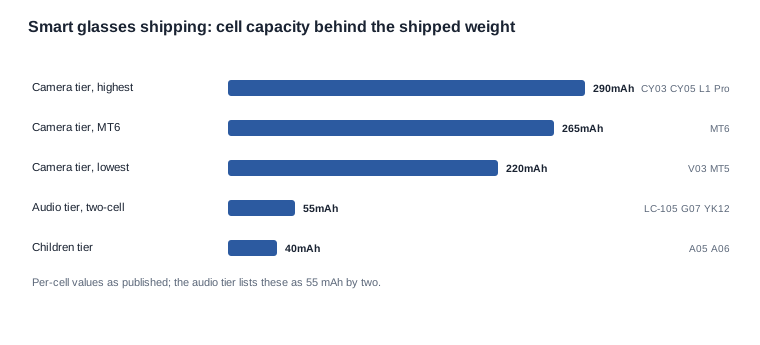
There is a third category, which is neither: the product mix. Our catalogue spans cell capacities from 40 mAh on the children's models to 290 mAh on several camera models, and the audio range is materially lighter than the camera range — the audio models run from 55 mAh per cell in the two-cell configurations up to 100 mAh, against 220 to 290 mAh for the camera models. A lighter configuration always freights better. Which tier you put in the range is a product decision, and it is worth knowing before you design the range rather than after.

Smart glasses shipping: when the freight number cannot move a decision
The test for skipping the optimisation is a percentage, and it is worth calculating before deciding anything else.
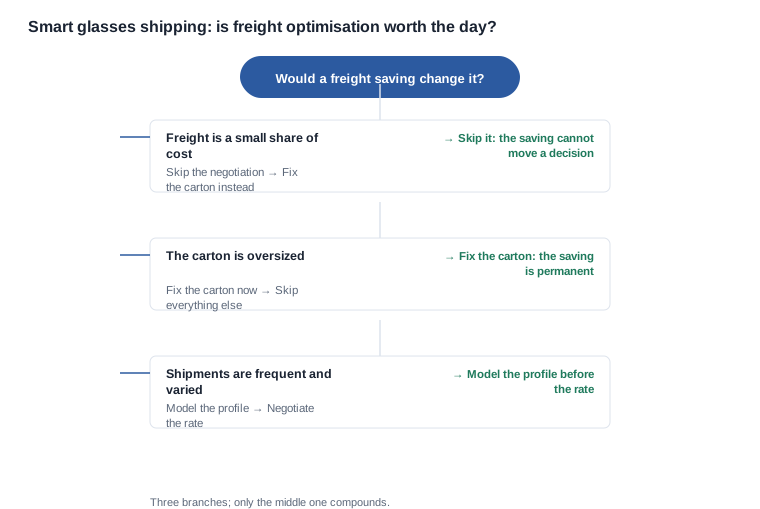
The calculation is three figures, and it is worth writing them down rather than estimating them.
- Freight as a percentage of landed cost. Take the freight on a realistic consignment of the actual configuration and divide it by the landed cost per unit. A figure in low single digits means the optimisation cannot move a decision.
- Shipments per year. The per-shipment saving multiplied by the count is the annual value. Four shipments a year means four opportunities; one shipment means one, and a one-off saving on a one-off is a rounding error at any percentage.
- What the saving would change. The output the whole calculation exists to produce. If the answer is "nothing", the optimisation is not worth running and the conclusion is a legitimate result rather than a failure.
Calculate freight as a percentage of landed cost
For each configuration, take the freight on a realistic consignment and divide it by the landed cost per unit. If freight is a small share, then a ten per cent improvement on it cannot change a decision you have made, and the half-day it takes to find that improvement is better spent on the documentation check, which prevents a loss that is typically larger.
Calculate the number of shipments per year
Optimisation is per shipment, so the annual value is the per-shipment saving multiplied by the number of shipments. A buyer placing four shipments a year has four opportunities; a buyer placing one has one, and a one-off saving on a one-off shipment is a rounding error whatever its percentage.
Ask whether the saving would change the channel decision
If a better rate would not move the number of units you can afford to bring in, it does not matter how much better the rate is. The useful question is not "how much can I save on freight" but "what would I do differently with the saving".
A fourth consideration is whether the freight quote itself is reliable. A freight number built on an estimated carton size, an assumed chargeable weight and a rate that expires is not a number that can be optimised against, because improving it means improving the inputs first. Where the carton dimensions are not published and not confirmed, the optimisation conversation is premature, and the shipping cost breakdown is the six-line version of what has to be established.
Smart glasses shipping: the four inputs that outlive the rate
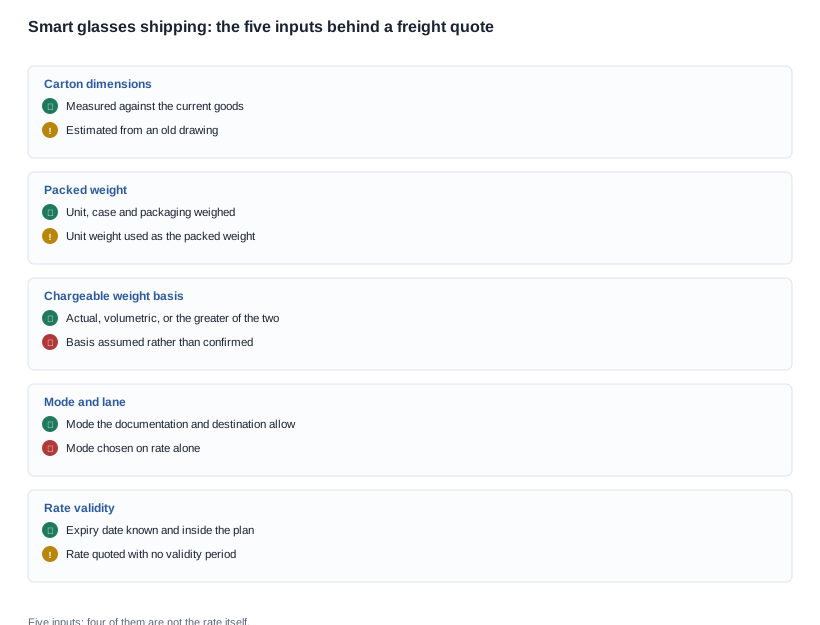
A freight quote is a number built from five inputs, and four of them are not the rate. Optimising the rate while the inputs are wrong is negotiating about the least consequential of the five.
The carton dimensions
These determine the volumetric weight, which for a boxed product is usually the larger of the two weights that matter. A quote built on an estimated carton is a quote built on a guess, and it will be wrong in whichever direction the estimate was optimistic.
The packed weight
The unit, the accessories, the case where one is included, the protective material and the carton itself. This is the second input to the chargeable weight and it is rarely the number the supplier quotes first.
The chargeable weight basis
Whether the carrier bills on actual weight, on volumetric weight, or on the greater of the two. The basis is what converts the first two inputs into a number, and it is worth confirming in writing rather than assuming.
The mode and the lane
The route determines the rate, the transit and the documentary requirements. For a lithium-powered product the mode is constrained rather than chosen, so a "better" rate on a mode the documentation does not support is not available at any price.
The validity of the rate
Rates expire, and a number quoted in one month is not the number in the next. A buyer who optimises against a rate that has expired has optimised against nothing.
The order of work matters, and it is the reverse of the order buyers normally take. The carton and the packed weight are inputs you control or can measure, and they feed the basis, which feeds the rate. Working backwards from the rate is the way buyers normally approach this and it produces a number that cannot be acted on.

Smart glasses shipping: three checks worth making on every consignment
Check the carton against the goods
This is the exception, and the reason it is worth doing regardless of order size is that the saving is permanent and applies to every future shipment of that configuration. It is also the cheapest of the three, because it is a tape measure and a drawing rather than a negotiation. A carton sized to the goods plus the packing material and the accessory rather than to a guess is the single highest-return hour in this category, and the logistics planning article covers the dimensions that have to be fixed before it can be done.
Confirm the chargeable weight basis before the rate is quoted
A boxed product is usually billed on whichever is greater, the volumetric weight or the actual weight, and the two cross at a particular density. A change of product tier can move a consignment from one basis to the other, which means the same goods can have a different freight profile depending on the configuration. Confirming the basis is free and prevents a rate that was quoted against an assumption.

Make sure the document set is right for the mode
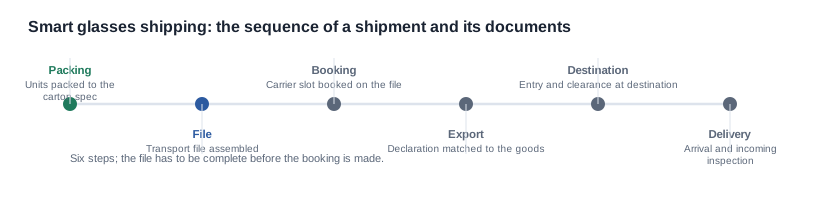
This is not an optimisation at all; it is a precondition, and it is the one that produces the largest losses in this category. A consignment of lithium-powered product needs a transport file that matches the configuration and the mode, and a booking made against an incomplete file is not a booking. The battery transport framework sets out the documents, and the shipment documentation article covers what a supplier has to have ready before the goods are sealed.

Smart glasses shipping: when the optimisation conversation is worth having
There are three situations where freight is worth real attention, and they have nothing to do with the size of the order.
The carton is the problem
If the shipping carton is larger than the goods require, volumetric weight binds on every consignment and the fix is permanent. This is worth doing even on a first order, because the saving is inherited by every reorder.
The mode is wrong
A product with a lithium cell has a mode constrained by the transport rules and the destination, and the wrong mode usually shows up as a cost that looks like freight but is actually a consequence of the documentation route. Working out the mode properly is often worth more than negotiating the rate, and the mode and air freight limits article is the starting point.
The shipment profile is irregular
If orders arrive in unpredictable quantities and destinations, then consolidation and routing are not available and the per-shipment savings disappear. In that case the work is in the order pattern rather than in the freight, and the distribution and stock article is the relevant one.
A fifth case is easy to miss because it feels like a product problem rather than a logistics one: the case configuration has changed since the file was written. Where a model ships with a charging case and a buyer has changed to a bare-device configuration, the carton, the declared weight and the classification question all change with it. The file has to be reissued, and if the change was made on the commercial side without the logistics side being told, the booking is the point where it surfaces.
There is a fourth case, which is easy to recognise because it feels urgent: a shipment that has already gone wrong. A held consignment, a refused load, a damage claim. The work then is not optimisation but evidence — the damage claims article covers the claims process, and the right response is to establish what the file should have contained and put it in place for the next load rather than to argue about the rate.
Smart glasses shipping: a small quarterly order with an oversized carton
The scenario below is a worked reconstruction rather than a customer story. No client is described and no figures are claimed; the configurations, the quantities and the destinations are assumed so that the reasoning can be followed, and every product fact referenced is taken from the published catalogue.
The situation: a small quarterly order and an oversized carton
A brand-side buyer orders an audio model four times a year, in modest quantities, to a single destination. The freight bill is small enough that nobody has modelled it, and the buyer has been asked by a finance function to look at logistics costs. The shipping carton was specified at the beginning of the programme, when the retail packaging was still being changed.
Step one: calculate the share before optimising anything. The freight turns out to be a small percentage of landed cost on each of the four shipments, and the annual number of shipments is four. A ten per cent rate improvement on that base would not change a decision the buyer has made. On the per-shipment side, the optimisation exercise is not worth running, and the buyer says so rather than spending a day producing a small number.
Step two: separate the permanent item from the rest. The carton is the exception, and it is worth checking whether the specification still matches the goods. The programme has changed packaging twice since the carton was set, and the carton was never re-measured against the current retail box. The volumetric weight is therefore paying for air on every shipment, permanently, and the fix is a single measurement and a single change. This is the one item the buyer takes forward, and it is taken forward because the arithmetic favours it rather than because it is interesting.
Step three: check the two things that are not optimisations. The chargeable weight basis is confirmed with the forwarder, and the transport document set is confirmed against the configuration in the current box rather than the one the programme started with. The second check is the more valuable of the two, because the catalogue does not publish a uniform charging arrangement across the range and a box that has changed since the file was written is a real risk. The shipping buyer checklist is the item list for both.
Step four: decide what goes in the file. The record notes that the per-shipment optimisation was declined and why, that the carton was re-measured and corrected, and that the carton specification is now tied to the retail packaging revision so that the next packaging change re-opens it automatically. Without that link the carton will drift again, and the buyer will be back here in two years with the same measurement to make.
Step five: revisit if the shipment profile changes. The decision is explicitly conditional. If the order frequency rises, if a second destination appears, or if the camera range is added to the programme, the per-shipment arithmetic changes and the exercise is worth running. The pricing comparison is the same method applied to the other large component of landed cost, and the logistics and shipping pillar sets out the wider framework.
A closing note on why the freight conversation is worth separating from the pricing conversation. The two are usually run together, and running them together means the buyer argues about a number that cannot move while the components that can move go untouched. The pricing method in smart glasses pricing treats the freight line as one component of a landed cost and asks which component is actually driving the margin; this article treats it on its own and asks whether the saving is permanent. Both questions are worth asking, and they answer different ones.
The freight question and the packaging question are the same question in this category, and the freight numbers are simply the packaging decision expressed in money.
Here, we publish the rows that determine what travels — cell capacity from 40 mAh on the A05 and A06 through 290 mAh on several camera models, charge times of up to two hours for twenty-six models and around one hour for the D17 and the ZH12, rated endurance per model, charging interface and case capacity where published, and the single published weight in the range, the MT6 at 158 g for the glasses body including its cell and camera and excluding the folding case, whose own weight is not published. We do not publish carton dimensions, packed weights, freight rates, duty rates or transit times, because those are commercial and logistical facts about a particular shipment rather than properties of a product. What we can do is tell you which published rows affect what gets loaded and how much of it, and which of your decisions are packaging decisions rather than logistics ones.
If you want to work through a specific configuration, send the model, the configuration, the quantity, the destination and the shipping pattern, and we will tell you which part of the freight bill is a packaging decision you control and which part is a rate you negotiate.


