Sourcing risk in this category is negotiable, but not in the way buyers usually expect. The risk does not come from the product being poor; it comes from the published data being thin, and thin data is a contract problem rather than a product problem. That distinction decides the entire negotiation, because you cannot negotiate a defect rate that was never measured, and you cannot negotiate a weight for a model whose weight has never been published. What you can negotiate is an obligation to produce the figure, on a defined method, by a defined date, against a named configuration.
Four risks are worth naming out loud: specification risk, compliance risk, concentration risk and continuity risk. Three of them close when you write an obligation into the order document. One of them — concentration — closes with a planning decision you make before you sign anything at all. Knowing which is which saves a buyer an entire negotiation cycle spent asking for something structural.
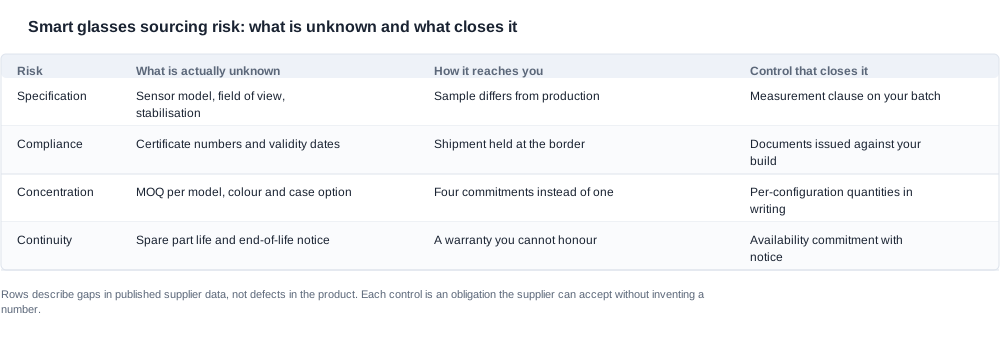
The four gaps that make smart glasses sourcing risk negotiable at all
The reader here is a procurement manager at the brand, a channel buyer or an importer, and the situation is one of three: two quotations are open and both carry a compliance clause that reads identically; a programme is being renewed and the terms were carried over from the first order without a second look; or a new market is opening and the documentation route has never been walked.
Underneath all three is the same question, and it is not a price question. It is: which of these gaps in the published specification would have to close for this order to fail, and who is going to close it? The commercial fear underneath a sourcing risk conversation is rarely a bad unit price. It is a first-article approval that arrives three weeks after the campaign launch, or a certificate number that the retailer asks for on the day the listing goes live, or a charging case that cannot be reordered in year three because nobody said it would be stocked.
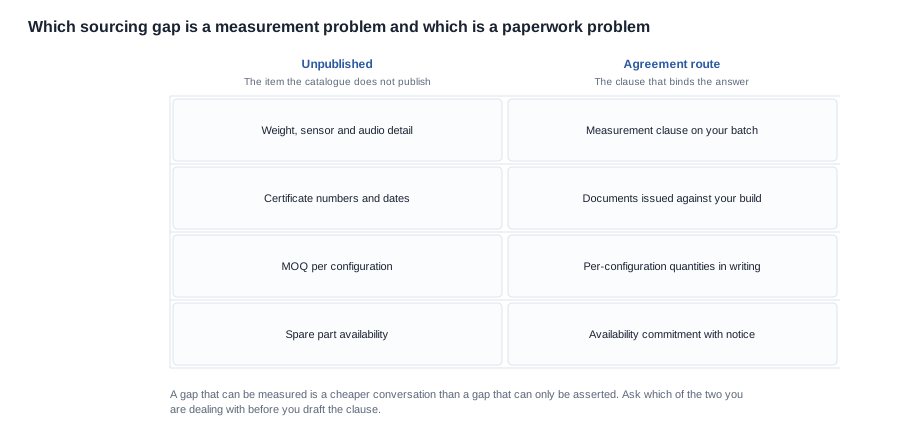
The reason this category is unusually well suited to a written negotiation is that the gaps are specific and named. A catalogue in this range publishes, model by model, the camera resolution tier, the battery capacity, the runtime, the charge time, the charging method, the Bluetooth version where it applies, and the charging case capacity where it applies. It publishes an ingress marking on the two models that carry one — the V06 and the S7 — and no others. It publishes a unit weight for one model only: the MT6 at 158 g, which is the weight of the glasses body including its battery and camera and excluding the foldable charging case.
Everything outside those rows is a legitimate open item rather than a defect. Sensor model, field of view, video resolution, stabilisation and low-light behaviour are not published for any camera model. Microphone pickup distance and the noise reduction method are not published across the range. Certificate numbers, issuing bodies and validity dates are not published. Whether a configuration stays available for the life of a warranty is not published. A buyer who knows which list a given question belongs to is negotiating from a position; a buyer who does not is negotiating from a complaint.

What each risk costs when nobody has priced it
Every risk above has a cost that is only paid when it lands, and the useful part of the negotiation is putting a number or a date against that cost so the two parties can rank the gaps. The table below is the working version. Each row states how the risk is measured, the line it has to meet before you sign, and the shape a weak answer takes.
| Risk | How it is measured | The line it has to meet | How an unresolved gap shows up |
|---|---|---|---|
| Specification | Ask which published rows govern your exact build | Every physical attribute is either published or covered by a measurement clause | A first article that matches the sample and not the production run |
| Compliance | Ask which documents will exist and against what model code | Documents are issued against your configuration and your brand name | A consignment held while the paperwork is chased |
| Concentration | Ask the minimum per model, per colourway and per case option | Each figure is stated separately, not as one range | Four commitments made when one was intended |
| Continuity | Ask what will be stocked and for how long | A written availability term with a notice period | A warranty obligation that cannot be honoured |
Two of these rows are administrative on their face and are the two that decide the outcome. Specification and compliance look like filing work, and both are the difference between an order that can be checked at goods-in and one that cannot. If a buyer accepts a consignment it cannot inspect against anything, the inspection becomes an opinion, and an opinion is not a control.
The reason to write the thresholds down rather than hold them in your head is that suppliers are not hiding these gaps; they are usually working from the same short published set that the buyer is working from. The difference between a supplier that handles the gap well and one that handles it badly is visible in a single behaviour: does the answer to a question about an unpublished figure arrive with a method attached, or does it arrive as a number?
Ranking the gaps before you spend negotiation capital on them
Not every gap deserves the same effort, and a buyer who treats all four as equally urgent ends up with a negotiation that is long, expensive and unfinished at the deadline. Rank them on two axes that a buyer can answer without any supplier data at all.
The first axis is the cost of the failure. A failure that stops a consignment at a border costs the programme a launch window; a failure that produces a unit that does not match the approved sample costs the programme a re-tool of the artwork and a second inspection; a failure that surfaces two years later, in the warranty period, costs the programme a customer relationship and a credit note. In this category the compliance failure is almost always the most expensive one, because the shipment is built, paid for, and then stopped, and the storage and demurrage costs land on the buyer who has already funded the whole build.
The second axis is the cost of closing the gap. A gap that can be closed with one sentence in the order document is cheap. A gap that requires a third-party test report, a new technical file or a re-run of a laboratory measurement is expensive and slow, and it may not be closable at all inside the programme's own timeline. Specification gaps sit at the cheap end when the attribute is something the supplier already measures internally — a unit weight or a runtime figure. They move to the expensive end the moment the attribute has not been measured at all, and the buyer should ask which end it is before deciding how hard to push.
A gap that scores high on the first axis and low on the second is where the negotiation effort belongs, because the return on the effort is largest. A gap that scores low on both is a note in the file, not a fight. A gap that scores high on both is usually a signal that the configuration itself should change — a model with published data, a published colourway, a published case option — rather than that the contract should become longer. The published range is unusually good on this last point, because for most attributes a buyer can choose a configuration where the answer already exists rather than commissioning the answer.
What a gap costs when the answer never arrives
There is a fourth cost that is easy to overlook, and it is the cost of the negotiation itself. A risk conversation that runs for four rounds without a single written obligation will consume the same management time as a price negotiation on a much larger order, and it will produce less, because the price negotiation ends with a number and this one ends with a document. Buyers who have been through a difficult evaluation know this pattern: the evaluation feels productive because the questions are good, and the order is placed with nothing different on paper than it was at the start.
The countermeasure is a simple one and it is worth enforcing on your own team. Every round of the risk conversation ends with an item that has been written down. If a round produces no new written item, the round was not a negotiation and the meeting should have been an email.
The clauses that move a risk onto the party that can carry it
The productive move in every one of these negotiations is the same: replace an assertion with an obligation. It costs the supplier nothing at the moment of signature, because it commits them to producing a fact rather than to guaranteeing an outcome.
A defect definition with an agreed boundary. Not a quality aspiration, but a statement of what constitutes a defective unit and where the line sits between a defect and an out-of-tolerance unit inside the agreed tolerance. A defect definition with no boundary becomes a monthly returns argument for the life of the programme, and it is the single most expensive silence in this category.
A first-article approval procedure. A named number of units, built before the production run, measured against a checklist that the buyer has written. Approval criteria agreed before the first article is built are cheap; criteria negotiated after it has been built are expensive, because the supplier has already priced the work.
A documentation obligation tied to your configuration. Conformity documentation, the battery documentation covering that build, the model designation on the label and the technical file behind it. The clause that matters is not "the supplier will provide certificates"; it is "the supplier will provide certificates issued against this configuration, under this brand name, with model designations matching the product label exactly."
A configuration-change notice period. Who may change a component, a sub-supplier or a process, how much notice you receive, and what happens to the schedule and the price if the change is one you did not approve. The camera models in this range make this concrete: the L2 Utral is offered with either a 900 mAh or a 1400 mAh case, and the case changes the carton, the print area and the goods-in check.
A spare-parts and availability commitment. How long a published configuration remains available, what will be stocked as a spare, and how much notice you get before a configuration is withdrawn. In a range where one model carries no charging case at all and another carries a foldable case, the question of whether the case can be replaced independently of the glasses is a real question with a real answer.
A statement of which figures are contractual and which are indicative. This is the clause that costs nothing and is almost never requested. It is also the one that protects the buyer most, because it prevents an indicative number quoted during the evaluation from being relied on in the landed cost model.
None of these six requires a supplier to invent a figure. Together they convert most of the published gaps into obligations, which is the only honest way to buy from a range where the interesting data is not public.

How to run the risk conversation before the deposit
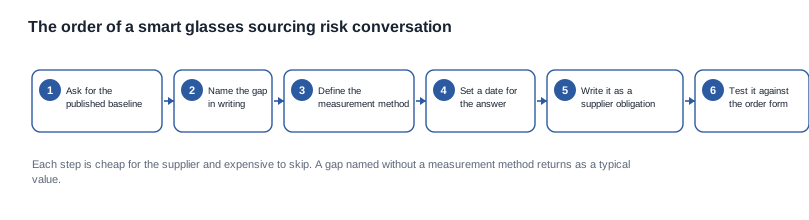
Verification in this category is a document exercise with a date attached, and it works best when it happens before the deposit rather than after it. The sequence below is the one that produces answers.
- Ask for the published baseline, not the summary. Request the specification rows for your exact model code, in writing. A buyer who asks for "the spec sheet" gets a marketing summary; a buyer who asks for the rows gets the data, and the difference in the reply tells you how the rest of the negotiation will go.
- Name the gap yourself, in writing. If the weight of your chosen model is not published, say so and ask what the supplier will commit to. A supplier who will not name their own gaps is a supplier who will not close them later.
- Attach a measurement method to every number that is produced. Weight measured on a sample from your batch, across a defined number of wearers. Runtime measured at a stated volume level and ambient temperature. A number without a method is not data, and the buyer who accepts one will find the difference in the field.
- Set the delivery date for the answer inside the order. An obligation with no date is a preference, and the first production slot is where preferences are tested.
- Check the answer against the order form before signature. Every commitment made in the negotiation should be visible in the document, or it is not a commitment at all. This is the step most sourcing processes skip, and it is the one that makes the negotiation worth running.
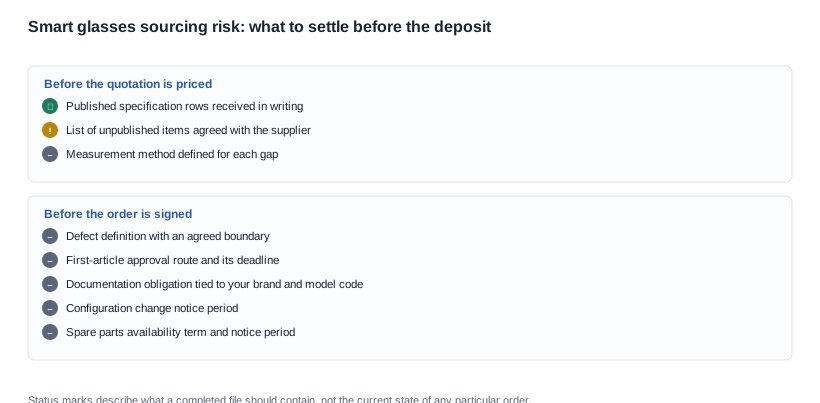
The questions that change the negotiation are worth having in the first enquiry round, because each one changes either the risk or the price of the risk:
- Which published rows govern this model code, and which attributes for this build are not published?
- What will you commit to for each attribute that is not published, on what method, by what date?
- Is the figure contractual or indicative, and how is that labelled in the order?
- What is the minimum for this model code, this colourway and this case option, stated separately?
- Which documents will exist for this build in this market, issued to which model designation?
- How long will this configuration remain available, and what will be stocked as a spare?
- What is the notice period for a configuration or sub-supplier change?
A buyer who asks all seven in the first round is not being difficult. They are establishing which quotation is complete, because a comparison between a quotation that answers these and one that does not is not a comparison at all. The sourcing risk overview sets out the wider risk picture, and the sample policy red flags article covers the habits that predict how a supplier will behave once the order is placed.

Where a sourcing risk negotiation fails after the order is placed
The obligation with no owner. A clause reads "the supplier shall provide certification documents" and no individual is named, so no individual produces them. Symptom: the consignment is ready and the file is empty. Root cause: the obligation was written as an outcome rather than as a task with a date and an owner. Prevention: attach every obligation to a named role and a dated milestone in the delivery schedule.
The gap that returns as a typical value. During the evaluation the supplier provides a measured figure for your batch. Two orders later the same question returns the catalogue figure or an industry average, because nothing in the order required the measurement to be repeated. Prevention: state in the order whether the figure is a one-off commitment or a standing one, and on what frequency it is refreshed.
The concentration that was never separated. A buyer asked for the minimum once and received one number for the range. Four models, four colourways on one of them, two case options on another, and each of those becomes a separate commitment with a separate minimum and a separate stock position. Symptom: three of the four lines are ready and one is months away. Prevention: ask for the minimum per model code, per colourway and per case option, and treat a single range-wide number as an unanswered question.
The continuity question with no answer. The supplier does not know whether the charging case can be ordered separately in year three, because nobody asked until the warranty claim arrived. Prevention: ask at the quotation stage, in writing, and put the answer into the agreement.
The measurement that arrived without the method. The supplier provided a weight figure and a runtime figure, both of them plausible and both of them useless, because no method accompanied them. The buyer priced the margin on those numbers and the first production run did not reproduce them. Prevention: treat a figure without a method as an unanswered question, and make the method part of the answer you accept.
The commitment that covered the wrong build. The supplier answered every question about a configuration that shared the model code but not the case option, the colourway or the packaging. Every answer was correct and none of them applied to the order. This is the failure that a configuration string in the order prevents, and it is why the specification attachment has to name the case capacity, the colour and the artwork version rather than referring to a model by name.
The risk that was renamed rather than closed. A supplier answered a question about the child-product route by describing the radio and chemistry routes instead, and the buyer moved on because the reply was long and technical. The gap was not closed; it was displaced. Prevention: ask the same question in the same form at every stage, and treat a change of subject as an unanswered question.
None of these six is a reason to change supplier. Each is a line that should have been in the order, and each is cheap to write and expensive to discover.
What Cynrin will put in writing, and what it will not
It is worth being precise: we would rather be measured against what we can commit to than against a page of figures we cannot evidence. For this range, the defect rate, the yield, the rework policy, the spare-parts availability, the unit weight for every model except the MT6, the camera specifications, the acoustic metrics, the ingress test report numbers and the certification numbers are all not published, and we will name them rather than fill them.
What we will put on paper for a named configuration is this: the specification as published for that model, the battery documentation covering that build, the model designation that will appear on the label, and the response time we will work to on the enquiry. Four commitments, none of them a figure we would have to invent to make the conversation easier. Unit prices, production lead times and minimum order quantities are confirmed per enquiry rather than published as fixed numbers, because all three are functions of the order rather than of the product.
The documentation structure behind this sits on the certification checklist page, the compliance route for a specific market is covered in the country requirements overview, and the importer side of the declaration is set out in the responsible party article.
Send us the models, the markets and the volumes you are working with, and we will tell you which of the four risks is structural for your programme and which three can be written into the agreement before the deposit goes out.
Tell us the configuration, the destination market and the volume, and we will mark which gaps are structural and which close with a clause.