

Who is responsible for declaration of conformity is a question with a short answer and a long commercial tail. The party that places a product on a market in its own name or mark carries the obligation, and in an OEM programme that party is usually the brand rather than the factory. That answer settles the first question only. It does not tell you who signs the document, who holds the test reports behind it, who answers the market surveillance authority when the product is pulled, or what happens to the allocation when the product is rebranded for a second channel. Those are commercial decisions, and they are made before anyone reaches for a form.
This page is written for the buyer who has to close that gap. It separates what is settled by the regulatory framework from what depends on the structure of your programme, and it states plainly which parts of the answer are not published on this site. The catalogue carries twenty-eight entries and no per-model certification row, so no amount of reading it will tell you who signed anything. What it can tell you is the product facts that the declaration rests on, and the gaps that a supplier has to close in writing before a programme is launched.
The framing matters more than the list of documents. A declaration of conformity is not a certificate you are given; it is a statement a named party makes about a specific product, supported by a technical file that somebody keeps current. If the party making the statement does not exist, or the file does not, the declaration cannot be transferred from one programme to the next by copying a PDF. A buyer who is handed a document without being told who maintains the underlying evidence has been handed a piece of paper rather than a compliance system.
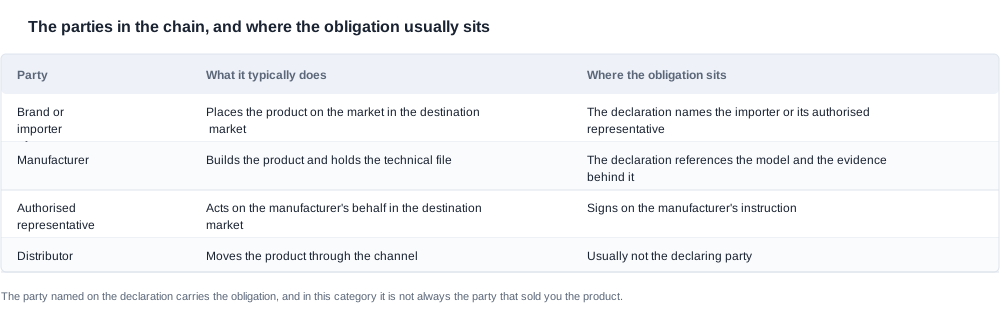
who is responsible for declaration of conformity: the allocation that actually applies
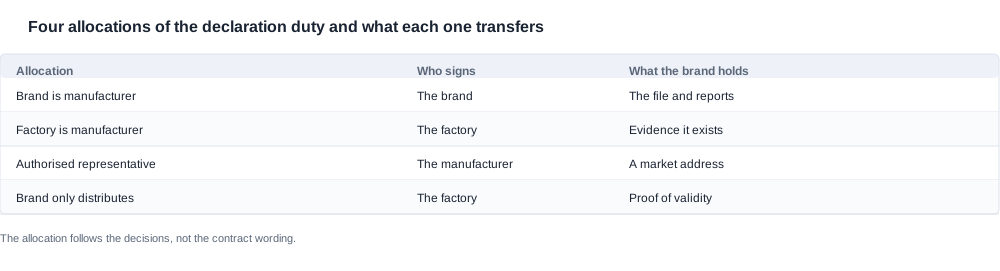
The allocation is a function of who is the manufacturer for that product, and "manufacturer" is decided by what the programme actually does, not by what the purchase order calls the supplier. Four allocations cover almost every case a buyer will encounter, and they are worth naming explicitly because the words in a contract are not what determines the outcome.
- The brand is the manufacturer. This is the usual outcome when the brand specifies the product, puts its own name or trademark on it, and decides the safety-relevant characteristics — the battery, the radio configuration, the materials, the instructions. The brand then carries the declaration, the technical file and the market surveillance duty. A factory may have designed and built the product, but the factory did not place it on the market under the brand's name.
- The factory is the manufacturer and the brand is a distributor. This happens when the brand buys an existing product as it stands and resells it without changing its configuration. The declaration and the file stay with the factory, and the brand's duty is to verify that the documents exist, cover the model being shipped, and remain valid.
- The brand acts as an authorised representative of a manufacturer established elsewhere. This structure exists so that a non-EU manufacturer can have one addressable economic operator inside the market. It changes who receives the authority's correspondence, not who signs the declaration.
- The brand only distributes. This is the narrowest case and the one most often assumed without checking. It applies where the product, its configuration and its documentation are all set by someone else.
The determining factor in practice is a single commercial act: whether the brand makes the safety-relevant decisions. Specify the radio configuration, the cell, the enclosure materials and the labelling, and the brand has usually taken on the manufacturer's role whether or not the word "manufacturer" appears in the supply agreement. Buy an existing catalogue product unchanged and the allocation usually stays with the factory. That is why the first question to settle with a supplier is not "who signs" but "what are we specifying".
Two features of our own range make this question sharper than it would be for a simpler product. The radio question is live because a Bluetooth product falls under the Radio Equipment Directive (EU) 2014/53/EU, which carries its own conformity assessment and declaration obligations on top of the general product safety framework that applies from 13 December 2024. And the battery question is live because every one of the twenty-eight entries in our catalogue publishes a charge time, with twenty-six publishing two hours or less and the D17 and the ZH12 publishing about one hour, which means a lithium cell sits inside every unit that carries a charge time at all. Both features push the brand towards the manufacturer role once it starts specifying them.
A third feature makes the question harder to answer with a document, and it should be said plainly. Three of the twenty-eight entries — the AR model, the electrochromic model and the bone-conduction model — are published without a formal SKU. A declaration of conformity is written against a specific product that can be identified. For an entry that has no SKU in our published records, the identity has to be established before the document can exist, and that is a question for the supplier rather than a gap that can be filled by a buyer.

What our catalogue publishes about certification, and what it does not
Our published position on certification is narrow, and it is worth stating precisely because buyers consistently assume more than is published here. The catalogue carries a company-level export certification page. That page is an image page: it holds ten patent certificates — eight appearance designs and two utility models — and the catalogue text contains no reference to CE, FCC or RoHS anywhere in it. There is no per-model certification row for any of the twenty-eight entries, and there is no per-model record of a pending certification either.
That distinction between an image page of patents and a per-model conformity record is not a technicality. A company-level page tells you that a company holds patents. It says nothing about whether a given Bluetooth product has been assessed for radio conformity, and it cannot be attached to a declaration of conformity for a specific model. If you have received our export certification page in a document pack and assumed it covered the units you are about to ship, that assumption needs testing before it reaches a customer.
Our published position is more explicit about the states that exist across the range, and a buyer should read them as three different answers rather than as one answer with missing detail. For the AI camera category, the Bluetooth audio category and the sport category, the catalogue text names no CE, FCC or RoHS, there is no per-model certification row, and no certificate number exists for us to quote. For the sport category there is an additional qualification: the IP54 marking on the V06 and the S7 is a catalogue annotation with no third-party test report number behind it. For the children's category, no certification information is published at all.
The remaining two categories without a formal SKU are the ones with the least room for an assumption. The electrochromic category has no differentiation claim available because no performance parameters are published for it. The bone-conduction category is published with an amplification gain of 35 dB, and our own product record marks that figure as the highest regulatory risk in the range, with the customisation capability for that category not disclosed at all. A 35 dB gain figure is the kind of specification that can move a product out of general consumer electronics and towards a category with its own regulatory treatment, and that is a question to resolve with a specialist rather than a question to answer from a catalogue page.
One more published fact constrains what any declaration can be based on. Our product record states that none of the twenty-eight entries comes with photography, video or test-report evidence. The catalogue therefore cannot itself serve as the evidence base for a declaration, because the evidence that a declaration points to is not published here. It has to be obtained from the supplier in a form that can be kept and re-checked, and the certification checklist sets out the document set a programme is expected to assemble.
Where the duty lands once a product is on a market
The declaration is signed by one party, but the obligations that follow it touch several. A product placed on a market under a brand's name has to be identifiable, has to have a responsible economic operator reachable in that market, and has to be supported by information a customer and an enforcement authority can act on. Where a brand sells through distributors, the brand remains the party that placed the product on the market, and the practical consequence is that a distributor cannot be asked to answer a recall that the brand has not prepared for.
The radio dimension adds its own layer. A Bluetooth product placed on the market in the European Union falls under the Radio Equipment Directive (EU) 2014/53/EU, and the declaration it carries has to reference the standards the manufacturer used, including the relevant EMC conformity standards in the EN 301 489 series. It is worth being careful with the numbering here, because the two are routinely confused: 2014/53/EU is the directive, and the EN 301 489 series is a set of harmonised standards assessed under it. A supplier who cites an EMC standard as though it were the directive has given you a document reference, not an assessment. The RED route reference covers how the radio question is usually structured for a product in this category.
The general product safety framework that applies from 13 December 2024 adds a second layer that is easy to underestimate, because it reaches products that were already being sold. It requires that the product, as placed on the market, be described by information that is consistent with what the product actually is, and it puts a traceability obligation on the economic operator responsible. That has a direct commercial consequence for OEM buyers: the label, the instructions, the packaging artwork and the online listing are all part of the compliance surface, and each one has to match the technical file. A listing that promises an ingress protection the product does not carry is not a marketing problem; it is a file that does not describe the product.
The traceability requirement is where a small brand is most often caught out, and it is a sourcing question as much as a legal one. A responsible person must be identifiable for the product in the market where it is sold, with an address that can be used. A brand that intends to sell into several markets needs to decide, per market, whether that address is a registered entity, an address it uses for compliance correspondence, or an authorised representative, and it needs to make that decision before the first listing rather than after the first enforcement letter. The GPSR reference covers the framework itself.
What none of this changes is the allocation from the previous section. A declaration is a statement about a product made by a named party. Moving responsibility downstream does not move the underlying work upstream: whoever ends up holding the duty still needs the test reports, the file and the knowledge to maintain them, and those have to exist before the signature, not after it.


The questions that settle the allocation in a specific programme
A generic question produces a generic answer. What a buyer needs is a sequence that forces the allocation to be decided in writing, early, with a date attached. Six questions do most of the work, and the order matters because each one narrows the next.
- Who specifies the safety-relevant characteristics — the cell, the radio configuration, the enclosure materials, the labelling and the instructions? The answer identifies who is making the manufacturer's decisions.
- Who places the product on the market under its own name or mark, and in which territories? Territory matters because the economic operator that has to be reachable is the one in the market of sale.
- Which specific model, colour and case configuration does the declaration cover, and does the supplier hold a declaration for that exact configuration rather than for a family? Our catalogue's own structure makes this a real risk: the L2 Utral publishes two variant names and two case capacities without stating the correspondence between them, so a declaration written for "the L2 Utral" may not cover the unit in the box.
- Who holds the test reports and the underlying technical file, and are they available for review before the first order rather than on request afterwards?
- What happens to the allocation if the product is rebranded or resold to a second channel, and does the declaration travel with it or does the new channel need its own?
- What notice does the supplier give on any change that affects the file — a component revision, a firmware change with a radio consequence, a manufacturing site change — and how is that communicated to the brand?
Those six questions are a due diligence sequence rather than a checklist to be completed once. The moment to run them is before you order, not after the first shipment, because the answers decide what is negotiable. Run them at quotation stage and the answers become terms — the allocation, the change-notification clause, the document hand-over — that can be written into the agreement. Run them later and they become a dispute. Which model you are asking about matters less than the sequence in which you ask, and the trade-off never changes: the questions take time and they occasionally end a supplier conversation, which is considerably cheaper than discovering the answer after the goods have shipped.
The third question is where most of the practical risk sits, and it is worth expanding. A declaration of conformity identifies a product. Our catalogue publishes a case capacity on five camera models, shows a case without a capacity on two more, and publishes no charging-case row at all for four camera models, so "the unit in the box" is not always the same set of parts as the unit in the catalogue page. The buyer who asks for a declaration covering a configuration rather than a model is asking the right question, and the answer will tell them how much of the configuration is actually controlled.
The sixth question has a matching commercial half. A supplier who will not agree to a change-notification clause is telling the buyer that the product can change underneath the file, and a brand that accepts that is accepting an open-ended liability in its own market. It is a reasonable thing to ask for, it is rarely refused outright, and it belongs in the agreement rather than in a meeting note. The contract terms reference is where the change-notification style clauses sit relative to the rest of the agreement.

The document set a supplier must hand over
Whatever the allocation turns out to be, a programme needs the same underlying material, and the honest position is that our catalogue supplies none of it. Six items are the ones to ask for, and each one should be requested for the exact configuration being ordered rather than as a general pack.
- A declaration of conformity for the exact model and configuration, signed by the party that has the authority to sign it.
- The test reports the declaration relies on, identifiable by report number and date, with the tested sample described in a way that matches the shipped product.
- The technical file index, so the buyer knows what exists and what is maintained by whom, without needing the whole file at this stage.
- The label and packaging artwork actually used, with the markings and the warnings that the file refers to, because artwork and file drift is the most common inconsistency found in review.
- The instructions as supplied to the customer, since these form part of the information that the declaration depends on.
- A written statement of the certification status per model, including the models for which no document exists.
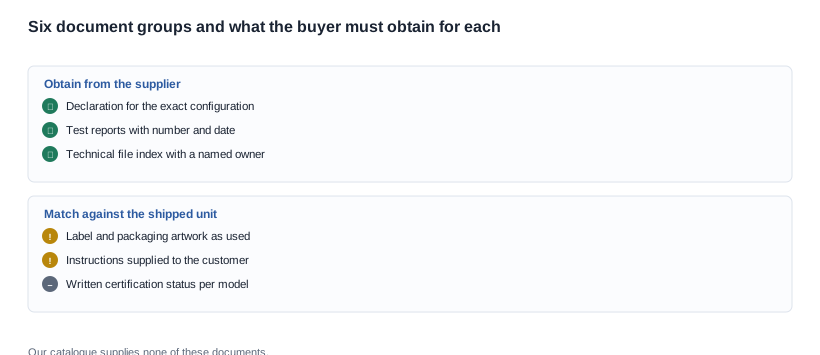
The last item is the one to insist on. A supplier that says "our certificates cover the range" has not answered the question, because a certificate covering a range is not evidence for a model that was never tested. The OEM documentation reference sets out the document categories that a programme typically has to assemble across engineering, quality and legal functions, and it is worth using as the request list so that nothing is discovered to be missing halfway through a launch.
Two further items are worth adding to the request if the programme involves more than one channel. The first is a notification route: a named contact at the supplier who can answer a technical file question within a defined period, which matters because the first authority question usually arrives without warning. The second is a sample of the finished unit in the shipping configuration, so the buyer can confirm that what is in the box is what the documents describe. The sample request reference covers how to state that request so the configuration is unambiguous.
The same list does a second job, because it tells you how to evaluate a supplier on documentation. A shortlist built this way is scoreable: every candidate model is measured against the same criteria, and the result is defensible because it rests on documents rather than on impressions. When two suppliers are set against each other this way, the differentiator is rarely the declaration itself. It is whether one of them can produce a per-model statement naming the certificate and the configuration, while the other can offer only a company-level page. That is one of the clearest red flags in the exercise, because it is the difference between a document set and a document pack.
What a buyer should not do is treat a supplier's willingness to forward a document pack as the same thing as a supplier being able to keep it current. A pack forwarded once is a snapshot. A file kept current requires a named owner on the supplier's side, an agreement on what happens when a component changes, and a copy that reaches the brand rather than staying with the factory. In an OEM programme the brand that holds the declaration is the one that has to answer years later, so it needs the evidence it is relying on in its own possession.
The line we draw on the declaration of conformity
We do not publish a declaration of conformity for any of the twenty-eight entries, because none is published on this site, and we will not present a company-level patent page as if it were a per-model conformity record. We will tell you what the catalogue does carry: ten patent certificates on an image page — eight appearance designs and two utility models — no mention of CE, FCC or RoHS in the catalogue text, no per-model certification row, an IP54 annotation on the V06 and the S7 with no third-party report number behind it, a children's category with no certification information provided, a bone-conduction category whose published 35 dB amplification gain our own record marks as the highest regulatory risk in the range, and three entries published without a formal SKU.
We will also tell you what the product facts are, because a declaration is only ever as good as the description of the product behind it: twenty-eight entries across camera, audio, sport, children's and three SKU-less categories; twenty of the twenty-eight carrying an AI function line; a charge time published on every entry; a charging method published on twenty-four of them and left unpublished on the L1 Pro and the CY05, and the MT6 and the CY03; and a resolution class on the eleven camera models with nothing further published about any camera in that range.
A practical version of the whole page is a three-part enquiry: what to ask, when to ask it, and what a good answer looks like. What to ask is the model, the configuration and the market. When to ask it is the quotation stage, before the terms are fixed. And what a good answer looks like is a per-model statement with a document reference behind it, rather than a general assurance about the range.
What we will not do is answer this question for you by allocating the duty, because the allocation is a commercial decision that follows from what your programme specifies. If you tell us the model, the configuration and the market you are shipping into, we will tell you which published rows bear on the answer, where the documentation gaps are that our own records record, and which questions have to be answered by the supplier and by you before the declaration can be signed by anyone.


