

Smart glasses for office: not a published row, but a measured number
A smart glasses for office order is decided well on the day it is placed and badly on the day it is renewed, and the reason is that the published specification set is strong on the facts of the first week and almost silent on the facts of the twelfth month. The catalogue publishes a rated runtime, a cell capacity, a charge time, a resolution class, a charging interface where it is published and a charging case capacity where it is published. It publishes no cycle life rating, no degradation figure, no standby draw, no runtime test condition and no service life. So the buyer who wants to know what a fleet costs over a year has to generate four numbers that the catalogue does not, and the whole subject of long-term use reduces to whether those four numbers are being produced.
This matters more than it might appear, because the year is where the commercial value of the first order is actually realised. A buyer with twelve months of issued counts, measured runtimes and a replacement log negotiates the second order from a rate. A buyer without them negotiates the second order from a hope, and pays the difference in unit price for it. The four numbers are not a reporting exercise; they are the input to the second order, and they are produced in the same period that the first order is in service.
The published rows are weakest exactly where the year-long question lives
The asymmetry is worth stating plainly, because it is unusual in a catalogue to be strong on one axis and silent on the adjacent one. On the day-one axis the range is unusually informative: eleven camera models each publish a resolution class, a cell capacity from 220 mAh to 290 mAh, a charge time, a rated runtime, and either a charging interface or an explicit absence of one, and each of the five models with a published case capacity publishes that capacity. On the year-one axis there is nothing at all. There is no cycle life rating, no expected capacity after a year, no degradation curve, no statement about whether the published runtime holds after two hundred charge cycles, no standby draw, and no service life. There is also no warranty period published in the catalogue, and no spare-part availability commitment.
That combination has a specific commercial consequence, which is that a one-year renewal cannot be forecast from the catalogue and has to be forecast from the fleet. Any model a buyer builds has to be built on the fleet's own data, which means the measurement routine has to be designed at the order stage rather than discovered at the renewal stage. The alternative is the common one: the buyer assumes the published runtime holds, discovers in month seven that the fleet is short-charged every afternoon, and fixes it with a second charging point per desk — a capital request, a procurement round and a fortnight, none of which were in the budget.
The other thing that has to be recognised early is that the charging infrastructure outlives the unit. The interface differs across the range — magnetic on the MT5 and the V06, the S7 and the V03, and the KY06, Type-C on the V03 Pro and the L2 Utral, and not published at all for the CY05 and the L1 Pro, and the CY03 and the MT6 — so a refresh that changes the model family can strand the docks that were installed for the first run. Docks are the most durable thing in the kit and the most likely to be incompatible with the second-order model, and the way to avoid that is to fix the interface at the first order and make the refresh a question about the same interface rather than about a better model.
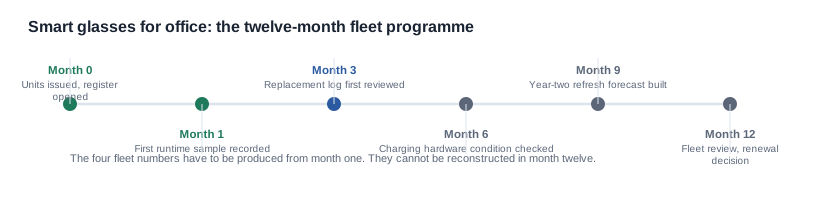

The four numbers a twelve-month fleet has to produce for itself
The four numbers are unglamorous and each one is currently produced by somebody as a side effect of a different job, which is why none of them exists at the end of the year. The work is to make each of them a deliberate monthly output with an owner.
The issued count, and why it is the denominator for everything else
The issued count is the number of units in service, and it is the denominator that turns every other number into a rate. A defect rate computed against units returned is a rate of returns, which is a flattering number by construction, because a unit that works badly and is never returned is invisible to it. The same applies to the usage count: the units that were issued and never used are the units that make a deployment look successful, and they only appear if someone counted the issues.
The issued count is also the number that has to be reconciled against the asset register, because a unit that is issued and not recorded is a unit that has been lost rather than one that is in service, and the two are indistinguishable in every other number. The practical routine is a single line per unit in a register, and a monthly reconciliation against the units physically accounted for. The full register structure is in the office gear checklist, and the deployment template that holds it is at the office deployment template.
A measured runtime, not a published band
The published runtime is a band without a condition: 5~8 h for the V06 and the V03 Pro, and the S7 and the V03, 6~8 h for the KY06 and the MT5, and about seven hours for the CY05 and the MT6, and the L1 Pro and the L2 Utral, and the CY03. A band without a condition is a claim, and a claim cannot be monitored. What a fleet can monitor is a measurement: the same units, the same volume, the same pairing, the same ambient conditions, recorded every month, which produces a trend line rather than a number.
The trend line is the point, and it is the only way to answer the year-long question, because the published figure cannot move and the fleet's own figure does. A runtime that holds steady across twelve months tells the buyer that the cell is behaving and that the charging routine is adequate. A runtime that falls across twelve months tells the buyer when the replacement wave will arrive, which is exactly the number needed to size the second order. A runtime that is stable but lower than the published band tells the buyer that the band was never a description of their use, which is worth knowing before a renewal is negotiated against it.
The replacement log
The replacement log is a list of the units that failed, with the model, the date and the reason. The reason is the field that carries the value, because a replacement attributed to a charging contact is a consumable and a hygiene problem, a replacement attributed to a cell is a cell problem, and a replacement attributed to a software or configuration issue is neither.
The log is also the document that turns a warranty conversation into a commercial one. A clause that names the issued count as the denominator and a log that supplies the numerator are what allow a buyer to say something specific about a rate, and a specific rate is worth more in a renewal than a general assurance that the supplier stands behind the product. A defect rate of a certain figure against a known denominator is an argument; a supplier statement that quality is a priority is not.
The spare ratio in practice, and what a withdrawal costs
The spare ratio is agreed as a number in the order, and then it is tested by the first withdrawal. A unit withdrawn for repair is a unit out of service, and in an office with a small issue, the absence of a spare is felt by the person waiting for it on the same day. The number that matters is not the ratio but the time to replacement, because that is what the user experiences, and it is a service commitment rather than a stock number.
The related point is that the spare unit has to be the same model as the unit it replaces, not merely a similar one. A spare drawn from a different model is a spare for a different workflow, and in an office where the record purpose differs by role, that is a subtle failure: the record still gets made, with the wrong model, and the error is in the data rather than in the process. The spare pool therefore belongs to the issue structure rather than to the store cupboard, which is the same argument that puts the cases in a central pool.
The case pool as a year-long asset
A case is a second lithium cell, and over twelve months it is the item in the kit that behaves most like a consumable and is most often treated as durable. The published capacities are 1400 mAh on the CY03, the L1 Pro and the CY05, 900/1400 mAh on the L2 Utral and 1200 mAh on the MT6's foldable case, and the cycle life of those cells is not published for any of them. So the case pool needs the same treatment as the fleet: a count, a drawing rule and a reconciliation.
The drawing rule is the part that decides whether a pool works. A pool that is drawn from on request and returned at the end of the day behaves like a shared locker; a pool that is drawn from and never returned is a stock that shrinks. The difference between those two is a signature on issue, and a signature is the cheapest available control, because it turns a loss from an invisible quantity into a conversation with a date attached to it. Where the case is a magnetically attached foldable unit rather than a separate object, the return behaviour is even easier to enforce, because the case and the glasses are one thing to issue and one thing to return.
The reconciliation is monthly, and it is the same monthly routine as the fleet count. A case that is not in the pool and not recorded against an issued unit is a lost cell and a lost asset, and the number of lost cases over a year is a number that has to be available for the year-two order, because it is part of the total cost of the case structure. Buyers often establish this number by accident in year two, when the pool is found to be a third smaller than the issue records implied, and the replacement has to be bought at the year-two price rather than the year-one one.
The transport file over a year
The battery transport documentation is a per-shipment document rather than a per-product one, and it is the item in the file that quietly expires. A configuration shipped in year one with a particular case architecture is a configuration whose transport file was prepared for that case. If the case structure changes in year two — from a case per unit to a pooled case, for example, or from one case capacity to another — the transport file has to be prepared again for the configuration as it will now ship, and the question of whether the case is covered has to be asked again rather than assumed from the previous shipment.
That is a small administrative point with a disproportionate consequence, because a transport file requested at the border is a delay on the buyer's schedule rather than a decision, and because the case is the object most likely to change in a renewal. Putting the transport file on the same schedule as the other order documents is the whole mitigation, and it costs one line in the order checklist.

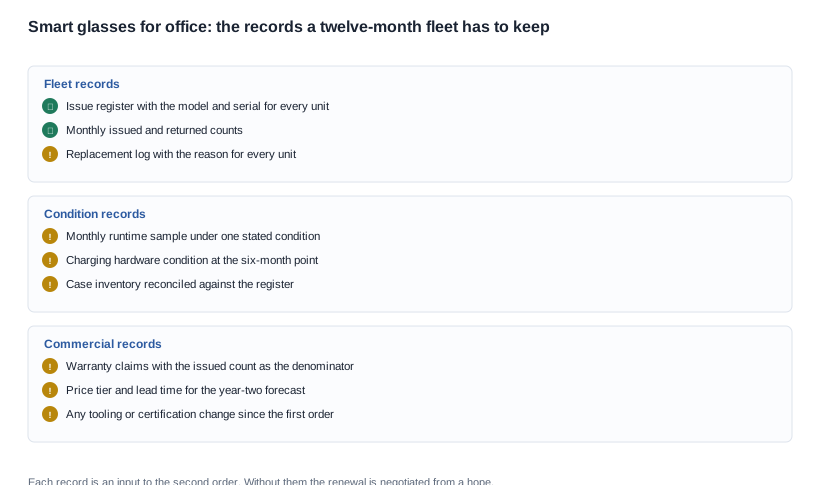

The cost structure of a year, and which lines the buyer controls
A fleet's annual cost is not the unit price, and a renewal negotiated against the unit price alone will miss the lines that have actually grown. The table below sets out the seven lines that recur, what drives each of them, and the term that has to be agreed at the first order for the line to behave predictably in year two.
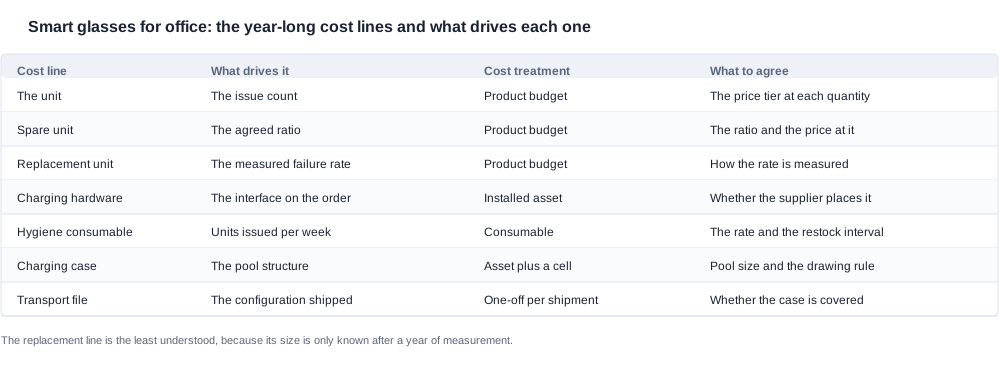
Two of those lines behave differently from the rest. The replacement line is the one the buyer controls least and understands least, because its size is the product of the failure rate and the fleet size, and the failure rate is the number that only a year of data produces. The charging hardware line is the one the buyer controls completely, because the decision to install at every desk rather than at the shared points is a choice made at the order stage, and it is a choice that gets more expensive every year it is deferred.
The consumable line is the smallest in money and the largest in effect, because the contact hygiene item is what keeps a magnetic interface working, and a fleet that is short of them reports a fault rate that looks like a product problem. The rate to agree is per unit per week with a restock interval, and it is a budget line rather than a product line, which is why it disappears from the second-order forecast and then reappears as a support problem. The budget treatment of the same items is at the office budget breakdown.

The refresh decision, and what it has to be based on
The second order is the point at which a year of deployment converts into commercial position, and there are three things the buyer can be in a position to say by then that a buyer without fleet data cannot.
The first is a measured runtime trend, which converts the renewal from a repeat of the first order into a specification discussion. A buyer who can show twelve monthly points can negotiate on the configuration that suits the actual use — including the case structure, which is the variable that the published data cannot settle because the catalogue publishes a case capacity for five camera models, indicates a case with no capacity for two, publishes no case row for three and publishes the V03 Pro explicitly without one.
The second is a measured failure rate with a denominator, which is the difference between a warranty argument and a commercial one, and which is also the input to the spare ratio for the next year. The third is an experience-based answer to the charging infrastructure question, which is where the audio tier produces a surprise. The eight audio models publish three runtime bands: about eight hours on the K01, the K02 and the LC-105 pair, about seven hours on the D11 and the D12, and about six hours on the G07 and the YK12.
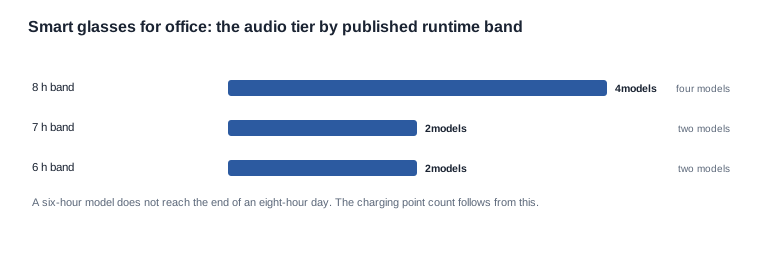
A six-hour model does not reach the end of an eight-hour day. An office that issues the G07 or the YK12 and waits for staff to charge them at the end of their shift is running a fleet that loses its second half of every day, and the symptom is not a complaint about the product but a slow accumulation of unrecorded meetings. The remedy is a second charging point at the desks where those two models are issued, which is a per-location kit decision rather than a per-unit one, and which is exactly the kind of thing that a year's data exposes and a purchase order never would.
What to change in the second order, and what to keep
The renewal is the first point at which a buyer can act on the data, and the temptation is to change everything. That is usually wrong, because the three things a fleet measurement can tell a buyer are the three things that should not change in a renewal.
The published configuration should not change, and the reason is the installed charging hardware. A refresh that moves between interfaces strands the docks that were placed for the first run, and the docks are the most durable and least movable item in the kit. The interface is fixed at the first order for the same reason the case architecture is: the charging point is an installation, and an installation is not moved for a spec improvement.
The record purpose should not change either, because the data that makes the renewal valuable is only comparable if the use is comparable. A renewal that changes what the records are for produces twelve months of data that cannot be compared with the next twelve, and the buyer loses the trend line that was the point of collecting it. If the record purpose has genuinely changed, the right response is a new baseline and a new measurement start, stated as such, rather than a silent redefinition inside a renewal.
What should change is everything the measurement actually bears on: the case structure, the spare ratio, the consumable rate, the charging point count per location, and the acceptance criteria for the first shipment of the new run. Those are the variables a fleet's data constrains, and they are also the variables that cost a buyer nothing to change, because none of them is embedded in the installed hardware or in the recorded data. The published rows behind them are at battery life and camera imaging, and the commercial structure of a renewal is at pricing.
What we publish about long-term behaviour, and what to send us next
We publish the rows a buyer can order from, and we will not fill the year-one gaps with a typical degradation figure. That means the resolution class, the cell capacity, the charging interface where it is published, the rated runtime, the charge time, the charging case capacity where it is published, the Bluetooth version on the audio and sport tiers, and the structural features that are published — with the IP54 marking on the V06 and the S7 stated as a catalogue attribute, and with the surround sound published on the YK12 and the ultra-slim detachable temples published on the G07, with no touch row published for any model in the range.
What we do not publish and will not estimate: the cycle life rating, the expected capacity after a year of use, the degradation curve, the runtime test condition, the standby draw, the operating temperature range, the service life, the warranty period, the frame material, the lens material, the coating, the hinge specification, the unit weight beyond the single 158 g whole-unit figure for the MT6, the field of view, the video specification and the storage and overwrite behaviour. A buyer who wants a year-one answer to any of those has to measure it, and we would rather say so than publish a figure that a fleet will disprove in month four.
Send us the issue count, the models, the environments and the date you need the renewal decision by, and we will return the published rows for that configuration, the documents that have to be settled before the order, and the four fleet numbers we would want measured from month one. The acceptance checks for the first week are at the office test sequence, the gate structure that catches the specification gaps is at the deployment gate checklist, what a first order produces in practice is at what to expect from an office deployment, and the scenario entry point is smart glasses for office.
Related reading
- How the scenario opens — smart glasses for office
- The kit that has to last the year — the office gear checklist
- The commercial structure — pricing
- The gates that catch the specification gaps — the deployment gate checklist
Send us the issue count, the models and the renewal date, and we will return the published rows and the four fleet numbers to measure from month one.


