

Smart glasses for outdoor: the scenario where sequence becomes a design decision
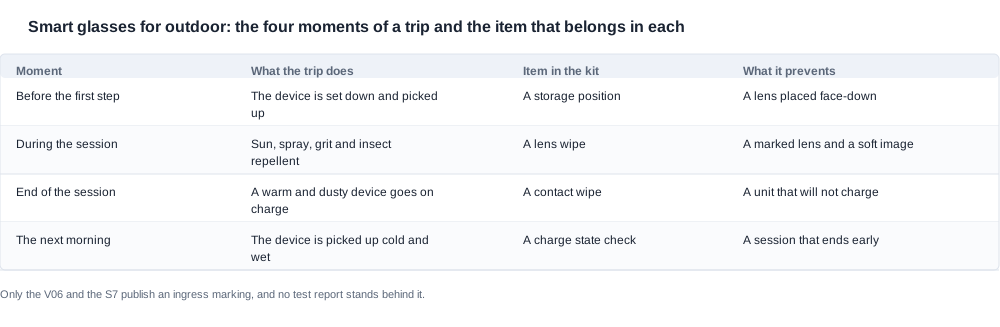
The short answer. An outdoor kit is not a set of accessories; it is a sequence of four moments, and the order in which the items are used is a design decision that belongs to the buyer rather than to the factory. A trip puts a device down before it starts, exposes it to sun, grit, spray and insect repellent while it runs, puts a warm and dusty unit on charge at the end of the day, and picks it up cold and wet the next morning. Each of those four moments has one item that belongs to it, and the most common outdoor failure is not a missing item — it is a lens placed face-down on a car roof because nothing in the kit told the customer where to put it. So the specification for an outdoor kit is two things: the four items, and the order the insert puts them in. The order is free to decide and cheap to print, and it is the difference between a kit that protects a lens and a list of parts in a box.
Who is specifying the kit, and what they are defending. The reader is a purchasing manager at the brand, a channel buyer or a product manager specifying an outdoor line for either a consumer channel or a professional deployment. The decision in front of them is what the kit contains and, in a way that is less obvious and more valuable, in what order the customer is told to use it. What is being defended comes in two halves. The first half is the claim the insert is allowed to make, because an outdoor kit is where a durability claim either survives or does not, and the difference between the two is decided by two models in the catalogue rather than by the copywriter. The second half is the return rate, and in this category the return rate is driven by a lens complaint that is really a storage complaint, which is why the storage position is the first item in the sequence and the first item in the insert.
Why two outdoor kits for the same device can cost very different amounts. The published rows for the sport family are close together, so the divergence between two quotations is rarely the battery. It is the charging architecture, because the interface decides whether a case is an accessory or the charger, and a case is the most expensive line in any outdoor kit and the one that carries a second lithium cell into the transport file. Our catalogue splits the charging method three ways across the twenty-eight models: seventeen are magnetic, seven publish a Type C interface, and four publish neither a charging method nor a charging port row — the CY03 and the MT6, and the CY05 and the L1 Pro, each of which does publish a charging-case capacity. The sport models that fit an outdoor line best, the V06 and the S7, are magnetic, and they are also the only two models in the entire catalogue that publish an ingress marking. The charging decisions are at charging solutions, the charging plan is at charging for outdoor trips, and the product family is at sport smart glasses.
The four moments of a trip, and the item that belongs in each
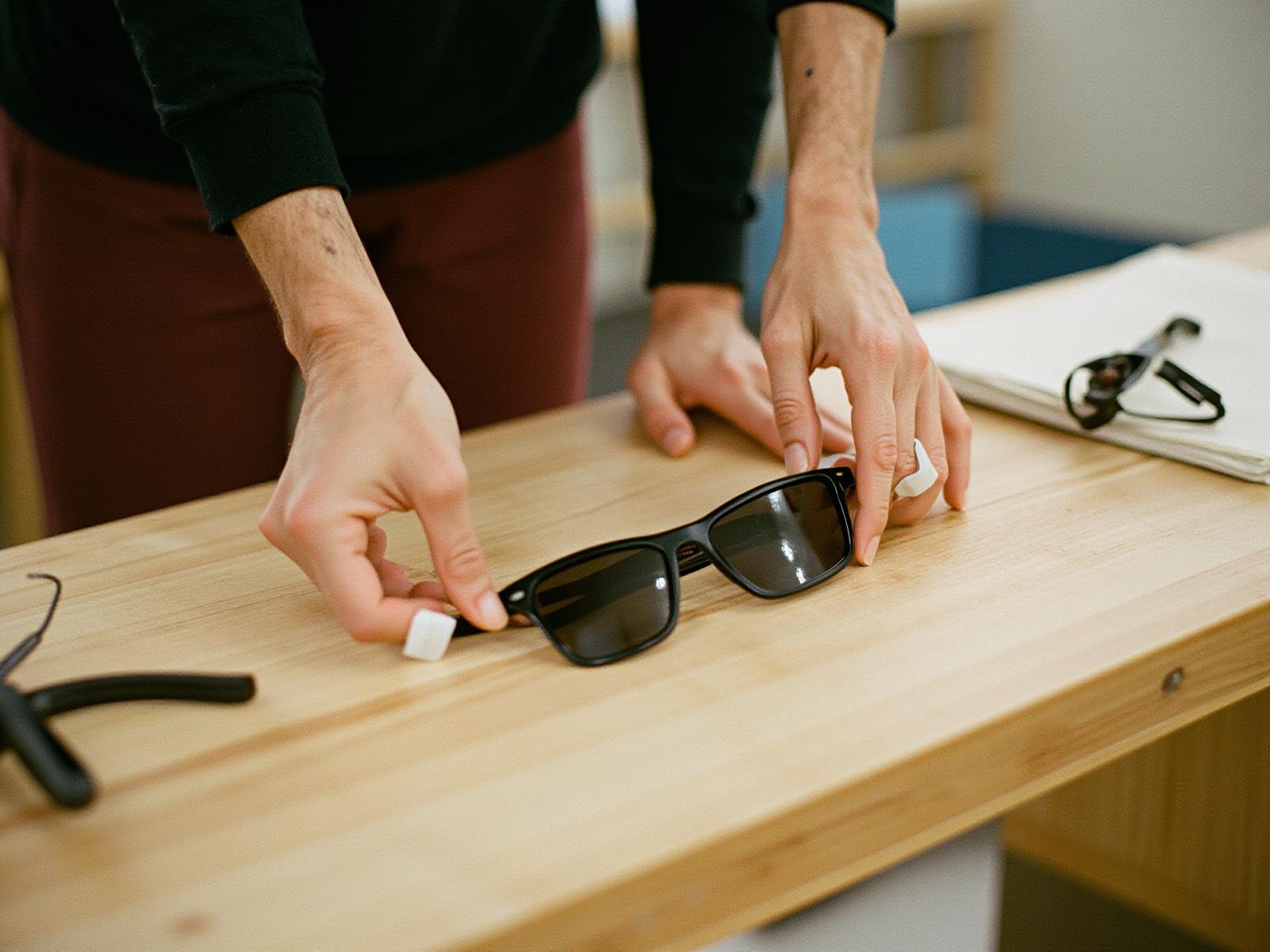
The first moment is before the first step, and it belongs to the storage position. A lens is damaged as often by what it rests against as by what is used on it, and an outdoor trip is constant putting down: a car roof, a trail wall, a picnic table, a tent floor. The item that answers this is a case, and the case positions in the catalogue are these. Five camera models publish a capacity: the L1 Pro and the CY05, and the CY03 — each at 1400 mAh, the L2 Utral at 900 or 1400 mAh as a configuration choice, and the MT6 at 1200 mAh in a folding case. Two more, the KY06 and the MT5, publish a case without a capacity. Three, the V06 and the V03, and the S7, publish no case row at all, and the V03 Pro has no charging-case row. The sport models publish no case row either. So for the two models that carry the ingress marking, the storage position has to be requested as a custom accessory, and a buyer who assumes the catalogue supplies one has assumed something it does not.
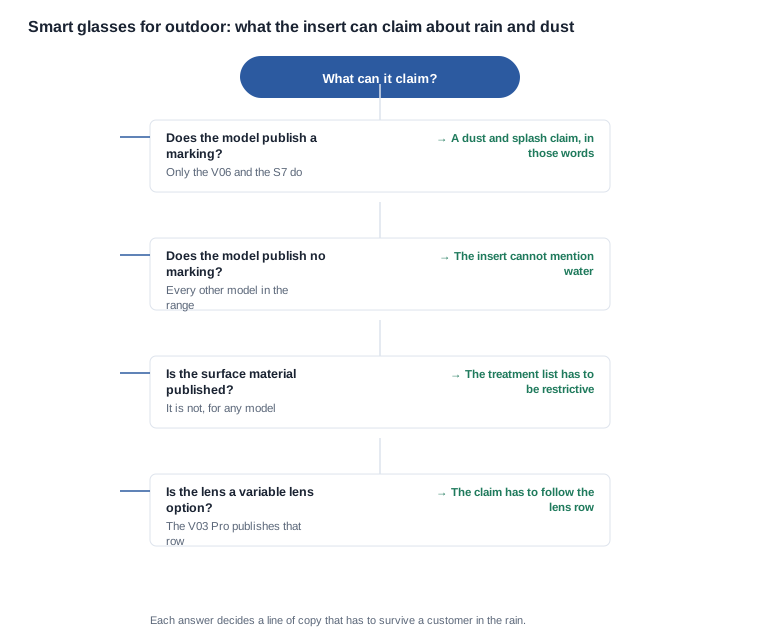
The second moment is during the session, and it belongs to the lens wipe. The trip agents are the substance of this moment, and they are the substances an outdoor customer actually carries: sunscreen, insect repellent, salt spray, dust, mud, and the condensation that forms on a cold lens when it comes into a warm tent. The lens material, the coating and the surface treatment are not published for any model in the range, so the instruction has to be restrictive rather than permissive, and the trip agents have to be named explicitly rather than described as "dirt". A supplied item is the only reliable way to control what reaches the lens during a session, because the alternative is whatever is in the pocket, and the pocket on an outdoor trip contains sand.
The third moment is the end of the session, and it belongs to the contact wipe. A device charged in a warm, dusty environment accumulates contact debris, and the failure is gradual enough that nobody reports it until the unit will not charge on the morning it is needed. That failure lands as a hardware complaint, travels to a supplier who cannot see the cause, and consumes the warranty budget of a product that is working perfectly. The contact wipe costs a fraction of a unit price and removes the category, and it has to be ordered to the sequence — after the session, before the charge — rather than sitting in the box as a general-purpose item.
The fourth moment is the next morning, and it belongs to the charge state rather than to the lens. This is the moment that decides whether the trip continues, and it is the moment where the published runtime numbers matter most. The camera family publishes runtime on all eleven of its models, in three groups: the V03 Pro and the V03, and the V06 and the S7 publish five to eight hours; the KY06 and the MT5 publish six to eight hours; the CY05 and the MT6, and the L2 Utral and the CY03, and the L1 Pro publish about seven hours. The sport rows add the D17 at about seven hours and the ZH12 at about eight. The charge times are published for all twenty-eight models, two hours or less for twenty-six of them and roughly one hour for the D17 and the ZH12. What is not published is the starting state of a charge or the point at which charging counts as finished, and neither is a night-time number, because a night-time charge is an overnight window that nobody has measured.

The trip agents, and why the instruction has to name them
A prohibition list that says "do not use solvents" is not a prohibition list; it is a hint. The outdoor instruction has to be specific, because the specific substances are the ones that reach the lens.
The list the buyer has to obtain, per model. The lens material, the coating and the surface treatment, in writing, because those three decide what may be applied to the lens at all. The permitted treatment for the lens, which is the item in the kit and the only thing the instruction may recommend. The permitted treatment for the charging contacts, which is a different surface with a different rule. And the prohibited agents, which have to be named rather than categorised, because the trip substances are what cause the damage and the customer will not recognise them under a category heading.
The four agents that cause the most outdoor damage, and why each one behaves differently. Sunscreen is a film that becomes part of the surface and is then wiped, so the risk is the wiping rather than the sunscreen. Insect repellent is a solvent, so the risk is the product itself. Salt spray is hygroscopic and leaves a residue that is abrasive once it dries. Dust and grit are the case where a lens is put down on a surface rather than in a case, because the grit is what gets ground into it. Naming all four in the insert, and pairing each with a permitted action, is what turns a prohibition into a procedure.
The claim the insert is allowed to make, and the two models it can make it about. Only the V06 and the S7 publish an ingress marking, and the marking covers splashing water and a dust protection level; it does not cover immersion or a sustained downpour, and no third-party test report is published behind it. A kit that includes a "waterproof" card, or an insert that says the device is safe in the rain, is making a claim the documentation cannot support — on any model, and on those two models the claim still has to be written as dust and splash protection rather than as waterproof. The digit reading is at IP ratings, and the buying list is at the outdoor checklist.
The one lens claim that is a published row. The V03 Pro publishes a variable lens and a Type C charging port, and it is the only configuration in the range that publishes a lens that changes. That row is worth putting in the kit decision, because a variable lens is a different outdoor proposition from a fixed one, and the buyer can describe it from the published row without extrapolating. What the row does not publish is the speed of the change, the light level that triggers it or the temperature range, so the copy has to stay at the level of the row.

The file that makes an outdoor kit quotable
An outdoor kit is decided by a small number of documents, and each request below has a completion standard. The standard is what keeps a claim in the insert traceable to a document, which matters more here than in any other channel because the copy is about surviving a trip.
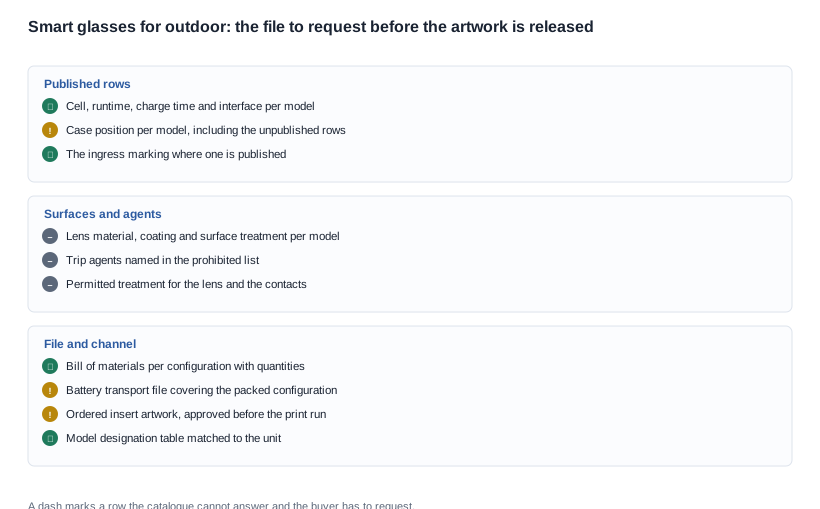
- The published rows for each model in the set — the cell, the runtime, the charge time, the interface and the structural features. The completion standard is that they are copied rather than summarised, so the sequence in the insert is built on the catalogue rather than on a range description.
- The case position per model. The completion standard is one of the four published states: a capacity, a case row without a capacity, no case row, or an explicit published absence. The L2 Utral also needs its configuration stated, because 900 mAh and 1400 mAh are two different products with two different freight weights.
- The case's own charge time, its charging input and whether it charges the device while plugged in. The completion standard is a number with a starting state and a yes or a no with the test method, because the overnight window is the number the trip plan is written around and none of the three is published.
- The lens material, the coating and the surface treatment, per model. The completion standard is a written statement per model, because it is the statement that makes the permitted-treatment line possible.
- The prohibited-agents list, with the trip substances named. The completion standard is a list the insert can quote directly, and the buyer has to check that sunscreen, insect repellent, salt and grit appear in it rather than a category heading.
- The permitted treatment for the lens and for the charging contacts. The completion standard is an item description the factory recognises, so that the same product can be ordered again in the second year.
- The battery transport file for the exact configuration, including the case. The completion standard is a document reference naming the model, the case configuration and the cell count. The requirement is at battery transport.
- The ordered insert artwork, approved before the print run. The completion standard is a proof showing the four moments in sequence, and the supplier's obligation to check it against the model actually being shipped. An insert ordered for a different configuration is the most expensive printing error in this category.
- The model designation table and the incoming inspection criteria. The completion standard is that the designation on the unit resolves to the paperwork, applied to a stated sample of the production lot. The register procedure is at certification checklist.
Where an outdoor kit fails on the second day
The lens that was put down on a car roof. Nothing in the kit told the customer where to put the device, so the device went on the nearest flat surface, face-down, with grit on it. The control is a storage position that is in the kit and in the first line of the insert.
The lens that was wiped with the wrong thing. A damp cloth, a sleeve, a pocket lining. The control is a supplied item and a named prohibition list, and it is the only line in the kit that controls what reaches the lens.
The unit that would not charge the next morning. The contacts were fouled at the end of the previous session, and the failure surfaced as a dead device in the cold. The control is the contact wipe at the end of the session, in that order, and a charge-state check as the first thing in the morning.
The trip that was planned on a rating. The runtime figure was multiplied by the days of the trip, and the multiplication ignored that no runtime in the range carries a test condition and that no charge time carries a starting state or an end criterion. The control is a buffer planned against the published window and measured on a sample, and a case or a second device whenever the configuration allows one.
The claim the insert could not carry. A "waterproof" card on a model with no ingress marking, or on one of the two models that have it. The control is the marking row, quoted in the copy in the words the row uses, and no test report behind it is published on any model.
The kit that was correct and the order that was not. Four items in the box, and no sequence. The control is the ordered insert, which is a design decision the buyer makes and the factory prints, and which costs nothing beyond the artwork.
The commercial terms of an outdoor line, and what to send us next
Whether a case is included, and at which capacity, is the cheapest way to build a price ladder from one platform. It is also a compliance decision, because an included case is a second lithium cell in the transit file, a measurable change to the pack volume, and a second object for a customer to lose on a trail. The trade-off is worth stating plainly: a case costs more per unit and reduces the lens-damage rate, and a buyer who has not measured that rate is negotiating the wrong side of the trade.
The consumables and their per-unit cost are usually the cheapest return-rate reduction available in this category. The lens wipe and the contact wipe cost a fraction of the unit price, and they are the first lines to be cut when a budget is tightened. The quantity to negotiate is the quantity per device per trip and the restock interval, and because an outdoor customer buys a case once and then a consumable every few months, the interval is what decides the reorder pattern. It should be set from the rate observed over the first season rather than from a forecast.
The order of the instruction is negotiable in a way that most buyers do not realise. The supplier prints the insert, so the sequence is a term of the artwork, and it is worth putting in the agreement as an item the supplier is obliged to follow. The same applies to the logo, the lens tint and the packaging, and to splitting a first run into two deliveries against a staged payment, which suits an outdoor launch that builds through a season.
What cannot be moved, because it is fixed before the commercial conversation starts. The cell configuration, the charging interface, the charge time, the runtime ceiling and the case architecture of any given model are published rows. The ingress architecture, and therefore the rating the product may carry, is fixed as well — it is a property of two models in the catalogue. Certification cost and its lead time follow the process and the testing body rather than the order size. Tooling and mould cost is a third category and the one most often bundled: tooling is normally amortised across an order while certification cost follows the product family, and a blended line hides a cost that repeats on every future order next to one that does not. Ask which line the quotation is charging.
The terms worth putting in the order. The published rows for each model in the set. The bill of materials per configuration. The case position, capacity and charge time. The lens material, coating and permitted-agents statement. The battery transport file for the exact configuration. The ordered insert artwork and the supplier's obligation to check it against the shipped configuration. The incoming inspection criteria and the point in the flow at which they are applied, which is the point at which the payment node sits. The warranty period with a stated response, and the treatment of a unit returned with a missing accessory. The building blocks are at pricing, contract terms and MOQ.
What we publish, and where we stop. We publish the colour availability, the cell capacities, the case capacities, the structural features, the charge times, the rated runtimes, the resolution tiers and the charging interfaces exactly as the catalogue states them, and we publish the absence of the frame and lens material, the hinge specification, a per-model frame weight, an operating temperature range, a cycle life rating and an ingress test report with the same prominence. We will not present a case capacity as a number of additional hours, and we will not state that any product is tested to IP54.
What to send us. Send the trip profiles, the channel, the price band, the markets and the models, and we will tell you which kit items the configuration requires, what order the instruction should take them in, which claims your configuration can support, and which three rows have to be requested in writing before the artwork is released. The scenario entry point is outdoor.
Related reading
- The point where the scenario starts — outdoor
- Which family this is — sport smart glasses
- The charge plan — charging for outdoor trips
- The buying list — outdoor checklist
Tell us the trip profiles and the channel, and we will say which kit items the configuration requires and what order the insert should take them in.


