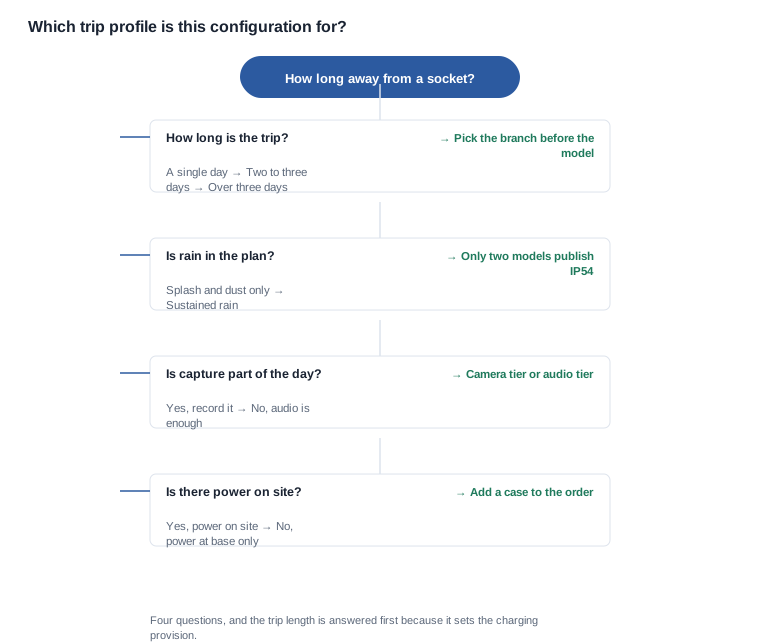
Outdoor checklists fail for a reason that is easy to miss: they are written as one list rather than as branches, so every accessory is marked essential for a two-hour walk and optional on a four-day traverse. For a channel buyer building a retail line, that produces the worst of both outcomes — a day-trip SKU that carries a case it does not need, and a multi-day SKU that carries a case that one unit cannot support.
The published figures in this category are wide enough that a single plan under-serves both cases. A rating written for a day out leaves a multi-day trip short, and a rating written for a multi-day trip makes the product look heavier and dearer than it is for the far larger day-trip volume. So a smart glasses for outdoor checklist that a procurement manager can actually use is built backwards from the trip profile, and it answers four commercial questions: which tier is in scope, which accessory set goes in the carton, what the product page may say, and which fields have to be closed before the purchase order is signed.
Smart glasses for outdoor trips: the trip length sets the charging plan
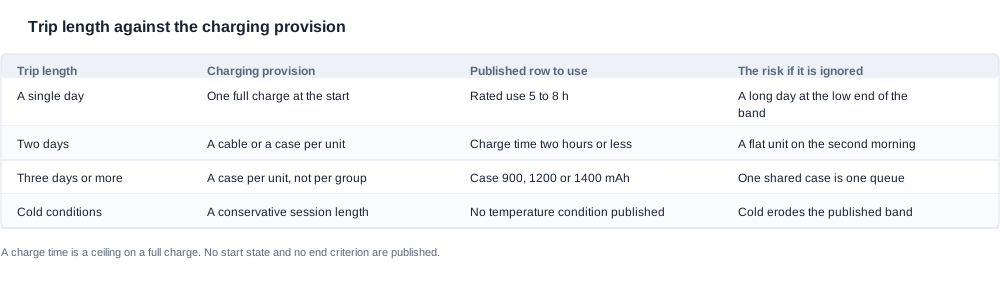
The published charge time across the range is a ceiling rather than a schedule, and that distinction changes the arithmetic of a trip plan. Twenty-six of the twenty-eight entries publish a charge time of two hours or less; only the D17 and the ZH12 publish about one hour. A ceiling of two hours or less permits exactly two hours, so a charging rota built on a two-hour assumption against a unit that takes two hours and ten minutes fails in the one place it cannot be recovered — the morning of the second day.
The second thing the published rows do not carry is a starting state and an end criterion. The charge time is stated for a full charge with no definition of what "full" means in the test, and no definition of the point at which the unit is considered ready. That means the figure cannot be turned into a case turnaround time for a goods-in or returns operation, because a case turnaround is a charge-from-partly-empty problem and the published figure is not a charge-from-empty problem.
| Trip segment | Charging provision in the carton | Published row to use | Commercial risk if it is ignored |
|---|---|---|---|
| Day trip | One full charge at the start | Rated use from five to eight hours | A unit that dies before the return, and a return rate that cannot be explained |
| Long day | Plan on the low end of the band | The five-to-eight-hour rows, read as five | A unit that dies during the second half of the working day |
| Two days | A cable or a case per unit | Charge ceiling of two hours or less | A flat unit on the second morning, which is a replacement unit and a freight cost |
| Three days or more | A case per unit, not per group | Case capacities of 900, 1200 or 1400 mAh | One shared case becomes one queue at the goods-out counter |
| Cold conditions | A conservative session length | No temperature condition published | Cold erodes the published band and the winter return rate rises |
The fourth row is the one that catches a channel buyer out. "A case per group" works for a day trip and fails on the third morning of a multi-day trip, because the case then has to be handed between users at a time when somebody is waiting. The catalogue publishes a charging case for a limited set of camera models — the CY03 and the L1 Pro, and the CY05 — each at 1400 mAh, the L2 Utral at 900 or 1400 mAh, and the MT6 as a 1200 mAh folding case — and the KY06 and the MT5 have a case with no published capacity. The catalogue publishes no case row at all for the V06 and the V03, and the V03 Pro or the S7, and a blank row is not a published statement in either direction: it is an open question to put to the supplier rather than a settled answer to plan a kit around.
The fifth row is the one a written plan cannot fix. Every rated use figure in the catalogue is published without a temperature condition, and no operating temperature range is published for any model. Planning a winter range against the published band means planning against a figure that was not measured in winter, and the gap between the two is not a specification the channel can close from the catalogue. It is closed by reading the figure as a ceiling, writing a plan with margin underneath it, and saying so on the product page so the seasonal return profile is predictable rather than surprising.
Reading an ingress designation against a trip rather than against a word
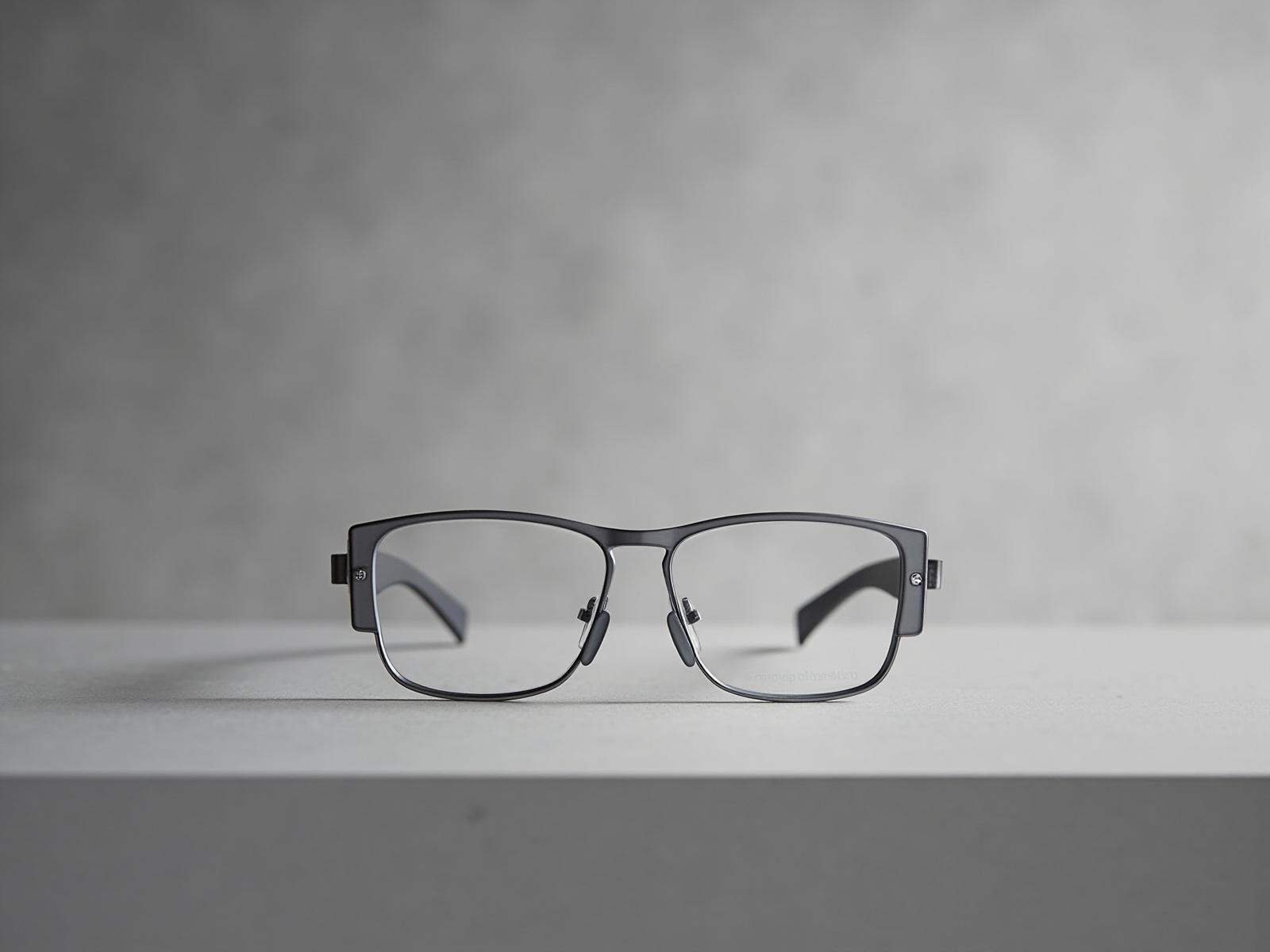
Two models in the entire range carry a protection marking. The V06 and the S7 both publish a catalogue IP54 marking and both are camera models in the sport form factor. No third-party test report number is published behind the marking and no test standard is cited in the catalogue either, so what is available to a channel is a marking to describe, not a level to substantiate.
Reading the marking against a trip is a two-step exercise. The first digit is a solid-particle protection level. The second digit is the one that matters outdoors, and a four means protection against splashing water rather than immersion, a water jet or driving rain. So a trip involving spray — a sea cliff path, a waterfall path, a shallow river crossing — sits inside what the marking describes. A trip involving sustained rain, wading, a submerged recovery or a hose rinse sits outside it.
That distinction is a liability question rather than a marketing nicety. A listing that says waterproof where the documentation carries a marking is making an assertion the documentation does not support, and the assertion is tested the first time a customer is standing in the rain. The wording that holds up names the marking and states what its second digit covers in the same sentence, so that a distributor's compliance reviewer and the end customer are never left to infer more than the catalogue says. Where a channel's target market requires a substantiated ingress figure, that is a report request with a lead time, and it has to be made before the programme rather than during it.
The case-sealing question belongs in the same branch as the marking. A charging case that is only partly sealed protects the unit less than a bag does while appearing to be the more serious option, and that mismatch is normally discovered on the fourth day of a trip when the case is already in the pack. Where the catalogue publishes a case capacity, it publishes a capacity and nothing else — no sealing standard, no ingress figure for the case itself — so the case in the published rows is a battery, not a weather protection device. A channel that puts a case in the carton as a weather feature is making a claim the documentation does not carry.
Two more trip conditions deserve a line in the packing instruction. A trip where the units are left in a vehicle overnight has a temperature problem that no published row addresses, since the operating temperature range is not published for any model. A trip where the units are handed over between people needs a hygiene instruction that no catalogue row covers either. Both are procurement tasks rather than product gaps: the instruction is written by the channel and goes into the carton.
And one branch question belongs to the buying team rather than the product team. Which of the trip segments a channel actually stocks is a margin decision, not a feature decision, because the accessory set is what separates them. A day-trip SKU needs no case, and a day-trip SKU therefore carries no case cost in the carton, no case in the freight band and no case to explain in the customer service macro. A multi-day SKU carries the opposite. The published case capacities — 900, 1200 and 1400 mAh — are therefore a price-ladder input as much as an endurance input, and the unit that sits at the top of the ladder is the one whose margin has to carry the accessory cost. A sourcing manager who treats the case as a free inclusion has misread the catalogue, because the case is a published capacity, a packaging decision and a freight-band decision all at once.

What a camera configuration adds to every branch

Choosing a camera configuration adds three checks to whatever branch the trip has already selected, and each one corresponds to a figure that is not published, which is why they are the ones that get skipped when a buying deadline lands before a documentation request.
Storage and retrieval. The storage path and the overwrite behaviour are not published for any model in the range. An outdoor session is long, and a silently overwritten take is a take that does not exist, which for a channel means a customer who paid for a capture and received nothing. The question has to be answered on a sample: how a long session is handled, whether it overwrites, whether it stops, and what happens at the boundary.
Field of view. Not published for any model, and the figure gets quoted as diagonal, horizontal or vertical by different suppliers without being labelled. It decides whether the frame captures what the eye sees or whether the operator composes the shot afterwards. The question to put in writing is what the number is and which axis it refers to, and if the answer is a single figure with no axis, treat it as unlabelled and do not put it on the page.
Stabilisation and the moving frame. Handheld first-person video from a head mount is difficult to use in long takes without stabilisation, and stabilisation is not published for any model in the range. A still frame is the easiest thing to capture and the least predictive thing to sell in this category, because the customer is filming while moving. A sample test therefore has to be a moving test, and the acceptance criterion written into the purchase order has to say so.
And the camera tier brings its own weight, which is not published either. Unit weight appears once in the whole catalogue, on the MT6 glasses body at 158 g, which covers the frame, the 265 mAh cell and the camera and excludes the foldable charging case. No other model has a weight row and no model has a bare frame weight. The camera tier is where the unpublished-weight problem is sharpest, and where a sample weighed from the production batch is least optional if the channel is going to make any comfort claim.
A worked configuration for the three-day branch. For a three-day traverse with no power at base and a recording requirement, the catalogue supports a cased camera configuration: the L2 Utral publishes a 290 mAh cell, a runtime of about seven hours, a charge ceiling of two hours or less, a Type-C port and a charging case at 900 or 1400 mAh, so a case per unit covers the trip without a shared queue. Two fields have to be closed on a sample before that configuration is signed: the storage and overwrite behaviour, and the unit weight. Two fields have to be closed in writing: the field of view with its axis labelled, and the standby current, because a unit left in a case overnight is a unit whose overnight draw is unpublished. The specification for that SKU goes to the factory with the purchase order, not after it.
The questions a cold or wet trip raises that a warm one does not
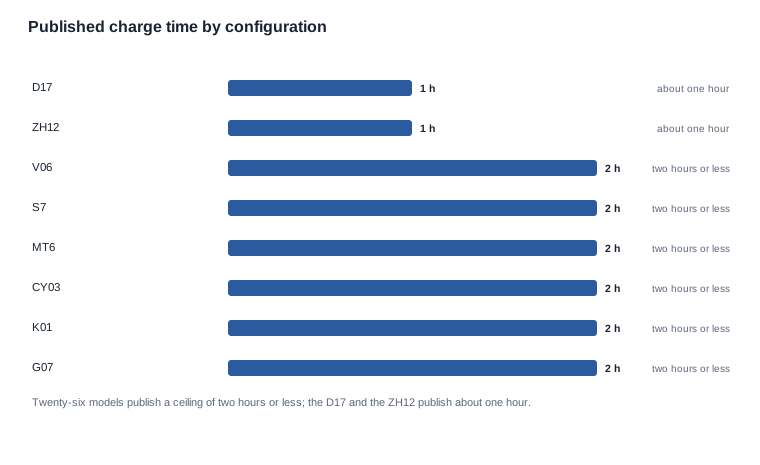
The bars above are the published charge ceilings across a sample of the range, and they are almost uniform. Twenty-six entries publish two hours or less and two publish about one hour. The uniformity matters for a buyer comparing configurations: charge speed is not a differentiator, and a sourcing decision made on it is spending negotiating capital on the one variable that cannot separate two models.
A cold trip changes three things and only one of them is on the page. The first is available energy, and the published runtime figures carry no temperature condition. The second is charge rate, because a cell below its comfortable charging temperature charges slowly, and the published ceiling was not measured cold. The third is condensation, which forms on a unit that comes in from the cold into a warm vehicle and which no catalogue row addresses at all. The commercial consequence of the third is a defect dispute: the unit was not dropped, it was not submerged, and the channel still pays for the replacement.
A wet trip changes the claim rather than the hardware. If the trip involves sustained rain rather than splash, then no configuration in this range can carry a substantiated water claim, because only two models publish a marking at all and that marking does not cover sustained rain. The answer is a plan rather than a product: a dry bag in the accessory set, a rotation that keeps some units out of the weather, and a product page that describes the marking accurately so the seasonal return profile is predictable.
A high-altitude trip changes one published row. Air pressure at altitude affects a sealed cell, and none of the catalogue rows carry a pressure condition. That is a question for the supplier in writing rather than an assumption to be made by the channel.
The set of questions a cold or wet trip raises is therefore short and specific. Whether the runtime figure is measured at room temperature and by how much it erodes below that. Whether the charge ceiling applies at low temperature. Whether the marking covers the exposure the trip actually has. Whether condensation has a rule in the packing instruction. And whether the unit is used in the rain at all. None of these can be answered from a catalogue page, and all five can be answered in a single written request or a single sample session — which is why they belong in a documentation request issued in week zero rather than in an enquiry that arrives with the purchase order.
Which is why this checklist ends where it ends. A trip profile selects a branch, the branch selects a configuration, the configuration selects the fields that have to be closed, and the closed fields become the specification and the acceptance criteria in the purchase order. The fields that cannot be closed on paper are the ones that decide whether a season is viable, and they are known in advance — which means the request can go out before the buying calendar commits the budget.
The configurations we will and will not quote against a trip
Stated plainly: we will state, for any configuration and any trip profile, whether it suits the brief and where its published rows stop. For the outdoor range that means the cell capacities, the charge ceilings, the rated use bands, the charging interfaces, the structural features that are published, the case capacities where they are published, the pixel classes on the camera models, and the IP54 marking on the V06 and the S7 stated as a marking and attributed to those two models only.
What we will not publish, and will not fill in from another supplier's listing: the field of view, the video resolution and frame rate, the stabilisation, the low-light behaviour, the storage and overwrite behaviour, the standby current, the operating temperature range, the cycle-life rating, the per-model unit weight beyond the single MT6 body figure at 158 g, and any ingress report behind the marking. Minimum order quantities, unit price bands, production lead times and packaging costs are confirmed per enquiry, because they depend on the configuration freeze, the quantity and the destination market rather than on the catalogue.
We will also push back, which is the part of this that costs us. A camera configuration for a cold multi-day traverse with no case and no power at base is a brief we will question rather than quote without comment, because the published rows do not carry it. A request for a waterproof claim on a model that publishes no marking is a request we will decline to support in writing, and the clause language for that is a matter for contract terms rather than for a product page. And a request for a unit weight on any model other than the MT6 is a request we will answer with the position that it is not published rather than with a figure that happens to look right for the range.
The outdoor section covers the gear around the unit, the published sport entries are on the sport smart glasses range page, and the packing side of a trip is covered at how to pack for outdoor. The commercial structure of a first order is at pricing.
If you describe the trip profile — the length, the weather, the power at the destination, whether the recording is the point, and the quantity and destination market for the order — we will tell you which branch it falls into, which published rows that branch rests on, which fields have to be closed before the purchase order, and which configurations we would not put in the carton. The support side of the same brief is at outdoor support resources, and the higher-speed case is at what to avoid with cycling smart glasses.
Related reading
- The packing side — how to pack for outdoor
- The support side — outdoor support resources
- The faster case — what to avoid with cycling smart glasses
- The measurement side — how to measure results for outdoor