

Smart glasses microphone quality: component figure, product figure
A microphone row on a datasheet is almost never a product measurement, and the gap between a component figure and a product figure is where most of the disappointment in this category comes from. Smart glasses microphone quality smart glasses how to read a datasheet is a read in three parts: what a microphone parameter actually is, which rows carry real weight, and what to do when the supplier publishes nothing at all — which, in our own range, is the normal case.
On the data, our position is plain and worth stating at the top, because it tells you what kind of document you are holding. We publish the technique for the Bluetooth audio family — open-ear acoustic structure, directional audio and smart noise reduction — and we publish no microphone specification for any model in it: no pickup distance, no noise figure, no frequency response, no microphone count and no third-party report.
That is not an oversight and it is not a marketing position. It is the honest description of where this category sits, and it is also the reason a datasheet read is so useful: the buyer who knows which row is missing can ask for it, while the buyer who believes the row is present will publish a figure that no unit meets.
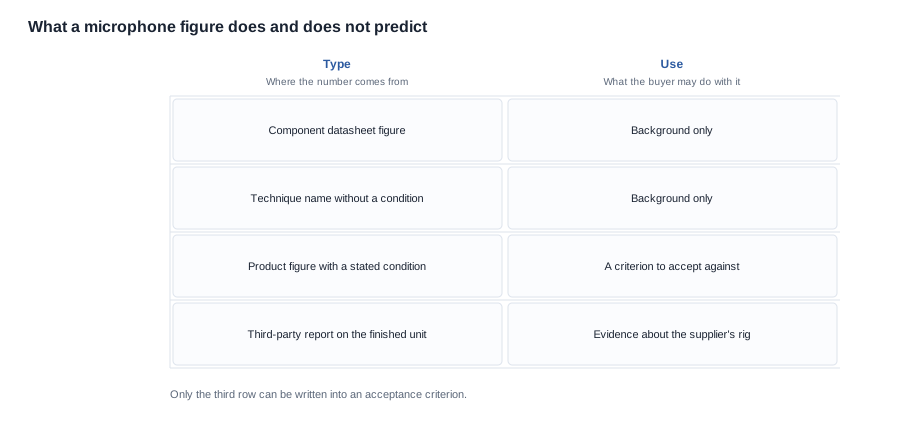
What a microphone read has to settle
Whether any figure on the sheet was measured on the finished product. This single question sorts the sheet into two documents: one that describes a microphone in a laboratory fixture, and one that describes the unit a customer will wear. Everything else follows from the answer.
Whether the supplier has a test rig at all. The presence of a third-party report on the finished product is evidence about the evidence. It tells you that somebody measured this product, on a method, on a date, and it tells you the supplier owns the equipment to do it again. A supplier with no rig will negotiate differently from one that has one, and the difference shows up in how they answer the request.
What the processing costs. Every noise-reduction stage has an artefact: gating, pumping, a voice that sounds compressed and lifeless, or speech that disappears when the noise estimate is wrong. A supplier who names the technique and describes the artefact is more useful than one who claims the technology removes noise, because the first can be tested and the second cannot.
Whether the sheet is comparable to anything. A figure with no condition attached, from a fixture, with the processing in a different state, is not a weaker answer than a product figure with a condition. It is a different answer, and mixing the two produces a conclusion that cannot be defended.
The buyer choosing a call-quality tier
A brand product manager building a business-emphasis range is deciding whether the call experience is the reason to buy or a checkbox, and their exposure is the return rate. A product that sounds bad on calls in a real street environment does not come back as a technical complaint; it comes back as "not what I expected", which is the most expensive kind of return to argue with.
A channel buyer assembling a tier for a marketplace listing holds a price point, a customer profile and a set of samples. Their exposure is the listing text, because "AI noise reduction" is a line that can be written for free and that a customer will test on their first noisy call.
A procurement manager with a target cost is usually being asked to make the acoustic tier cheaper, and the temptation is to change the microphone or relax the processing. Both changes are invisible on the outside of the product and both change the acoustic result, which is precisely why they need a notice clause rather than a quality conversation.
What a microphone decision actually costs
The four cost layers behind an open-ear acoustic performance
The microphone component. A bought-in part, specified by part number, with a datasheet that describes its behaviour in a fixture. The cost of this layer is small and the cost of getting it wrong is not, because the component has to be specified against the frame geometry it will sit in, not against a free-air test condition.
The acoustic structure of the frame. Open-ear audio means the transducer is on the outside of the head and the sound has a path to the ear that the frame itself shapes. The port, the grille, the seal around the transducer and the position of the port relative to the mouth are all part of the acoustic result, and all of them are frame decisions rather than component decisions. This is the layer where a frame programme and an acoustic programme meet.
The processing. The digital signal chain: the noise estimate, the gain applied, the gating thresholds, the mixing between the voice path and the playback path. In our range the published technique for this family is open-ear acoustic structure, directional audio and smart noise reduction, and the technique names are real. What is not published is what the processing does at its edges, which is where a customer will hear it.
The firmware and the codec. The voice codec actually negotiated on a call, the build that carries the processing, and the default state the unit ships in. The codec is a network condition rather than a microphone condition, but it decides what a customer hears on a call, and a product that negotiates one codec behaves very differently from one that negotiates several.
Why the acoustic data is absent from almost every sheet
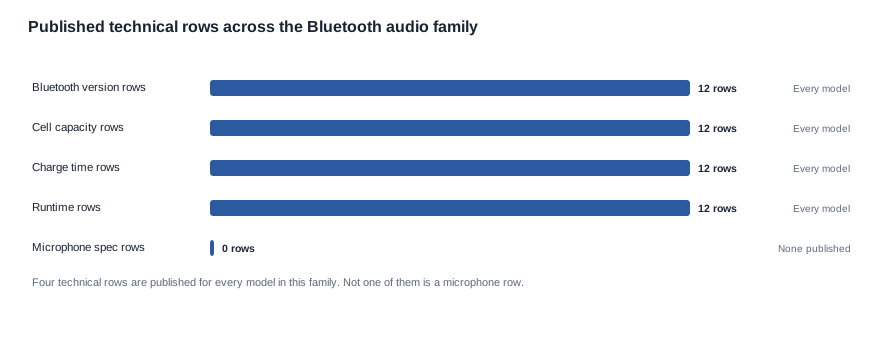
The chart above counts the rows our own catalogue publishes for the Bluetooth audio family: the Bluetooth version, the cell capacity, the charge time and the runtime are published for every model in the family, and the microphone specification rows are published for none of them. That is not an accident of this catalogue. It reflects where the data sits in the supply chain.
A microphone figure can only be produced by somebody who has the assembled product, a defined stimulus, a defined noise environment and an agreed way of scoring the result. Component suppliers have the first two and not the last two. Assembly factories have the last two and often not the first. The measurement itself belongs to a product development team that, in this category, frequently does not exist, because the acoustic design is inherited from a platform rather than developed per product.
The commercial consequence is that the absence of microphone data is not evidence of a bad product. It is evidence that nobody has been asked to produce it. A buyer who treats the blank as a defect will disqualify good products, and a buyer who treats the blank as acceptable will publish a claim that cannot be defended.
The nine rows that decide whether a microphone is specified
Send the table before the samples are tested. The right-hand column tells you whether the supplier has measured anything at all.
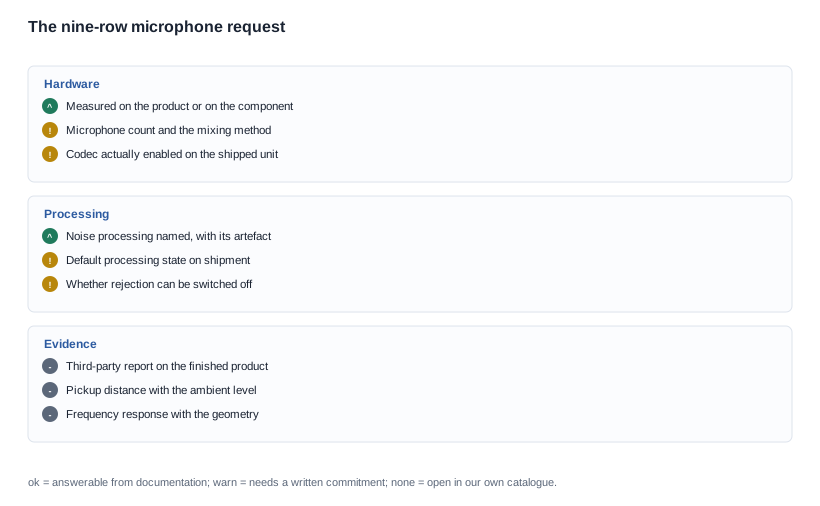
The thresholds that separate a result from a technique
The product-versus-component question, asked first. A supplier who answers it immediately has a test method; a supplier who does not has a component selection. The threshold is a statement that the figure was taken on the assembled frame, worn or mounted as it will be used, with the processing in the state the customer will receive.
The microphone count and the mixing method. A number, and a description of how the microphones are combined. "Multiple mic array" is a category; two microphones mixed with a fixed weighting is a configuration, and a configuration can be tested and compared. A beamforming description that names the algorithm and the geometry is better still, because it tells you what happens when the source moves off-axis.
The noise processing, named, with its artefact. A named technique and a description of what it costs. This is the threshold that separates a useful answer from a slogan, and it is worth being blunt about why: a supplier who can describe the artefact is telling you they have heard it.
The third-party report on the finished product. A report with the method and the date. If one supplier has a report and the other does not, that is a fact about the two documentation systems rather than about the two products, and the comparison should proceed on a test rather than on the paperwork.
The pickup distance, with the ambient level. A figure with the noise floor stated. Distance without a noise level is meaningless, because the same microphone has a different usable distance in a quiet room and in traffic.
The frequency response, with the measurement geometry. A band, measured on the frame, with the geometry named. A response measured on a bare component in a fixture cannot be transferred to a frame with a port in it.
The default processing state on shipment. A stated default, and whether it can be switched off by the customer or by the paired application. This is a product decision rather than a technical detail, and it is the one most likely to differ between a demonstration unit and a production unit. A device that ships with aggressive rejection enabled behaves differently in a quiet room from one that ships with it disabled.
The voice codec actually enabled. The codec that will ship, on the unit that will ship. "Bluetooth audio" is a category that covers the difference between a product that negotiates a narrow-band codec and one that negotiates a wide-band one, and in a poor network the difference is the whole experience.
The model designation and the firmware build. A published designation for the exact configuration. Without it, no document can name the unit, and without the build number no measurement can be tied to a product state.
The comparison that is not a comparison
Two comparisons break more often than the rest, and both are silent.
Two products with different processing states. If one unit has noise rejection on and the other has it off, the comparison is not between two microphones; it is between two signal chains, and the signal chain is doing most of the work. The fix is procedural: set both units to the same state before recording, and write the state into the record.
Two products at different levels. The louder product wins, and the louder product is not the better one. A comparison that skips the level match is measuring the amplifier, and the amplifier is the easiest thing in the chain to turn up. The fix is to match the output level rather than the volume setting, and to record which setting produced the match.
There is a third, quieter, one: two products measured on different firmware builds. The result is tied to a build, and the build changes. A complaint that appears after an update is usually a measurement that was never re-run, and the fix is to record the build number with every measurement and to re-run the sheet against the build that will actually ship.

The fifteen-minute test and the protocol that follows it
Four steps, and the first one costs almost nothing and separates the candidates immediately.
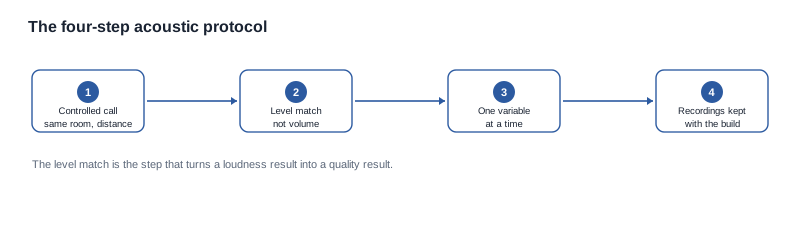
1. Run the controlled call first. Have the same person make the same call on the sample and on a reference device, in the same room, at the same distance, on the same handset, over the same network, using the same phrase. Same everything, and it takes fifteen minutes. The purpose is not to produce a score; it is to produce two recordings that are directly comparable, which almost no datasheet in this category will give you.
2. Match the level before you compare anything. Play both recordings back at a matched output level, not at their recorded levels. If the sample is louder and the recording was made at a higher level, the comparison has already been decided by a volume control before the listener has heard a word.
3. Change one variable at a time. Turn the noise rejection off on one unit and repeat. Change the distance. Change the environment. Every comparison that fails is a comparison that was not controlled, and the uncontrolled variable is usually the volume setting or the processing state.
4. Keep the recordings, with the build number attached. They become the reference against which later deliveries are compared, because microphone performance drifts between production lots more often than a specification sheet suggests, and a supplier disputing a result will want to know what it is being compared against.
Build the three environments into the protocol before the samples arrive, not after the first disappointment: a quiet room, a moderate indoor environment, and an outdoor street environment. If the ranking is stable across all three, you have a product. If it changes, you have found out that the product is tuned for one of them, which is still a decision you can make deliberately.
The acoustic evidence to request before the deposit
The microphone configuration, in writing, with the count and the mixing method. A written description of the processing, including the artefact it produces and the default state on shipment. The voice codec that will ship, and whether more than one can be negotiated. The pickup distance, with the ambient noise level, or a written statement that it is not published. The frequency response with the measurement geometry, or a written statement that it is not published. Any third-party report on the finished product, with the method and the date. The firmware build that carries the processing. The certificate numbers for the rest of the conformity file, with the issuing body and the validity dates. The model designation written on the quotation.
Where a microphone programme fails, and what the firmware holds
Six failure modes, and the answer for each
A component figure is quoted in a product listing. The symptom is a product page that states a pickup distance the unit has never achieved, and a customer who tests it in a noisy place. The root cause is that the sheet was read without asking whether the figure was measured on the product. The answer is to ask the product-versus-component question before any figure is used, and to publish nothing you cannot attribute to the finished product.
The louder product wins, and the louder product is not the better one. The symptom is a selection decision that a listening test cannot reproduce. The root cause is that the level match was skipped. The answer is to match the output level, not the volume setting, and to record which setting produced the match.
A comparison is won in a quiet office and lost on a street. The symptom is a returns cluster concentrated in one customer segment and one environment. The root cause is that only one environment was tested. The answer is to build three environments into the protocol before the samples arrive and to watch whether the ranking holds across all three.
Noise processing removes part of the speech and nobody notices. The symptom is a signal that is perfectly intelligible and completely lifeless, and a customer who describes the product as having no sound quality without being able to say what is wrong. The root cause is that the test scored clarity only, and clarity scores do not capture a lifeless signal. The answer is to listen for artefacts explicitly — gating, pumping, and the sense that something has been removed — and to treat a gating artefact as a failure regardless of the clarity score.
The customer complains after a firmware update. The symptom is a complaint that has no counterpart in the pre-update testing. The root cause is that the result was tied to a build and the build changed without a re-test. The answer is to record the firmware build number with every measurement and to re-run the sheet against the build that will actually ship.
Two units from the same production lot sound different. The symptom is a batch-level consistency problem that only a customer with two units will find. The root cause is that no reference recording was kept, so there is nothing to compare the second unit against. The answer is to keep the reference recordings with the model designation and the build, and to re-check a retained unit against them at the start of each new lot.
The commercial terms, and why the firmware is not one of them
The acoustic tier is negotiated on configuration, not on unit price. A microphone arrangement that includes a processing profile, a firmware branch and a default shipping state is a configuration, and a supplier who prices the acoustic tier per unit is offering something different from one who prices it per configuration. The minimum order quantity is negotiable on that basis, and the accessory set that accompanies an open-ear frame — the case, the cable, the spare tips — is worth negotiating separately, because the case and the tips have their own minimums and their own lead times.
Packaging and insert design stays cheap to negotiate even on an acoustic-led order. The market labels, the language of the documentation pack, the care instruction for the skin-contact parts and the quick start guide for the pairing sequence are all low-cost decisions with no tooling implication, and the quick start guide is unusually important in this category: most acoustic complaints are traceable to a pairing state the customer never reached.
Delivery splitting against an acoustic sample-approval milestone is often granted more easily than a price concession, because the acoustic result is the one thing nobody can predict from a photograph, and the supplier knows it. Payment staging is a standard area: a deposit on confirmation, a balance on inspection and before the goods leave, and a retention against the document set.
The acoustic engineering itself is fixed once the platform is chosen, and a supplier who will not move the microphone set, the digital signal processing tuning or the default processing state is telling you that the acoustic behaviour of the product cannot be bought. Certification cost and certification time are also not commercial levers: the cost is per product family and the elapsed time belongs to the test laboratory and the review queue. A one-off tooling cost is usually amortised across the first order, and the questions worth asking are over what volume it is amortised and what happens to the tooling if the programme is discontinued.
The clauses that carry an acoustic order
Four of them, and the first is the one that is missing from most purchase orders in this category. First, a notice obligation before any change of microphone, digital signal processing tuning, default processing state or firmware branch, because a firmware change alters the acoustic result without altering the hardware and is therefore invisible on the outside of the product. Second, the model designation as a line item with the certificate numbers attached. Third, the acceptance criteria for the sample, referencing the protocol and the level match. Fourth, a clause on who bears the cost when a sample does not meet the acceptance criteria.
A business channel whose customers take calls in noise
The scenario and the protocol decision
This is a hypothetical scenario, written to show the decision sequence rather than to report an outcome. No customer, project or order is described.
Assume a brand-side product manager building a business-software channel, where the end customer is a warehouse supervisor wearing the glasses on a noisy floor for a whole shift and taking calls. The binding constraint is not the acoustic tier's price. It is that the two candidate suppliers both describe their products with the same three technique names — open-ear acoustic structure, directional audio and smart noise reduction — and neither of them publishes a microphone specification.
Step one, the request. The manager sends the nine-row request to both suppliers, per model. The first supplier answers the product-versus-component question directly and gives a microphone count with a mixing method, plus a written description of the processing and its artefact. The second supplier answers with the three technique names again. The manager now has a measurable difference between the two suppliers, and it is not the one the marketing suggested.
Step two, the artefact. The first supplier describes the gating behaviour at its edge. The manager asks what the product sounds like when the noise estimate is wrong, which is the condition a warehouse floor produces constantly. The answer is specific, and it is testable, and it is not the answer a marketing sheet would have given.
Step three, the protocol. The manager writes the three-environment protocol: a quiet office, a loading bay, and a street. Same caller, same distance, same handset, same phrase, same network, levels matched before comparison, processing state recorded, build number recorded. She keeps the reference recordings.
Step four, the result. The ranking is stable in two of the three environments and reverses in the third. That reversal is the finding, and it is a finding about a product designed for a certain environment rather than a defect. The manager now knows the product is a good fit for the indoor channel and a poor fit for a street-facing channel, and she can position it accordingly instead of discovering it through returns.
Step five, the default state. The manager asks what the unit ships with. The answer is that aggressive rejection is on by default, which is the right default for a warehouse floor and the wrong default for an office buyer. The request produces a per-channel configuration request, and the configuration request is now part of the price negotiation rather than a favour.
Step six, the claim. The listing describes the technique in words, states that the processing state is adjustable, and does not publish a pickup distance or a noise figure, because neither was established on the finished product. The listing is narrower than the competitor's and it is defensible.
Step seven, the commercial structure. The manager negotiates the acoustic configuration minimum against a committed configuration count, separates the case and the spare-tip minimums, and puts the notice clause covering the microphone set, the processing tuning, the default state and the firmware branch into the purchase order before the deposit.
The result is a tier that can be positioned for a specific channel, with a claim the brand can hold and a reference recording set that will settle the next argument. The decisive step was the artefact question, and it took one line in a request.
What our catalogue publishes about microphones
We publish the technique for the Bluetooth audio family — open-ear acoustic structure, directional audio and smart noise reduction — and we publish no microphone specification for any model in it. No pickup distance, no noise figure, no frequency response, no microphone count and no third-party report. We will not quote a microphone figure from the industry for a product we have not measured, and we will not present a technique name as a result, because the technique is the mechanism and the result is what the customer hears.
We will also say plainly what a read of a thin datasheet can and cannot produce. It can tell you how many microphones there are, what processing is applied, and whether the supplier has ever measured the finished product. It cannot tell you which product sounds better in your customer's environment, and no amount of further reading will change that, because the missing information is a measurement that has not been taken.
What we will do is supply units with a known firmware build, work through the protocol with you, and hand you the recordings so that what you publish is something you have heard rather than something you were told. The rows behind this read are in microphone spec sheet explained, the measurement method is in how to measure microphone quality, the budget question is in microphone advanced considerations, and the background is under noise control.
The requests to make before you commit
Send the product-versus-component question first, on its own line. A supplier who answers it immediately has a test method, and a supplier who does not has a component selection. Nothing else in the request depends on a supplier having a measurement rig, and this first question is the one that tells you whether they do.
Ask the processing question with the artefact attached. "What does it cost you when the noise estimate is wrong" is a better question than "what noise reduction do you use", and it is the question that separates a measurable product from a described one.
Run the three-environment protocol before you commit, and keep the recordings. Fifteen minutes per environment per unit, and the output is a reference set that settles the next argument rather than starting it.
Related reading
- The rows behind this read — microphone spec sheet explained
- The test method — how to measure microphone quality
- Where the budget is best spent — microphone advanced considerations
Tell us the two products and the environment, and we will write the comparison script with you.


