

Most voice problems in this category get misdiagnosed at the first step, because the customer describes the symptom from their side — "they cannot hear me" — while the cause is usually somewhere else entirely. That gap between the reported symptom and the actual cause is where the cost sits: units get replaced for reasons that have nothing to do with the microphone, and the underlying fault is still there when the next customer reports it.
Smart glasses microphone quality smart glasses advanced considerations therefore begin after you accept that the reported symptom and the actual cause are usually different things. What follows is a diagnostic order, the five cause patterns that account for most of it, and — the part most suppliers leave out — what each cause means commercially, because two of the five are not defects at all and should never be resolved by replacing a unit.
Smart glasses microphone quality: the reported symptom and the real cause
The order of the questions is the whole method. Each question eliminates a group of causes for very little effort, and the first two eliminate most of them.
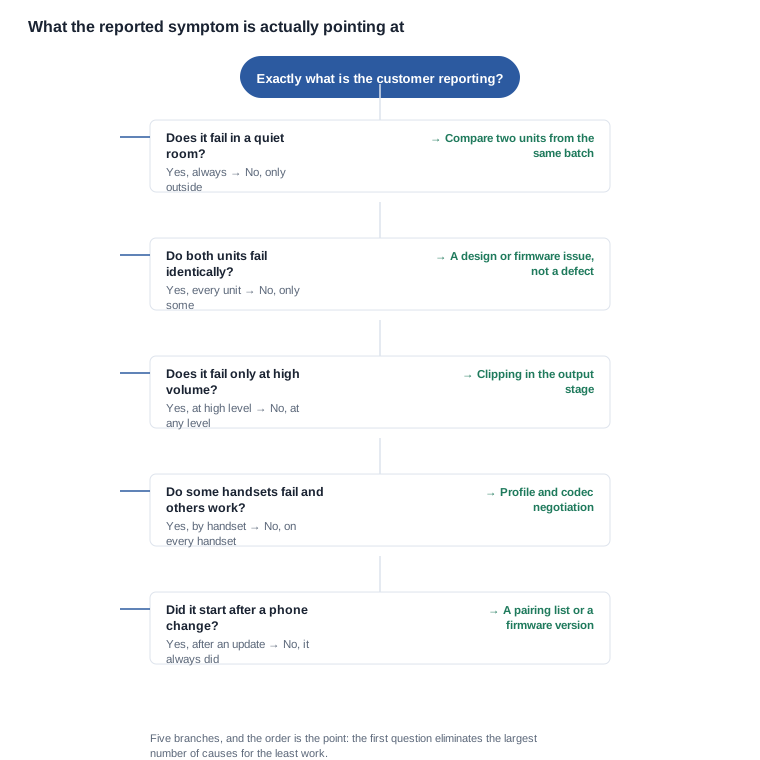
Question one: does it fail in a quiet room? If it fails indoors in a quiet office, the chain is device-side and the candidate list is narrow — the microphone path, the firmware, the profile negotiation, or the hardware itself. If it works indoors and fails outside, the cause is environmental and the candidate list is a different, smaller one.
Question two: do two units from the same batch behave identically? This single comparison resolves more cases than any specification question. If both fail identically, it is a design or a firmware issue and no unit is defective. If only one fails, it is a hardware defect and that unit should be replaced — but only that unit, and only after the other four patterns have been ruled out.
That distinction is worth money. A batch-wide fault that gets handled as a batch of defective units costs a full replacement run; a batch-wide fault handled as a firmware fix costs a firmware build.
The order the questions should be asked in
There is an order, and it is not the order the complaint arrives in. Environmental cases first, because they are the most common and the fastest to confirm — a two-minute test on a street in wind separates them from everything else immediately. Then the batch comparison, because it is cheap and it splits the world into design and hardware. Then the handset pattern, because it is the second most common cause and it points away from the microphone entirely. Then the pairing history, which requires the customer to tell you something and is therefore slower. And only then the volume behaviour, which is the least common of the five and the easiest to misread as a microphone fault.
Five symptom patterns and what each one actually is
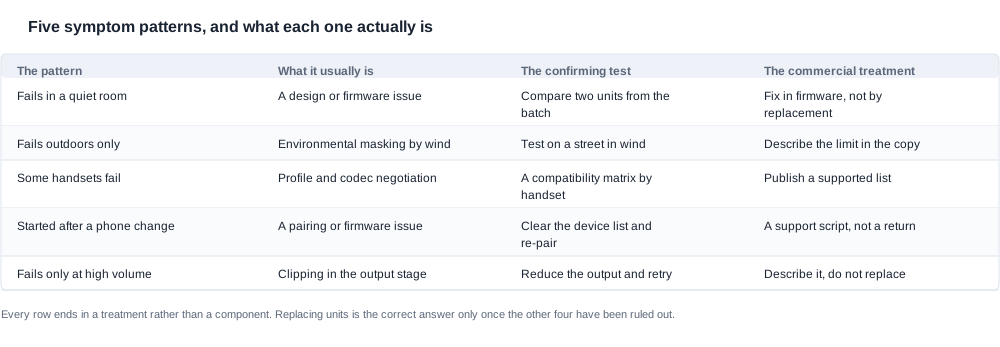
It fails in a quiet room too. Then the chain is device-side. Compare a second unit from the same batch before anything else. If both fail identically in a quiet room, it is a design or a firmware issue; if only one fails, it is a hardware defect and the unit should be replaced. If both fail, the next question is whether any unit of that model has ever worked. If not, this is a specification gap rather than a fault — check whether the product was ever verified for calls at all, because a camera platform is often designed around capture with audio as a secondary function.
It fails outdoors but works indoors. This is the common case, and it is not a defect. It is environmental masking, and specifically wind. An open-ear microphone has no seal and no windscreen architecture, so moving air reaches the capsule directly. The practical implication for a buyer is straightforward: if your product's proposition includes calls on the move, test on a street in wind above walking pace, at both low and high output, and record it. A unit that is fine in an office and unusable on a bicycle is not broken — it is a product that does not do what the listing implies.
Some phones fail and others work. That pattern points at profile and codec negotiation, not at the microphone. The handset and the device negotiate at connection time, and they can land on different configurations with different handset vendors. The volume of failures is not a microphone characteristic, which is why a specification sheet cannot help here. The remedy is a compatibility matrix rather than a specification: take the phone models that dominate your market, pair each with the sample, and record what actually happens. That matrix becomes both your evidence and your support script.
It started after a phone upgrade. Almost certainly re-pairing or firmware. Three things can break this, in order of likelihood: the paired-device list on the handset has filled up and a device was evicted silently, so it will refuse to reconnect; the firmware on the field unit is older than what the new handset expects; or the identifier scheme changed between production batches — which happens when a Bluetooth device name is customised, and our published customisation list does include the Bluetooth device name as an option.
It only fails at high output. That is clipping in the output stage, not a pickup problem. Reduce the output and it will work, which confirms the diagnosis. If it still fails at a moderate output, it is a hardware fault.
Why the two-unit comparison resolves more cases than any specification
Because the specification cannot tell you which of these five you have. Our range publishes the audio technologies the catalogue states — open-ear acoustic structure, directional audio and intelligent noise reduction — alongside Bluetooth V5.3 and V5.4, cell configurations from 40 mAh up to 290 mAh, charge times of two hours or less on every entry, runtimes from roughly five to eight hours and roughly twenty hours on the children's models, and magnetic or Type-C charging. What is not published anywhere in the range is the microphone count, the capsule type, the pickup pattern, the sensitivity, the frequency response and the pickup distance.
With those rows empty, a specification comparison cannot separate a design limit from a hardware fault. The two-unit comparison can, in about ten minutes, and it does so without a laboratory, an instrument or a written protocol. That is why it is the second question and not the last one.
The cause that is a design decision, not a defect
Two of the five patterns above describe a product working as designed within a limitation, and the commercially important decision is what you do about them.
The first is wind. An open-ear microphone in a temple has no seal, so the acoustic information is contaminated before the capsule receives it, and no amount of downstream processing recovers it. Software reduces wind noise; it cannot remove it. The second is output clipping at high levels, which is a signal-chain limit rather than a pickup limit.
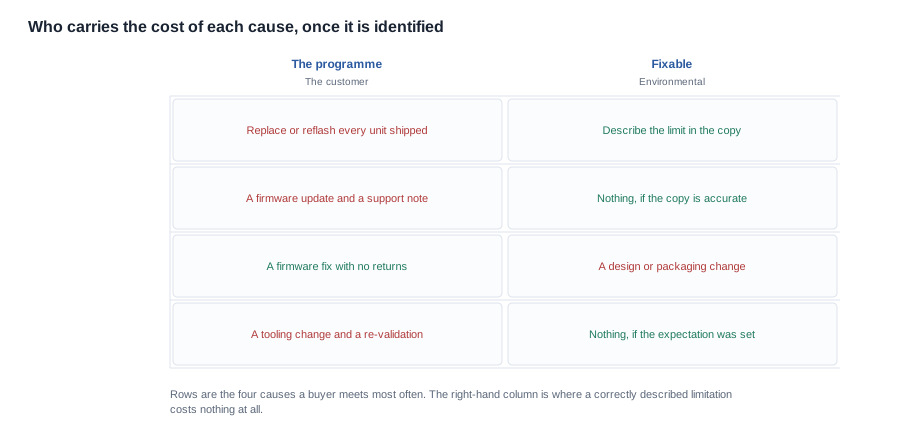
The matrix above is the commercial version of the diagnostic. When the cause is fixable — a firmware issue, a profile negotiation problem, an output-stage setting — the cost falls on the programme, and the remedy is a firmware build or a support note. When the cause is environmental or a usage limit, the cost falls on the customer, and the correct remedy is to describe the limit accurately in the listing, the packaging and the support script. A correctly described limitation costs nothing; an incorrectly described one costs every return and every review.
What the wind case means for the listing copy
A listing that promises clear calls "anywhere" is a listing that generates returns from exactly the environments where the product is most attractive. The narrowing is cheap and it costs nothing in performance: say that calls are intended for quiet and moderately noisy indoor environments, say that outdoor use in strong wind is expected to reduce intelligibility, and say what the product is for. Buyers who hear that will order it for the right use; buyers who do not hear it will return it.
The point is that this is not a defect to be fixed. It is a boundary to be written down, and writing it down before the product page exists is the difference between a support script and a dispute.
The cause that lives in the pairing, not in the microphone
The third cause pattern — the one that starts after a handset change — deserves separate treatment because one of its three variants costs a production run to fix.
The paired-device list on the handset has filled up. Many handsets cap the number of remembered devices, and an evicted device refuses to reconnect without being re-paired. The diagnosis takes seconds once you know to look, and the remedy is a support script: clear the device list and pair again.
The firmware on the field unit is older than the handset expects. This one is a rollout question. It requires either a firmware update policy or a minimum-version statement in the listing, and either of those is a decision that has to be taken before the product ships.
The identifier scheme changed between production batches. This happens when a Bluetooth device name is customised, and our published customisation list does include the Bluetooth device name as an option. The consequence is severe and entirely preventable: units from two batches present differently to the handset, previously paired devices no longer match, and the fix is not a support action but a production change. The prevention is to fix the identifier in writing before the first order, and to add a change-notice clause so that a later rename cannot happen inside a production run.
This is the clearest example in this category of a technical decision with a commercial cost, and it is invisible until it has already been paid for.
Who carries the cost once the cause is identified
Every one of the five patterns resolves to one of two commercial treatments, and choosing the wrong one is the expensive mistake.
The unit is replaced. This is correct only for a genuine hardware defect — the single unit that fails in a quiet room while its batch-mate works. Everything else is a batch-level condition, and replacing the batch treats a firmware or design issue as a component issue.
The behaviour is described. This is correct for the environmental and usage limits: wind masking, output clipping at high levels, and the handset-specific negotiation problems that the compatibility matrix identifies. A described limitation is a support answer. A described limitation that was not described is a return.
The cause is fixed in firmware. This is correct where the pattern is batch-wide and deterministic — every unit fails identically in a quiet room, and the fault is in the audio path configuration rather than the hardware. The cost of this is a firmware build and a rollout, and the alternative cost is a replacement run.
The decision rule is simple enough to write into a support process: before any unit is replaced, the pattern is identified against the five causes above and recorded. That single rule is what turns a rising complaint queue into a manageable one, and it is why the diagnostic order matters commercially rather than technically.

What the warranty and the returns policy should say for each cause
The five causes map onto three different policy positions, and the commercial cost of getting them wrong is much larger than the cost of writing them correctly.
Replace, with no further investigation. This applies to the single unit that fails in a quiet room while its batch-mate works. It is the only pattern where a physical exchange is unambiguously the right remedy, and it is also the only one where the evidence is already complete.
Describe and support. This applies to wind masking, to output clipping at high levels, and to the handset-specific negotiation problems. The remedy here is a support script and a corrected listing, and the returns policy should say that a unit which behaves as described is not defective. A policy that quietly accepts returns on described behaviour is the most expensive line in this article, because it converts a copy decision into a recurring cost.
Investigate, then decide. This applies to the batch-wide deterministic failure and to the post-upgrade re-pairing failure. Neither should be replaced on sight, because both are likely to be batch-level conditions, and both need a decision that is bigger than a unit. For the re-pairing failure the remedy is a support action and, occasionally, a firmware update. For the batch-wide failure it is a firmware build, or a design conversation with the supplier, and in that second case the decision is whether the product's proposition survives the condition — which is a commercial decision the support team should not be making alone.
The policy wording that makes this work is short: a named list of causes, a named remedy for each, and a rule that a unit is not replaced until the pattern has been recorded. Everything else about the returns policy can be generous.
A worked scenario for a support team with a rising call-complaint queue
The worked case below is hypothetical, and it sets out the order in which the microphone questions would be asked rather than the answers a client received.
Assume a brand that launched a camera-glasses line with a call feature. Six weeks in, the support queue shows a cluster of complaints phrased as "the other person cannot hear me". The brand's first instinct is to suspect the microphone and raise it with the supplier.
Step one: the brand does not replace anything yet. It asks each complainant one question — where were you when it failed — and splits the cluster. The majority of the tickets describe an outdoor or in-vehicle environment. A minority describe a quiet office.
Step two: the two outdoor-facing units are compared. Both behave identically in a quiet room and both degrade outdoors. Two units failing identically is a design condition, not a hardware fault, so the batch is not defective and no replacement run is triggered.
Step three: the quiet-office failures get a batch comparison. Two units from the same lot fail identically in a quiet room, which means a design or firmware condition. The brand asks whether any unit of that lot has ever worked, and finds that the lot has not been verified for calls at all — the audio path was treated as secondary to the camera. That is a specification gap, and the remedy is a verification pass rather than a replacement.
Step four: the handset question is asked of the remaining tickets. The failures cluster on two handset models. The brand builds a compatibility matrix from the models that dominate its market and finds a consistent pattern, which becomes both the support script and a published supported-device list.
Step five: the copy is corrected before the next lot ships. The listing is narrowed to describe the environments in which calls work, and the wind expectation is stated plainly. The brand also asks the supplier to confirm the Bluetooth device name for the next production batch in writing and adds a change-notice clause, because the identifier is the one item in this story that could have cost a production run.
The outcome is that the queue stops growing for reasons the brand can explain, the replacement rate falls, and the copy stops generating a category of complaint that no firmware update could have fixed.
What we will not invent, and what we will do instead
We publish no microphone specifications for our range — count, capsule type, pickup pattern, sensitivity, frequency response and pickup distance are all Not published — so we cannot tell you what an acceptable rejection level should be and we will not invent one. What we can do is give you the diagnostic order above, which is what actually reduces the units you replace for no reason.
What we will do is run the measurement that produces your own baseline. The method for that is in how to measure smart glasses microphone quality, the supplier's own claims are read in smart glasses microphone quality spec sheet explained, and the connectivity side of the re-pairing failures is covered in smart glasses bluetooth version myths. The wider treatment of pickup and noise control sits under noise control and microphone pickup.
Four fields a failure record cannot leave out
The record of a diagnosed failure is worth more than the diagnosis itself, because it is the only way to see whether the same cause is arriving through a different channel. Four fields, and none of them is optional: the cause category from the five above; the configuration of the unit, including the lot; the environment the failure occurred in; and the remedy applied. Add the handset model and you can also see a compatibility pattern building up, and add the firmware version and you can see whether a rollout fixed it.
The discipline of writing those four fields down at the time is what separates a support team that is learning from one that is coping. Coping is replacing units and watching the rate; learning is knowing that the rate is one cause, in one environment, in one lot, and being able to say so to the supplier.
Which of the five causes we can confirm from your units
Send us three failing units and one working unit, and we will tell you which of these five causes the pattern matches. If you can also send the environments the failures happened in, the diagnosis gets faster still — and if it turns out to be a described limitation rather than a defect, we will say so rather than help you build a replacement programme around it.
Related reading
- Reading what a supplier's sheet claims: smart glasses microphone quality spec sheet explained.
- The connectivity decisions behind re-pairing failures: smart glasses bluetooth version myths.
Send us three failing units and one working unit and we will tell you which of these five causes the pattern matches.


