

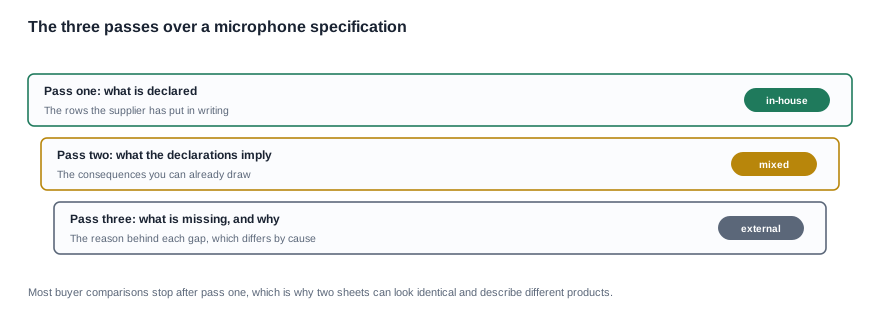
If you want smart glasses microphone quality smart glasses spec sheet explained rather than a list of numbers, read it in three passes: what is declared, what the declarations imply, and what is missing together with the reason it is missing. Most buyer comparisons stop after the first pass, which is how two products with specification tables that read identically end up behaving nothing alike. This walkthrough uses our own range as the worked example, because our range happens to be unusually honest about how much it does not state — and because a range with almost no acoustic rows is the clearest possible demonstration of what a specification sheet can and cannot settle.
For a sourcing team, the value of the three-pass method is that it produces a comparison that does not depend on either supplier having a good acoustic story. Pass one tells you whether the two sheets even describe the same things. Pass two tells you what each sheet commits the product to, whether or not it says so. Pass three tells you which gaps are permanent, which are a single unanswered question, and which are a sign that the marketing and the engineering disagree.
Smart glasses microphone quality: what the published rows say and omit
For the voice-related attributes, the published rows for our smart glasses range are these, and this is the complete list.
- Bluetooth version, stated per model.
- Cell configuration and capacity, stated per model.
- Rated runtime and charge time, stated per model.
- Charging interface, stated per model.
- A surround sound or directional audio description on the audio family.
- A lens-based electronic atomiser and posture and distance detection on one pair of children's models.
- An IP54 marking on two camera models, the V06 and the S7.
That is the entire published surface. Now read it for what it settles. The Bluetooth version fixes the radio generation for a model. The cell configuration fixes the energy in the pack. The runtime and charge time fix the quoted operating window. The charging interface fixes the tooling and the cable that ships with the product. The audio description fixes the technique family and nothing about its result. The children's rows fix which mechanisms exist. The IP54 marking fixes a catalogue annotation on two models.
And here is what is not published for any model in the range: microphone count and placement, capsule type, sampling rate, signal-to-noise ratio, sensitivity, frequency response, pickup distance, cancellation depth, beamforming method, and any third-party acoustic report.
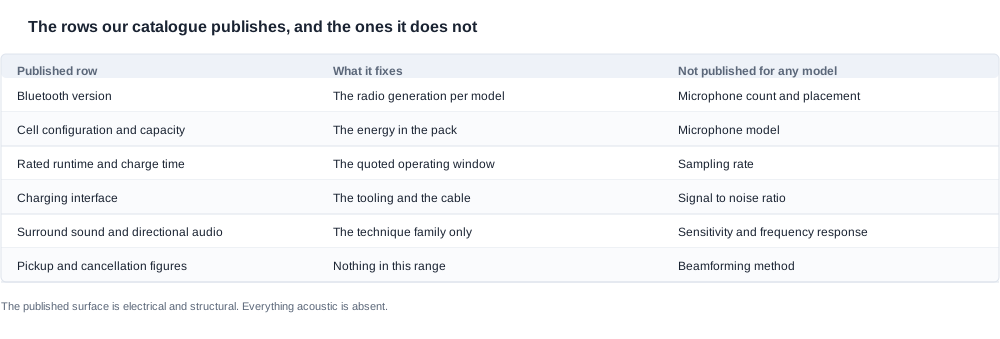
Stating that list plainly is the first pass, and it is worth pausing on what it means rather than moving on immediately. Most specification sheets that appear complete are complete because a template was filled in, and the filled rows are frequently the ones a buyer never checks. In this range the template is visibly unfilled, which makes the gap easier to notice and easier to discuss. A blank row is at least a prompt for a question.
The published rows as a concrete example rather than an abstraction
The audio family makes this concrete. The K01 and the K02 publish two 90 mAh cells, roughly eight hours of rated use, magnetic charging and Bluetooth 5.3. The D11 and the D12 publish a single 100 mAh cell, roughly seven hours, Type-C charging and Bluetooth 5.4. The LC-105-1 and the LC-105-2 publish two 55 mAh cells, roughly eight hours, magnetic charging and Bluetooth 5.4. The G07 and the YK12 publish two 55 mAh cells and a shorter rated window of roughly six hours, with the G07 noted for a slim and detachable temple and the YK12 for a surround sound slim temple. The sport models publish the same rows on their own terms: the YKC02 publishes two 70 mAh cells, roughly eight hours, magnetic charging and Bluetooth 5.4, the D17 publishes 115 mAh, roughly seven hours and about an hour to charge on Type-C, and the ZH12 publishes 100 mAh, roughly eight hours and about an hour to charge on Type-C.
Those rows are precise, per-model, and directly usable for a landed cost calculation and a channel battery expectation. If a buyer wants to know which of these platforms can hold a call for a working shift, the runtime row answers it. If a buyer wants to know whether a caller in a noisy street can hear the person speaking, not one of those rows says anything at all, because the range publishes no acoustic row to read.
The lesson for the first pass is not that thin data is bad. It is that a specification sheet is a statement about what the supplier has chosen to put in writing, and the buyer has to read it as such.
What the declared rows imply once you read them as consequences
This is the pass most buyers skip, and it is where a specification sheet earns its keep. Reading consequences rather than values.
Bluetooth 5.3 versus 5.4 is a power decision, not an audio decision. It is routinely presented as a quality upgrade for voice. It is a radio generation, and its bearing on a call is indirect. What it does influence directly is power consumption, which interacts with the runtime figure, which interacts with how long a call the product can hold. Read it as a battery row and it becomes useful; read it as an audio row and it becomes a misleading claim.
A stated runtime is a voice decision in disguise. A camera platform drawing on a 290 mAh cell for roughly seven hours has a materially shorter voice-call window than an audio platform with two 55 mAh cells stated at roughly eight hours. If calls are the primary use for the channel, the runtime row is doing the work the microphone row should have done. That is not a reason to discount the runtime row. It is a reason to notice that the voice proposition in this category rests on power budget and geometry, because the acoustic row is absent.
A surround configuration description tells you about channel count, not about channel quality. Two models can both publish it and differ entirely in output. The description narrows nothing about loudness or clarity, and readers routinely treat it as though it does.
An AI feature label tells you nothing about where the processing runs. A catalogue entry for an AI voice assistant does not establish whether processing happens on the device, whether it works offline, which languages are supported, or where data is stored. None of those are published for this range, and a buyer who needs to know has to ask before promising anything about the feature in listing copy.
An IP54 marking on two models is not a statement about the other twenty-six. The marking appears on the V06 and the S7 as a catalogue annotation. It does not transfer to the Bluetooth audio family, and the audio family carries none, which for an open-ear design with a sound port and a microphone port is a structural point rather than a documentation gap.
Why the second pass changes what you compare
Two suppliers can publish exactly the same rows and still be in different categories, because the rows are commitments about power, and power commitments change what a voice product can do over a shift. The second pass therefore turns a visual comparison of two tables into a comparison of two operating windows, which is the thing the channel actually experiences.
The practical method is short. For each model on the shortlist, write down the consequence of each published row before writing down the row itself. If the consequence cannot be written, the row is decorative. That single discipline removes more ambiguity from a sourcing comparison than any amount of additional requesting.
Why the reasons for a blank row differ, and how to read the difference
The interesting part of a specification sheet is not that rows are absent. It is that the reasons differ, and the reason tells a buyer what to expect from the supplier and how much effort the gap will cost to close.
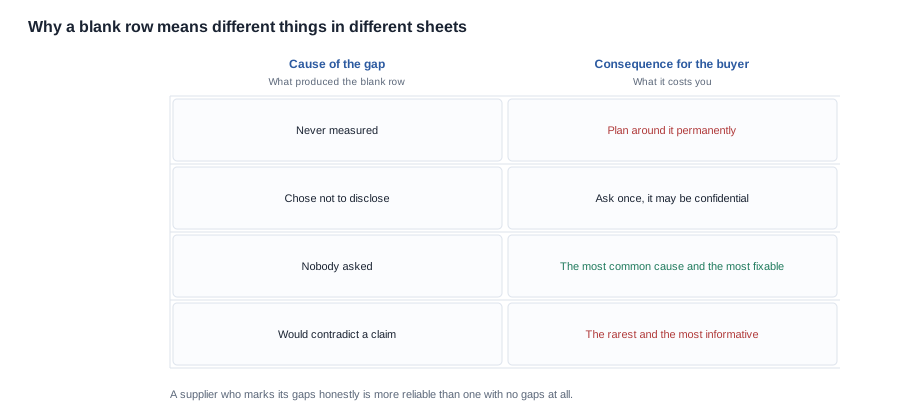
A blank because it was never measured. The figure will not appear later unless someone commissions the work. This is the gap to plan around permanently. It is not a documentation delay, and a buyer who treats it as one will keep re-asking and keep being disappointed.
A blank because the supplier chose not to disclose it. Worth asking once, politely. Some figures are genuinely confidential, usually because they would let a competitor infer the design. A supplier who declines once, with a reason, is behaving normally.
A blank because nobody asked. The most common cause and by far the most fixable. A supplier who has never been asked for a microphone count may simply not know the answer, or may not have realised it was needed. One specific question usually closes this gap, and the question costs nothing.
A blank because the figure would contradict a claim. The rarest and the most informative. If a supplier claims advanced noise pickup and cannot state a microphone count, the claim has no visible mechanism behind it. That is worth surfacing to a product team before the order rather than after the first customer complaint, and it is the one case where a gap is itself the finding.
A worksheet that separates the two documents
The mistake that makes specification comparison slow is mixing two different documents into one request. One document is what the supplier publishes. The other is what the buyer asks for. They overlap, they are not the same, and asking for the second while reading the first produces confusion rather than clarity.
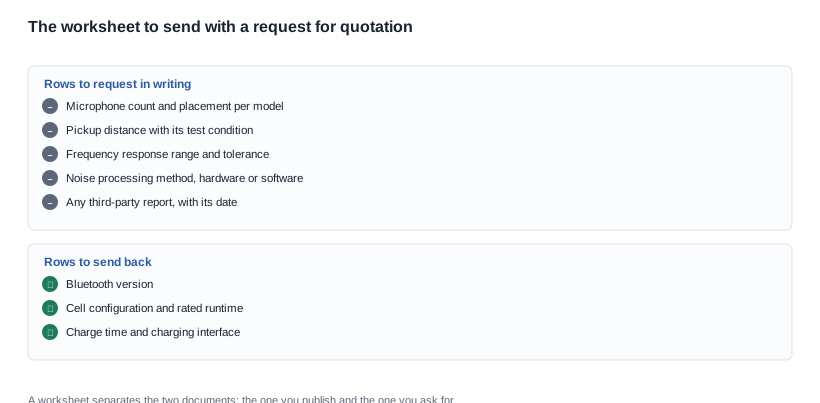
The rows to request in writing are the ones a buyer needs and cannot derive: microphone count and placement per model, pickup distance with its test condition attached, frequency response range and tolerance, the noise handling method and whether it is implemented in hardware or in software, and any third-party report with its date. The rows to send back are the ones that are already published and should be restated as the common baseline: Bluetooth version, cell configuration and rated runtime, charge time and charging interface.
Sending the second group back is not administrative padding. It establishes that both parties are working from the same baseline, which is what makes the first group answerable at all. A request for a pickup distance that does not state the platform, the cell configuration and the runtime is a request that can be answered with a number from a different product.

Scoring two suppliers on disclosure rather than on claims
Apply the three passes in order, and score on the third rather than on the first.
Confirm both suppliers declare the same set of rows. If one sheet has a row the other does not, the comparison is not yet meaningful. Ask for the missing row before comparing anything else.
Read the implications and check they are consistent with what each supplier claims. A supplier claiming advanced noise pickup and publishing a runtime row that implies a very short voice window is describing something that needs a question.
Count the gaps, and treat the causes differently. A gap caused by nobody asking is a one-question cost. A gap caused by the figure never being measured is a permanent cost, and it belongs in the total cost calculation alongside the unit price and the tooling. A gap caused by a contradiction is a finding about the marketing.
Then compare the two suppliers on that basis, and the result is usually clearer than the buyer expected. The second supplier is usually not being dishonest. They have optimised for a different question — a channel that wants a complete sheet for a catalogue, or a channel that wants a measurable one for an inspection — and the gaps sit in different places. What a sourcing team should be searching for is not the sheet with fewer blanks but the sheet whose blanks are explainable and whose stated rows are consequences rather than decoration.
A scoring method that survives an internal review
A workable way to make this defensible inside a buying committee is to score three things and record them in the file. First, the coverage: how many of the rows a buyer needs are present or explicitly refused. Second, the traceability: does each present row name a model, a configuration and a condition. Third, the honesty: does the sheet mark its gaps rather than leave them to be discovered.
Those three scores can be produced by two people independently and will usually agree, which is what makes them usable in a review. A single opinion about which sheet reads as more complete does not survive a review, because every buyer has a different completeness in mind.
What a permanent gap costs, and why it belongs in the total cost
A gap that was never measured is not a documentation inconvenience. It is a permanent property of the product as it will be sold, and it has to be priced alongside the unit price, the tooling and the freight rather than mentioned in passing.
The arithmetic is worth doing explicitly, because it changes the outcome of a shortlist. Take two suppliers who quote the same unit price for an audio platform. One publishes a microphone count, a placement description and a third-party report; the other publishes neither. If the channel is a call-driven one, the second supplier's product will be evaluated by the only thing the customer can evaluate without instruments, and the brand carrying it will not be able to answer a complaint with a document. The cost of closing that gap after launch is a sampling programme, a re-test, a revised listing and a period in which the claim is either withdrawn or unprovable. The cost of establishing it before the order is one request, one report and a week of the supplier's schedule.
That is the total cost question, and the answer is that a permanent gap has a price even when nobody quotes it. A buyer comparing two quotations should add the cost of the missing evidence to the quoted unit price and then ask which of the two totals they would rather carry.
Three pitfalls that make the three-pass method fail
Comparing a full sheet against a short one. The sheet with more rows has not necessarily been measured more thoroughly; it may simply have been formatted for a catalogue rather than for a technical file. Compare like against like, and if the two suppliers publish different row sets, normalise before comparing.
Reading a method name as a measurement. Intelligent noise reduction, surround sound, directional audio and hi-fi are technique families. A sheet that uses them in a row where a figure is expected has substituted a label for a number, and the substitution is easy to miss because the layout is identical.
Treating a permanently blank row as a temporary one. A buyer who assumes a gap will close eventually will keep planning around evidence that is not coming. The three-pass method exists partly to force the distinction between a gap that will close when someone asks and a gap that will only close if someone commissions the work.
The sequence of questions to put to a supplier, in the order that works
The order matters more than the wording, because the first question determines whether the rest are answerable.
- Which rows does this sheet publish for each model, and which does it not publish? Ask for the list, not the sheet. The list is shorter, easier to verify and harder to dress up.
- For each published acoustic row, what is the measurement condition behind it? A row with a condition can be compared; a row without one is a label.
- For each blank acoustic row, what is the reason it is blank? Never measured, not disclosed, never asked, or it would contradict a claim. The four answers carry very different consequences and only one of them is a matter of timing.
- Is there a third-party report, and does it name the models in this quotation? A report that names a different configuration does not cover the order.
- Which of these rows would you write into a purchase order as an acceptance criterion? The answer identifies which rows are real, because a row nobody would enforce is not a criterion.
How to choose when the sheets are genuinely equivalent
There is a point in the comparison where two suppliers publish the same rows with the same gaps and the same conditions, and the specification sheet can no longer separate them. That point is real and it arrives more often than buyers expect, because in this category the acoustic evidence is thin across the board.
When it arrives, the shortlist has to be decided on the things a sheet cannot carry: the production process behind the acoustic result, the fixture and reference practice, whether the supplier will run a scripted test on production units rather than engineering samples, the lead time and the payment structure, and whether the supplier will put the acceptance criteria into the purchase order rather than into an email. The specification sheet was the cheaper part of the due diligence, and it was never going to be the deciding part.
What we leave blank on purpose, and why that is not a weakness
Our specification sheets for the microphone-related attributes are largely blank, and we would rather show that honestly than publish plausible industry values against them. A supplier who fills those rows with typical numbers is producing a document that appears more complete and is less useful, because every downstream number a buyer derives from it inherits the error, and the error is invisible because nothing in the document marks it as an assumption.
There is a commercial reason for this beyond accuracy. In a voice channel, the acoustic claim is the claim the customer will test, constantly and without instruments. If we published a figure we cannot evidence, the failure would arrive as a customer complaint against our brand rather than as a documentation question against our catalogue. An empty row produces a question we can answer. An invented row produces a dispute we cannot.
The same logic applies to the electrical rows, where we publish generously. The cell configuration, the runtime, the charge time and the charging interface are stated per model because they are settled, checkable and useful. Where a figure is a range rather than a value — and the rated runtime is the clearest example, since a quoted runtime has no stated start condition and no end criterion — we publish the figure the catalogue holds and say plainly that it is the rated window rather than a guaranteed duration. A charge time without a stated start state and a stated end criterion cannot be turned into a shift-change allowance, and saying so is more useful to a buyer than a precise number that cannot be used.
Where the boundary of our documentation sits
We publish the rows we have and mark the rest as not published. For the Bluetooth audio family, that means the cell configuration, the rated runtime, the Bluetooth version, the charge time, the charging interface and the acoustic technique names — open-ear acoustic structure, directional audio, intelligent noise reduction — and nothing else acoustic. For the sport models, it means the same set. The IP54 marking is the one published exception outside those two families, and it sits on the V06 and the S7 in the camera models. For the children's models, it means the published mechanisms, the cell configuration of 40 mAh for the A05 and the A06 and 70 mAh for the A07, the rated runtime of roughly twenty hours, the magnetic charging and the Bluetooth 5.4 row on the A07.
We will not describe a per-model certification position we cannot evidence, and we will not infer one from the company-level export certification page on the catalogue front page, which carries images rather than text and states no certification position in words. We will not quote a microphone figure from the industry, and we will not convert a technique name into a performance claim.
What we can do is take the two specification sheets you are comparing, tell you which of the gaps on each side are structural, and tell you which of the gaps are simply the questions nobody has asked yet. The parameter-by-parameter treatment of these figures is at how to read a datasheet. Producing your own comparable measurement is at how to measure smart glasses microphone quality, the settings that generate most field complaints are at smart glasses microphone quality advanced considerations, and the design background sits at noise control and microphone pickup.
Send us the two specification sheets you are comparing and we will tell you which gaps are structural and which are just gaps.
Related reading
- Producing your own comparable measurement: how to measure smart glasses microphone quality.
- The settings that cause most microphone complaints in the field: smart glasses microphone quality advanced considerations.
Send us the two spec sheets you are comparing and we will tell you which gaps are structural and which are just gaps.


