

Most buyers negotiate price as a single number, which is the hardest version of the conversation because the number has no structure to argue about. The reductions that actually hold come from changing a decision the factory made, not from applying pressure to the same decision.
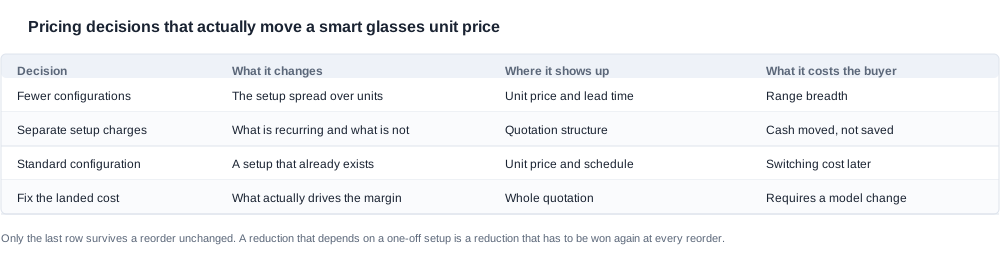
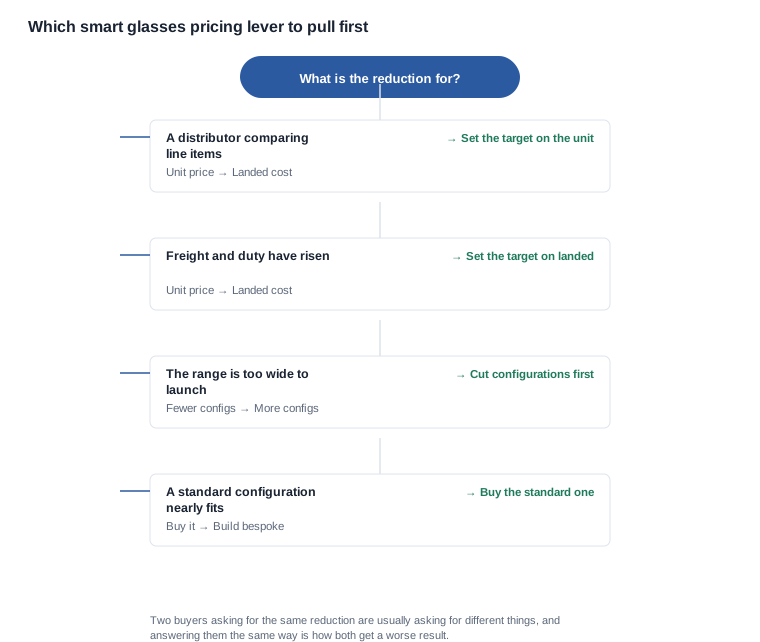
There are four of those decisions in this category, and they are worth putting in order, because the order determines which one is worth the effort. The first is how many distinct configurations are in the order. The second is whether the non-recurring costs are separated from the recurring ones or buried in the unit price. The third is whether the buyer is buying a configuration the factory has already built rather than one it has to set up. The fourth, which comes last and not before, is what the reduction is actually for — because two buyers asking for the same reduction are usually asking for different things, and answering them the same way is how both get a worse result.
The published position is why this matters so much. Our unit prices are not published and are confirmed per enquiry, because in this range they depend on the configuration, the quantity, the packaging and the component allocation behind the order. A buyer who wants a lower price is therefore not asking for a published figure to be adjusted; they are asking for one of four decisions to be changed.
Smart glasses pricing: unit price is an output, not a lever
The reader here is a buyer working for the brand, a channel buyer or an importer, and the situation is one of three: two quotations are open and the buyer has been asked to justify the higher one; a programme has launched and the reorder price has come back at or above the first-order price, which is usually a surprise; or a distributor has asked for a lower line item to match a competitor's listing.
Underneath all three is the same question, and it is not about the factory's margin. It is: which of the decisions behind this quotation are the buyer's to change, and which are the factory's? The fear underneath a price conversation in this category is rarely that the price is too high. It is that the price is the same on the reorder for a different reason — that the reduction was won once, on a one-off setup that will not recur.
That distinction is the whole method, and it is worth making explicit because it changes what a buyer should write down. A reduction that depends on a one-off setup is not a reduction, it is a one-off. A reduction that depends on a configuration the factory already has is a reduction that recurs. A reduction that depends on the order being simpler is a reduction that recurs for as long as the order stays simple.

The four decisions that actually move the unit price
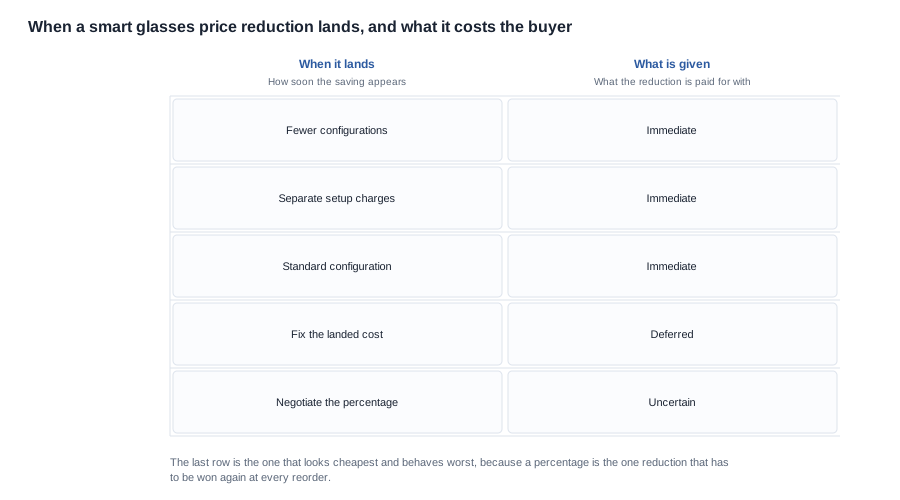
Narrow the configuration count. Every variant consumes setup — a firmware build, an artwork proof, a calibration batch, a packaging run — and that setup is real work whether or not it appears as a separate line. A first order of one thousand units across four colourways is not four times harder to build than a thousand units in one, but it is roughly four times the setup. Consolidating to one or two colourways for the launch and adding the rest at reorder is usually the largest available reduction, and it costs nothing but patience.
This is where the published configuration options matter, because the number of configurations is not the buyer's choice alone. The V06 is published in four colourways and the V03 Pro in three, and the L2 Utral with either a 900 mAh or a 1400 mAh case. Each of those is a distinct material set with its own setup. A buyer who wants the widest possible range from a single supplier is asking for the largest possible setup, and the quotation is reflecting that correctly.
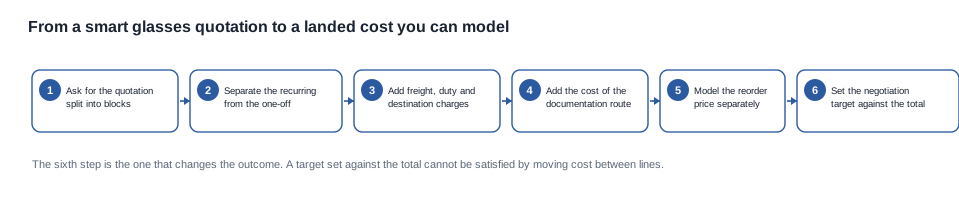
Move the non-recurring costs off the unit price. A factory quoting a high unit price with a low setup charge is being transparent about where the money is. If the total is genuinely competitive, that structure is usually preferable to a low unit price carrying a fixture, tooling or artwork charge that appears after the deposit. Ask for the quotation split into a recurring part and a non-recurring part. That split tells a buyer which parts can be amortised across reorders and which are being paid once for a configuration they may abandon, and it makes the second order's true price visible, which is the number the margin model actually needs.
Buy the standard configuration where it exists. If the catalogue already contains a configuration close to the buyer's, moving to it is faster than negotiating one — not because it is cheaper in unit terms, but because it removes a setup, an approval cycle and a component allocation. The trade has a limit: if the catalogue configuration requires artwork that will be replaced in six months, the saving is temporary and switching twice costs more than it saved. Worth doing when the programme is stable, worth avoiding when the market is still being tested.
Decide what the reduction is for, before asking for it. A buyer who wants a lower unit price because a distributor is comparing line items and a buyer who wants a lower landed cost because freight and duty have risen are asking for different things, and the second one cannot be solved by a price reduction at all. Ask for the landed figure once per order — goods, freight, duty, destination charges, and the cost of the documentation route — and set the negotiation target against that total. It also removes the outcome where the unit price improves and the freight quietly absorbs the gain because the packaging changed.
The threshold set for comparing two quotations
Two quotations are not comparable until they are decomposed into the same blocks. The table below is the working criteria set, and each row states how the item is measured, the line it has to meet, and how a weak quotation shows up.
| Item | How it is measured | The line it has to meet | How an inflated quotation shows up |
|---|---|---|---|
| Configuration count | Count the distinct builds in the quotation | Stated per line, not implied | A price that silently covers several builds |
| Recurring and non-recurring split | Ask for the quotation in blocks | Setup, tooling and artwork named separately | One number with the setup inside it |
| Specification basis | Ask which published rows the price covers | Model code, colourway and case named | A price for a model family |
| Quantity basis | Ask the quantity the price assumes | The tier is stated | A price at a tier the buyer is not buying |
| Valid-for period | Ask how long the price holds | A period with a review date | A price valid indefinitely |
| Reorder treatment | Ask what the second order looks like | Quoted separately or explicitly explained | One price quoted for both orders |
| Landed cost | Ask for freight, duty and destination charges | The total is stated as a total | Only the unit price is quoted |
The last two rows are where a buyer loses money without noticing. A price with no validity period is not a price; it is an indication, and the difference between the two is discovered at the reorder. And a quotation that quotes one price for the first order and the reorder has quietly assumed the setup recurs, which it does not.
How to evaluate a quotation before you compare it
The evaluation is a sequence and the sequence matters, because a buyer who starts with the headline number anchors on it for the rest of the conversation.
- Ask for the quotation in blocks. Recurring, non-recurring, tooling, artwork, packaging, freight and duty. A supplier who cannot produce that split has a price, not a quotation.
- Check the specification basis against the published rows. The published rows for this range are specific: the camera resolution tier per model, the battery capacity, the runtime, the charge time, the charging method, the case capacity, and the ingress marking on the two models that carry one. If the quotation's specification does not match the published rows for the model code, the price is for a different build.
- Ask what the quantity tier is. A price quoted at a tier the buyer is not buying is not comparable, and in this category the tier interacts with the configuration because the setup is spread across the run.
- Separate the battery position. The Bluetooth audio tier in this range uses paired cells rather than a single cell, published as cell values: 55 mAh twice on four models, 90 mAh twice on two, and a single 100 mAh on two more. Those cells total 110 mAh and 180 mAh for the paired models — those totals are derived from the published cell values, not published figures themselves, and they are still worth asking about, because two suppliers quoting the same audio model may be quoting different cell configurations.
- Ask for the first order and the reorder separately. The first order carries the setup; the reorder does not. A supplier who quotes both and shows the difference has told the buyer exactly what the reorder will cost.
- Add the landed cost and set the target against the total.
The questions to ask, and how to evaluate what comes back
The questions below are worth putting in the first enquiry round, because each one changes either the price or the meaning of the price.
- How many distinct configurations are in the quotation, and how many are new material sets?
- Can the quotation be split into a recurring part and a non-recurring part?
- Which setup, tooling and artwork charges are one-off, and which recur?
- What is the quantity tier the quoted price assumes?
- Which published specification rows does this price cover, by model code?
- How long does the price hold, and what happens if the configuration changes inside that period?
- What does the reorder price look like at the launch configuration?
- What is the landed total, including freight, duty, destination charges and the documentation route?
- What does the buyer have to commit to for this price — a quantity, a date, a payment schedule?
The evaluation that follows is a three-number test: the unit price at the quantity actually being bought, the landed total per unit, and the reorder unit price at the same configuration. A buyer who has all three can compare two quotations. A buyer who has only the first is comparing advertisements.
The trade-offs to weigh rather than assume are these. Consolidating configurations saves setup and costs range breadth, and the buyer has to decide whether the range is being bought for the launch or for the year. Separating the setup charges saves nothing on the first order and makes the reorder visible, which is worth it only if the buyer actually reads the reorder. Adopting a standard configuration saves a setup and costs flexibility, and it is worth doing when the programme is stable. Setting the target on the landed total is more accurate and slightly harder to negotiate, because it puts freight and duty into a conversation they were not part of.
Before you order, the practical test is whether the buyer can state, from the quotation alone, what the second order will cost at the launch configuration. If that number cannot be produced, the quotation has not resolved the question the buyer was actually asking.

Where a price reduction is quietly undone
The reduction that depended on a one-off setup. The buyer consolidated the launch to one colourway and the unit price fell. The second order restored the full range and the unit price returned, along with the setup. The reduction was never a reduction; it was a discount on a smaller order. Prevention: ask for the reorder price at the launch configuration, not at the launch promotion.
The configuration that changed after the quotation. The case option, the colourway or the packaging changed, and the price was held against the old quotation. A supplier who honours a price against a changed specification is absorbing a cost, and the absorption appears later as a smaller quantity or a longer lead time. Prevention: state the validity period and what happens when the configuration changes inside it.
The freight that ate the gain. The unit price fell, the packaging grew and the freight rose, and the landed cost ended up higher than the original quote. Prevention: negotiate against the landed total, and check the packaging assumption explicitly, because the print area on a 1400 mAh case and on a 900 mAh case is not the same.
The specification quietly reduced. A buyer asks for the same specification and gets a cheaper build, and the difference shows up in the field rather than in the ledger. The published rows are the defence: they are specific enough to check a delivered unit against, and the camera resolution tier in particular is a per-model published figure that does not vary quietly.
The discount that comes with a condition. A price held against a specific quantity, a specific date or a specific payment schedule is a conditional price, and the condition is worth more than the discount. Read the condition before reading the number.
The comparison that was made on the wrong number. Two quotations, one compared on the unit price and one on the landed total, and the cheaper-looking one is more expensive. It is the most common outcome of a negotiation that skipped the decomposition, and it is invisible to a buyer who has never seen the two quotations side by side on the same basis.
The quantity tier that was assumed rather than quoted. The buyer's plan assumed a volume, the factory priced the tier above it, and the unit price is higher than the model predicted. Nothing is wrong and nothing was misrepresented; the number was simply attached to a different quantity than the buyer had in mind. The prevention is to state the quantity in the enquiry rather than in the follow-up call.
None of these six is a reason to change supplier. Each is a line that should have been in the enquiry, and each is much cheaper to fix before the order than to fix in the reorder, because a reorder is renegotiated from a weaker position.

A first order priced and a reorder priced separately
This is a worked case rather than a client project. The point is the order of steps. A brand-side procurement manager has two quotations for a camera model with a charging case, for a European retail launch. Both quote a unit price and a delivery date.
Decomposing them shows that one quotation includes the artwork setup, the first-article test and the certification file for the launch configuration inside the unit price, while the other quotes them as separate lines. On the face of it the first is cheaper. On the landed total, including freight, duty and the documentation route, the second is cheaper — and the first order's true cost is higher because the setup is spread over a smaller quantity than the buyer assumed.
The restructure that follows uses the four decisions in order. The configuration count is cut for the launch to the single colourway the launch needs. The setup charges are separated so the reorder price becomes visible. The standard configuration is adopted for the audio bundle, because a published option exists that removes a firmware build. The target is then set against the landed total rather than the unit price, and the negotiation is conducted on the total.
One further point is worth making before the numbers are put in the model, because it is the point at which buyers most often get this wrong. The four decisions do not all belong to the buyer. The configuration count and the choice of a standard configuration are the buyer's. The separation of the setup charges and the landed cost are a joint exercise, and the target-setting is a buyer decision about what the reduction is for. A buyer who arrives with a number and no view on the purpose will get a number and no view on the purpose, and the second round of the negotiation will start from a worse position than the first.
The result is a first order that costs slightly more per unit than the opening quotation, and a reorder that costs materially less than the original model predicted. The commercial judgement is that the second number matters more, because a buyer who negotiates only the first number has optimised the quarter they are about to launch and inherited the cost of the year after it.
What our pricing position covers, and what it does not
Our unit prices are not published on this site and are confirmed per enquiry, because in this range they depend on the configuration, the quantity, the packaging and the component allocation behind the order.
We will quote a first order and a reorder separately, and we will show which lines fall between them, so a buyer can see what the margin actually depends on. We will also tell you honestly when a reduction you have asked for is not available on our side — a component cost at a given quantity is not something that can be negotiated by argument, and pretending otherwise wastes a quarter. We will not move a cost into a setup charge to show a lower unit price, and we will not hold a quoted unit price against a configuration that changed after the quotation was issued.
For the wider framework, the pricing section covers how the number is built, how pricing works is the structure behind it, the worked example takes one quotation end to end, and MOQ negotiation covers the quantity-for-price trade that sits underneath all four decisions.
Send us the configurations, the quantities, the destination market and the two quotations, and we will tell you which decisions each one has already made and which are still yours.
Send the configurations and the two quotations, and we will tell you which decisions are still open on each.


