

This example uses no real figures, because ours are not published. What it does is show the structure a first-order cost has and where each line responds to a decision the buyer makes. The point is the shape, not the numbers.
It is a hypothetical case rather than a client project. No customer, no order and no quotation is described, and every figure in it is either taken from our published catalogue rows or is deliberately left as a blank for the reader to fill. The scenario is a brand opening a camera glasses programme for a European market, and the reasoning is the part worth studying.
Smart glasses pricing worked example: one order, line by line
Why the example uses no figures
A worked example with invented numbers teaches the wrong lesson. The reader remembers the numbers rather than the method, and the numbers then get quoted as though they came from a factory, which is exactly the problem the rest of this site is about.
So the blanks stay blank. Where a line would carry a price, this example names the line and the decision behind it. Where a line can be checked against published data, the published value is given. The result reads like a template with the specifications filled in and the money left for the reader, and that is the form that is actually useful.
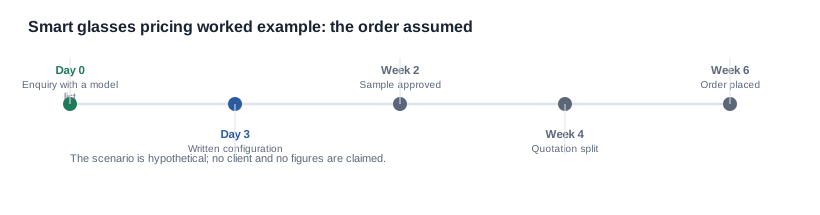
The order we are assuming
The scenario, stated once and then left alone:
- A brand opening a camera glasses programme for an initial quantity in a European market.
- Two candidate models, one at the 8 MP tier and one at the 13 MP tier.
- Two colourways rather than the full published range.
- A retail channel with a returns policy already in place, and a launch window that cannot move.
Everything else is left open, because the example is about how the lines are built, not about what the programme is.

The brief this smart glasses pricing example assumes and the constraints behind it
The three constraints that shape every line
Three constraints do most of the work in this example, and they are the kind a real buyer always has.
- The launch window is fixed. A delay is not a cost that can be absorbed, because the retail calendar is not negotiable. This constraint pushes the schedule risk to the front of every question about documentation and lead time.
- The channel has a returns policy. Units that come back have to be replaced, and the cost of that has to exist in the model rather than appearing in the second quarter.
- Two colourways, not the full range. The buyer has decided to carry two variants, which is a decision that affects setup, artwork and stock, and which most often hides the largest recoverable sum in the whole order.
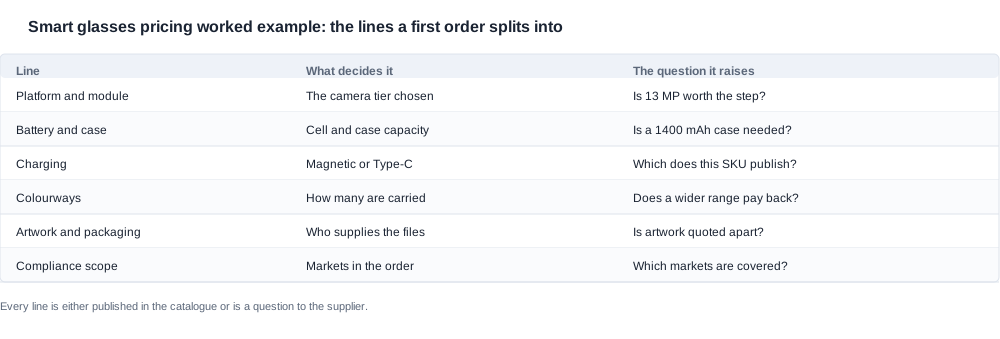
The criteria a buyer applies to this brief
Before any of the lines below is built, the brief has to answer four questions, and a buyer who cannot answer them is not ready to compare two quotations.
- Which model, which build? A model name is not a specification. In this range the L2 Utral publishes a choice of 900 or 1400 mAh case, the V03 Pro publishes three colours with a photochromic lens configuration and no charging-case row, and the V06 publishes four colours with a detachable inner frame and an IP54 marking.
- Which quantity? The volume basis decides whether the setup amortises and whether the case and packaging decisions pay back.
- Which destination market? The market changes the compliance scope, the freight basis and the duty treatment, and it cannot be added later without reopening the number.
- What is the programme expected to run at? A first order and a programme are different commercial objects, and the difference decides how a one-off is amortised.
The three things the buyer does not know yet
The example also starts with three genuine unknowns, because a worked example that begins with a complete specification teaches nothing about how to get to one.
- Whether the charging method on the chosen model is magnetic or Type C. In our range the method is published for twenty-four of the twenty-eight models, and the camera models that do not publish it are the CY05 and the CY03, and the L1 Pro and the MT6.
- Whether the case capacity of 1400 mAh or the choice of 900 or 1400 mAh is the right commercial choice.
- What the market access file covers for each model in the destination market. Our catalogue carries one company-level export certification page and no per-model certification row, so this cannot be answered from published data at all.
Each of those three unknowns becomes a line in the order, and each is answered by asking rather than by assuming.
Line one: the platform and camera tier in a smart glasses pricing example
What line one contains
Line one is the electronics and the module. In this example it holds two candidate builds:
- The 8 MP option. The V03 publishes 8 MP, a 220 mAh cell, magnetic charging, endurance of five to eight hours and a charge time of two hours or less.
- The 13 MP option. The L1 Pro publishes 13 MP, a 290 mAh cell, a 1400 mAh charging case and endurance of about seven hours, with a charge time of two hours or less.
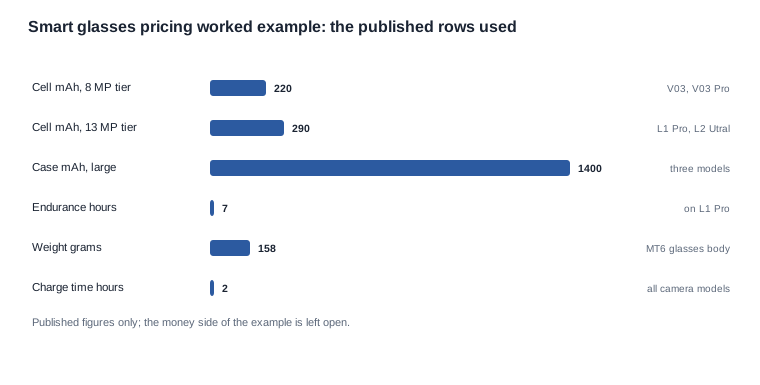
What the published rows actually say
The two builds differ on three published rows at once, and a buyer who reads the price difference as a camera difference is reading it incorrectly. The module differs, at 8 MP against 13 MP. The cell differs, at 220 mAh against 290 mAh. And the box differs, because the L1 Pro carries a 1400 mAh case while the V03 publishes no charging-case row in its published specification.
The third difference is the one most often missed, and it is the one that changes the freight line more than the module line changes the electronics.
How to compare the two options once both are quoted
The comparison in this example is not a comparison of two unit prices. It is a comparison of two landed costs over the same programme, and the checklist that produces it has five entries:
- The recurring unit cost of each build, as quoted against the same quantity.
- The amortised one-off total for each, over the programme volume the buyer expects.
- The delivered cost of each, at the same destination and the same incoterm.
- The returns and replacement reserve for each, which is larger for the build that ships with a case.
- The documentation scope for each, which has to cover the same markets in both cases.
The fifth entry is the one teams leave out, and leaving it out makes the comparison wrong in a direction nobody notices. Two builds priced with different market access scopes are two different obligations, and the unit price difference between them is partly an artefact of that difference rather than a cost difference in the product.
The question the line raises
The question this line raises is not "how much more is the 13 MP build". It is whether the retail channel's listing, the marketing claim and the price the buyer intends to charge are all consistent with the tier that gets built.
If the plan is a 13 MP listing, the 13 MP build is the only one that delivers it, and the difference between the two configurations is a marketing budget rather than a price negotiation. If the listing does not depend on the tier, the 8 MP build is a legitimate choice, and the money saved on line one has to be weighed against the case on line two and the freight in the delivery basis.

Line two: the battery, case and packaging block of a smart glasses pricing example
The case decision
The case decision in this example is a genuine choice, and the catalogue shows both sides of it. Three models publish a 1400 mAh case, the L2 Utral offers a 900 or 1400 mAh choice, the MT6 publishes a folding 1200 mAh case, the KY06 and the MT5 carry a case whose capacity is not published, and the S7 and the V03 Pro, and the V03 and the V06 publish no charging-case row at all.
So the 8 MP option in this example publishes no charging-case row, and the 13 MP option publishes a 1400 mAh one. That is a difference in the customer experience as well as in the freight, and it is the kind of difference that a brand discovers in a channel review rather than in a cost model.
The packaging decision
The packaging decision is the one that most often hides the largest recoverable sum. The buyer has already decided on two colourways, which means the artwork scope is two colourways rather than the three the V03 Pro publishes or the four the V06 publishes. The question is whether the packaging artwork is produced by the supplier and priced as a one-off, or supplied by the buyer, and the answer changes line three rather than line two.
The accessory list is the second packaging decision. A box with the device, a charging cable, a printed quick-start card and a cloth travels differently from a box with the device alone, and the difference appears as volumetric weight in the delivery basis rather than as a product weight.
The criteria for deciding the box
Two questions settle the box, and both are worth asking before the quotation rather than after it.
The first is whether the case is part of the product the channel expects or an accessory. If the channel expects a case, removing it saves money on the build and creates a returns topic in the channel, and the returns topic is usually more expensive than the saving. The second is whether the case capacity is a decision the buyer should make. A 1400 mAh case and a 900 mAh case are different products with different freight and different customer expectations, and only one of them is right for a programme with a fixed launch window.
The freight consequence
This is where the freight line is actually determined, and it is worth being precise about why. Freight on a product this size is usually governed by the volume of the consignment rather than by the weight of the device. The catalogue publishes one product weight, 158 g for the MT6 glasses body including the battery and camera and excluding the folding charging case, and it does not publish the weight of that case.
So the freight contribution of a cased configuration cannot be estimated from published data. It has to be asked for, at the destination, on the same incoterm as the goods price. A buyer who adds a percentage to the unit price to cover freight is working from an assumption, and this is one of the places where the assumption is most likely to be wrong in the wrong direction.
Line three: the non-recurring lines and how they amortise in smart glasses pricing
The one-off lines
The one-off lines in this example are the artwork and packaging development, the tooling or mould statement, the market access work for the destination market, and the sample and development units. Each appears once and each has a trigger, and the trigger is what tells the buyer whether the line is genuinely one-off or merely named that way.
The tooling line deserves particular attention, because it is the one most often misunderstood. New tooling is a one-off for the programme, but it is an asset that amortises across every subsequent order, and it may be supplied by the buyer rather than by the supplier. Which of those is true determines whether the reorder is cheaper or whether a second tooling cost is waiting in the next quotation.
How the amortisation works
The amortisation question is a decision rather than an arithmetic, and it depends on the volume the buyer expects to run. A one-off spread across a first order of one quantity looks enormous; spread across a programme it looks reasonable. Two cautions apply.
First, amortising a one-off across a first order and then presenting the amortised figure as the unit price is the most common way a first-order cost is made to look attractive. The amortised figure belongs on a programme total, not on a unit price line, because a unit price that includes an amortised one-off cannot be compared with a supplier's unit price.
Second, the assumption has to be labelled. A buyer's own volume forecast is an assumption, and in a cost model an unlabelled assumption is indistinguishable from a fact and will be treated as a fact.
The questions to ask before you order
The line three work is where a buyer asks the questions that settle the reorder, and they are worth writing down before the quotation is signed:
- Which of these one-off lines will appear again on a reorder of the same specification, and which will not?
- Who owns the tooling, and what happens to it if this relationship ends?
- Is the artwork development per colourway or per programme?
- What is the market access scope for each model in the order, and what was the date on each file?
- Which of the quoted quantities is the price attached to, and what happens if the order lands outside that band?
The last of those is the one that catches people. A price attached to a quantity is a price with a band around it, and a reorder at a different quantity is a new quotation even when the specification has not moved at all.
The reorder consequence
The reorder consequence is where the line three work pays back. On the second order, artwork and development do not reappear, tooling does not reappear, and the market access work reappears only if a new market is added. So the second order's unit cost is structurally lower, and the difference between the first order and the second is a function of how well line three was specified.
A buyer who has an itemised line three can predict the reorder. A buyer with a bundled one-off cannot, and will either be surprised by a number that has not changed or by a number that has dropped for reasons nobody wrote down.
What the smart glasses pricing worked example settles, and what it leaves open
What the example settles
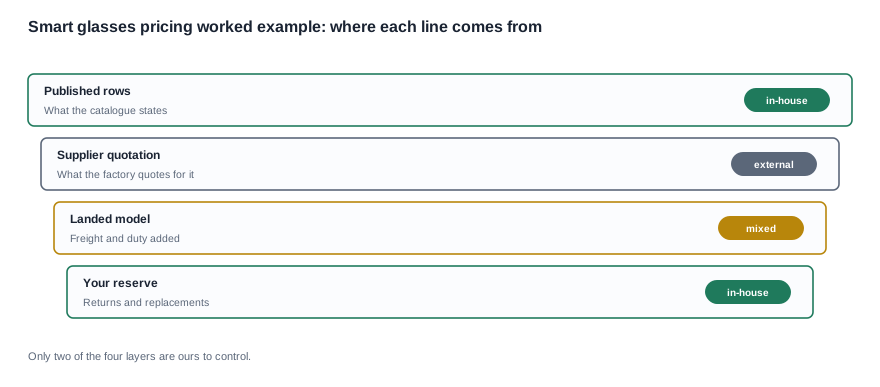
Four things are settled by the structure itself, and they are settled before a single figure is entered. The order of the lines is fixed. The specification is written before it is priced. The delivery basis is built from the box rather than from the device. And the returns reserve is inside the model rather than outside it.
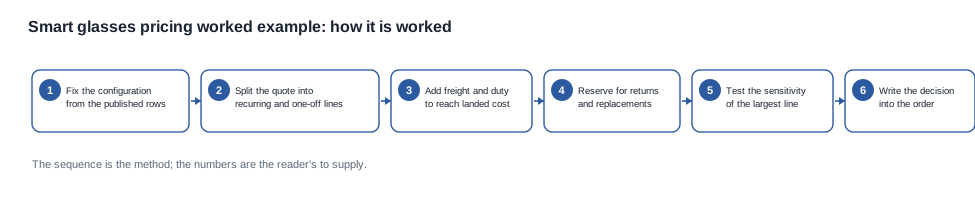
The example settles the order of operations, which is the transferable part. The configuration comes first, because without it there is nothing to price. The non-recurring block comes second, because it determines the shape of the reorder. Freight and the delivery basis come third, because they are set by the box rather than by the device. The returns reserve comes fourth, because it belongs in the total cost of the programme rather than on the invoice.
The sequence, restated as a method
The order of the lines in this example is the method, and it is worth restating in one place because the order is what makes it work: fix the configuration, split the quote, build the delivery basis, reserve for the returns, then look for the recoverable sum. A buyer who does these in a different order will still produce a number, but the number will move around while the decisions around it stay put.
A note on the pitfalls this example avoids
Three mistakes would each have produced a plausible-looking number in this example, and all three are common.
The first is treating the difference between the two builds as a camera price difference when it is a camera, a cell and a box difference at once. The second is amortising a one-off into the unit price so that the first order looks affordable. The third is leaving the returns reserve out of the total because no supplier quoted it, which makes the programme look cheaper than the channel will ever let it be.
None of these is a matter of carelessness. Each one is a step that produces a tidier number, and each one moves cost from the visible part of the model to a part that will reappear later. The example keeps all three costs visible for that reason.
What the example leaves open
The money, entirely, and that is deliberate. It also leaves open the three unknowns listed earlier: the charging method where the catalogue does not publish it, the case choice, and the market access scope per model. Each of those is a question with a written answer available on request, and each of them changes a line in the example.
It also leaves open the parts of the model that are not published at all: sensor part numbers, product weights beyond the MT6, defect rates, and production capacity for a particular week. A worked example that filled those in would be inventing numbers, and inventing numbers is the failure this whole approach exists to avoid.
Sending the order assumptions, and the lines they produce
Send us the models, the quantity, the destination and the number of colourways, and we will tell you which configurations exist for that combination, which published rows are open for them, and what a quotation for them would have to itemise. The pricing section sets out the structure behind the quotation, how pricing works covers the mechanism the lines above come from, how to reduce it covers the levers that reduce a total cost without touching the specification, and documents to request lists the paperwork behind each line of the example.
Send the configuration, the quantity and the market, and we will say which lines of smart glasses pricing are settled on the published data and which ones you would have to fill in yourself.


