

Smart glasses for education: the setting where the file comes first
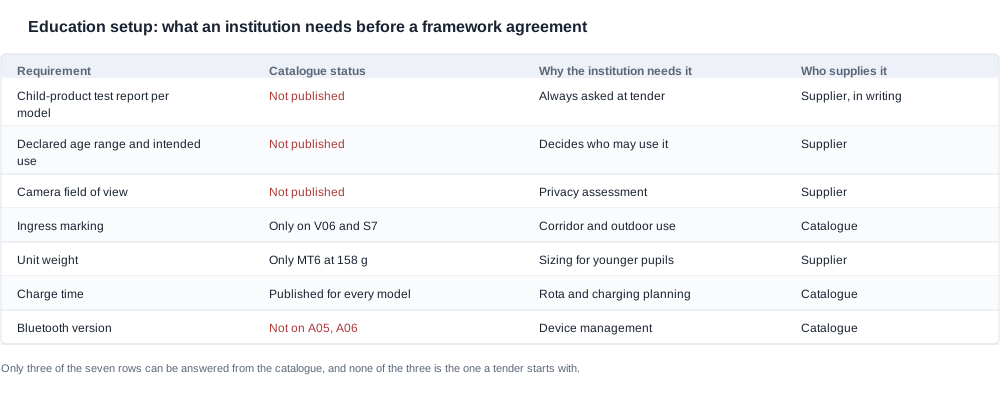
Institutional buyers do not open a sample box. They open a due diligence file, and every line in it has to be answered in writing by somebody who is accountable for the answer. That single difference between an institutional purchase and a marketplace purchase reshapes the whole job of specifying smart glasses for education: the specification is not the hard part, because our catalogue publishes the electrical rows for all twenty-eight models, and the file is. The catalogue publishes a company-level export certification page with ten design patent images, it has no per-model certification row at all, and its text contains no CE, FCC or RoHS reference anywhere. So the child-product test report, the declared age range, the technical file and the declaration of conformity are not documents a buyer can find. They are documents a buyer has to request, and the quality of the answers is the quality of the supplier.
That is the organising fact of this article, and it has a practical consequence. In this category a school, a district or a training provider can be blocked on documentation alone, months after the hardware was chosen and the budget was committed. The deployments that go smoothly are the ones where the documentation request was the first action rather than the last.
A second fact shapes the scenario specifically. Our range contains three models published as children's products: the A05 and the A06, each with a 40 mAh cell and a rated runtime of about 20 hours, and the A07, with a 70 mAh single cell and the same rated runtime band. Everything else in the range is published for general use. A procurement officer who reads "children's smart protection glasses" and hears a vision claim is reading a claim that does not exist, and a school that repeats it in a tender document has created a problem for itself. The red line in this category is not a marketing preference; it is that no model in the range may be presented as delivering a medical, a hearing or a vision outcome.
The three children's models and what their catalogue rows settle
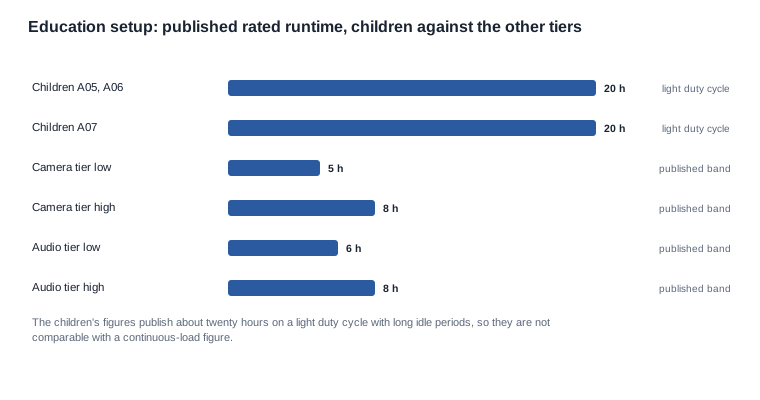
The A05 and the A06 publish a 40 mAh cell, a rated runtime of about 20 hours, a charge time of two hours or less and a magnetic charging method, and they publish no Bluetooth version. The A07 publishes a 70 mAh single cell — which is a different number from the 70 mAh times two configuration on the YKC02 sport model, and the two are easily confused in a quotation — the same rated runtime band of about 20 hours, the same two-hour-or-less charge time, magnetic charging, and Bluetooth V5.4. That is the whole published surface of the three children's models, and it is enough to plan a charging rota and to build a service schedule. It is not enough to answer a tender.
The child-product technical file has to be requested per model
Children's products carry obligations that ordinary consumer electronics do not, and they are enforced differently in different markets. The European framework runs through the General Product Safety Regulation together with the harmonised toy safety standards, and the United States runs through the Consumer Product Safety Improvement Act and its lead-content and third-party testing requirements, which bring ASTM F963 into the conversation. The point for a buyer is not which standard applies; the point is that the obligations attach to a model, to its materials, and to its intended use, which means a document covering one model does not transfer to another.
Our catalogue publishes none of it per model. So a buyer asking for the test report for the A05, and a buyer asking for the test report for the A07, are asking for two different documents, and the second one cannot be answered from the first. The request has to name the model, the configuration and the batch, and it has to ask for the report number and the issuing body rather than for a general assurance, because a report number can be checked and an assurance cannot.
The same logic applies to the declaration of conformity and the technical file. Both are per-model artefacts that a school or a district will ask for in a tender, and both have to come from the supplier rather than from a catalogue. The compliance requirement that governs how the set itself is shipped is set out at child product, and it applies to the procurement file rather than to the specification.
The claim boundary, and why "protection" is not a vision claim
This needs stating in a procurement document rather than in a marketing discussion, because the catalogue's own naming is what creates the risk. The A05 and the A06 are published under a name that translates into a protective framing for children. That framing is a catalogue product name, and it is not a clinical or an optical claim, and it must not be carried into a tender document, a parent letter, a school website or a staff briefing as though it described an outcome.
There are two ways this goes wrong, and both are expensive. The first is the tender document, where a protective phrase is copied into a specification and then has to be defended by the school against a parent who asks what it protects against. The second is the reverse error, where a cautious buyer removes the children's models from the set entirely because the name sounds like a claim, and then specifies a general model for a classroom of young pupils without any of the children's-specific design. The correct answer is neither: the name is a name, the models are catalogue models with published electrical rows, and the intended use has to be defined in writing by the institution, because the catalogue does not define it.
A camera in a classroom cannot be assessed on an unpublished field of view
Eleven of the twenty-eight models in the range carry a camera, and the catalogue publishes their resolution class — eight at 8 MP and three at 13 MP — but it does not publish the field of view for any of them, nor the storage and overwrite behaviour, nor the capture latency. An institution that intends to use a camera model in a space where pupils are present cannot complete its own risk assessment without the field of view, because the assessment question is precisely what the camera can see.
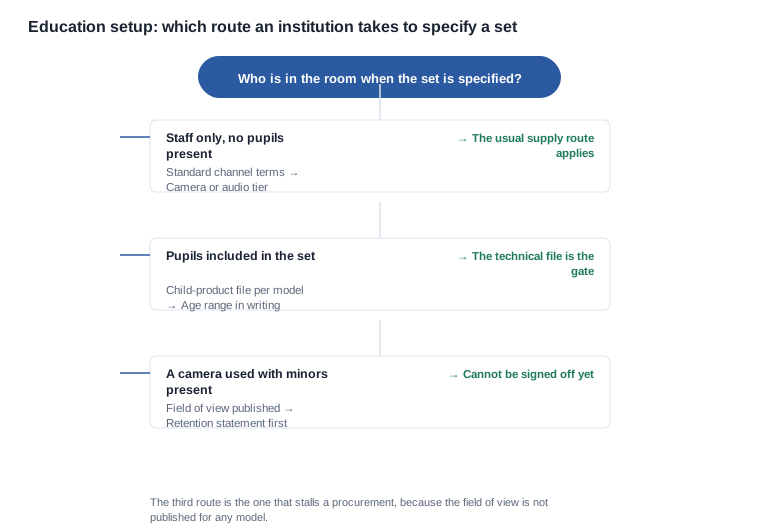
That makes the camera question a procurement gate rather than a preference. There are three workable answers, and the buyer should choose one before the model is named. Restrict the set to models used by staff in contexts where no pupil is present, in which case the camera is not the assessment subject. Use the audio tier, which holds eight models and carries no camera at all, in which case the assessment question does not arise. Or request the field of view, the storage behaviour and the retention position in writing from the supplier and complete the assessment on that basis, which is a legitimate route but adds a document and a delay that a buyer has to plan for.

The deployment stages, and which one decides the others
The stages of an institutional rollout are usually described as a sequence, and describing them that way is where projects go wrong. The stages are not a sequence; they are a set with one gate in front of them. The gate is the documentation and the intended use. A district that has agreed a model, a volume and a price, and then discovers that the technical file for the exact model cannot be produced, has not lost a week; it has lost the deployment window, because the tender cycle will have to be re-run.
Where the eight stages collapse into four
The first decision is the use and the age range, in writing, before any model is named. Second is the documentation set, requested per model, with report numbers rather than assurances. Third is the camera question, settled by scope, by tier choice or by a written field of view. Fourth is the service terms: warranty period, spare unit ratio, replacement lead time and the invoicing schedule, because an institutional deployment of any size is a service arrangement rather than a product sale, and a deployment without a spare ratio has no operational answer for the day a unit is lost.

The institutional buying chain
A procurement officer, a department head and a finance approver are three different readers of the same file, and they need three different things from it. The procurement officer needs the technical file, the test report numbers, the declaration of conformity and the supplier's approved-vendor documentation, because those are the tender conditions. The department head needs the use case, the training plan, the charging rota and the support arrangement, because that is what a deployment looks like from a classroom. The finance approper needs the invoice structure, the delivery schedule, the warranty period and the exit position, because a framework agreement is a multi-year commitment and the cost of leaving it has to be priced.
The commercial consequence is that the request list has to be organised by reader, and that a supplier who treats it as one document is usually slower rather than faster. A buyer who sends three separate, numbered requests — one per reader — gets three answerable sets. A buyer who sends one combined request gets a general reply, and general replies do not clear a tender condition.

How an education configuration is verified before it reaches a classroom
Verification in an institutional setting has two halves that are usually confused. One half is device verification, which is the same work as in any channel: confirm the configuration against the catalogue rows, run the functional checks on two units from the same batch, and write one criterion per measured characteristic. The other half is file verification, which is specific to this scenario and is mostly about whether a document exists, names the model, and can be checked by a third party.
The verification set and its completion standard
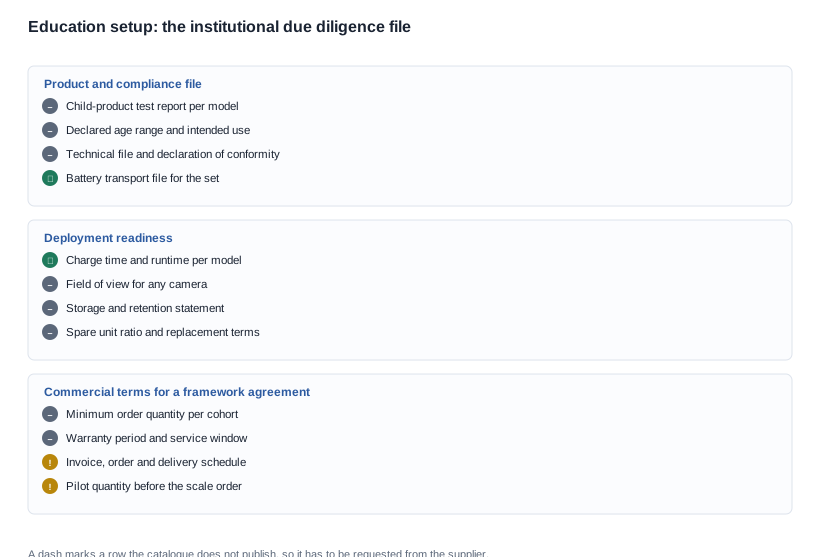
Four device checks and four document checks, each with a written completion standard.
On the device side: a configuration match between the packed unit and the catalogue row for that model, including the charging method, the cell configuration and the case status where a case is in the set. A charge-cycle measurement on two units from the same batch, against the published two-hour-or-less charge time that applies to every model in the range including the three children's models, and against the roughly one-hour charge time the D17 and the ZH12 publish. A runtime observation against the stated use, with the duty cycle recorded, because the children's figures publish about 20 hours on a light duty cycle with long idle periods and are not comparable with a continuous-load figure. And a gross weight measurement for the packed set, which the catalogue publishes for no configuration.
On the document side: the test report number for each model, each checkable with the issuing body. The declared age range and intended use, in the institution's own words. The technical file and declaration of conformity, per model. And the warranty period with its exclusions, since nothing in the catalogue states one.
Documents to request before the framework agreement
The request is organised by reader rather than by document type. For procurement: the child-product test report per model with report numbers, the technical file, the declaration of conformity, the battery transport documentation for the exact set including any case, the model designation table, and the certificate register so that every number can be checked in the issuing body's public register. For the department head: the charging rota implied by the published charge times, the training material, the warranty and service terms, and the spare ratio. For finance: the invoice structure, the delivery schedule against the academic calendar, the payment terms, the minimum order quantity per cohort, and the exit or termination position.
Two documents in that list are the ones most often skipped and most often regretted. The model designation table is what lets the institution check that the unit in front of it is the model in the file, and without it every document check applies to a model the school cannot confirm. The battery transport documentation for the exact set is the document that a delivery is stopped without, and it is requested far too late in the process. The related material is at education buying checklist and the deployment format is at education deployment template.

Where education deployments lose money, and which terms stay open
Institutional losses in this category are not usually in the unit price. They are in a deployment that stops at the tender stage, a rollout that has no service answer on the first morning, and a framework agreement whose exit terms were never written. The terms that stay open sit in exactly those places.
Failure modes in an institutional rollout
A tender that has to be re-run. The symptom is a deployment that misses the academic year. The root cause is that the documentation request came after the model and the volume were fixed, and the model-specific file turned out to be unavailable. The prevention is to request the file first, and to ask for report numbers so that availability is established before anything is committed.
A deployment with no service answer. The symptom is a teacher carrying a spare unit in a bag because the replacement route is unclear. The root cause is that the agreement settled the warranty period but not the spare ratio or the replacement lead time. The prevention is to write the service terms as part of the commercial terms rather than as an operational afterthought.
A claim that reached a parent letter. The symptom is a parent asking what the glasses do for eyesight, and the school having no answer. The root cause is that the catalogue product name was carried into a communication as though it described an outcome. The prevention is a one-page boundary statement in the parent-facing material, written before launch, stating what the device does and does not do.
A camera nobody could assess. The symptom is an approval that stalled at the safeguarding review. The root cause is that the field of view is not published for any model, so the review had nothing to work from. The prevention is to settle the camera question at the first decision rather than at the approval meeting.
A battery plan that did not match the duty cycle. The symptom is a class that stopped using the device by lunchtime. The root cause is that the roughly 20-hour children's figure was treated as a continuous-load figure. The prevention is to state the duty cycle alongside the figure in the charging rota.
A pilot that produced no usable data. The symptom is a scale order that went ahead anyway. The root cause is that no criteria were written, so the pilot produced opinions. The prevention is to write one criterion per measured characteristic before the pilot and to read the pilot's returns against them afterwards.
The commercial room in a school framework agreement
The model architecture is fixed — the cell configuration, the charging interface, the case architecture and the camera module — and certification cost and lead time are fixed in character because they are laboratory and regulatory costs. Fixed in substance and shown on a separate line, tooling still has two negotiable elements: when the charge lands and what volume carries it.
The room in an institutional agreement is in the service and the schedule. Whether the supplier will produce the per-model documentation on a named timetable rather than on request is the term that decides whether the deployment survives its own tender cycle. Whether a pilot quantity can be taken at a pilot tier before the scale order, and whether the pilot's criteria are then written into the scale agreement, is the cheapest insurance available in this category. Whether a spare unit ratio is included in the volume and at what price, and whether the warranty covers the spare units on the same terms as the deployed units, decides whether the institution runs a service or runs a queue. Whether the delivery schedule can be staged against the academic calendar rather than shipped as one consignment is a logistics term with a large cash consequence, because a consignment delivered in the wrong month has to be stored or returned. Whether the invoice structure can support purchase order numbers and a named cost centre is an administrative term that delays payment when it is missing. Minimum order quantity per cohort, and whether two cohorts can be placed against one framework. Logo, packaging artwork and the language of the printed instruction, which for this channel is a document with safeguarding consequences rather than a marketing insert. And the exit position — what happens to the units and to the documentation if the institution changes supplier — which is the term nobody negotiates and everybody wishes they had.
A worked example. Assume a training provider placing a mixed set for two cohorts, with staff-only use in one and pupils included in the other, and with a framework agreement rather than a one-off purchase. The first move is to split the set by use rather than by price, because the two uses have different documentation obligations. The staff cohort takes a camera model, chosen for the resolution class and the published charge time, with the camera question handled by scoping the use to staff in contexts where no pupil is present. The pupil cohort takes the audio tier, which carries no camera and therefore removes the assessment question entirely, and the provider keeps one children's model as a spare rather than a primary unit. The second move is the documentation request, sent as three numbered requests to the three readers, with the child-product report asked for by report number and by model so that availability is established before the purchase order. The third move is the service terms, where the spare ratio, the replacement lead time and the warranty period are written into the agreement rather than into an operational memo, because a training provider without a service route is a training provider with a queue. The fourth move is the schedule, staged against the two cohort start dates rather than shipped as one consignment, which also converts an early documentation failure into a recoverable delay rather than a total one. The fifth move is the pilot, one cohort at the pilot tier, with the acceptance criteria written before it starts and read against it afterwards, so that the scale order is an evidence-based decision rather than a deadline. The result is a deployment that can answer a safeguarding review, a finance approver and a parent question, because the file was built for all three readers from the beginning.
What an education buyer can hold us to
The working rule we apply: we publish the rows an institution can order from, and we do not publish the compliance rows we do not hold. That means the cell configuration, the charging interface where the catalogue publishes it, the charge time, the rated runtime, the resolution class, the case capacities where they are published, the ingress marking on the V06 and the S7 stated as a catalogue attribute, and the 158 g whole-unit weight on the MT6 with the exclusion of its foldable case stated alongside it.
What we do not publish and will not estimate: the per-model child-product test report, the technical file, the declaration of conformity, the declared age range, the camera field of view, the storage and overwrite behaviour, the capture latency, the warranty terms, the defect definition, the unit weight apart from the MT6, the pack gross weight, the sensor, the video specification, the operating temperature range, the cycle life rating, the runtime test condition, and the charging method on the CY03 and the CY05, and the L1 Pro and the MT6. We will not state that any model carries a certification our catalogue does not name, and we will not present a model as delivering a medical, a hearing or a vision outcome, because none of our catalogue rows supports such a claim and the naming of the children's models is a product name rather than a claim.
What we will do is take the institution, the use, the cohorts, the ages involved, the volume, the target market and the deployment window, and tell you which published rows apply to which model, which documentation has to be requested per model, whether the camera question blocks the configuration, and which service terms belong in the framework agreement.
What to send us next. Send the institution type, the intended use, the cohort sizes, the ages involved, whether any camera is in scope, the volume and the deployment window, and we will return the configuration split with the published rows for each model, the per-model documentation request, the service terms to write into the agreement, and the pilot plan to put in front of the approver.
Related reading
- The point where the scenario starts — smart glasses for education
- The buying checklist — education buying checklist
- The deployment format — education deployment template
- The compliance requirement — child product
Tell us the intended use and the ages involved, and we will return the configuration split and the documentation request.


