

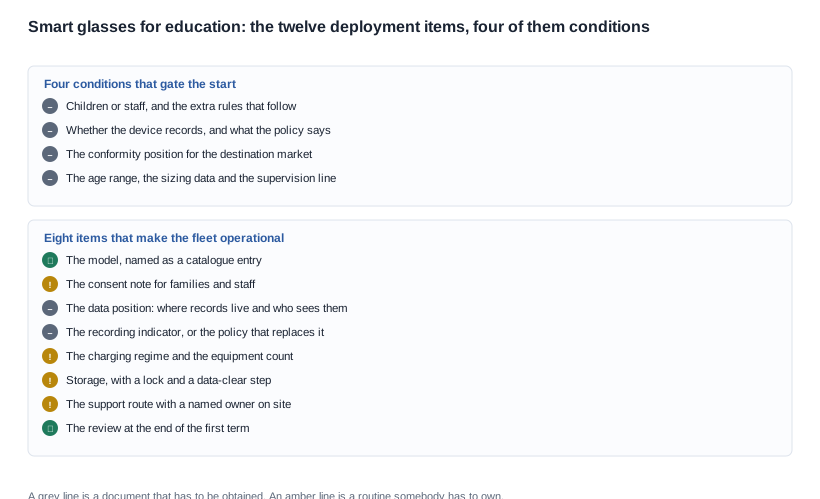
Smart glasses for education smart glasses checklist is twelve items, and the structure of the list is the argument: the first four are conditions and the remaining eight are the deployment. The first four determine whether the product can be used in the school at all, and a deployment that has skipped them will not fail visibly — it will simply not be used.
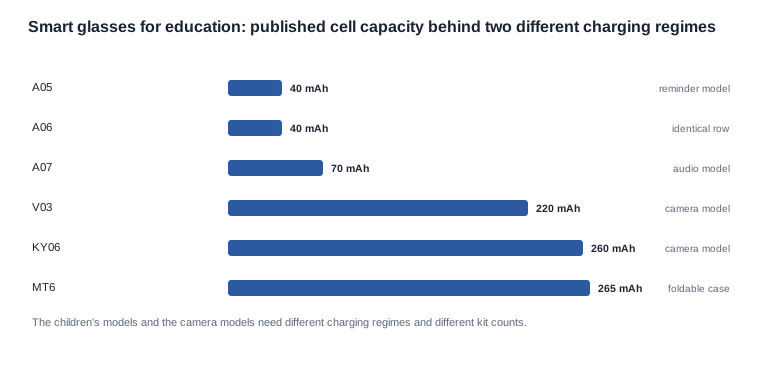
We publish the kids range's configuration — the A05 and the A06 at 40 mAh with roughly twenty hours of rated runtime, magnetic charging, a lens-type electronic atomiser module and posture and distance detection, and the A07 at Bluetooth V5.4 with a 70 mAh cell and the same runtime — and we publish no certification position, no data flow, no recording indicator, no fit data and no age position for this range.
Smart glasses for education: twelve items, and four of them are conditions
The conclusion first. This is a deployment document, not a purchasing one. The ten checks that decide whether an order is worth placing live in the buying checklist, and the twelve items here assume the order is placed and the units are in the building. The distinction matters because the two lists fail differently. A purchasing list that is skipped produces a shipment that cannot be sold or cannot ship. A deployment list that is skipped produces a fleet that sits on a shelf with a signed consent form, and the failure is silent, because nobody reports a device that is simply not being used.
The four conditions are gates, not tasks. They are answered before the first session and they cannot be answered by the channel alone. Each one needs an answer from an institution, an adviser or the company, and each one needs a document. The remaining eight items are the deployment: they are owned by the school, they need a named person, and they need a routine rather than a document.
What the published configuration settles and what it does not. The published rows settle the electrical behaviour of the range, and they are the input to the charging regime, the storage plan and the service interval. They settle nothing about whether the product may be used in a particular school, in a particular country, with a particular age group, because there is no per-model conformity row, no data flow, no recording indicator specification, no sizing data and no age position published for this range. The four conditions exist precisely because those rows are missing, and they are not satisfied by a good product.
The four conditions that decide whether a deployment can start
Condition one: children or staff. Whether the product is intended for children or for staff decides which additional requirements apply, and whether they apply at all is a question about the specific model and the destination market rather than about the product category. It is the first question because it has the longest lead time of the four: an answer that arrives late cannot be used, because the programme has already started.
The additional requirements that apply to products intended for children cover mechanical and small-part properties as well as the radio and chemistry sets, and the standards that come up in this category include EN 71 in Europe and ASTM F963 in the United States. Whether they apply to a given product is a determination for the destination market and a qualified adviser, and the buyer needs that determination in writing with a holder named on it. The second half of the condition is organisational: it decides who inside the institution has to approve the deployment, which is rarely the person who owns the budget. In a school, the purchasing decision and the safeguarding decision are made by different people, and a deployment that has satisfied one and not the other has a problem that will not appear until a family asks a question.
Condition two: does it record. A device that records a classroom raises the consent question, the retention question, the storage question and the access question, and none of them is a product question. A device that only reminds raises a much smaller set of them, because a reminder produces a notification rather than a record. For the three children's models in this range, the reminder and audio functions are what the catalogue publishes, and that materially reduces the governance burden — which is a procurement advantage that is worth naming when a school compares configurations.
Condition three: the conformity position. Ours is recorded as not provided for the kids range. The catalogue carries a company-level export certification page whose content is images rather than text, and the catalogue text contains no reference to CE, FCC or RoHS, and there is no per-model certification row anywhere. The children's rules have to be confirmed as applicable or not for the specific model, and this item cannot be closed by a school and cannot be closed by a channel without the company and a qualified adviser.
Condition four: the age range. It decides the sizing, the supervision line and the age position in any warranty language. We publish no sizing data for these models, so this is a sample question and a certification question at once, and it is the condition most often left implicit because it feels like something the school already knows. If the school has an existing age policy for devices in its care, that policy and the model's suitability have to be checked against each other rather than assumed to agree.
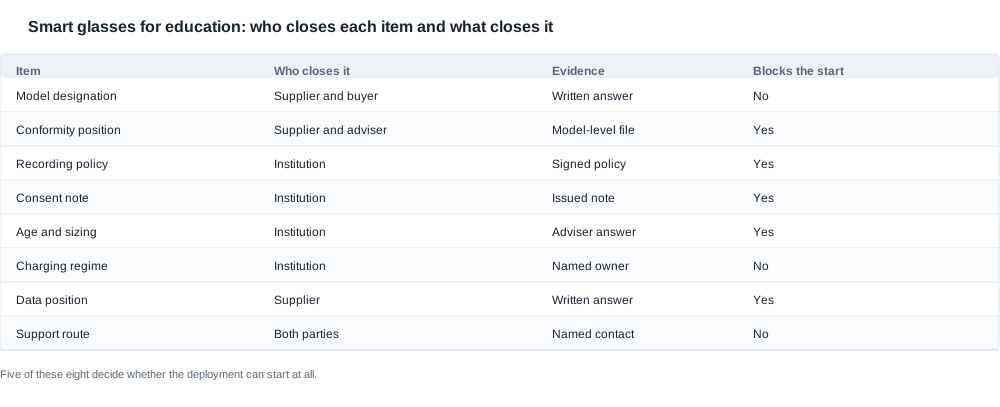
The eight items that turn an order into an operating fleet
Item five: the model. The A05, the A06, the A07 or, where a camera is required for staff, a model from the wider range. Note that the A05 and the A06 publish identical parameters and that our own catalogue records the difference between them as unconfirmed, so the entry has to be named rather than described.
Item six: the consent. What parents, staff and the school have been told, in two sentences: what the device does and what it does not do. This is the document that prevents the largest single category of complaint in the education channel, and it has to be issued in the language the families read.
Item seven: the data position. Where any records live, who can see them and how long they are kept. We publish no data flow for any model in this range, so this has to be settled with the supplier in writing before the deployment starts. A school that cannot answer it for its own governance is in no position to answer it for a parent.
Item eight: the recording indicator. Whether a person can be seen to be recording. We publish no indicator specification for any model, and where there is no visible indicator, the policy has to compensate for it rather than assume a feature that is not published.
Item nine: the charging regime. Where the fleet charges, and how much equipment that needs. On the kids range the charging is magnetic, so each device needs its own cable or dock and the quantity follows the unit count. On the camera models the picture changes again, because the published cell capacities run from 220 mAh to 290 mAh and several configurations ship with a charging case.
The regime also decides what the school has to provide. A room with four sockets cannot charge a class set, so the charging equipment count is not an accessory decision but an infrastructure decision, and the shelf it lives on needs a power plan and a place in the room's routine. Where a configuration includes a case, the case is a second lithium cell, which changes the parcel the institution receives, the way the units are stored between classes, and the scope of the transport documentation that has to be settled before the shipment rather than discovered by the forwarder. A deployment that has counted devices but not cases has under-counted its own logistics.
Item ten: the storage. A locked cupboard if there are cameras in the fleet, and a data-clear step if the devices change hands or change cohorts.
Item eleven: the support route. A named person on site, because the person holding the broken device is a teacher, and a teacher is the least able to absorb the cost or the time of resolving it.
Item twelve: the review. Scheduled at the end of the first term, and it is where the sizing data, the return reasons and the parental feedback get read together rather than separately. A review that reads three sources separately produces three impressions; a review that reads them against the criteria written before the first session produces a decision. The output should be one of three: extend, adjust the routine, or stop — and the criteria should say in advance which of those a given result leads to.

The pairs of items that fail together
Conditions four and eleven are linked, because a device that does not suit the age group in front of it produces returns and questions, and the returns process needs to handle both. The two items are usually owned by different people, which is why the link is invisible on an organisational chart and obvious in the first week.
Conditions seven and ten are linked, because a data position that is not settled means the storage arrangement cannot be designed — you cannot write a data-clear step for a device whose data position has not been answered, and you cannot write a retention rule for a device whose storage location is unknown. These are the two linked pairs where a deployment discovers its gaps in week one rather than at the end-of-term review.
Condition one and item six are linked in a way that is easy to miss. The additional requirements that apply to products intended for children are what the consent note is about, so a consent note written before the age question is answered is likely to describe the wrong thing. The order of the two is not a formality: a note that promises more than the compliance position supports creates the exposure the buyer was trying to avoid.
Items nine and five are linked through the published configuration. The charging equipment count is derived from the device count and the interface, and the interface is per model, so a model decision made after the kit is quoted produces either an equipment shortage or a spare. That is worth knowing before a school orders, because the two linked pairs are where a deployment discovers its gaps in the first week rather than at the review.
What a broken link costs, in practice. When two linked items fail together, the cost is not the sum of the two items; it is the cost of the question they generate. A unit that does not suit the age group in front of it produces a return, and a return produces a question from a family, and the question has to be answered by someone while a class is waiting. A data position that has not been settled produces a storage arrangement that cannot be written, which produces a cabinet that is either too secure or not secure enough, which produces a second review by the institution's own governance process at exactly the moment the programme was supposed to be running. Both of those land on the same person: the teacher. The reason to name the linked pairs before the deployment starts is not tidiness. It is that the person who absorbs the consequence of a broken link is never the person who holds the checklist.

The first-month sequence for getting units into classrooms
The twelve items are easier to run as a sequence than as a checklist, because four of them have to happen before the units are used and eight have to happen in the first week.
Week zero is the sign-off: the recording policy, the consent note, the conformity position and the age and sizing answer, each with a document attached and each with a name against it. If a condition is still open at the end of week zero, the honest decision is to hold the devices rather than to start a term with an open condition, because the cost of a term started under an open condition is a term of unusable data.
Day one is counting. The units go into a numbered tray with a place per unit, and the register is opened with a serial, a firmware build and a date. The count on day one is the baseline that every later count is compared against.
Week one is the charging shelf and the count sheet. One magnetic dock or cable per device, in a position somebody owns, and a sheet at the end of every day with a number and a signature.
Week two is the first real read: the count against the register, the open tickets, and the first question from a family.
Week three is where the routine gets adjusted rather than the hardware. If units are flat by the fourth period, the answer is a shelf and an owner, not a different model. That distinction is the one a deployment gets right or wrong, and getting it right is what keeps a hardware conclusion out of the record.
End of term one is the review against the criteria that were written before the first session, which is the only review that produces a decision rather than an impression.
What happens when the sequence slips. It will, and the plan should say what happens rather than leaving it to the person with the least authority. If a condition is still open at week zero, the devices stay in the box and the school is told why in writing — a term started under an open condition produces unusable data and a second term of distrust, which is worse than a delayed start. If the count sheet has not been filled in for two consecutive days, the response is to fix the routine, because a routine that survives two missed days will not survive a term. And if the support route has no named owner, the escalation goes to the channel until it does, which is a service obligation the channel has to accept rather than a courtesy it can decline. None of these are hardware decisions, and none of them should reach the supplier as a defect claim.
Who carries the first month. In a school, the first month is carried by the teacher, and the channel's part is to make sure the teacher is not carrying it alone. That means the kit is delivered before the devices, the printed card is in the language the class uses, the count sheet arrives blank and ready to use, and there is a named person at the channel who can answer the first question about the routine rather than routing it into a support queue. The published electrical rows let a channel answer the questions about charging with certainty; the questions about the routine are answered by supplying the routine.
What our published configuration settles and what it leaves open
What we publish for this line: the cell capacities of the A05, the A06 and the A07, the charging times, the rated runtime with its stated caveat, the charging interface, the Bluetooth version where it is listed, the presence of the posture and distance reminder on two of the three children's models, and the colour options. We also publish that the A05 and the A06 carry identical parameters and that the difference between them is unconfirmed.
What we do not publish, and will not estimate: the conformity position for this range, the data flow, the recording indicator specification, the sizing data, the age position, the per-model unit weight, the coating specification, the detection method and its accuracy, and the cell life over years. The catalogue carries a company-level export certification page whose content is images rather than text, and the catalogue text contains no reference to CE, FCC or RoHS, so there is no per-model certification row for this range to quote, pending or otherwise.
We would rather a school saw the open questions than had them glossed over by a specification. What we can do is fill the eight items our published configuration reaches and tell you which four have to be closed before the order by the company, the institution and a qualified adviser.
The four questions worth putting to a supplier before the order. Which requirements apply to this configuration in the destination market, and who holds the evidence. Which catalogue entry is being supplied, given that two children's models publish identical parameters and the difference between them is recorded as unconfirmed. Where the charging equipment comes from, in what quantity, and on what lead time relative to the devices. And what the replacement route is for a unit that fails during a teaching week, with the response time and the freight allocation named. These four questions are the commercial version of the four conditions, and a supplier who answers all of them has demonstrated that the deployment is under control rather than merely shipped. A supplier who answers none of them has not priced the deployment, and the difference shows up in the first month of use rather than on the invoice.
Send us the year group, the setting, the unit count and the destination market, and we will tell you which of the four conditions has to be closed first, which of the eight deployment items the published configuration already settles, and which of them are waiting on a document from somebody other than us. The channel context is under smart glasses for education, the selection sequence is in how to choose for education, and the deployment template is in education deployment template.
Related reading
- Which model, and why — how to choose for education
- The nine fields to fill in — education deployment template
- What each model is for — education product recommendations
Send us the year group and the setting, and we will tell you which of the four conditions has to be closed first.


