

The question is not really "is this a factory" — it is "does the party on the other side of the quotation control the process that makes my order". A well-run trading company can be a better partner than a factory, and a factory can behave like a trading company. Both of those statements are true simultaneously, which is why the distinction has to be established rather than assumed.
What follows are six exchanges, each of which reveals something, and none of which requires a visit. Each is answerable over email, in a single round, by a supplier who is prepared — and the ones that produce the longest pause are usually the ones that tell you the most.
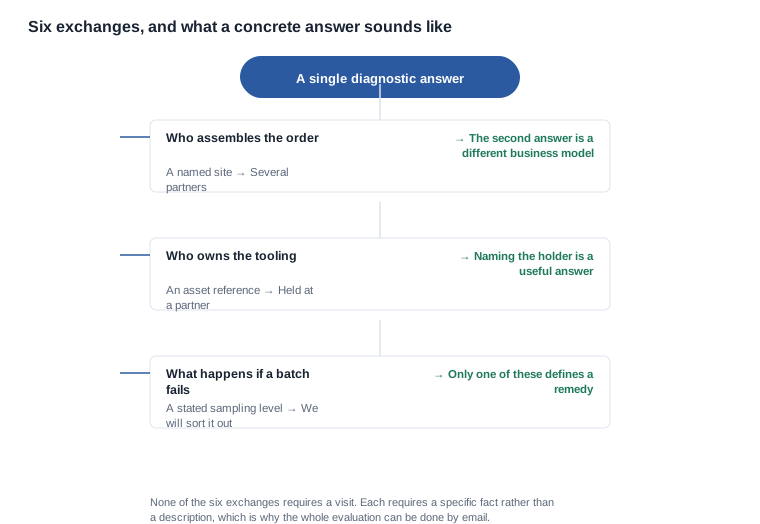
Each exchange asks for a specific fact rather than a description. That distinction is what makes the whole evaluation possible without travelling: a description can be produced by anybody with a marketing department, while a specific fact has to come from somewhere in the organisation.
Factory vs trading company: six exchanges, and none of them needs a visit
1. Name the build site. Ask plainly which site will assemble and test the order.
A factory answers with a name and a location, and often volunteers the sub-suppliers. A trading company explains that production is shared across partners, which is legitimate — but it means your contract is with a party that does not control the process.
Push once if the answer was vague. "Which site" answered with "we work with several partners" is a beginning; follow it with "and for an order of this size, which one."
2. Name the contractual party. Who are you contracting with, and who carries the obligation?
This is the question that settles the matter. If the company you contract with does not build the product, write down what they are responsible for and what they are not — specifically, which questions route to them and which must reach the production site.
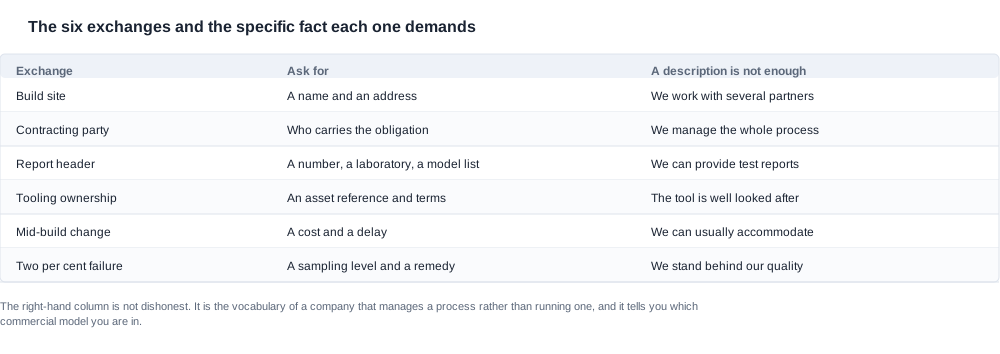
Those two exchanges together establish the commercial model, and everything after them is about the details of that model rather than its identity.
3. Request a report header. Ask for a test report and read the header: report number, laboratory name, and the model list printed on the report itself.
You are not trying to catch anyone. You want to know whether the document names your model. A family-level report covering a different variant tells you about a different product, and this step eliminates a large share of the ambiguity in this category because most documents here are issued per family or per electrical design rather than per marketing name.
4. Ask who owns the tooling. This is the cleanest test available, because tooling is a capital asset and factories track them.
Ask for an asset number, a cavity count, an expected life in shots, and ownership terms in the purchase order. A trading company holds no tooling and will name the partner who does. That is a useful answer and it tells you something concrete: your contract is with a party that does not own the equipment that makes your product.
5. Propose a mid-build change. Suggest a small change and ask what it costs and what it delays.
A factory can answer immediately and may tell you the change is free. A trading company has to ask a partner, and the answer arrives later — which tells you both about control and about how long every future question will take.
6. Ask what happens if two per cent of the batch fails. A factory's answer is a procedure: the acceptance sampling level, the evidence required from you, who pays the freight, whether the remedy is replacement or credit.
A trading company's answer is a gesture, because the disposition decision belongs to the partner. If a supplier cannot state an AQL without hesitating, ask what their standard is. The answer or the hesitation is the finding.

Exchanges one and two: the site and the party
The first two exchanges are worth separating from the rest because they establish something the later four only illustrate. A supplier can produce a convincing report header, a named tool owner and a stated sampling level while still being an intermediary — and an intermediary that does all three is a good intermediary. What it means is that you are contracting with a party who is managing a process rather than running one, and the commercial consequences of that are permanent rather than situational.
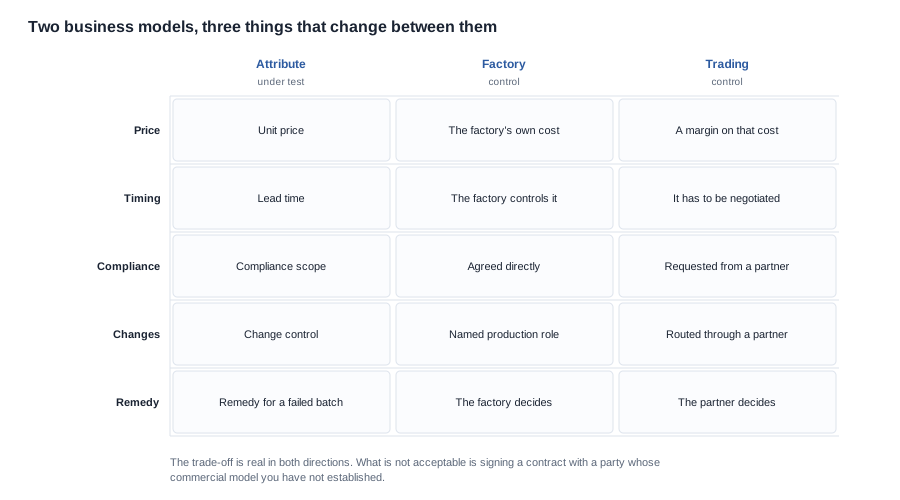
That distinction shows up in three places before a single unit is ever built. Price, because a factory quotes its own cost while an intermediary quotes a margin on it, and the difference between the two is not recoverable by negotiation. Timing, because a factory controls its schedule while an intermediary has to negotiate it, which means a date from an intermediary carries an additional dependency that is invisible in the quotation. Risk, because with a factory you own the relationship with the party making the goods, and with a trading company you own the relationship with the party who arranged them.
None of those differences is a reason to avoid an intermediary. For a small first order, or for a buyer whose channel is in a market whose rules are unfamiliar, an intermediary can be faster and cheaper than a factory that would rather sell direct, and fighting that model costs more than accepting it.
What is worth saying is that the intermediary case is strongest exactly where a buyer is weakest, which is why the first order in an unfamiliar market is often the one where the model matters least. A buyer who does not yet know which documentation their destination requires gains very little from direct access to a production line, and gains a great deal from somebody who already knows which factory handles that market. The same buyer, on their third order with a settled specification and a known route, has the opposite requirement: they want access to the process because they know what to ask about it.
That is the useful way to hold the trade-off in mind. The commercial model should follow the buyer's maturity with the category, not the other way round, and a buyer who moves from an intermediary to a direct relationship between orders is making a change that the six exchanges will make obvious.
A related point concerns sub-suppliers. A factory that sub-contracts a specific step — a particular test, a specific enclosure operation — will usually name it, because it has to manage it. A trading company will name the partner who makes the product and will often stop there. The distinction matters for audit rights: being able to audit the site that assembles your order is worth considerably more than being able to audit the site that cuts your mould, because the first is where your defects will be produced.
What matters is that you know which model you are in before you commit, because the three consequences above cannot be adjusted afterwards. A price agreed with a party whose cost you cannot see cannot be renegotiated on the basis of information you did not have. That is the practical cost of not running the first two exchanges.
There is also a third-party version of exchange one that is worth running when the first answer is unsatisfying: ask which partner would make an order of your quantity, and ask whether you may audit them. A trading company that names a site and offers access has given you something genuinely useful, and a trading company that declines both has told you that the process is not visible to you at any price.
Exchanges three and four: the document and the asset
Exchanges three and four are the two that most reliably distinguish an organisation that holds records from an organisation that has been told about them.
The report header test works because it requires no expertise in the standard being applied. Three questions are on the page: what is the report number, which laboratory issued it, and which models does it list? A supplier that produces a document will produce one with all three, and the third is the one that matters. If your intended model is not in the list, the document is about a different product regardless of what the family name suggests. In this category that happens frequently, because documentation is commonly issued per electrical design rather than per marketing name, and because designations within a range drift.
There is a fourth question on the same page that experienced buyers ask and most skip: what date was the report issued, and does it postdate the build you are buying? A report issued years before a design change is not evidence about the current product, and a supplier who cannot say when a report was produced is telling you that nobody has checked.
The same test applies to claims that are not reports. A catalogue marking such as an ingress rating is not a test report, and in our range the sport tier's IP54 marking is published as a marking with no report number behind it. A supplier who presents a catalogue marking as though it were a report has failed the header test by omission, and the omission is worth asking about directly.
The tooling test works because tooling is expensive, physical and long-lived. A factory holds tools and tracks them, which means it has an asset register, an expected tool life measured in shots, and a practical opinion about when a tool should be replaced. A trading company holds none of these and has to relay the question. The follow-up that distinguishes the two is to ask what happens to the tool if the project ends — a factory has an answer grounded in its own asset management, and an intermediary has an answer grounded in a conversation.
The reason these two exchanges are so diagnostic is that neither can be faked by a person who does not hold the underlying records. A report header exists or it does not. A tool register exists or it does not. Both are artefacts rather than opinions, which is exactly what you want from a test that has to work over email.

Exchanges five and six: the change and the remedy
The last two exchanges test response capability rather than possession, and they are the ones that predict how the programme will actually feel.
Exchange five — propose a mid-build change and ask what it costs — works because the answer has to come from whoever controls the engineering and the schedule. A factory can answer because it holds both. An intermediary has to ask, and the delay is itself the finding: every future question in the programme will be answered at the speed of a relay rather than the speed of a decision.
The question is worth making specific rather than hypothetical. "What would a logo change cost?" invites a policy answer. "If we changed the case capacity from the 900 mAh option to the 1400 mAh option at this stage, what would that involve?" invites a real one, and the difference between the two answers is often the difference between a factory and an intermediary even when everything above has been ambiguous.
Exchange six — ask what happens if two per cent of the batch fails — is the commercial version of the same test. The question is not adversarial; it is routine, and a supplier with a quality system will have a procedure ready. The substance of the answer is the acceptance sampling level, the evidence you must provide, who pays the freight, and whether the remedy is replacement or credit. A factory can answer all four from its own process. An intermediary can answer the first and will have to check the rest.
There is a fourth variant of this exchange that is even sharper, because it cannot be answered from a procedure: ask whether you may send units back for failure analysis, and who pays for the freight. The answer tells you whether the supplier expects to be judged on the goods or only on the paperwork.
There is also a fifth question that belongs with this pair, and it is the one that tells you whether the previous four answers were rehearsed. Ask what the acceptance sampling level is, and then ask what happens to a unit that arrives outside it — specifically whether it is reworked, scrapped or shipped against a concession. The third of those is the one that splits the two models most cleanly, because shipping against a concession is a commercial decision that has to be taken by somebody who can afford it, and that somebody is the party you are contracting with.

When the answer is vague: how to escalate without ending the conversation
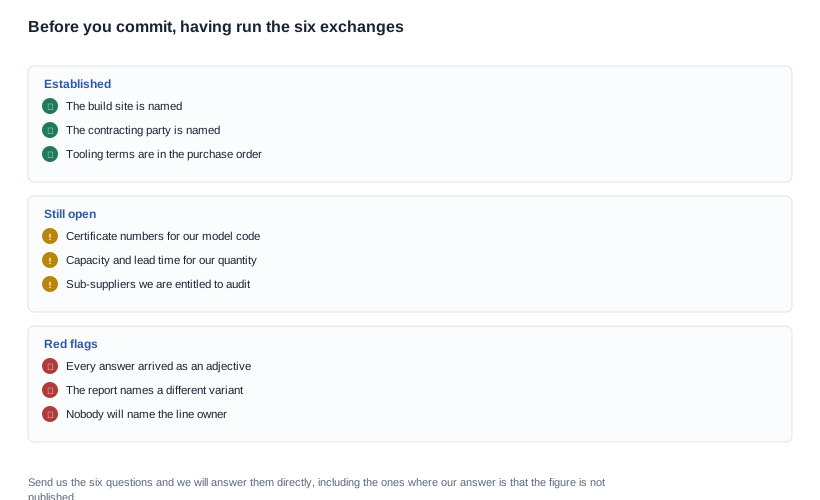
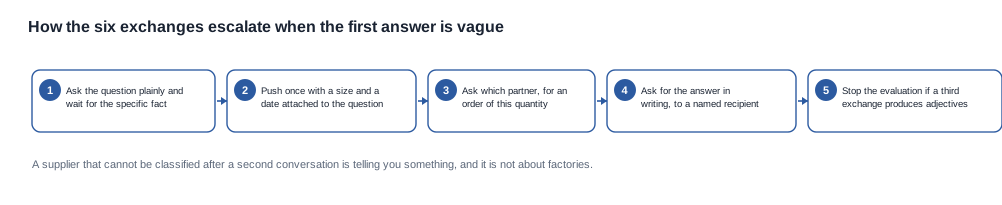
A vague answer is not the same as a bad answer, and the useful skill is escalating without losing the supplier. Four steps work in practice.
Ask the question plainly and wait for the specific fact. Most vagueness in the first exchange is a habit of cautious answering rather than an evasion. A direct restatement — "so which site assembles an order of two thousand units" — resolves it more often than not.
Attach a quantity and a date to the question. This is the single most effective escalation. A supplier with capacity can answer immediately; a supplier without it has to check, and the check is the answer.
Ask which partner, specifically. "We work with several factories" becomes answerable when followed by "which one for this order".
Ask for it in writing, to a named recipient. Not as an accusation — as a request to have the answer on the record before the purchase order. Most suppliers agree, because they know what the question is for.
Stop after the third exchange if the answers are still adjectives. A supplier that cannot be classified after a second or third conversation is telling you something, and it is not about factories — it is about whether they intend to be accountable for the process they are selling.
The other half of this section is knowing when to stop asking altogether, which is a different skill. Some suppliers are simply not set up to give the answers — their commercial model is aggregation and they genuinely do not hold the process detail. Asking them four times produces nothing but friction. The right response is to accept the model, adjust the questions to match it, and take the protections that the model requires: a named factory bound in the contract to a stated compliance scope, an agreed inspection standard, and a remedy that does not depend on the intermediary's own cost.
That adjustment is not a compromise; it is the correct response to a fact. A buyer who has established that they are dealing with an intermediary and then negotiates as though they are dealing with a factory is spending effort on a position the supplier has never taken and will not take.
There is one case where you should not accept the model at all, and it is worth stating precisely so that it is not over-applied. If the supplier has declined to name a factory at all, and will not bind a named factory into the agreement, then the protections above are unavailable — because they all require a named party to bind. At that point the question is not which model you are in but whether the goods are traceable to anyone, and a buyer who cannot establish that has no basis for a purchase order.
Being direct about what we will answer
We are a factory, and the honest way to present that is to be specific about what it proves. We will name the site that builds your order, identify our sub-suppliers where you need to audit them, and put terms in writing before anything is committed.
What we will not do is publish a headcount, a floor area or a line count, because those figures have not been provided to us in a form we are willing to print — and a fabricated factory size is the first thing that collapses when a buyer arrives.
We will also answer the sixth exchange properly, which means stating a sampling level, an evidence requirement and a remedy rather than describing our quality system in general terms. If a supplier answers that exchange with adjectives, you have learned what you needed to learn without spending a day in a factory.
Send us the six questions and we will answer them directly, including the ones where our answer is that the figure is not published.
It is worth saying why we answer the fourth exchange the way we do. Tooling ownership is the question where factories and intermediaries diverge most sharply, and it is also the question with the longest tail: a tool cut for your product becomes the single largest dependency in the relationship, and the terms attached to it determine what happens to your product if the relationship ends badly. We would rather have that conversation before the tool is cut than after, which is why we treat ownership, modification cost and end-of-project terms as one item rather than three.
The commercial consequences of each model are set out under factory vs trading company, the remote version of these checks is in what to check on a video call, and the documents to verify independently are in supplier verification.
One closing caution about the sixth exchange. Asking what happens when two per cent of a batch fails is not a test of goodwill and it should not be run as one. A supplier that answers it carefully has told you what its process does with a failure, which is the information you need; a supplier that answers it dismissively has told you the disposition decision sits somewhere you cannot reach. Either way the answer belongs in the purchase order, because the conversation version of a remedy agreement is not a remedy agreement.
It is worth running the six exchanges in a fixed order rather than in the order that comes to mind, because the first two settle the commercial model and the remaining four are easier to interpret once that model is known. Run out of order, the answer to question five can be ambiguous in a way that is genuinely unresolvable — a factory and an intermediary can both give a reasonable answer about a defect if neither has been asked what it controls. Sequencing the exchanges removes that ambiguity rather than arguing with it.
Related reading
- Running the remote version first — what to check on a video call
- Where the sourcing boundary actually sits — what do you outsource
- Verifying the documents a supplier supplies — supplier verification
Send us the six questions with your programme and we will answer them directly.


