

Bone conduction glasses technology: building a standards map
The absence of a standard
There is no standard for bone conduction glasses, and a buyer who expects one will spend weeks looking for it. That absence is not a gap in the industry's willingness to regulate; it is a consequence of where the product sits between two regulatory territories.
The technology sits in the space between an assistive listening device and a communications device, and the two territories regulate them differently. In the United States the FDA's classification at 21 CFR 800.30 defines over-the-counter hearing aids by air conduction, which places a bone conduction product outside that definition and in a different regulatory position. In the European Union the frameworks that would apply are the sector rules for radio equipment and the general safety rules, and the EN 18031 harmonised standards cited into the Radio Equipment Directive (EU) 2014/53/EU cover the cybersecurity requirements for radio equipment. The General Product Safety Regulation (EU) 2023/988 applies from 13 December 2024 and layers general safety obligations on top of the sector rules.
Our published entry for the bone conduction product in this range gives a 35 dB amplification gain, a 200 mAh battery, a charge time of two hours or less, roughly seven hours of runtime and Type-C charging. No model designation is published, and the certification status is not published to us.
So bone conduction glasses technology smart glasses industry standards is a question about which frameworks apply to what, and which answers are not published anywhere. The answer is a map, and building it is the buyer's work rather than the supplier's.
The buying task behind the standards question
A buyer who asks "which standards apply" is usually asking one of three things, and the three have different answers.
A product or R&D lead wants to know which requirements will be written into the design, so that the design can be built to satisfy them rather than retrofitted. That is a design-input question, and it has a definite answer: the radio and safety frameworks are design inputs, the transport framework is a sourcing constraint on the cell, and the medical frameworks are not design inputs at all as long as the claim stays where it should.
A compliance or legal reviewer wants to know which frameworks apply per market, and wants to know the boundary cases. The answer is that the set differs by market and by claim, and that the boundaries are defined negatively in the one territory that matters most, which means the product has to argue its own position rather than rely on an inclusion.
A category buyer wants to know whether a supplier's "certified" claim means anything, and wants the questions that separate the two kinds of supplier. This is where the framework knowledge pays for itself, because a supplier can evidence a technical file and a test report and still be unable to answer the questions that decide whether the product may be sold.
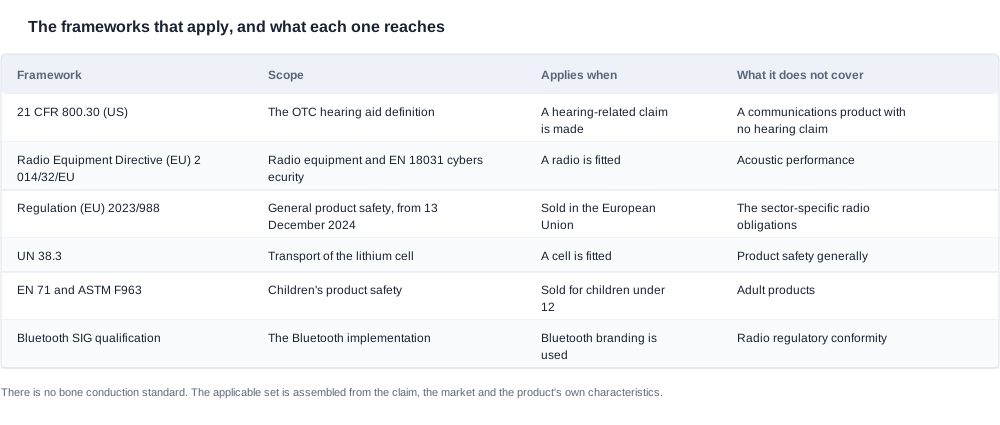
Where the frameworks sit against each other
The frameworks a bone conduction product meets
1. The medical device frameworks, which apply depending on the claim. If the product is positioned as an assistive listening device or makes a hearing-related therapeutic claim, the medical device route applies in each market, and it is a different route in each. The boundary in the United States is air conduction, and the fact that bone conduction is excluded from the OTC hearing aid definition is exactly why the claim has to be settled deliberately rather than by copywriter.
2. The radio frameworks, which always apply. A bone conduction product with Bluetooth is a radio product. In the European Union that means the Radio Equipment Directive with its conformity assessment and the EN 18031 cybersecurity requirements. The United Kingdom applies UKCA with a diverging framework. The United States applies FCC equipment authorisation. The Bluetooth SIG qualification applies to the implementation.
3. The general product safety framework, which applies on top. GPSR in the European Union from 13 December 2024, with its obligations around traceability, a responsible person, a technical file and the information supplied to the user.
4. The transport framework, which applies because of the cell. A 200 mAh lithium cell in the product is subject to the transport regime, and the UN 38.3 test summary covers a specific cell.
5. The children's product frameworks, which apply only if the product is sold to children. EN 71 in the European Union and the ASTM F963 and CPSIA frameworks in the United States work on an edition cycle, where a new edition can require retesting. For a bone conduction product aimed at an adult workwear or commuter channel these are irrelevant, and the only reason to know about them is to make sure the product is not accidentally sold into a channel where they do apply.
6. The Bluetooth qualification, which applies to the implementation rather than to the product. It is a membership and listing obligation rather than a regulatory authorisation, and it is easy to mistake for one.
What makes this category harder to standardise
The claim determines the route, and the claim is not a technical fact. Whether a 35 dB gain is presented as a hearing-assist feature or as a communications feature changes the regulatory position entirely. Nothing in the hardware changes; the copy does.
The boundary is defined negatively. The United States excludes air conduction from the OTC hearing aid definition, which means a bone conduction product has to argue its own position rather than relying on an inclusion. That argument is a legal one, and it is different in every market.
The categories do not align across jurisdictions. A product that is straightforward in one market may sit in a different category in another, and the divergence has to be tracked rather than assumed. The United Kingdom already diverges from the European Union in this category.
The frameworks cover different things and do not compose into one answer. A radio conformity assessment says nothing about the acoustic safety of a transducer against a skull. A transport summary says nothing about the product. A Bluetooth qualification says nothing about either. A buyer who asks "are we compliant" is asking a question that has no single answer, and the useful version of the question is "which frameworks apply, and which of them have we evidenced".
The applicability tests that pick the set
Five questions that determine the applicable set
The conformance map for this category is short, and it is built by answering five questions in order. Each one adds or removes a framework.
Question one: does the product make a hearing-related claim in this market? If yes, the medical device framework for that market is in the set, and the rest of the programme changes character — a quality system, a registration, a different cost structure and a different approval path. If no, and the answer is written down, the medical framework is out of the set, and the position has to be documented rather than assumed.
Question two: does the product contain a radio? For any product with Bluetooth, the answer is yes, and the radio framework for each destination market is in the set. This is the one framework that is certain, which makes it the natural starting point for building the file.
Question three: is it sold into the European Union? If yes, the general product safety regime applies, with its obligations around traceability, a responsible person, a technical file and the information supplied to the user. These are largely administrative, and they are the framework most often underestimated, because the technical file requirement assumes you have a model designation and a stable configuration.
Question four: is a lithium cell fitted? If yes, the transport regime applies, and the test summary covers a specific cell. A cell substitution invalidates it.
Question five: is the product sold for children under twelve? If yes, the children's product frameworks are added, with their own testing and their own edition cycles. If no, and the product is not sold into a children's channel, they are out of the set.
The thresholds that make each answer usable
A framework in the set is not yet a plan. Four thresholds turn the set into a dated, evidenced schedule.
Per framework, a named assessment route. A conformity assessment under the sector route, an internal assessment where the route allows it, a notified body where it is required, or a registration where one exists. The threshold is a document naming who did the work, not a general assurance that the product is compliant.
Per framework, a document that names the model. A family-level document does not automatically cover an unnamed model, and this entry has no published designation, so the identity work is a precondition rather than a formality.
Per framework, an edition and a validity. Standards work on an edition cycle, and a certificate references an edition. The threshold is knowing which edition the file rests on and what the transition rules are, because a new edition can require retesting and the obligation does not stop at the certificate date.
Per framework, a change trigger. A Declaration of Conformity has no expiry and what invalidates it is a change to the product. The threshold is a written list of what counts as a change for this product — the cell, the amplifier, the firmware, the transducer — and a process for assessing each one.

Building the conformance map, and where it fails
How to build the map, and how to check it
Building the map is a one-day exercise with the right inputs, and it is the input to the launch schedule, the technical file and the contract.
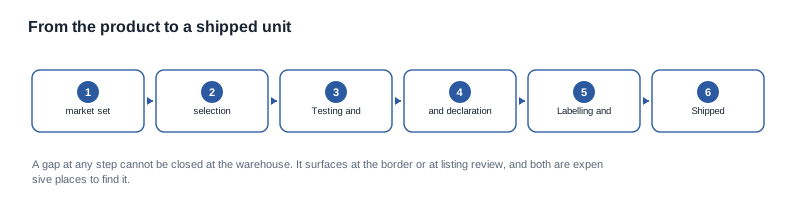
Start from the claim, in one sentence, because it selects the medical framework in or out. Add the radio framework for every destination market. Add the general safety framework for every market that requires it. Add the transport framework because the cell is fitted. Add the children's frameworks only if the channel includes children. Then, for each framework in the set, record four things: the route, the document that evidences it, the edition it rests on, and the change that would invalidate it.
The verification pass then asks one question of each line: does the document named on this line exist, does it name the model, and is it in the issuing body's public register? A line with a document that cannot be produced is a gap, and a gap found at this stage is a line on a schedule; a gap found at the border or at listing review is a stopped programme. The criteria for calling a line closed are deliberately strict, because the cost of a false negative is higher than the cost of an open line.
The supplier-side questions are a different list, and they are worth writing down before the first call, because the questions to ask a supplier are the only way to tell a prepared supplier from an unprepared one. Which frameworks have been assessed for this model, and by whom. What is in the technical file. Which cell is fitted and what the transport documentation covers. Whether the claim appears anywhere in the copy. And, crucially, which frameworks have not been assessed, because a supplier who answers that question honestly is a supplier you can work with.
There is a second question to ask that most buyers forget, and it is the one that tells you whether to shortlist the supplier or not: whether the supplier will tell you, in writing, which documents are model-specific and which are family-level. A supplier who distinguishes between the two is describing a real file. A supplier who treats them as the same is describing a marketing position.
The questions a supplier cannot answer
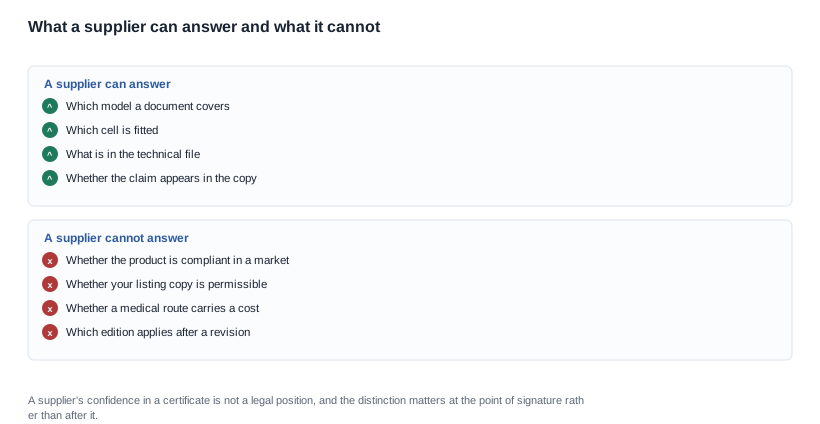
Four questions in this category cannot be answered by a supplier, and a buyer who expects answers to them has misjudged the relationship.
Whether the product is compliant in a market. Only a legal and regulatory function can answer this, and a supplier's confidence in a certificate is not the same as a position.
Whether the listing copy is permissible. The claim boundary is a legal question, and a supplier who rewrites your copy for you is taking on a liability they do not hold.
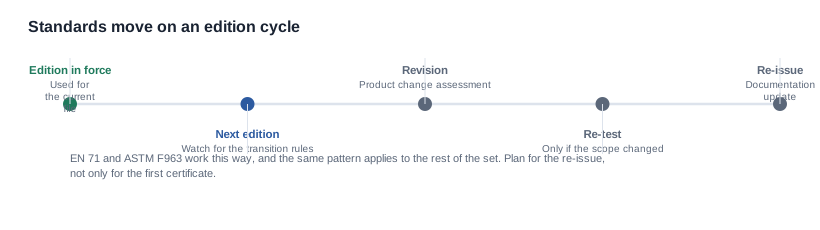
Which standards will apply after the next revision. EN 71 and the ASTM F963 and CPSIA frameworks in the United States work on an edition cycle, where a new edition can require retesting, and this applies to the product's other characteristics too. A supplier can tell you what is in the file today; nobody can tell you what the file will need to be after the next revision without a change process.
Whether the medical route has a commercial cost attached. Where a medical device route applies, the cost is not only the laboratory time; it is the registration, the quality system and the ongoing obligations.
Where the map fails
A framework that was assumed rather than checked. The most common version is a product sold into a market on the basis that it works like the market next door. The United Kingdom already diverges from the European Union in this category, and the divergence is not only paperwork.
A product that grew into a framework. A product that starts as an adult audio frame and is later sold into a channel that includes children has acquired a framework that was never in the map, and the acquisition is discovered by a channel, not by a compliance function.
A cell substituted after the map was built. The transport line of the map refers to a cell, and the map is only valid for that cell.
A family treated as a set of models. A document covering a family does not cover a product with no designation inside it. The map has a line for the model, and an unnamed model has nothing to point at.
A standards plan written as a one-off. The frameworks move, and the plan has to include the monitoring that keeps it valid. A plan written once and filed is a plan that is wrong within a year.

Cost, terms and a worked standards audit
What the conformance map does to the commercial terms
Fixed and not a negotiation target: each assessment and its laboratory time, the technical file, the registration where one applies, the ongoing obligations that come with a conformity route, and the cost of a second qualification run of the same model.
Negotiable: the scope of the assessment, meaning how many markets and how many configurations a single assessment covers; the monitoring arrangement for edition changes; the documentation deliverables in the technical annex; the number of units taken at the pilot tier rather than the run tier, which is where most of the real room sits because the factory's exposure concentrates in the first run; the split of a first production run into two deliveries against a staged payment; and the logo, lens tint and retail packaging configuration.
Documents to request before a deposit: the conformance map itself, with the route, the document, the edition and the change trigger for every line. The certificate register with numbers and validity dates. The technical file and the declaration. The transport documentation for the fitted cell. The change-control procedure. Written confirmation of the claim in the listing copy and of what is not claimed. Where the clause language is set out: contract terms. Where the commercial structure of a first order is set out: pricing.
A worked standards audit
Assume a channel buyer is assessing a supplier who has said the product is "CE marked and FCC certified" and is asking for a first order into three markets.
The audit starts by asking what the sentence means, because it collapses at least two frameworks into one word. The answer comes back as a radio conformity assessment for the European Union and an FCC authorisation for the United States, with a technical file the supplier can show. That covers the radio line of the map, and it is genuinely good news, because the radio framework is the one certain line.
The audit then asks what is not covered, and the answer is where the work is. The general product safety regime in the European Union is not evidenced by the radio assessment, and its obligations — a responsible person, traceability, a technical file, the information supplied to the user — are administrative rather than laboratory-based, which means they are close to a documentation exercise if the supplier has a model designation and a stable configuration. And the supplier has no model designation, which is the second gap, and it is the one that blocks the map rather than the file.
The transport line is checked against the fitted cell, and the answer is a test summary for a cell, which is checkable and which is also the line most exposed to a later substitution.
The medical line is asked about directly, and the supplier answers that the product is not a medical device, which is the right answer in substance and the wrong answer in kind. What the audit needs is the written position, the reasoning, and the statement of what the product is not claimed to do. The range-wide checklist at certification checklist and the boundary at medical device boundary are the two references that make the conversation concrete.
The audit then tests the edition question, and the supplier's answer is that the file is current. The better question is which edition the assessment rests on and what the transition rules are, and the answer to that is usually more specific and more useful.
The audit ends with the map, and the map is the deliverable. Seven lines across three markets, each with a route, a document, an edition and a change trigger, each marked as evidenced, requested or out of scope. Two lines come back as requested rather than evidenced, and those two are the ones that go into the purchase order as conditions, with dates attached.
The commercial conclusion follows from the audit rather than preceding it. The supplier's compliance position is good enough to proceed with a pilot, and not good enough to sign a full first run until the identity and the general safety documentation are in place. The unit price is a separate conversation, and the first-run risk — the factory's exposure — is the currency that the staging of the order spends.
What we can answer, and what to send us
The conformance map line we will not fill
Concretely, we publish the 35 dB gain as the catalogue states it and we will not present it as a hearing-aid specification, a hearing-aid benefit, or an assistive-listening claim, because the regulatory position in the United States is governed by the air conduction definition at 21 CFR 800.30 and a bone conduction product sits outside it.
We will also be direct that the certification status for this entry is not published to us, that no model designation is published, and that a product with a 35 dB gain and no published certification position requires a legal review before it is listed in any market. We will not fill a line of a conformance map with a guess, because a framework named without evidence is worse than a framework marked as not yet established.
Which framework applies to your claim
If you tell us the destination markets, the intended claim and the intended channel, we will say which frameworks are decisive, which of them we can answer from what we hold, and which lines of your map have to come from a supplier and be evidenced before a date can be committed. The mechanism is described under bone conduction audio, the radio and safety routes are covered at red directive, and the range is at bone conduction glasses.
Related reading
- Bone conduction audio technology
- Medical boundary compliance
- Red Equipment Directive compliance
- Bone conduction glasses range
Send the destination markets and the intended claim, and we will say which frameworks are decisive.


