

A light-responsive lens is the easiest feature to demonstrate and the hardest to buy, because a driven lens is a consumable and consumables have a service life that nobody has published. The published specification for the photochromic platform in our range is Bluetooth V5.4, a 100 mAh cell, a charge time of up to two hours, a rated runtime of approximately seven hours, magnetic charging and an electrochromic lens — with no transition time, no tint depth, no light transmission figure, no temperature range, no cycle life and no model number. Those four missing rows are not decoration; they decide whether you can write a two-year warranty on the product and what happens to a customer whose lens has gone pale. So the programme is: establish the mechanism first, then measure transition in both directions, measure transmission in both states, measure the spread across the lens, cycle the lens until something fails, and write the failure criterion down. Until that last step exists, every number you have is a photograph of one sample.
How to test photochromic: the lens wears out
The buyer who has been shown a demonstration and a feature name
The reader is a brand buyer, a product manager or a channel buyer who has been given a demonstration and a feature name, and who now has to decide whether to put it in a range. The task is to convert the demonstration into a specification, and a specification for this category has an unusual property: it has to describe a product that will be used up.
That is the point most proposals miss. A passive lens that responds to ultraviolet light is a passive lens forever. An electrochromic lens that is driven is a device with a cycle count, and the end of that cycle count is a customer whose glasses no longer darken, a claim, and a replacement cost. The product page says nothing about it, because a product page describes the purchase and not the third year. A buyer has to describe the third year anyway, because the warranty period in the contract has to cover it.
The commercial risk being managed is the one the published runtime hides. A lens that is being driven draws current, and the approximately seven-hour rating from a 100 mAh cell comes with no test condition attached. A buyer who assumes the lens is passive will size the product for a working day and discover the specification does not support it. A buyer who assumes the lens is immortal will write a two-year warranty and discover the specification does not support that either.
Two catalogue entries, and the specifications neither of them publishes
The published rows for the electrochromic entry are these: the 100 mAh cell, the charge time of two hours or less, the Bluetooth version, the roughly seven-hour rated runtime, magnetic charging, and the fact that the lenses are electrochromic. For the V03 Pro configuration, which lists a light-responsive lens as an option, the published rows are the camera resolution, the 220 mAh cell, the charge time of two hours or less, a rated runtime of five to eight hours, the charging interface, the temple type and the colour options.
What is absent from both is the same set of things, and their absence is the finding: transition time in either direction, the transmission range in the clear and dark states, the tint depth, the uniformity tolerance, the temperature range, the cycle life with a failure criterion, the behaviour at a flat battery, the coating description, and a model designation for the dedicated entry. There is no published weight for either of them either.
The four service questions a lens has to answer
A lens that is driven has to answer four questions, and none of them is a performance question.
How long does it last? A cycle count on its own is a quantity. What a buyer needs is a cycle count plus the state at which the lens is considered failed, and the second half of that pair is the buyer's to write, because the failure criterion is a commercial decision about the return rate rather than a technical constant.
What does it look like when it fails? A lens that has been driven a few hundred times and no longer reaches a meaningful depth is not visibly broken. It is a customer who says the glasses do not work, and a support team with nothing to check. A written failure criterion, written before the sample, converts that into a testable claim.
What does it do when the battery is flat? A powered lens has a state at power-off, and that state is what the customer sees on the morning the cell runs out. If the answer is that the lens goes clear, that is a support-script line and a listing sentence. If the answer is that the state is undefined, that is a complaint waiting for a trigger.
Does it drift between units? Two lenses in the same box should look the same at the same state. If they do not, a customer comparing two units photographs them, and the listing image becomes the argument.
The four rows that decide how long the lens stays sellable
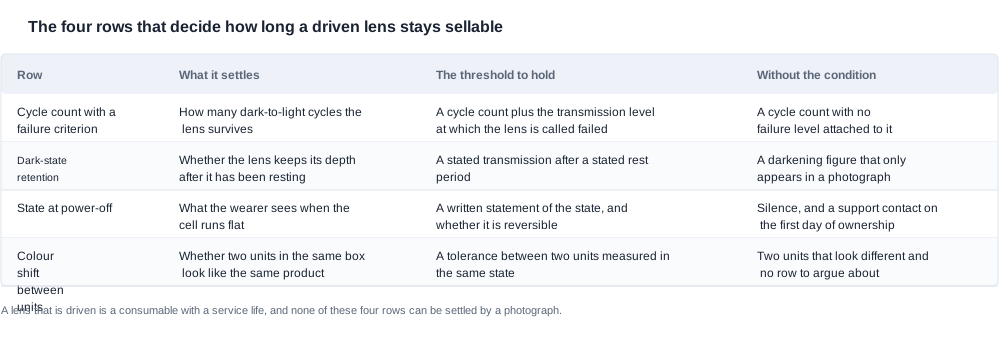
The four rows in that table are the service specification, and each one has a threshold worth holding and a failure signature worth recognising.
The cycle count with a failure criterion decides whether the warranty has a measurable end. The threshold to hold is a cycle count together with the transmission level at which the lens is called failed, and both numbers have to come from the same test. A cycle count without a criterion is a quantity, and a quantity cannot be attached to a warranty.
The dark-state retention decides whether the lens still does its job after it has been sitting in a pocket. The threshold to hold is a stated transmission after a stated rest period. A darkening figure that only appears in a photograph, taken in the moment the lens changed, tells you nothing about what a customer sees on a cold morning.
The state at power-off decides what the customer sees when they forget to charge. The threshold to hold is a written statement of the state and whether it is reversible, and it belongs in the quick start guide, the listing and the support script in that order.
The colour shift between units decides whether a customer who opens two boxes from the same production run sees the same product. The threshold to hold is a tolerance between two units measured in the same state, and it is the row that catches a supplier substituting a lens module without telling anyone.
Reading the lens thresholds without a datasheet
The transition time is only usable with its direction and its light condition attached. The same lens can change in seconds outdoors and in minutes indoors, and a figure without the condition is positioning language rather than a specification. Two figures, one per direction, each with the initiating and ending light levels, each with a temperature — that is the minimum.
The transmission range in both states is what the specification is actually about. A lens that moves from ninety per cent transmission to twenty per cent, and one that moves from ninety per cent to forty-five per cent, are different products with the same story. The clear-state figure matters as much as the dark-state figure, because the clear state is the indoor experience, and a supplier who quotes only the darkened number has quoted the part that flatters the product on a beach.
The uniformity tolerance is what a good lens is rejected for at first article. A centre reading is easy and nearly useless, because a user notices edge-to-centre variation before they notice an average. The threshold to hold is a maximum difference between zones, measured on a stated grid, agreed before the first article rather than discovered at it.
The temperature range decides whether the product is shippable into your markets. It is almost always quoted wider than it is useful, and the honest question is how slow the lens is at the cold end rather than whether it still functions.
The power cost of cycling is the check that catches the commercial surprise. A lens that is being driven draws current. The published seven-hour rating from a 100 mAh cell has no test condition attached, and the difference between the product with the lens cycling and the product with the lens static is the number that decides whether a working day needs a charging case.
One warning applies to every row in the table, and it is the warning a buyer most often ignores: these figures are not directly comparable across suppliers, and the reason is usually the measurement rather than the product. A transition time measured from bright sunlight to indoor light is not comparable with one measured from indoor to sunlight, and neither is comparable with a figure measured at thirty-five degrees against one measured at five. Until the conditions are stated, two numbers in the same row are two different measurements.

Turning six sample readings into a serviceable lens specification
The six readings, and the figure each one yields
Step one establishes the mechanism, and it is not a measurement. The question is whether the lens is driven by light or by the platform, whether the change is automatic, commanded, or both, and what state the lens is in when the device is powered off. Each of those three answers changes the customer expectation the listing has to meet, and none of them is answerable from a feature name.
Step two produces the transition time in both directions. The number the customer feels, and the one a supplier is most likely to give as a range or a qualitative description, because a fast transition is a genuine engineering achievement and a slow one is visible.
Step three produces the transmission in the darkened state, in the clear state, and at a mid point. The specification is about this row, because it decides what a minimum usable transmission is for your channel.
Step four produces the spread across the lens — centre, edge and corner of each lens. This is where cheap implementations show themselves, because a gradient is visible immediately in a photograph and immediately on a face, and it is the most common reason a customer concludes a product is defective rather than merely inconsistent.
Step five produces the operating range, because a lens that behaves differently in a cold climate is a product whose listing has to be market-specific, and in a market with a strong summer season that is a commercial decision rather than a technical one.
Step six produces the power cost of cycling, measured against the same product with the lens static. This is the step most often skipped, and it is the one that changes the bill of materials.
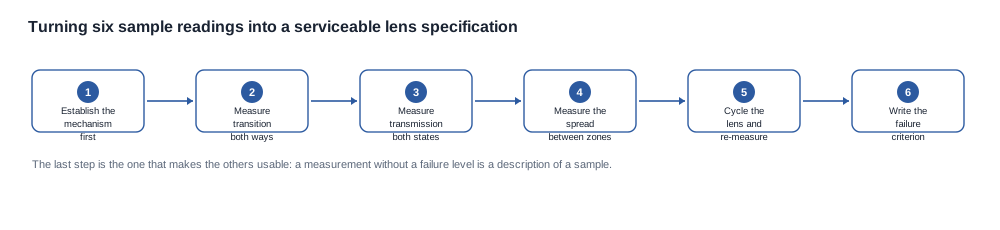
The last step of the whole protocol is the one that makes it a specification rather than a set of observations: write the failure criterion. At what transmission, in which state, after how many cycles, is the lens failed? That sentence is what a warranty attaches to, what a support team works from, and what an incoming inspection check can actually be built on.
The cycle that decides the warranty period
The cycle test is slow, and that is the point. It is the only measurement in this category that produces a service life, and it has to run long enough for the answer to be meaningful, which means it usually starts while the specification is still open rather than after it.
The way to run it without losing the schedule is to treat the cycle test as a background activity that produces a finding rather than a gate. A unit is cycled through repeated dark-to-light transitions on a fixed protocol, and its transmission is measured at intervals. Nothing in the commercial programme waits for that number, because the warranty can be written against a conservative cycle count and revised once the measurement lands. What cannot be done is writing a warranty against a cycle count that has not been measured, and then discovering at month nine that the lens has failed at a number the supplier never claimed.
The same logic applies to the temperature. A lens that is cycled at one temperature and then shipped into a market with a different one is a product whose service life is unknown rather than known, and the cost of that uncertainty is a warranty term that has to be short.
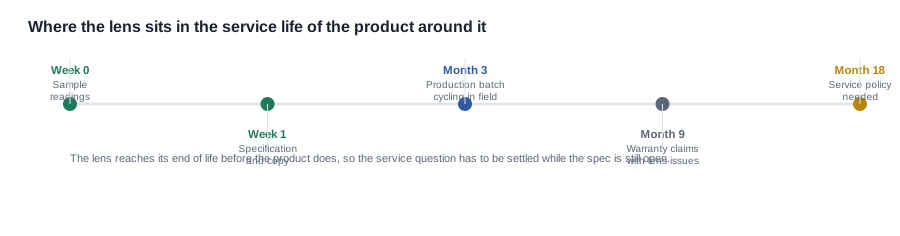
The timeline above is the commercial shape of the problem. The lens reaches the end of its service life before the product does, which means the replacement or refurbishment question arrives while the product is still selling. A brand that has not answered it will answer it under pressure, from a support inbox, at a cost per unit it has not budgeted.
The lens paperwork to request before the deposit
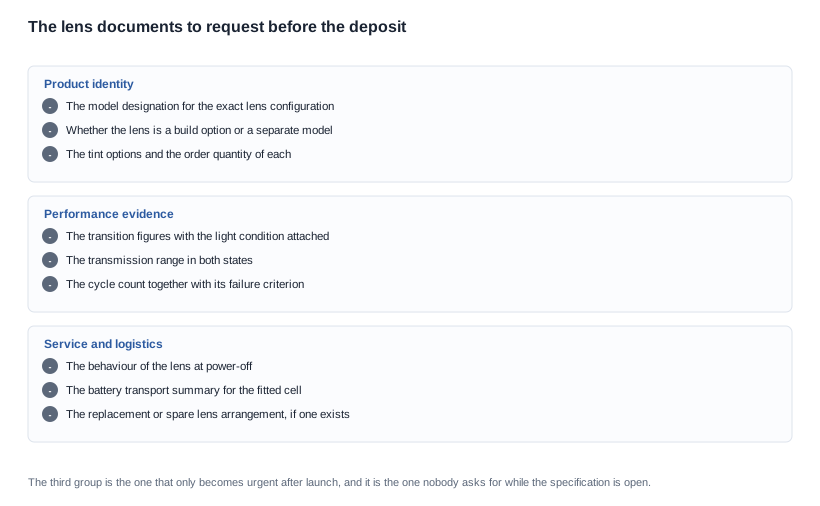
The checklist above is arranged in three groups because the three groups have three different owners and three different deadlines. The product identity group has to be settled before anything is ordered, because a configuration without a model designation cannot be listed on a certificate, correctly packaged or correctly described at customs. The performance evidence group has to be settled before the specification is written, because a number without its condition is a marketing claim and the support team ends up defending it. The service and logistics group has to be settled before the warranty is signed, because it is the group that only becomes urgent after the launch and nobody asks for it while the specification is still open.
The questions to ask are the same for every supplier, and there are six of them in total: the model designation for the exact lens configuration, whether the lens is a build option or a separate model, the tint options and the order quantity of each, the transition figures with the light condition attached, the transmission range in both states, and the cycle count together with its failure criterion. On top of those, the behaviour of the lens at power-off, the battery transport summary for the fitted cell, and the replacement or spare lens arrangement if one exists.
A supplier who answers the performance evidence group has a measurement habit. One who answers only the product identity group is telling you that the lens is a catalogue item rather than a specified one, and the difference shows up in the warranty conversation four months later.
Three of those documents sit outside the supplier entirely, and a buyer who does not ask for them will find out at the shipping gate rather than at the sample. The procedure at sample evaluation is what confirms that the unit in your hand is the production configuration rather than a promotional build. The register at certification checklist is where every certificate number in the file gets resolved, and it is the step that catches a document that names the platform rather than the lens configuration. And the battery transport file at battery transport has to cover the cell that the lens configuration actually uses, because a lens option that changes the power path changes the transport position even when the cell family does not.

Where a lens programme loses money after the launch
The claim runs ahead of the mechanism. The symptom is a customer reporting that the lens does not work. The root cause is usually a copy line written from the retail word rather than from the mechanism — "photochromic" written where the product is electrochromic, or "adapts to the light" written where the product never reaches a meaningful depth. The prevention is the cheapest one in this article: fix the claim wording before the product page is written, and let the copy describe what the mechanism does rather than what the customer hopes for.
The product performs correctly and is still returned, because the expectation was set by another technology. The symptom is a cluster of returns from one channel with a description that does not match the product. The root cause is a buyer who has handled mineral photochromic lenses carrying that expectation into the listing for a powered lens. The prevention is to state the mechanism in the copy and to set the same expectation in the listing, in the packaging and in the support script.
A unit is flat and the lens is in an undefined state. The symptom is a first-day support contact that the support script cannot answer. The root cause is that the power-off behaviour was never specified. The prevention is a written statement of the state, published in three places, agreed before the sample.
The warranty is set from a cycle count and the first claim is unanswerable. The symptom is a claim that cannot be settled because nobody can say what a failed lens looks like. The root cause is a cycle count used as a service life. The prevention is to write the failure criterion at the sample stage and set the warranty against it.
The programme is a month late and the cause is a document rather than a factory. The symptom is a launch date that slips while the units are ready. The root cause is that the model identifier was requested last, so the artwork, the technical file and the customs description all waited on it. The prevention is to ask for the identifier in the first email and to treat the launch date as derived from it rather than from the production schedule.
The lens option is treated as a colour rather than as a combination. The symptom is a consistency problem in the field that appears after the launch, usually in the best-selling colourway. The root cause is that the per-variant check was never established. The prevention is to put lens, coating, tint range and frame material on the change-control list, with a notice obligation attached.
A worked scenario: an outdoor brand adding a lens option
This is a worked case rather than a customer case. It is written so the order reads.
Assume a European outdoor brand with four colourways and an existing camera platform, currently shipping into three markets, considering a light-responsive lens option for a spring line. The binding constraint is not the lens. It is that the brand's own listing reviewer rejected a claim in the previous cycle because the supplier's datasheet had no measurement behind it, and the brand does not want to repeat that.
The mechanism comes first. The brand's channel is cyclists and trail runners who spend hours outdoors and whose complaints are about swapping glasses. The exposure is direct sun, so a passive ultraviolet-driven lens is mechanically sufficient, and it removes a cell, a driver, a firmware function and a charging routine from the design. The engineering lead notes that the passive route also removes the flat-battery question entirely, which removes one of the acceptance criteria they would otherwise have to write.
The service question is asked in the same email. Because the passive route has no cycle life, the brand does not have to write a failure criterion, and the brand's service team does not inherit a lens replacement problem. That single decision removes a warranty term, a support script line and a spare-parts arrangement from the programme.
The demonstration is turned into a measurement. Rather than accepting the supplier's figure, the brand buys one unit, places it next to a mineral lens the team already owns, and photographs both in the same light at the same moment. The result shows the tint is visible in a photograph, which is the test that matters, because the brand's own product photography will show the lens. The brand records the protocol and the observation in a single page, and that page becomes the source of the copy.
The paperwork is checked in parallel. The brand asks for the certificate numbers per configuration and finds that the family-level document names the platform rather than the lens configuration. That is a real gap, and it converts the model designation into a precondition rather than an administrative detail. The brand makes the designation a condition of the first order and puts a re-issue obligation into the contract.
The commercial structure follows the combination count. Four colours with a lens option is four new combinations, and the brand negotiates the per-configuration minimum on the basis of a committed combination count rather than a unit count. The artwork approval moves earlier than it normally would, because the lens configuration has to appear on the box, and the brand adds one artwork round for the feature demonstration to the schedule.
The claim is written to be narrower than the evidence. The brand's copy says the lens adapts to light conditions and does not claim sunglass depth, because no transmission range was available. The listing reviewer accepts it, because the claim is now narrower than the evidence rather than wider.
The result is a cheaper programme, a narrower claim, and a schedule with one identified precondition rather than four unowned risks. The decisive decisions were made before the sample order, and the lens specification was never the thing that decided the outcome.
The negotiation that follows. Two lines carry most of the value here. The first is the per-configuration minimum, which moves when the brand commits to a combination count rather than a unit count, because four colours with a lens option is four new combinations and the fixed cost of a configuration is spread across them. The second is the artwork round count, which is a real cost in weeks and a small cost in money, and which is worth adding deliberately rather than having added by accident. The trade-off a buyer should be careful about is the warranty length: a longer warranty on a lens with an unpublished cycle life is a price the brand has not calculated, and shortening it is cheaper than discovering it.
The pitfalls in this category are mostly paperwork, and they are cheap to prevent. The model identifier has to be requested in the first email rather than in the fourth week. The battery transport file has to cover the cell that the lens configuration actually uses, not the cell on a different model. And the criteria for the first article have to be written before the sample, because a tolerance set afterwards is a tolerance that has already been missed.
What we publish about the photochromic platform, and what stays open
We publish the rows we hold and mark the rest as open, because in this category a plausible-looking number is easy to produce and impossible to check.
For the dedicated electrochromic entry, what we publish is the Bluetooth version, the 100 mAh cell, the charge time of two hours or less, the roughly seven-hour rated runtime, magnetic charging, and the fact that the lenses are electrochromic. What we do not publish, and will not estimate, is the transition time in either direction, the transmission range in either state, the tint depth, the uniformity tolerance, the temperature range, the cycle life, the coating description, the behaviour at power-off, the frame weight, or the model designation. For the V03 Pro configuration we publish the camera resolution, the cell, the charge time, the runtime, the charging interface, the temple type and the colour options, and we publish no lens performance figure for that configuration either.
Across the whole catalogue, one unit weight is published — 158 g for the MT6 — and no model in the range publishes a weight with a light-responsive lens fitted. For a product whose listing leads on comfort and on all-day use, that is a gap we would rather name than fill.
We also make no claim covering vision, health or eye-protection results for any of our products, in any market. A device whose function is to detect a position or a distance and to remind is not a clinical intervention, and a listing that implies otherwise is a regulatory exposure rather than a marketing decision. If your channel is built on an eyesight concern, this is the wrong category, and we would rather tell you that before the sample order than after the copy is written.
Four actions before the photochromic quotation
Ask the mechanism question first, in writing. Whether the lens is passive or driven, whether the change is automatic or commanded, and what state the lens is in at power-off. Everything else is downstream of those three answers.
Send the service questions as a list. The transition times with their conditions, the transmission range in both states, the cycle count with a failure criterion, and the power-off behaviour. The questions to ask are the same for every supplier, so the comparison between them is fair.
Write your own failure criterion before the sample arrives. A transmission level in a named state after a named number of cycles. The criterion is yours because it is a commercial decision, and it is the only way a warranty in this category can have a measurable end.
Send us the markets, the session length and the price band. We will tell you which of the six steps decides the project for that combination, which published rows apply, and which numbers have to come from a sample before a purchase order is signed. The clause wording is published at contract terms, and the commercial structure of a first order is published at pricing. The technology background is at photochromic lens technology, the field behaviour is at real-world performance, the low-light question is at clarity in low light, and the product entry is at photochromic smart glasses.
Related reading
- The technology behind the lens — photochromic lens technology
- The product entry — photochromic smart glasses
- Field behaviour — real-world performance
- The low-light question — clarity in low light
Tell us the markets, the session length and the price point, and we will say which of the six tests decides the purchase.


