

A lens that changes is easy to demonstrate and hard to describe, and the gap between the two is where listings go wrong. The published specification for the photochromic platform in our range is Bluetooth V5.4, a 100 mAh battery, a charge time of up to two hours, a rated runtime of approximately seven hours, magnetic charging and an electrochromic lens. There is no model number, no lens performance figure, and no statement of what the product does with the light level.
So this article works from four everyday situations where the lens either earns its place or does not — and it is worth being clear at the start that the two mechanisms in this category behave very differently in exactly those situations.
The framing matters for a buyer, because a buyer in this category is not choosing a specification to satisfy, they are choosing a behaviour to live with for a year of a customer's day. A product that is technically excellent and behaves badly in a car is a failed product for a commuting channel, and no datasheet will tell them that. The four situations below are where that answer is found, and the control strategy is what determines it.
The photochromic smart glasses real world performance question is answered by the control strategy
Capability and behaviour are different things
A capability is a specification. A behaviour is an experience. A buyer can publish "adapts to light conditions" and be entirely accurate, and a customer can still be disappointed, because the gap between the two is exactly where the returns live.
The published configuration for this platform is six rows: radio generation, charge time, cell capacity, rated runtime, charging interface and mechanism. Those rows describe a circuit. They do not describe what the product does in a car, in a meeting or at dusk, and every buying decision that is made from the configuration alone is a decision made without the behaviour.
This is also why the category's performance claims are so often wrong. A supplier who publishes a switching time is publishing a capability measured under one condition. A customer who experiences the product in a car is experiencing a behaviour under quite another. Neither is dishonest, and the gap between them is where the returns, the reviews and the copy disputes come from.
Why the four numbers are the ones a buyer needs
To specify this feature properly, four numbers are needed: the transition time in each direction, the tint depth, the light transmission in each state, and the operating temperature range. None of them is published for the platform in our range, and the only other light-responsive platform in the range, the V03 Pro, publishes no lens figure either, so all four have to be established by the buyer.
The reason these four and not others is that each one corresponds to a distinct moment in a customer's day. The transition time in each direction decides whether the lens keeps up with a walk from shade into sun and back again. The tint depth and the transmission in each state decide whether the outdoor session is usable or merely dark. The operating temperature range decides whether the product works in the market the buyer is selling into.
A buyer who has these four can write a channel-appropriate product page. A buyer who has six electrical rows and none of them can write a product page that says "adapts to light conditions" and nothing more, which is defensible but thin, and thin listings in this category convert poorly.
The four situations where a changing lens earns or loses its place
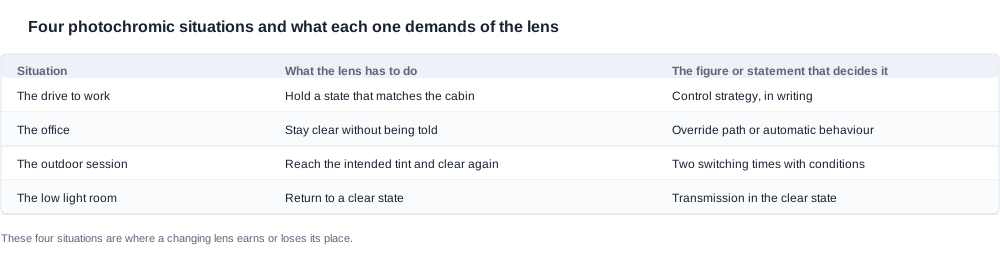
The four situations below are the ones a buyer should be able to name before the sample order, because each one demands something different from the lens and each one is settled by a different figure or statement.
| Situation | What the lens has to do | The figure or statement that decides it |
|---|---|---|
| The drive to work | Hold a state that matches the cabin | The control strategy, in writing |
| The office | Stay clear without being told to | The override path, or the automatic behaviour |
| The outdoor session | Reach the intended tint and clear again | Two switching times, with their conditions |
| The low light room | Return to a clear state | The transmission in the clear state |
The drive to work and the car
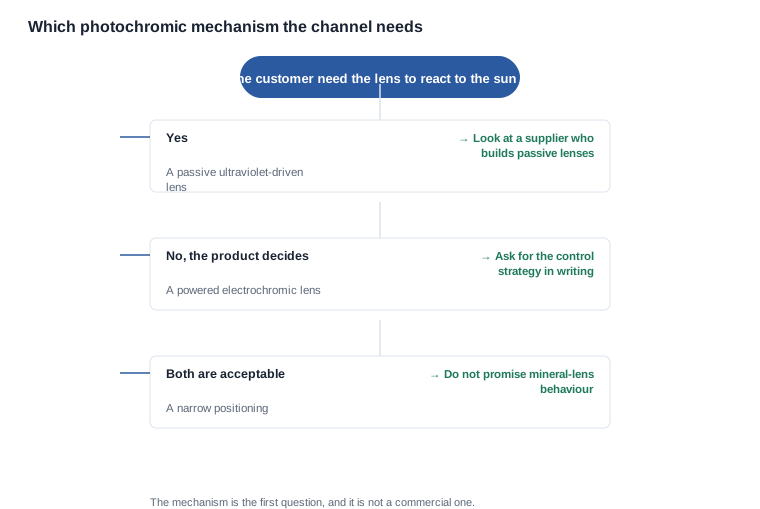
This is the situation where the two mechanisms separate most sharply, and it is worth knowing which one a channel is buying.
Behind a windscreen, an ultraviolet-driven lens barely changes, because the glass blocks most of the ultraviolet that drives the reaction. A product-controlled lens works there, provided the product is measuring cabin light rather than the ambient ultraviolet — and whether it does is a matter of the control strategy, which is a written statement and not something a buyer can assume.
For a brand whose customer is a commuter, this is the decisive test. A lens that barely changes behind glass is still a correct product for the right channel, and it is a wrong product for a commuting customer, and the only way to know which is to look rather than to reason from a datasheet.
There is a second dimension to the car case, and it is a product decision rather than a mechanism question. If the product drives the lens on a schedule or on a sensor rather than on a light level, then the transition happens at a particular point in the journey, and the buyer has to decide whether that point is defensible. A lens that darkens as the car enters a tunnel and clears as it leaves is a product a commuter will describe as clever. A lens that darkens at an arbitrary point in the drive is a product a commuter will describe as random.
The office and the meeting
An office is the case where a lens that changes has to decide not to, and where the marketing and the behaviour diverge. A darkened lens in a lit office reduces the light the wearer receives, and whether that is helpful depends on the task and on the ambient level rather than on the product.
The two questions that settle it are both about control. What does the product measure, and can the wearer override it? A product that holds a clear state indoors and changes outdoors needs either an override or a control strategy that produces the same result. A product that changes on a schedule will darken in a meeting, and a customer who takes their glasses off in a meeting has decided the product is not for their workplace.
The commercial reading is that the office case is a channel filter rather than a defect. A brand selling into a desk-based corporate channel should establish the office behaviour early, because it is the behaviour that determines whether the product is worn at all.
The outdoor session and the low light room
The outdoor session is where a changing lens has the clearest value, and where the missing figures matter most. A lens that darkens too slowly is a complaint; a lens that does not darken enough is a complaint; a lens that darkens unevenly is a manufacturing-quality issue rather than a design one, and it has to be caught on a grid rather than discussed in a review.
The low light room is the mirror case, and it is the one most often left out of a listing. A lens that has darkened and does not clear leaves the wearer in a dim room with a dark lens, and that is the state in which a customer describes the product as broken rather than as slow. The transition time in the clearing direction and the transmission in the clear state are the two numbers that decide whether the low light case works, and both are unpublished.
The low light behaviour is covered separately in clarity in low light, and the market context for adjacent audio products is in bone conduction market trends.
The mechanism comparison that explains the differences
How the two mechanisms decide the state
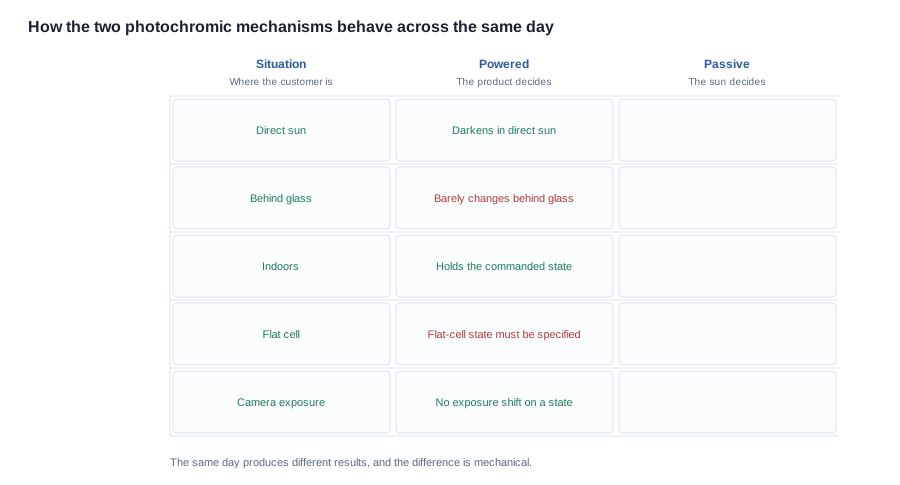
An electrochromic lens is driven by a voltage the product applies. It needs a battery, a driver and a control strategy; it changes quickly and repeatably because the product decides when; and its cleared state is the default state.
A photochromic lens is driven by ultraviolet light in the environment. It needs no power, it changes on its own, it changes slowly, and it does very little behind a windscreen.
Those two sentences account for almost every practical difference buyers encounter. The product-controlled lens does its work in direct sun and in a car, provided the product has a brightness signal to react to. The light-driven lens does its work in direct sun and nowhere else. The product-controlled lens holds a state indoors; the light-driven lens clears itself. The product-controlled lens has a flat-battery state to specify; the light-driven lens has no battery and therefore no such state.
The four edge cases the mechanism creates
The mechanism also creates four edge cases that a buyer has to answer explicitly rather than assume.
- The flat-battery state. A powered lens on an empty cell is in a state, and the state has to be specified. A lens that holds a dark tint with no power is a pair of sunglasses a customer cannot switch off.
- The overnight state. If the unit is switched off with the lens dark, does it stay dark when it is switched on? This is a product decision that a firmware team makes and a customer experiences.
- The transition during a capture. Where the product also carries a camera, a state change moves the exposure. The behaviour has to be in the acceptance criteria, because it will otherwise be found during a product shoot.
- The override path. Whether the wearer can force a state, and how, is a specification question that a product page and a support script both depend on.
None of the four is difficult to answer. All four are easy to leave unasked, and each one becomes a customer complaint rather than a specification row when it is left.
How to choose the mechanism when there is no comparison product
Because our range publishes no lens data for either light-responsive platform, the electrochromic entry and the V03 Pro's photochromic configuration, a buyer cannot A/B the two mechanisms from published data. The decision still has to be made, and it is made by asking questions rather than by comparing specifications.
The questions to ask a supplier are short. Is the lens driven by the environment or by the product? What does the lens do behind glass? What does it do indoors? Does the wearer have an override? What happens on a flat cell? A supplier who answers all five has characterised the product and can be measured against a protocol. A supplier who answers one is describing a category.
The second half of the decision is about which direction the buyer's programme can absorb. A passive lens needs no charge routine, no flat-battery behaviour, no control strategy and no firmware coordination, and it cannot darken indoors. A powered lens can do things a passive lens cannot and creates four states that have to be specified. The trade-off is not price; it is specification workload against control.
There is a third input, and it is the one most often left out. If the buyer's channel is dominated by one situation, the mechanism question largely disappears, because the situation tells you which behaviour has to be right. A commuting channel is a windscreen question. A warehouse or field-work channel is a daytime outdoor question. A desk-based channel is an office question. Establishing which situation dominates is faster than any comparison, and it is the question to ask before the supplier call rather than after it.
The camera exposure consequence
Where a camera is fitted, the lens and the sensor are coupled whether the product design intends it or not. A lens that changes state changes the light reaching the sensor, and an automatic exposure responds to it. The visible symptom is outdoor footage that is briefly over- or under-exposed around the transition.
This is a specification item, and it is the kind of item that gets discovered late because it is invisible in a static photograph. The test is simple: record while the lens changes state, in the conditions the channel sells into, and put the result in the acceptance criteria. A supplier who describes this as a software fault after the fact is describing a specification that did not exist.
Running the four-situation protocol on one sample
The protocol, step by step
The four-situation protocol turns behaviour into figures, and it is the fastest route to the four numbers a buyer does not have. It is applied to one unit, in this order.
- Record the unit and its starting state. Model string, serial, charge level, and the lens state at power-up. A protocol that does not start here cannot be repeated on a second unit.
- Run the drive with the sample behind glass. Observe and time both directions. This is the case that decides whether the mechanism suits a commuting channel.
- Run the office case in a lit room. Put the unit in the conditions the channel's customer works in, and record whether the state changed without being commanded.
- Run the outdoor case, timing both directions. Time the darkening and the clearing separately, with the light level and the temperature written down next to each reading.
- Run the low light case and record the clear state. Measure or photograph the lens in the state the customer ends up in at the end of the day, which is the state that produces the worst reviews.
- Photograph the sample in every state. A photograph is the only artefact that can be attached to a claim in a listing, and the comparison against a known lens is the only way to judge depth without an instrument.
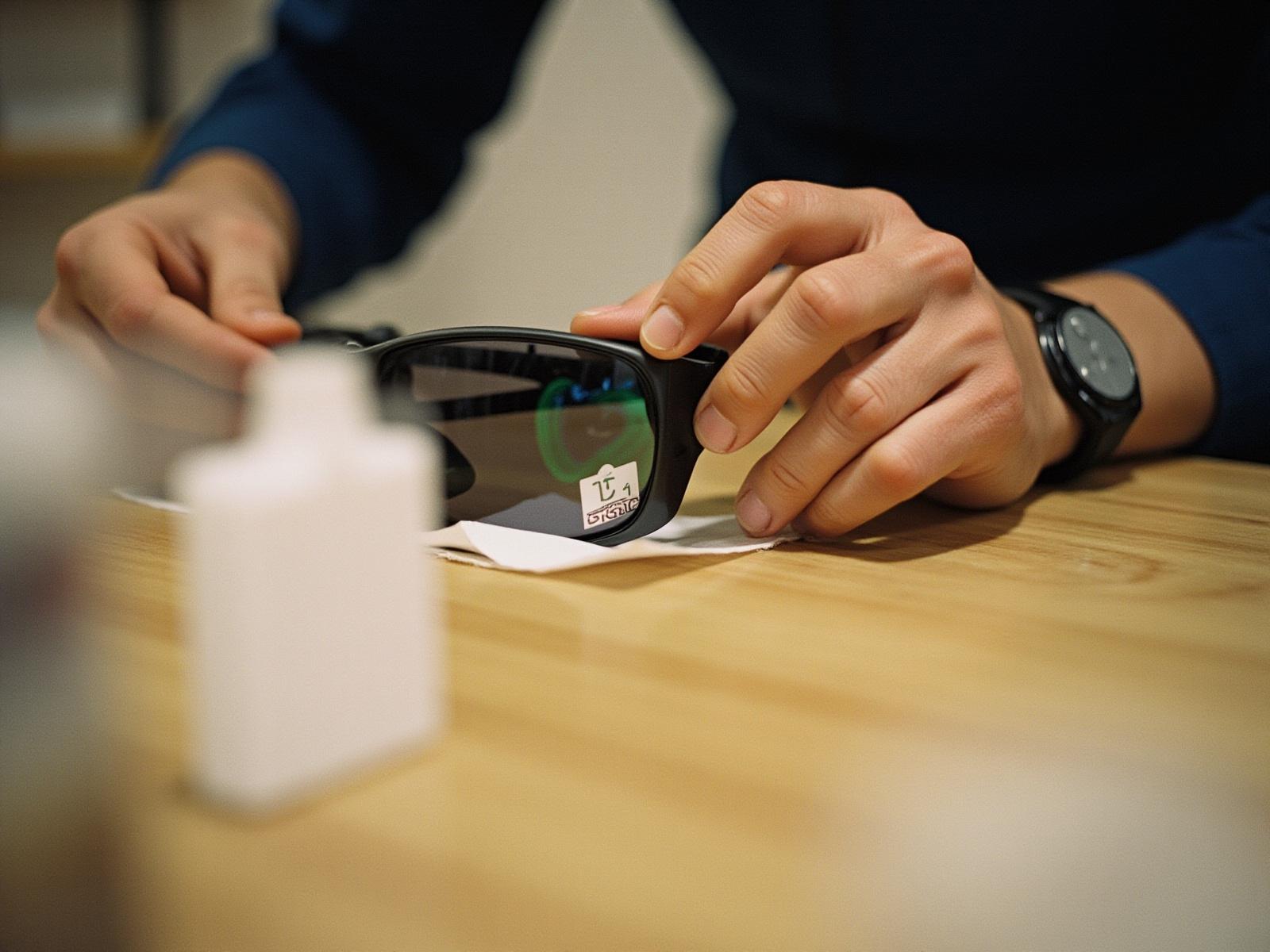
The measurement method is set out in how to measure photochromic smart glasses, and this protocol applies it to behaviour rather than to a number.
What to record and what to photograph
The recording sheet is short, and its discipline is what makes the observations transferable. Each reading gets the unit identifier, the light level, the direction of the change, the temperature, the charge level, the elapsed time and the reading itself. A sheet that records only the reading is not a measurement record; it is a list of numbers with no conditions, which is the same defect the whole category suffers from in reverse.
The photograph has a specific job. A side-by-side comparison against a lens the team already owns, in the same light, at the same moment, tells the buyer whether the tint is visible in a photograph — and the photograph is what the product page will show. It also gives the buyer the depth position for their own copy, because a buyer who cannot produce a depth figure should not publish one, and the photograph is how they find out whether they can.
Turning the observations into a specification
Once the protocol has been run, the observations become specification rows, and the conversion is mechanical. Two switching times with their conditions. A transmission figure in each state. A temperature range. A flat-battery state.
What does not become a specification row is the impression. A lens that "seemed slow" is not a row; a lens that took a stated time to reach a stated darkness from a stated light level is. This distinction is the whole point of running the protocol rather than demonstrating the product, and it is the difference between a copy the customer can falsify and a copy the customer can only reinterpret.
There is a commercial reason to do the conversion before the first order rather than during the launch. A specification written from the buyer's own measurements is the only figure comparable with the next supplier's, and it is the only figure that can be attached to a purchase order as an acceptance criterion.

Publishing the state of the lens instead of the benefit
The state form of the claim and the outcome form
The distinction that keeps a listing safe is between a claim about the state and a claim about the outcome. "The lens returns to its clear state automatically" is a claim about the mechanism, it is accurate, and it survives review. "Improves clarity indoors" is a claim about an outcome, and there is no published figure behind it.
The state form is available today. The mechanism is electrochromic, the lens is powered, and the product decides when the state changes. That is a describable behaviour, and it is the description a customer can check by putting the product in a bright place and watching.
The outcome form is not available, and it is worth being blunt about why. There is no published transmission range, so any claim about how much light reaches the eye in a given condition is a claim the buyer cannot evidence. A listing reviewer who asks for the evidence will remove it, and a removal after launch costs more than a narrower claim written at the start.
What we publish, and the boundary we do not cross
It is worth being precise: we publish the platform's electrical rows and the mechanism, and we publish the empty performance rows beside them rather than filling them with typical values. We publish Bluetooth 5.4, a 100 mAh battery, a charge time of up to two hours, a rated runtime of approximately seven hours, magnetic charging and an electrochromic lens, and we publish no transition time, no tint depth, no light transmission in either state, no temperature range and no model number.
We will also say plainly that a product-controlled lens is a better product in three of the four situations here and a worse one in the fourth, and that a buyer who wants a passive lens should be looking at a different supplier rather than at a negotiation. The mechanism and the control strategy are the two facts that decide the channel, and neither of them is a price item.
We make no vision, health or eye-protection claim for any product in the range, in any market, and the boundary between this category and a medical device is set out under medical device boundary. A device whose function is to detect a position or a distance and to remind is not a clinical intervention, and a listing that implies otherwise is a regulatory exposure rather than a marketing decision.
What we can do is run the four situations on samples with you and turn the observations into the four numbers that neither of us currently holds. The background is under photochromic lens technology, the low light case is in clarity in low light, and the range is photochromic smart glasses.
Where the four situations come from
Send us the four situations your customers live in, and we will tell you which mechanism they need.


