
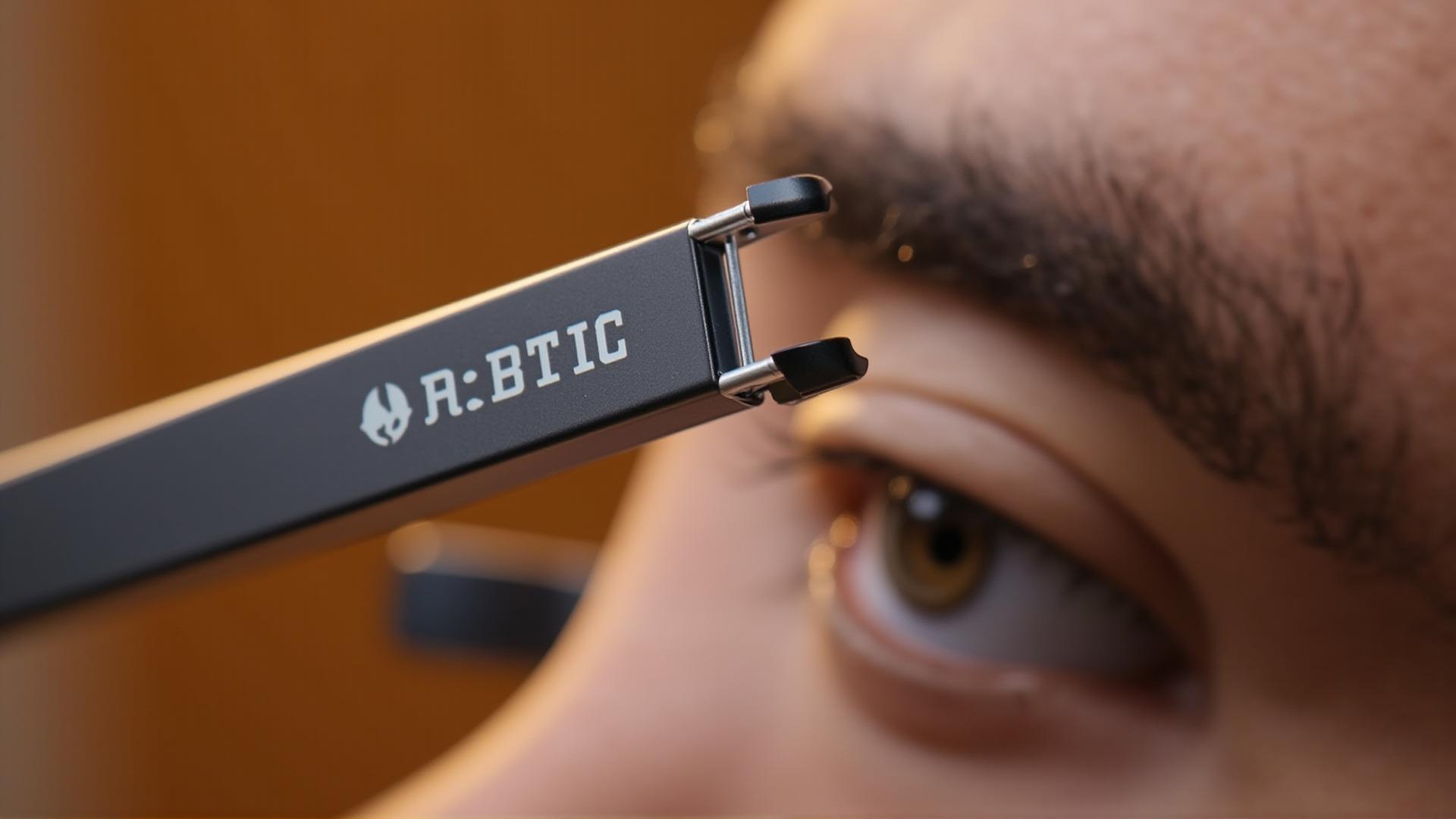
Smart glasses for kids parenting: what a family observes before it goes home
Before a children's device goes home, somebody has to answer three questions, and none of them is about the specification sheet. Does it stay on a child's head through a whole day. Does it charge after a day of being handled by a child rather than after a night on a shelf. And can the family live with the rules that come with it. Those three questions are what a household test is actually for, and they are all properties of the object rather than of the datasheet. A buyer who treats a children's product test as a specification test produces a report that nobody in the household can use, because the household is not the reader of the report.
The reader in this scenario is a channel buyer or an e-commerce seller supplying a family-facing product, or a brand-side programme manager building a retail range. The situation is usually a range decision — which of the two or three children's configurations to list, at what price point, with what in the box — rather than a technical evaluation. Every scenario in this set carries the same underlying fear — the opening consignment is not the unit the buyer signed — plus one that is specific to this product category, and it is the one that ends a programme rather than a shipment: the applicable children's product requirements for the target market have not been established for this range, and a family is the harshest test of a compliance claim that anybody downstream.
Our published position for the children's entries is a 40 mAh cell on the A05 and the A06, 70 mAh on the A07, a rated runtime of about twenty hours on all three, a charge time of two hours or less, magnetic charging on all three, a lens-type electronic atomiser with posture and distance detection on the A05 and the A06, and open-ear audio on the A07. Not published for any model: the lens material, the coating, the surface treatment, the per-model unit weight, a runtime test condition, a cycle life rating and any statement of which agents may be used on the surfaces. So the position, the charging behaviour and the rules have to be established by observing the object and by writing the rules, and the open rows are what a supplier has to close in writing before a family gets one.
The listing language is part of the test, not a separate task. A family buys on the listing, and the listing is what sets the expectation that the household then judges the device against. That makes the copy a procurement artefact in this category: a listing that describes the atomiser as protecting a child's eyes, or that describes the posture detection as protecting their posture, creates an expectation that the published rows cannot carry, and the expectation arrives as a review rather than as a question. The only safe position for a channel brief is the one the documentation supports — the mechanism, the cell, the charge time, the runtime, the interface — and the consequences of each mechanism for the family's routine. A brief that stays inside those rows does not need a legal review to be correct, and a brief that steps outside them needs one that no catalogue can supply.
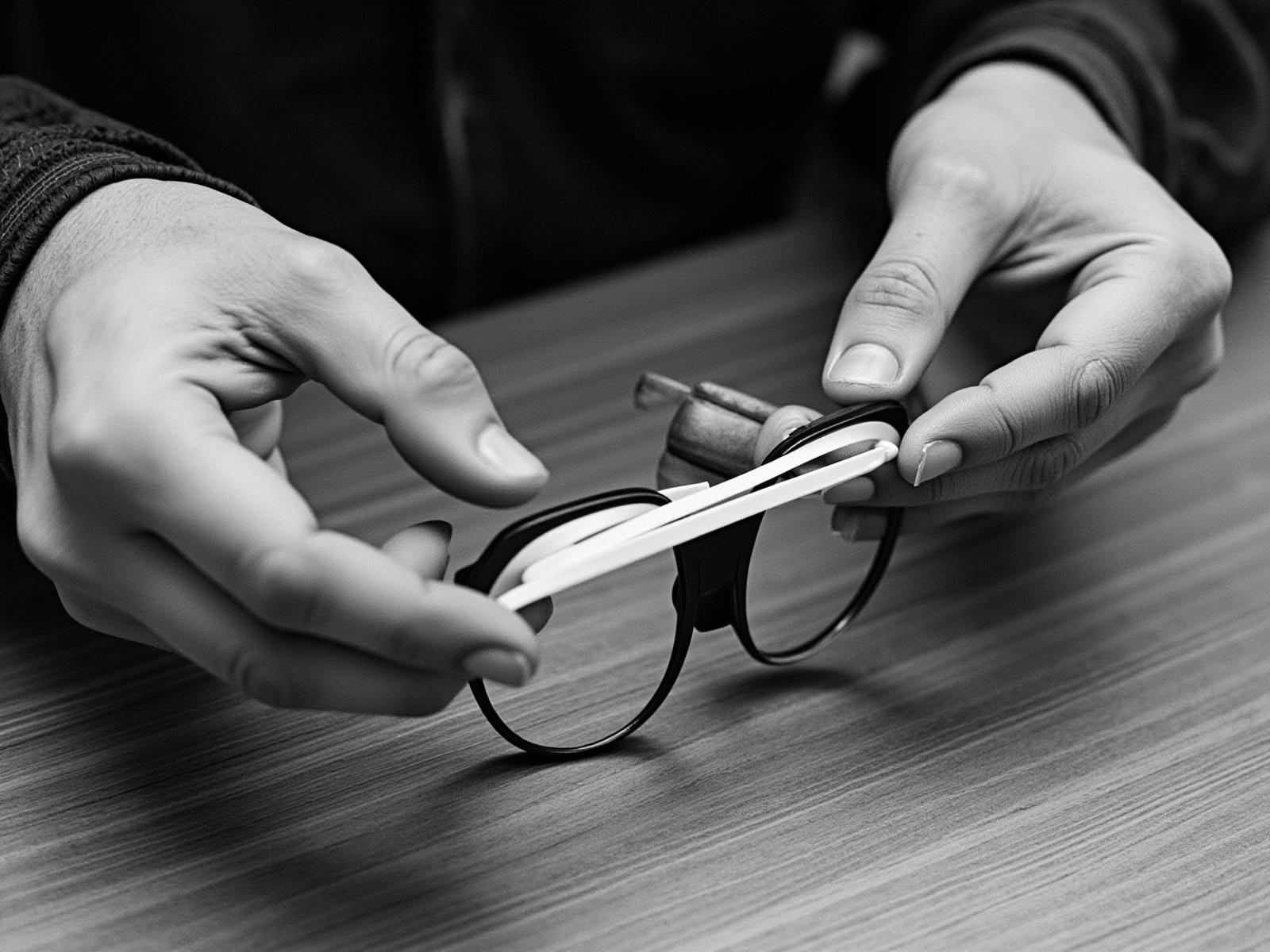
The three household tests and what each one produces
The fit test. The child wears it for a full day, and the parent watches where it sits. What it produces is a decision on whether the frame works for this child — and no published weight figure can make that decision, because the per-model unit weight is not published for any model in the range. The single weight figure in the catalogue is 158 g for the MT6, the whole unit including the battery and the camera and excluding its foldable case, and it belongs to a camera model with no children's application at all. A child's head shape, a child's habit of pushing frames up, and a device that is asked to do a job all day are the actual variables, and they are observed rather than calculated. The model comparison is at how to compare models for kids parenting, and the product family is at kids smart glasses.
The charging test. The device is charged after a day of being handled, not after a shelf night. What it produces is a realistic answer about the routine the family will actually keep, and the routine is the output rather than the number. The published runtime of about twenty hours on the A05, the A06 and the A07 is standby-dominant: it describes a light workload with long idle periods rather than continuous use. A family that charges it overnight and uses it in short bursts will see something close to that figure; a family that expects a full working day from it will not. So the test is not "how long does it last" but "how long does it last after a day of a child's use, and does the routine survive a week".
The rules test. The family works out what the child may do with each published feature. What it produces is a short rules list, matched to what the documentation actually states. Each published mechanism is a behaviour a child interacts with, and each one needs a rule the parent can say in a single sentence and enforce on a bad morning.
The storage test and the surface test. Where the device lives between uses, and what is used on the lens. These two are usually folded into the fit test and should not be, because they produce different rules. Storage is a case or a defined position, and the case is also a second lithium cell to declare for transport — so for a family product it is a decision with a shipping consequence attached. The surface test produces the lens-wipe instruction, and because the lens material and the coating are not published, that instruction has to be restrictive rather than permissive: the available cloth in a house is a kitchen cloth, and it is not safe on an undescribed coating. The battery rows are at battery life and the maintenance routine is at the upkeep routine for kids parenting.
The rules list, and the published feature behind each rule
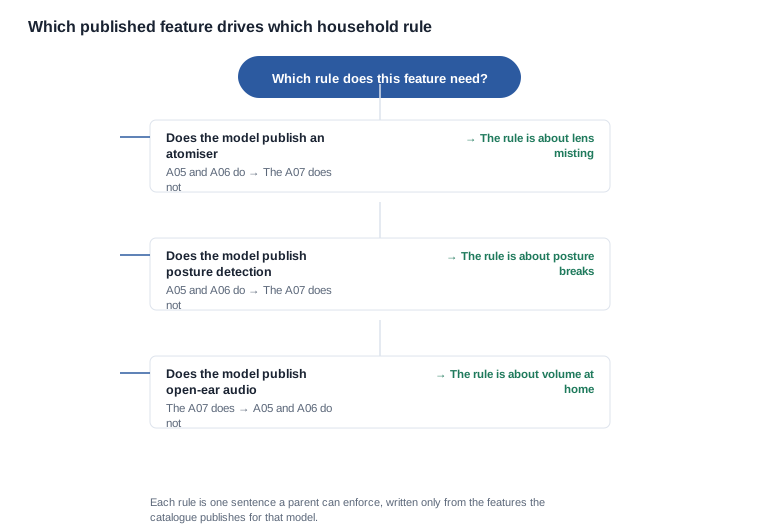
A rules list is written from features, and the discipline is that each rule traces back to one row the catalogue publishes for that specific model — and to nothing else. The A05 and the A06 publish a lens-type electronic atomiser together with correct-posture and correct-distance detection, and each of those publishes a behaviour that needs its own sentence. The A07 publishes open-ear audio instead, which needs a rule about volume in a shared space rather than a rule about misting or posture. A family list that mixes the two families produces a rule about a feature the child does not have, and the first time that rule is enforced the parent finds out the documentation was wrong.
A note on the boundary the rules have to respect. A parent will ask what the product does for a child's eyes, and the honest answer is that we do not make that claim and we do not have the data for it. The published mechanisms are hardware behaviours — an atomiser, posture and distance detection, open-ear audio — and none of them is a statement about vision, myopia or eye health. The applicable children's product requirements for the major markets have not been assessed for this range, so the responsible action for a buyer is to obtain that assessment rather than to write around it, and the route is at child product compliance. A rules list that stays inside the published features is both safer and more useful, because a rule the parent can enforce is worth more than a rule that sounds better in the listing.
There is a second reason to keep the rules list narrow, and it is commercial rather than legal. Every rule is a support interaction. A rule the parent cannot enforce generates a complaint to the channel, and a complaint about a feature the documentation never described is a complaint the supplier cannot resolve with a replacement — because the replacement behaves the same way. Narrowing the rules list to the published features is therefore the cheapest support-cost reduction available in this product family, and it costs a paragraph in the packaging copy.

The checks that have to happen before a device leaves the box
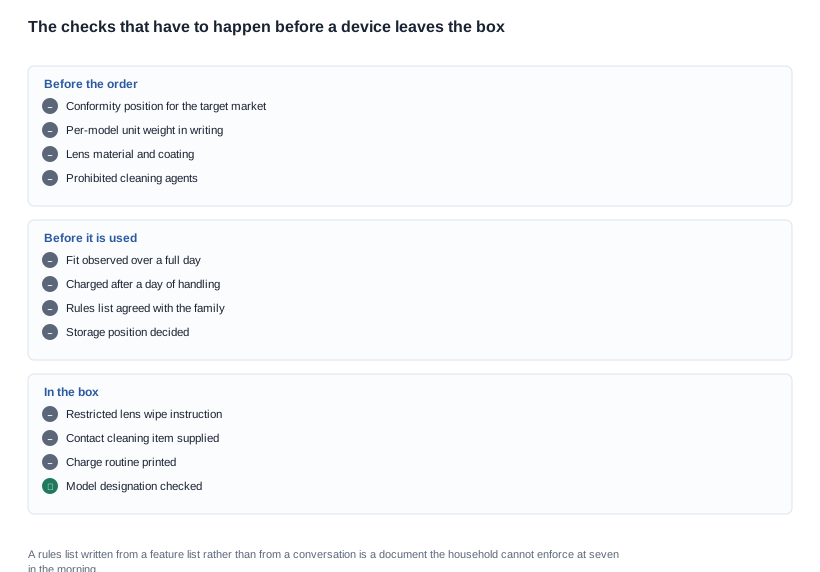
- The conformity position for the market it is going into, asked in writing before the family gets one, because the applicable children's product requirements have not been established for this range.
- The position observed over a full day, recorded by the parent rather than inferred from a specification.
- The charging routine, stated as an action — which cable, where it sits, how long it takes. The D17 and the ZH12 publish roughly one hour of Type C charging; the rest of the range publishes two hours or less, and the difference between a routine that fits a bedtime and one that does not is the difference between a routine that is kept and one that is abandoned.
- The rules list, one line per published feature, written so the child can follow it and the parent can enforce it.
- The storage position, and the lens-wipe instruction restricted rather than permissive, because the lens material and the coating are not published and a household wipe is improvised.
- The contact wipe, because a device handled all day picks up debris on the charging contacts and a flat battery is reported as a fault.
The scenario entry point is smart glasses for parenting, and the buying-side list for this scenario is at the kids parenting checklist. The point of the list above is that items one and six are the two that a buyer cannot get from a datasheet: one is a document to obtain, the other is a few cents per unit.
The insert is the last and the most important of these checks. A family-facing product carries its documentation as a single sheet in the box, and the sheet has to do four jobs at once: name the model and its designation, state the charging routine as an action, set the storage position, and print the rules list. Four things make that sheet work. It has to be one page, because a sheet a parent reads at the bottom of a box is a sheet they do not read. Each rule has to be one sentence, because a sentence is enforceable and a paragraph is not. The rules have to be ordered by when the rule applies rather than by which feature they concern, so the storage line comes before the rules. And the sheet has to include the model designation, because that is the only thing that makes a return traceable and it is the first thing a support desk will ask for. A supplier who has not read the sheet has not tested the sheet, and asking whether the supplier will review the artwork before it ships is the cheapest quality check available in this product family.

Six ways a household test goes wrong
A test that checks the box rather than the child. Whether it powers on and connects is not the question a family is asking. Prevention: the observation plan, not the unboxing.
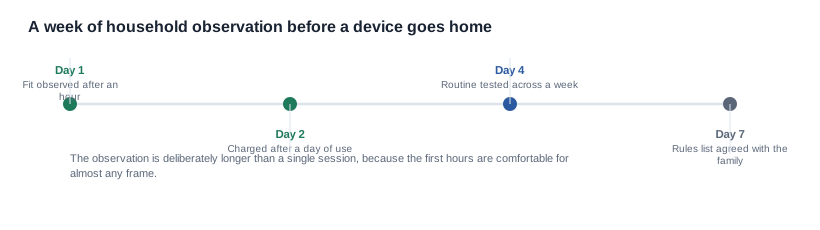
A position judged in ten minutes. The first hours are easy for almost any frame, and the pressure only establishes itself once the person has stopped thinking about the device. Prevention: a full day, and a second day for the models where the first day is uneventful.
A runtime quoted as a working day. The twenty-hour figure is standby-dominant, and quoting it as continuous use is the most common expectation failure in this category. Prevention: the routine written down and tested across a week.
A rules list written from a feature list rather than from a family conversation. The features are the same either way; the difference is whether the parent can enforce the rules at seven in the morning. Prevention: draft the list with the family, not with the brochure.
A permissive lens-wipe instruction in a house. A kitchen cloth is the default and it is not safe on an undescribed coating. Prevention: the restricted instruction and a supplied wipe.
A product shipped without checking the market it is going into. For a children's product that question is upstream of everything else, and it is the one that decides whether the shipment is allowed in at all.
What stays open commercially for a children's configuration
The published rows settle the electrical side of a children's configuration and nothing else, and the buyer who negotiates them is negotiating something that cannot move. The cell and therefore the runtime ceiling, the charging interface and therefore the charging routine, the published mechanisms on each model, the certification cost and its lead time, and tooling — amortised across the first order and quoted as a separate line rather than folded into the unit price. Those are the fixed elements, and they are what make two quotations comparable.
The open part is where the commercial work actually is, and each item has a configuration consequence. Whether the conformity assessment is funded, and by whom, is the first, because it is a cost and a lead time that the catalogue does not carry. Whether the per-model unit weight, the lens material and the coating, and the agents that must not be used are supplied in writing is the second, and it is the group of rows that decides whether the family's handling rules can be written at all. Whether a case is included and at which capacity is the third, because the case is what makes the storage rule enforceable — and it is also a second lithium cell that has to be declared for transport. Whether a lens wipe is in the box, and whether it is single-use or washable, is the fourth. The wording of the rules list, and whether the supplier will check it against the documentation before the artwork ships, is the fifth, and that check is worth more than the wording itself. Whether the insert is printed, digital, or both is the sixth. Whether the app capability for these models is verified is the seventh, and it is a row the catalogue itself flags as requiring verification rather than as settled. Minimum order quantity tiers are open. Logo, lens tint and packaging are open. A family-facing channel that is built season by season is where the first order arrives in two deliveries with staged payment, and the units kept at pilot quantity are where the deepest price movement sits.
The first shipment produces the most useful data in the category, and it is usually thrown away. A family-facing product generates a defect pattern within weeks, and the pattern is different from every other category in this range because the cause is rarely the hardware. A device that will not charge is usually a contact that was never wiped. A device that comes off the head is usually a position issue that the rules list should have addressed. A parent who cannot explain a feature is usually a feature the rules list did not cover. So the channel has to record what comes back, and the record has to separate the three causes — hardware, configuration and custody — because each of them has a different owner and a different fix. A family product whose channel keeps that record can improve its rules list between one season and the next, which is a genuine and compounding commercial advantage. A channel that does not keep it buys replacements it does not need and never learns which rule was missing.
The documents to request before a deposit are the conformity assessment position per target market, the per-model unit weight, the lens material and coating statement, the agents that must not be used, the rules list, the lens-wipe instruction, the storage and handling instruction, the model designation table, the certificate register with numbers and validity dates, the packaging artwork proof, and the agreed incoming inspection criteria. The clause language is at contract terms, the commercial structure of a first order is at pricing.
Here, we publish the rows a buyer can order from and we will not fill the open ones with typical values. For the children's models that means the cell capacities of 40 mAh and 70 mAh, magnetic charging, the rated runtime of about twenty hours, the charge time of two hours or less, the atomiser and posture and distance detection on the A05 and the A06, and open-ear audio on the A07. We will not publish a per-model unit weight we have not measured, we will not state that any coating is scratch-resistant, and we will not make or imply a vision, myopia or eye-health claim for any model, because the applicable children's product requirements have not been assessed for this range and we have no data for such a claim. A parent asking what the product does for a child's eyes deserves a straight answer rather than a careful-sounding one.
What we will do is take the markets, the age range, the channel and the annual volume, and tell you which published rows apply, which household test decides the purchase, which compliance question has to be answered before the first unit goes out, and which rules can be written from the documentation without inventing anything. Send those four and we will return the rules list skeleton built from the published features of each model, the conformity route for the market you have named, and the kit each configuration should carry.
Related reading
- The opening point of the scenario — smart glasses for parenting
- The family behind this model — kids smart glasses
- The model comparison — how to compare models for kids parenting
- The children's compliance route — child product compliance
Tell us the markets and the age range, and we will say which household test decides the purchase.


