
An education deployment has a training programme, and most of them start with the device. They should start with the question of whether the product may lawfully be used in that setting at all, because for a product intended for children the applicable requirements for the major markets have not been assessed for this range, and everything after that is conditional on the answer. So the first session is not a device session; it is a session in which the school or the buyer is told what is documented, what is not, and what must be obtained before the product is used with a child.
Two further conclusions set the shape of that first session. The first is that the compliance question has to be answered before a purchase order rather than after a delivery, because a school that has already issued devices cannot be told afterwards that the requirements were never assessed. The second is that the training has to establish what is not claimed, and that is a harder session than it sounds: a parent, a teacher or a pupil will ask what the product does for a child's eyes, and the honest answer is that the claim is not made and the data for it does not exist.
The published position for the children's entries is narrow and it is worth stating exactly. The A05 and the A06 publish a lens-type electronic atomiser with posture and distance detection, a 40 mAh cell, a charge time at or under two hours, a rated runtime of about 20 hours and magnetic charging, and neither of them publishes a Bluetooth version row. The A07 publishes four lenses, a 70 mAh cell, a charge time at or under two hours, a rated runtime of about 20 hours, magnetic charging and Bluetooth V5.4. Not published for any of them: the lens material, the coating, the surface treatment, the frame weight, a runtime test condition or a cycle life rating. The applicable requirements are the route at child product compliance, and that is where the responsible action lives rather than in a paragraph written around it.
A smart glasses for education programme starts with the compliance question, not the device
Who the training is for, and what it is protecting
The reader is a brand-side buyer, a channel buyer or an e-commerce seller approaching an education deployment — a school, a district, a training provider or a museum education team — and the situation is one of three: a rollout is being planned and the sequence has to be decided, a first cohort is already live and the training has to be retrofitted, or the programme is being quoted and the buyer needs to know which questions to ask before signing anything.
What the training protects first is the school's own position. A claim taught to staff — about protection, about a child's eyesight, about water resistance — is a claim the school carries, because the school made the product available to children in an educational setting. A training programme that teaches staff to answer a question with a claim the documentation does not support has created a liability inside the school, and the buyer created it. That is the reason the compliance session comes first and not last.
The second thing the training protects is the deployment itself. A shared device in a classroom is a device that is lost, scratched and returned flat, and each of those arrives as a problem for a member of staff who did not cause it. The staff session is therefore not a nicety: it is the mechanism that decides whether the devices survive a term.
The third thing is the parent relationship. A family that receives a card stating the same rules the school is enforcing, in the language of the market, is a family that is not surprised by them. The alternative is a parent who hears about a rule from a child rather than from the school, and that conversation costs more than the card.
Why the compliance session cannot be moved later
The published catalogue contains a company-level export certification page carrying ten design-patent images, and it carries no per-model certification row at all, with no CE, FCC or RoHS wording anywhere in its text. That means a buyer's due diligence has to establish the conformity position per target market as a written document, and it has to establish it before a device is issued rather than during it.
The practical consequence is a scheduling one. The conformity position, the certificate register with the model designation matching the model ordered, and the incoming inspection criteria all sit upstream of the sessions. A programme that schedules the training first and the paperwork afterwards will discover a problem after the staff have been trained, which is the most expensive moment to discover it.
There is a second reason the session comes first, and it is about what a pupil is being asked to do. The A05 and the A06 publish posture and distance detection, which is a behaviour a pupil interacts with, and the honest framing of it is that it is a prompt rather than an outcome. A prompt tells a pupil that they are too close; it is not a clinical result and it does not establish any benefit to a child's eyesight. Staff who are taught the difference will answer a parent's question correctly, and staff who are not will improvise.
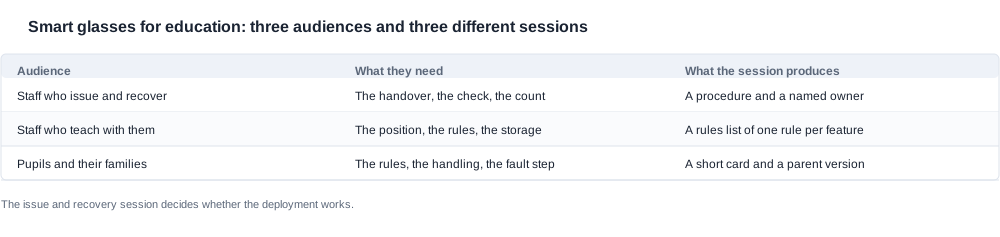
Smart glasses for education: three audiences and three different sessions
The staff who issue and recover the devices
| Audience | What they need | What the session produces |
|---|---|---|
| Staff who issue and recover | The handover, the check, the count | A procedure and a named owner |
| Staff who teach with them | The position, the rules, the storage | A rules list of one rule per feature |
| Pupils and their families | The rules, the handling, the fault step | A short card and a parent version |
The staff session is the one that decides whether the deployment works, and it is the one that is usually skipped. It has to produce a procedure rather than an explanation: where the devices live between lessons, who checks them at the end of a session, who charges them, what happens when one comes back in a state that cannot be issued, and what a device that cannot be reissued is replaced with. The count matters as much as the procedure, because without it a loss rate is invisible and the first sign of it is a budget that does not reconcile.
The procedure also has to say where the devices charge, because that is the one operational decision that changes everything else. The published charging rows for the children's entries are magnetic charging with a charge time at or under two hours, which means a shared base rather than a device on every desk, and the routine then becomes: returned devices go to the base, the base charges them, the base checks them, and the base issues them. A school that issues charged devices without a base is relying on somebody remembering, and the return rate shows the cost of that.
The staff who teach with them, and the pupils
The teaching session is a position and a rules session, and the rules are the harder half. The published features on the A05 and the A06 are a lens-type electronic atomiser with posture and distance detection, and the A07 is an audio model with Bluetooth V5.4. Each is a behaviour a pupil interacts with, and each needs a rule that can be stated in one sentence and enforced in a classroom. A rules list written from a feature list rather than from the classroom will be too long to remember and too vague to enforce, and the two failure modes it produces are a pupil ignoring it and a teacher giving up on it.
The teaching session also has to settle the storage position, because a device placed lens-down on a desk or pushed into a bag without a case is the most common damage route in a classroom. The catalogue lists no charging-case row for the camera models and does not publish a case for the children's entries, so the answer is a storage arrangement the school defines rather than a product feature the catalogue provides — which means the buyer has to specify it and the supplier has to supply the material for it.
The pupil and family session is short, and it should be. Three things: the rules, the handling instruction, and what to do when the device stops working. The handling instruction has to be restricted rather than permissive, because the lens material and the coating are not published and a classroom cloth or a tissue is the most available thing in a school. The maintenance side is at how to maintain smart glasses for kids parenting, the parent-side resource is at kids parenting support resources, and the buying-side list is at the education buying checklist. The scenario entry point is smart glasses for education.
What the education training materials are allowed to state
The published children's rows and what they mean
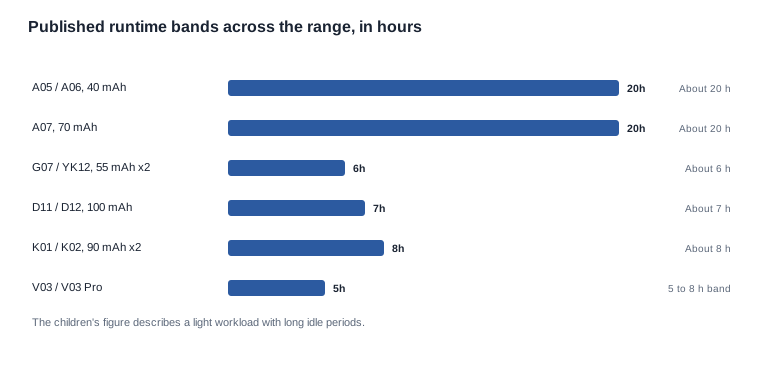
The chart is the single most important thing to show an education buyer, because the twenty-hour figure looks like a different product category from the five-to-eight-hour camera figures and it is not. The A05, the A06 and the A07 publish a rated runtime of about 20 hours on a 40 mAh, 40 mAh and 70 mAh cell respectively, while the camera models in the same range publish five to eight hours on cells of 220 mAh to 290 mAh. The difference is the workload: the children's figure describes a light load with long idle periods between short interactions, and the camera figure describes a continuous recording load.
Quoted without that qualification, the twenty-hour figure becomes a promise the product does not keep, and a parent who tests it will conclude the product is faulty. Quoted with it, it is accurate and it is the number the whole category is built on. No runtime in this range carries a test condition, which means the workload has to be stated by the school in the card rather than inferred from the number.
The rules cards and the claims they must not carry
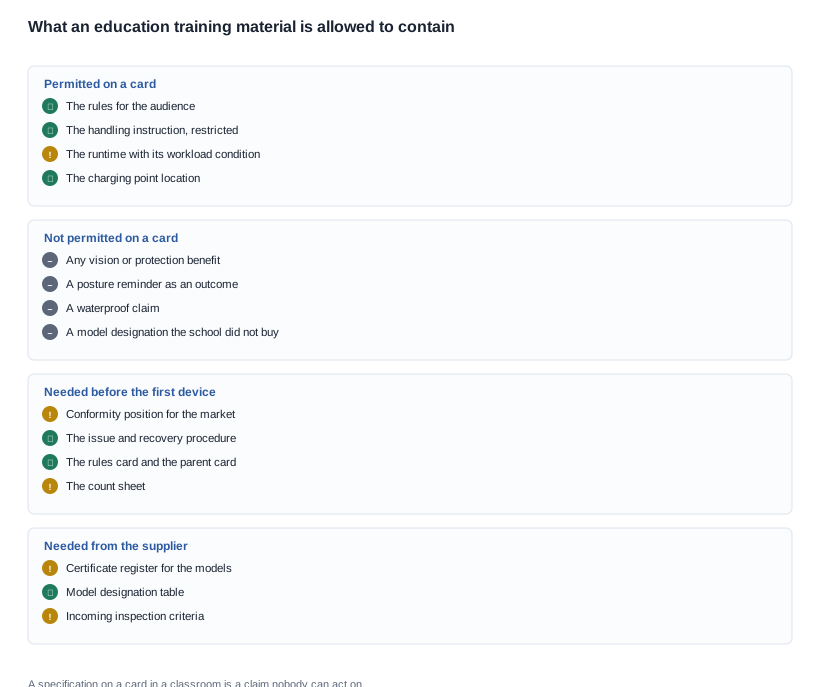
A card in a classroom is a claim nobody can act on and somebody will repeat, which is the test the materials have to pass. The permitted content is short: the rules for that audience, the handling instruction in its restricted form, the runtime with its workload condition, and where the charging point is. The prohibited content is equally short and equally absolute: any vision or protection benefit, a posture reminder stated as an outcome, a waterproof claim, and any model designation the school did not buy.
The last of those is easy to overlook. A card that lists several models in the range invites a member of staff to answer a question about a model the school does not have, and an answer about the wrong model is not a small error — it is a claim about a product that will never be in the room.
The evaluation criteria for the materials are therefore four, and they are checkable before the print run. Every statement traces to a published row or to a rule the school has written. No benefit, outcome or protection wording appears. The runtime carries its workload condition. And the model designation on every card matches what was ordered.
The three artefacts an education programme has to produce
The staff procedure, the rules card and the parent card
Three artefacts, and each has to survive two facts: staff turn over, and a pupil is handed a device without ever having been in a session. A one-page staff procedure at the issue point — where the devices live, who checks them, who charges them, what the count is. A one-page rules card that goes in the kit, so it is in the hand of whoever holds the device rather than on a wall. And a short parent card, in the language of the market, stating the same rules the school is enforcing.
None of them should contain a specification, for the reason above. The staff procedure is the one that has to contain the most operational detail, and the parent card is the one that has to contain the least, because a parent who is told a specification will ask about the specification and the school does not need that conversation in the first week.
The consumables question is part of the artefacts rather than a footnote. A school needs to know what goes in the box and how often it is replaced, and whether the item is single-use or washable is a specification decision with a cost attached: a washable item is cheaper per unit and a single-use one is easier to specify in a classroom where nobody tracks an inventory. That decision belongs in the bill of materials, not in a discussion after the first delivery.
How the sessions are sequenced

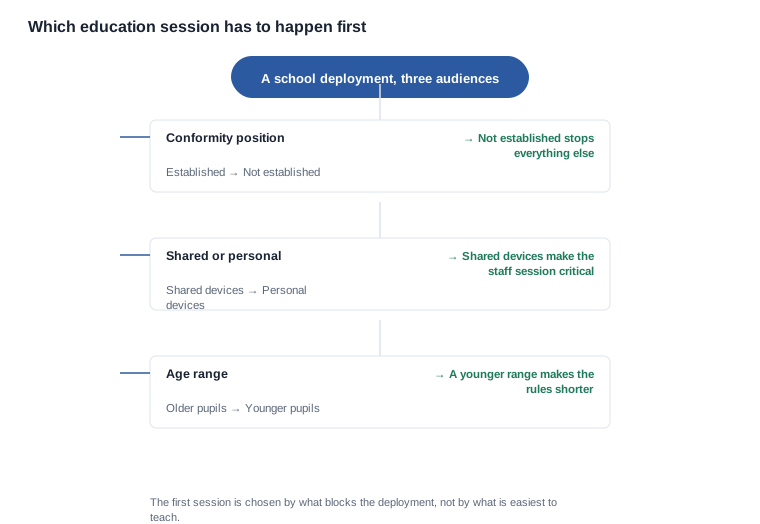
The sequence in the flow above is fixed by dependency rather than by convenience. The conformity position comes first because it can stop the programme. The staff session comes second because the staff are the ones who hand a device to a pupil, and a pupil who receives an uncharged or damaged device learns that the device is unreliable. The teaching session comes third, because it assumes the staff procedure exists. The rules card and the parent card are issued with the devices rather than after them.
The last step is the one that decides whether the programme improves, and it is the one that gets dropped: a term-by-term review of the count and of the tagged faults. That review is where a decision to change the storage arrangement or to change the rule count is made on evidence, and it is also where the buyer's next-year volume decision is made. A programme without that review is a programme that repeats the same faults at the same cost, which is the worst of the outcomes available.

Where education training programmes go wrong
The device session first and the compliance question last. A school that has already issued devices cannot be told afterwards that the requirements were never assessed.
A feature tour for the pupils. Pupils do not need to know what the device contains; they need to know what they may do with it.
A permissive handling instruction in a classroom. The most available cloth in a school is not a safe one for an undescribed coating.
An expectation of all-day continuous use. The twenty-hour figure is a standby-dominant figure, and a lesson timetable is not the workload it describes.
No count of what went out and what came back. Without it, a loss rate cannot be separated from a training problem, and the two have completely different remedies.
A rules list that a pupil cannot remember. Long rules lists are not enforced; one rule per feature is.
Cards that name models the school does not own. A member of staff answering about a model that is not in the building makes a claim about a product that will never be there.
The commercial terms an education training programme has to settle
Terms that move and terms that do not
The commercial value of the training in this channel is the difference between a working deployment and a deployment that is quietly abandoned after the first term, and the terms that move with it are the ones that change what the artefacts can say. The first is whether the supplier runs the staff session, in person or remotely, and whether they review the rules card and the parent card before the print run. The second is whether the insert is printed, digital or both, and who writes it — which matters because in a school the written material is the part that outlives the staff member who delivered it.
The third is the handling item in the box and whether it is single-use or washable, which is a per-unit cost decision that also decides how much classroom time the consumables take. The fourth is whether replacement wear parts are stocked, because a school that has no spare will stop issuing devices that have a damaged temple rather than repair them. The fifth is the count sheet, which is the artefact that makes the loss rate visible.
The order thresholds are open, and so is the quantity a school keeps at pilot level, because a rollout that starts with one class is precisely the case where a staged opening order is the right order. Splitting a first run into two deliveries against a staged payment suits the same rollout. Logo, lens tint and packaging are cheap to change between runs and expensive to change once the parent card is printed, and a parent card is printed in the language of the market, which multiplies the number of print runs rather than dividing it.
What does not move is the electronics, the cell and the charging interface, and therefore the charging routine the procedure teaches. The safety assessment route follows the process and the testing body. Certification cost and lead time follow the same route. Tooling sits on its own line, spread across the first order, and never inside the unit price. The wording and the numbers are both published: the language of the terms is at contract terms, and the commercial design of a first order at pricing.
A hypothetical school rollout, step by step
Take a district that has been given a rollout budget for the coming year, has to place the order before the end of the financial year, and has no prior experience of body-worn devices in a classroom.
The first decision is the conformity position, and it is taken before the order because it can stop the programme. The district asks for the position per target market, and the answer establishes that the catalogue carries no per-model certification row, so the district has to obtain the position in writing for the models it intends to buy. The second decision is the audience split: shared devices across a year group rather than personal devices, because a shared deployment is cheaper per pupil and it is the shared case that makes the staff session critical.
The third decision is the staff session, and it is scheduled before the devices arrive, because the staff are the ones who will receive them. It produces the base arrangement, the issue and recovery procedure, the count sheet and the handling item decision. The fourth decision is the rules cards, and it is a one-rule-per-feature list for the teaching staff and a short pupil session for the classes in the pilot group. The fifth is the parent card in the language of the market, which is the one print run that cannot be shared between regions.
The sixth decision is the commercial one: the pilot share at the year-group level, the split delivery against a staged payment, and the replacement wear-parts stock. The outcome is a rollout in which the compliance position is documented before the first device arrives, the staff have a procedure before they are asked to use it, and the term-by-term review has a count to review. Read this as an illustrative sequence rather than as a report of a specific engagement, and take from it the order of the decisions rather than the numbers it happens to contain.
What we publish for an education configuration
It is worth being precise: we publish the rows a buyer can order from and we will not fill the open ones with an industry average, and in an education setting that position matters more than in most. For the children's entries that means the lens-type electronic atomiser with posture and distance detection on the A05 and the A06, the lens count on the A07, the cell capacities, the charge times at or under two hours, the rated runtimes of about 20 hours, the magnetic charging and the Bluetooth V5.4 on the A07.
What we do not publish, and will not estimate: the lens material, the coating, the surface treatment, the per-model weight, the runtime test condition and the cycle life rating. We will not make a claim about a child's eyesight, because we make no such claim and we do not have the data for one, and we will not describe the posture and distance detection as an outcome rather than a prompt. We will not state that any model in the range is certified to CE, FCC or RoHS, because the catalogue carries no per-model certification row and no such wording in its text, and the applicable children's requirements are a document to be obtained rather than a line to be assumed.
What we will do is take the markets, the age range, whether the devices are shared or personal, the rollout size and the annual volume, and tell you which session has to happen first, which claims the materials are allowed to carry, and which questions have to be answered before the first device reaches a classroom. The scenario entry point is smart glasses for education, and the children's compliance route is at child product compliance.
What to send so the rollout sequence can be set out
Send the markets, the age range, whether the devices are shared or personal, the rollout size and the annual volume, and we will say which session has to happen first, which claims the materials are allowed to carry, and which questions have to be answered in writing before the first device is issued. If a rollout is already live, send the count sheet and the fault log instead — that is the fastest way to find out whether the training or the configuration is the problem.
Related reading
- Smart glasses for education — the scenario entry point
- Education buying checklist — the buying-side list
- Child product compliance — the applicable requirements route
- Kids parenting support resources — the parent-side material


