
Kids eye protection glasses technology: four gates and eight of the twelve items
Smart glasses for children are the highest-risk sourcing decision in this category, and the reason is not technical. The published hardware is not complicated: the A05 and the A06 publish a 40 mAh cell, magnetic charging, roughly twenty hours of rated runtime, a lens-type electronic fogging arrangement and posture and distance detection, and the A07 publishes Bluetooth 5.4, a 70 mAh cell, magnetic charging and the same runtime, with no atomiser and no sensing rows published. What is missing is the documentation, the claims position and the fit data, and in this category those gaps are what stop a launch.
Our records state the certification position for the children's range as entirely not provided, and they name the additional requirements that apply to products for children in Europe and the United States as matters to be confirmed. The list below is twelve items, each with the criterion that tells you the answer is real.
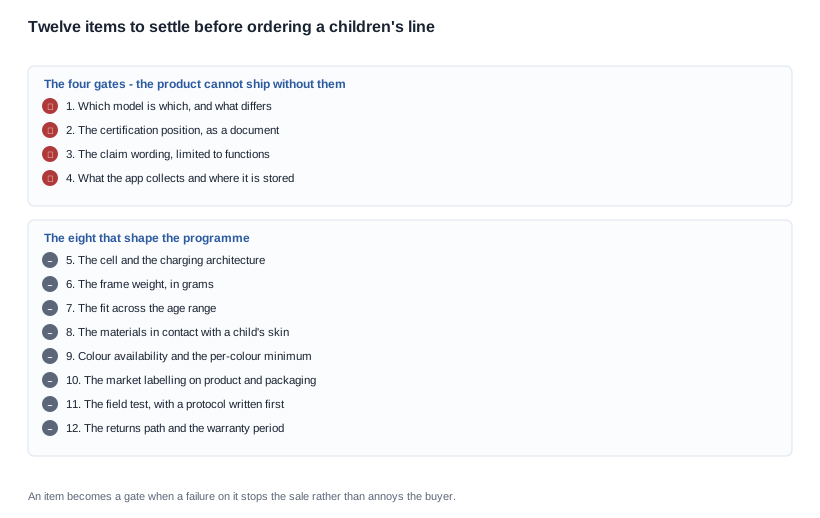
The organising principle is a single distinction, and it is the one that makes the list usable. Four of the twelve items are gates: a failure on them stops the sale. The other eight shape the programme: a failure on them makes the product worse than the alternative but does not stop it shipping. A list that mixes the two without saying which is which produces a programme that spends its urgency on the wrong item, and the symptom is a team that has escalated a colour minimum while the certification position is still unknown.
Who runs this list, and what it is competing with
The list is usually run by a procurement manager who has been given a children's line inside a wider buying cycle, alongside audio lines and camera lines and photochromic entries that are all easier. That context creates a specific pressure: the children's line is the one where the comparison against an adult line looks most favourable on paper, because the unit price is low and the electronics are simple, so it wins the slot on cost and then consumes the programme's time.
The list is also competing with the supplier's own catalogue, which is a complete, confident and largely irrelevant document. Every row a buyer would normally use is present in it, in a tidy table, and the rows that decide this purchase are absent. A procurement manager who has been handed a catalogue and a list like this one has to be told explicitly which of the two they are reading.
That is the argument for the gates. The four gate items are the ones where the supplier's catalogue is silent, where the answer has to come from a document or from a decision, and where being wrong has a consequence that cannot be fixed by a price adjustment afterwards.
The test that decides whether an item is a gate
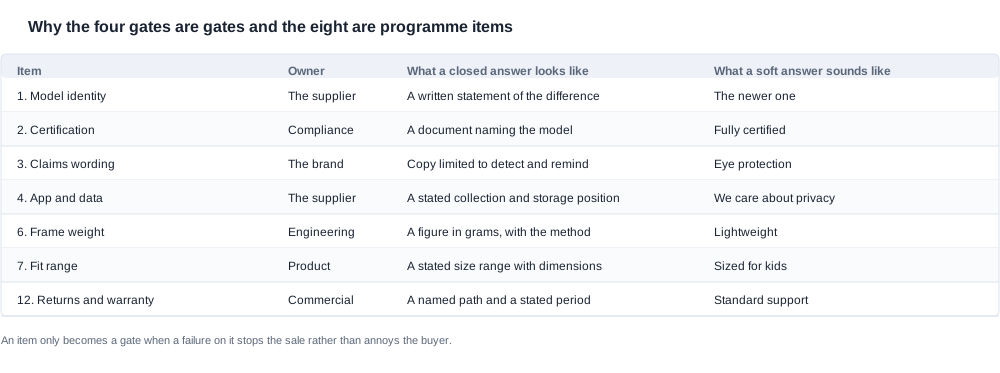
An item is a gate when a failure on it stops the sale rather than annoys the buyer. That single sentence settles every item on the list, and it is worth applying it carefully because the boundary is not where buyers expect it to be.
The certification position is a gate because a product that cannot lawfully be sold in a destination market cannot be shipped into it, whatever else is true about it. The claims wording is a gate because a listing that has been pulled has to be relisted, and the relisting takes weeks during which the channel is dark. The model identity is a gate because ordering the wrong one of two models that publish identical rows means the documentation you commissioned names a product you do not ship.
The frame weight is not a gate, even though it is the number buyers want most. A product that is heavier than it should be returns; it does not get stopped at the border. That is exactly the kind of distinction a list like this exists to make, because the buyer's instinct is to escalate the most visible problem rather than the most consequential one.

The four gates: model, certification, claims and data
1. The model, with the difference stated. The A05 and the A06 publish identical parameters, and our catalogue records the difference between them as unconfirmed. The A07 publishes a different configuration entirely, with no sensing rows published for it. A buyer who has not established which model is which is buying on a name, and the request is a written statement of the difference rather than an assurance that there is one.
2. The certification position, as a document. This is the item that decides everything else. The certification status for this range is recorded as entirely not provided, and the children's product rules that apply in Europe and the United States have to be confirmed as applicable or not applicable for the specific model. A claim is not a document, and this is the one place in our catalogue where we have no claim either.
3. The claims wording. These are habit-reminder devices. They detect posture and distance and they respond. They do not diagnose, treat, prevent or correct anything, and a listing that leans on the phrase "eye protection" invites a claim we cannot support in markets where the rules for children's products and for health claims are both stricter. The wording should describe the reminder function and nothing more.
4. The app and the data. App and firmware customisation for this range is marked unverified, and we publish no data-handling detail for any model in this tier. A school, a parent or a retail buyer will ask what the app collects, where it is stored and who can see it, and in a children's product the answer has to be defensible rather than reassuring.
The gate that is hardest to close
Item two, the certification position, is the hardest to close for a structural reason: it is the only one of the four whose answer may be "not provided" rather than "yes" or "no". A buyer can ask for a model difference and get it, can ask for claims wording and get it, can ask about data handling and get a position. Nobody can make a certification position exist.
That makes the request itself the deliverable in the early weeks. What the buyer needs is not a yes, it is a date, a model list and a document reference for whatever exists, plus a clear statement of what does not. A supplier who answers "not published, here is the testing plan and here is what we can evidence now" has given the buyer something to work with. A supplier who answers "fully certified" has given the buyer something that will fail at the first register check.
The second hardest is item four, not because the answer is complicated but because it belongs to a supplier who may not be the party building the app. Where the firmware or the app comes from a platform partner, the question has to be routed to that partner, and a routing delay of three weeks in a children's programme is a schedule problem rather than a technical one.
The gate that is easiest to lose
Item three, the claims wording, is the gate most often lost, and it is lost quietly rather than by a decision. Nobody in a launch meeting rejects a phrase; the phrase survives because there is no meeting at which it has to survive.
The mechanism is well known in this category: the copy is written by someone who has read the category name rather than the conformity file, or has copied a competitor's listing because that is faster, or has taken a phrase from an internal product brief written before the compliance position was known. None of those is a deliberate decision to make a claim, and each of them produces one.
The prevention is procedural rather than editorial, which is why the item is on the gate list: the wording has to be reviewed against the file before the artwork is approved, and the artwork sits at the end of the schedule. A claim corrected at the artwork stage is a design change. A claim corrected after the print run is a reprint, a second minimum order quantity and a gap in the channel.

The eight that shape the programme
5. The battery and the charging architecture. 40 to 70 mAh and about twenty hours of rated runtime, with no test condition attached. More importantly: does the frame charge on its own or only in a case? That is a facilities decision in a school and a logistics decision in a warehouse, and it changes the support load more than any electrical figure.
6. The weight. A frame weight, not a whole-unit weight — and the frame weight is the figure that matters most in this category and the one we do not publish for any model in the tier.
7. The fit across the age range. A product sold for a four-to-eight age range has to fit a four-year-old and an eight-year-old, and the published data does not describe the frame dimensions.
8. The skin contact materials. A declaration covering the surfaces that touch a child's skin, which is a stricter question than the same question for an adult product.
9. The colour and the packaging. Per-model availability and the per-colour minimum, which in this category is a larger commitment relative to the product value than it is in the adult range.
10. The labelling. The market-specific operator and safety information, on the product and on the packaging, with a separate set per market.
11. The field test. Tested with children, with a parent present, and with a clear protocol for what is being observed. The reminders are the feature, so the test is whether the reminders are noticed and acted on.
12. The returns and the warranty. A stated path and a stated age range, because a product for children has a warranty period that runs against the child's growth, and a return in this category is usually a fit problem rather than a defect.
Why the frame weight is the hardest number in this category
We publish the frame weight for exactly one model in the entire catalogue — 158 g for the MT6 — and that model is not a children's model. Every other model in the range, including all three in this tier, publishes no weight at all, and no frame dimensions either.
There are three reasons the number resists publication, and a buyer should know all three before asking for it. A frame weight depends on the material and the construction of that specific variant, so a range of colours with different finishes does not have one weight. It depends on whether the battery is in the temple or the bridge, which changes by model. And it is a tolerance rather than a figure, because the factory quotes a nominal and ships a distribution around it.
For a children's product, that last point is the one that matters. A nominal weight is not what a procurement decision needs; what it needs is the upper end of the distribution for the specific variant, because the tolerance is what a small child's temple has to carry. So the request is not "what is the weight" but "what is the weight of the heaviest unit in this variant, measured, with the measurement method and the sample size". A supplier who answers with a nominal and a tolerance has answered; one who answers with a single number has not.
The fit range and the age range are two different questions
Item seven is the one most often collapsed into a single number and it deserves separating. The age range is a marketing decision — the label says four to eight, and the product has to be credible across it. The fit range is a measurement — the frame dimensions in millimetres, the temple length, and the range of head sizes the frame actually accommodates.
The gap between the two is where children's eyewear returns come from. A product can be excellent at age six and unusable at age four, and a marketing age range that spans both will produce returns from one end. The request is therefore not "what age range does it fit" but "what are the frame dimensions, and what head-size range do those dimensions accommodate". Both numbers have to be produced by measurement, on the units that will actually ship, because the fit programme is a sampling exercise with real children rather than a comparison between catalogue rows.

Running the list as a gate rather than as a checklist
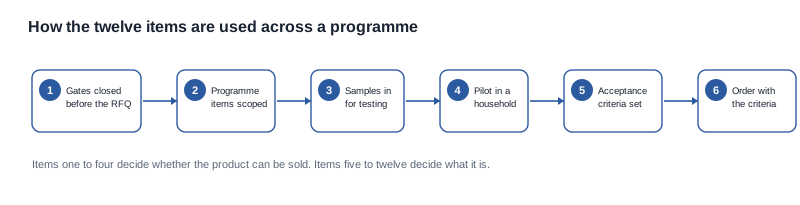
Items one to four are documentary, and they are the ones that decide whether the product can be sold at all in a given market. Settle them before anything is ordered, because everything downstream — the packaging, the listing copy, the channel — depends on them.
Items five to twelve are the programme, and the two that catch people out are the weight and the fit, because they are the two that a datasheet does not answer and a single sample does not either. They need a sampling programme with a written protocol, and that programme has to be scoped and budgeted like any other line of the project.
The distinction that makes the list work is that the four gate items have owners outside the buyer's own decision, while the eight programme items have owners inside it. A gate item is closed by somebody else — the supplier, the test body, the app partner, the compliance reviewer — and it is closed by evidence. A programme item is closed by the buyer's own scope, and it is closed by a decision. Running the four gates as if they were programme items is how a programme ends up with a beautifully scoped fit programme and a product that cannot be shipped.
The three commercial terms that carry this category
The minimum order quantity is the first number a new-category buyer reaches for and the least valuable lever available, because the unit price is the smallest component of the cost in this tier. The three numbers that actually move are the per-model documentation scope, the per-market label scope and the acceptance criteria.
The documentation scope is the biggest one, because it multiplies with the range. A line of three models across four markets with two colourways each is a document set count that is easy to understate and hard to reverse once the first market has been qualified and the second has not. Negotiating the scope and the unit price of the documentation as one line, before the first order, is worth more than any unit-price concession and it is the only version of the conversation that produces a real number.
The label scope is the second, and it is a packaging conversation rather than a certification one. Which labels apply to which markets, in which language, and which warnings each market requires is a low-cost negotiation with no tooling implication, and it is the easiest concession available to a supplier because it does not touch the factory.
The acceptance criteria are the third, and they are the term that protects the buyer on the failure that matters most. A criterion written into the purchase order is an acceptance standard; a criterion that lives in an email is not, and a lot that fails it is a lot the buyer can refuse. In this category the criteria that are worth writing are the detection observations, the duty-cycle run and the fit sampling, and each of them has to be agreed before the sample is accepted rather than after the first lot arrives.
What does not move is the certification cost and the certification time, which are a fixed cost per model and per market with the elapsed time set by the test body, and tooling, which is a one-off cost usually amortised across the first order — so the useful questions are over what volume it is amortised and what happens to it if the programme is discontinued.
Which failures each item prevents
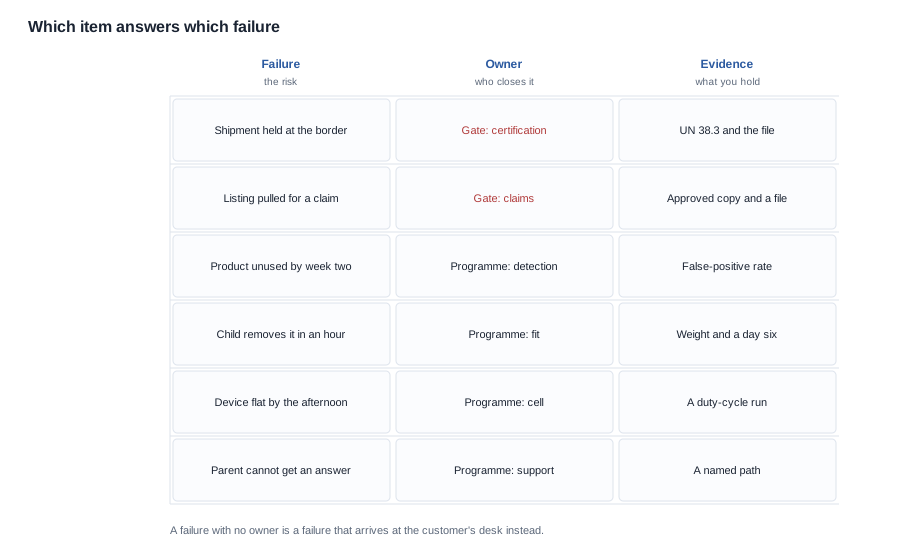
The matrix reads two ways. Read across a row and you see that a single failure can be closed by more than one item — a shipment held at the border is closed by the certification gate and by the transport document, and only the first of those is on the gate list. Read down a column and you see the concentration of risk: four of the six failures above are closed by programme items, which is why a programme that treats the gates as the whole list still ships a product that comes back.
That distribution is also the argument for spending the programme's time on the eight rather than on the four. The four gate items have to close before anything ships, but they close on other people's timetables. The eight are the buyer's own work, and they are where the return rate is decided.
What we can close today, and what we cannot
The three questions to send us
Ask us for the documentation status of a specific model. We will tell you what we hold, what we do not, and which of the twelve items our documentation already closes. For most models in this tier that is the electrical rows and the function rows; for none of them is it the certification position, and we will say that first rather than last.
Ask us to compare the two sensing models. The A05 and the A06 publish identical rows and the difference between them is not published to us, so we will tell you exactly how much is known and how much has to be obtained. What we will not do is infer a difference from the designation or from the order in which the models were introduced.
Ask us whether the channel's proposition is an eyesight concern. We make no vision, health or eye-protection effect claim for any of our products in any market, and we would ask anyone intending to build a listing in this category to resolve that with the right compliance route first. The technology context is under kids eye care technology, the models are on the kids smart glasses page, the market-entry rules are under children's product compliance, and the two related questions in this set are the upgrade considerations and what a supplier verification covers.
Where the checklist comes from
- The compliance position — children's product compliance
- The upgrade question — kids eye protection upgrade considerations
- Verifying what a supplier holds — kids supplier verification
- The range — kids smart glasses
Ask us for the documentation status of a specific model and we will tell you what we hold, what we do not, and which of these twelve items still have to be confirmed.


