
Smart glasses for outdoor: the setting where scope replaces the feature list
The conclusion an outdoor channel can act on
Smart glasses for outdoor is bought as an environment specification before it is bought as a device, and the two models in our range that publish an ingress marking are not the two models most outdoor channels end up buying. The IP54 marking belongs to the V06 and the S7, both sport camera models with a removable inner frame. It appears on no audio model, on no kids model and on no other sport model, and no third-party test report is published behind it for any model in the catalogue. Every other outdoor configuration therefore has no published ingress position at all, and that fact has to reach the training session, because the session is where the exposure is actually managed.
That produces a straightforward conclusion for a buyer planning an outdoor line. Decide the environment first — rain, splash, dust, heat, cold — and then decide which rows you need the supplier to produce. If the environment includes sustained water, the marketing term "waterproof" is not available to you on any model, because the catalogue contains no test report behind any ingress claim, and a claim you cannot document is a claim you cannot sell into a channel that will test it. The published charging decisions, the runtime bands and the structural rows remain usable, and the session can still be built on them, but the environmental rows have to be requested rather than inferred.
The second conclusion is about the deliverable. The one-session format works in this category because the user is about to go outside, often alone, for an unpredictable period, and will not meet the person who trained them again. The output of the session is therefore not a slide deck; it is a physical card with a small number of behaviours on it, and the behaviours on that card are dictated by what the documentation can support rather than by what the device can do.
Who is buying, and what the session has to deliver
The reader is a brand-side buyer, a channel buyer or an e-commerce seller assembling an outdoor line: a distributor stocking a hiking or a field brand, a reseller building a package for a retail chain, or a brand owner opening a new outdoor category. The situation is usually a quotation to compare, a season to launch into, or a market to enter, and in each case the same question sits underneath: which model can be configured for the environment the customer will actually put it in, and what does the session have to teach once that is settled.
The fear underneath it is not a bad unit price. It is a season where the returns arrive for a reason nobody wrote down — a rainy market, a dusty market, a market where the temperature swings — and the reason turns out to be a row that was never requested. That is the expensive version of the failure, because a defect claim is recoverable and an environment claim is a statement about the whole line.
Two things have to arrive before the session can be designed. The first is the environment profile: how long the device is out, whether it is in rain or only in splash, whether it is in dust or sand, and whether it is in a vehicle or on a ridge. The second is the configuration, because a session that has to cover four models covers four card variants and four sets of published rows, and the training cost scales with the number of variants rather than with the number of sessions.
Why this is an environmental decision before it is a training decision
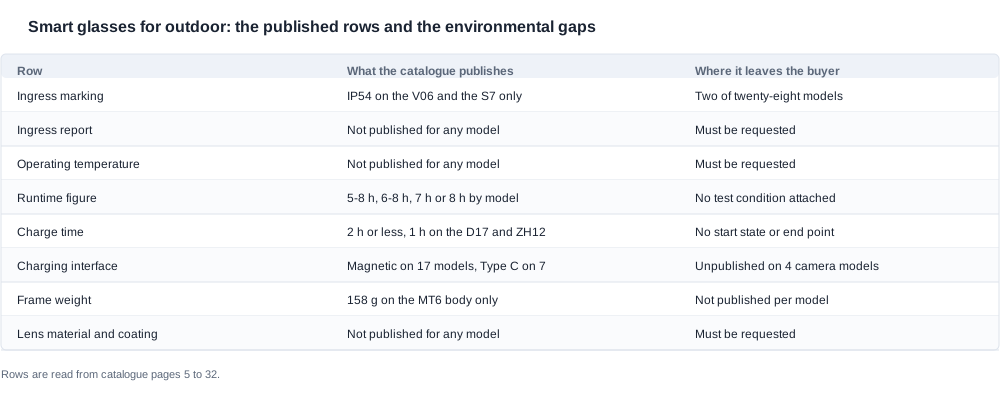
The table above is the working version of the environmental criteria list, and it separates three categories that buyers routinely merge. The first category is published and comparable: the runtime bands, the charge times, the structural features and the charging interfaces. The second category is published but incomplete: the ingress marking, which exists on two models without a report behind it, and the frame weight, which exists for one model and describes the glasses body rather than the frame. The third category is not published for any model at all — the operating temperature range, the ingress test report, the lens material, the coating and the runtime test condition — and that is the category an outdoor deployment lives or dies on.
The runtime rows deserve a warning, because they are the numbers most often quoted as though they were outdoor figures. The published runtimes across the range run from five to eight hours on the S7 and the V03 Pro, and the V03 and the V06, six to eight hours on the KY06 and the MT5, roughly seven hours on the MT6 and the CY03, and the L2 Utral and the L1 Pro, and the CY05, roughly eight hours on the K01, the K02, the LC-105 pair, the YKC02 and the ZH12, and roughly twenty hours on the three kids models. None of them carries a test condition. A rating measured at one volume level, one duty cycle and one ambient condition will not describe a device left on a windscreen in summer or carried through a cold night, and the moment a customer measures it differently from the supplier, the number in the listing is the number that fails.
The same caution applies to the charge time, and this is a point worth making precisely because the catalogue is unusually complete here. Every model in the range publishes a charge time: two hours or less on all of them except the D17 and the ZH12, which publish roughly one hour. That completeness is real, but the published figure carries no starting state and no end point, so it cannot be turned into a statement about how long a user waits, and it cannot be used as a case turnaround time for a channel that stocks spare units.

The published rows an outdoor configuration can be built from
Two models carry an ingress marking, and they are not the outdoor models
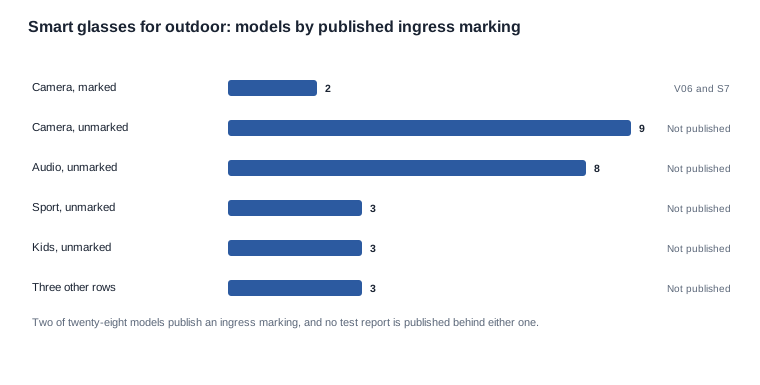
The distribution above is the argument in one picture. Twenty-six of the twenty-eight published models carry no ingress marking at all, including the entire eight-model audio group, the three sport models a channel would naturally reach for first, and all three kids models. The two that do are the V06 and the S7, which sit in the camera group and publish a removable inner frame alongside the marking.
That matters commercially in two directions. For a buyer who wants a marking on the specification sheet, the shortlist is two models out of twenty-eight, which is a narrow enough list that the decision is really about whether the camera group is wanted at all. For a buyer who is buying the audio group for an outdoor channel, the honest position is that there is no published ingress row for the configuration and therefore no ingress claim to make — which is a perfectly sellable position, provided the listing says what the device does instead of what it survives.
The second digit of the marking also has to be read carefully even on the two models that carry it. IP54 is a dust protection level together with protection against splashing water. It does not cover immersion and it does not cover a sustained downpour. And because no test report is published behind the marking, the marking itself is a catalogue attribute rather than a certified claim, which is a distinction that has to be in the training material and in the listing, because the customer in a downpour is the person who tests it. The digit reading is at IP ratings.
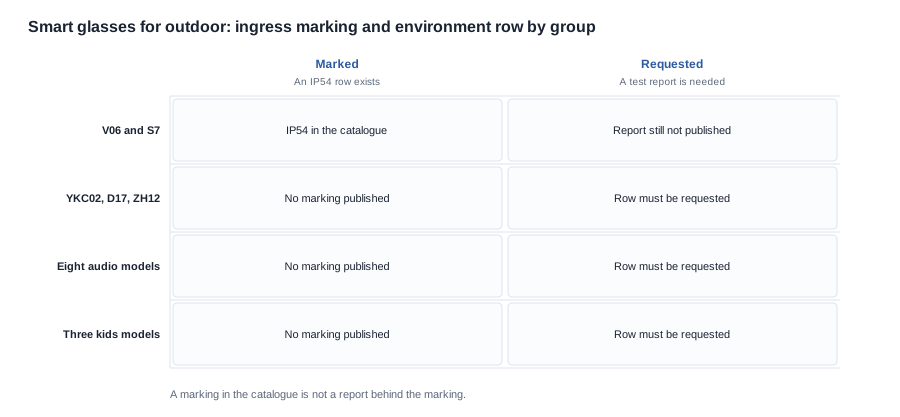
The matrix above sets the two questions side by side: whether a marking exists, and whether a report exists behind it. For the V06 and the S7 the first column is filled and the second is empty. For every other group both are empty. That asymmetry is the whole procurement task: it tells a buyer exactly which request to make and which claim to withhold.
The environmental rows nobody has published
Four rows are absent across the entire catalogue, and all four of them are environmental. There is no operating temperature range for any model, which means a channel cannot state a temperature limit in a listing or in a card. There is no ingress test report for any model, which means the marking on the two sport camera models cannot be backed by a document. There is no lens material and no coating for any model, which means a scratch or glare claim cannot be made and the wipe behaviour cannot be justified by a specification. And there is no runtime test condition, which means the rating cannot be presented as an outdoor endurance figure.
The structural rows that are published do carry useful weight for an outdoor line, even though they are not environmental. The V06 and the S7 publish a removable inner frame, the G07 publishes ultra-slim detachable temples, the YK12 publishes slim detachable temples, and the D17 and the ZH12 publish a remote capture control so that a capture can be triggered without reaching for the device. A detachable temple is a fitting system and a serviceable part rather than a cosmetic feature, and in a channel with a wide size range that is a return-rate lever before anything else.
What is not published is the hinge specification, the frame material, the per-model weight beyond the single 158 g whole-unit figure for the MT6, the field of view, the video specification, the cycle life rating and the Bluetooth version for any camera model. The catalogue also carries no per-model certification row: the export certification content is a company-level page, and the catalogue text contains no CE, FCC, RoHS, REACH or UN38.3 marking at all, so the market-access position for an outdoor line is a document to request rather than a page to point at.
Verifying the environment before the session is designed
The request that settles the exposure
The verification work for an outdoor line is a document exercise with one physical exercise attached, and the document part fits into one message if it is written narrowly enough.
- Ask for the ingress position in writing for the exact model and configuration, and for the test report behind it, including the report identifier and the issuing laboratory.
- Ask for the operating temperature range, with the storage and the operating condition stated separately rather than as one number.
- Ask for the runtime figure with its test condition — volume level, duty cycle and ambient condition — per model.
- Ask for the lens material, the coating and the frame material, so the wipe instruction and the storage instruction can be written against a specification.
- Ask for the per-model unit weight and the hinge specification, which are the rows a sizing commitment needs.
- Ask for the certification scope for each destination market, per model, since the catalogue carries none.
- Ask for the model designation table and the certificate register references, so every unit in the shipment can be traced to a document.
- Ask for the incoming inspection criteria in writing, including what is checked for water ingress damage and what is checked for lens condition.
The order matters. Start with the rows that have to be true before production begins — the ingress position, the temperature range, the certification scope — and work backwards to the commercial terms, because a term negotiated against a specification that later changes is not a term, it is a misunderstanding with an invoice attached.
The card as a specification document
The session itself is short, and its output is a card. But the card is not a courtesy: it is where the unpublishable rows are converted into behaviour, and it is therefore a specification document in everything but name. Four behaviours go on it, and each one has to rest on a row or on a written answer.
| Behaviour on the card | What it prevents | What it rests on |
|---|---|---|
| Where the device sits and how it is re-seated | A session where the footage is soft because the device moved | The published structural rows, since per-model weight is not published |
| Where and when it charges | A trip that ends with a flat device | The published interface and charge time, with the condition stated |
| What it is wiped with | The scratch claim, and the soft-image complaint after it | A specified consumable, since lens material and coating are not published |
| What the marking says and does not say | A rain test the customer runs and writes about | The IP54 marking as a catalogue attribute, with the second digit stated plainly |
The charge row on the card has to carry the published decision with it. A Type-C device recharges from a cable the user already carries, and the D17 and the ZH12 publish roughly one hour of charging against two hours or less elsewhere. A magnetic device needs the case carried, which is volume in a pack plus a second lithium cell to declare for transport. The charging decisions are at charging solutions and the published runtime rows are at battery life.

The flow above is the order the session should run in, and the third step is the one buyers want to move earlier. Choosing the model after the session has been designed produces a card that has to be rewritten, and a rewritten card produces a second training session that nobody budgeted for.
Where an outdoor deployment goes wrong
The failures below are the ones that reach a buyer as a surprise, and each is written as a symptom, a root cause and a control.
A feature tour. The user learns what the device contains and not what they should not do with it, and the session produces no card. Control: the card is the deliverable and the session is only the process that produces it.
A session that does not fit. Anything longer than a few minutes between unpacking and departure does not happen, because the user is on a schedule. Control: run the session immediately before the first outing.
A waterproof claim the documentation cannot carry. This is the recurring one, and it is unsupported twice over: the marking is on two models, and no report behind it is published. Control: the card states what the marking means and what it does not, and the listing carries no stronger word than the catalogue does.
A runtime stated as an outdoor endurance figure. "About eight hours" is a rating without a condition, and the customer will measure it in their own conditions and contradict the listing. Control: the card states the published band and the fact that no test condition is published.
A wipe step on the insert but not in the routine. Instructions on a card are read once; a routine attached to the end of a trip is followed. Control: attach the wipe to the moment the device goes back in the pack.
No card. The knowledge leaves with the trainer, and the user is alone in a place with no socket. Control: a card per user, in the language of the market, with the four behaviours on it.
No count of what went out. For a dealer network, a rental or a sponsored programme, a device that does not come back is a device that is bought again, which reads as a repeat sale in the accounts and is a loss in reality. Control: count out and count back, and treat the difference as the loss rate.

What an outdoor programme costs commercially
Four terms an outdoor programme can still move
Four terms in an outdoor programme carry genuine room, and all four sit outside the unit price. The first is whether the supplier runs the session and reviews the card before it ships, so that the criteria the session teaches are the same criteria the incoming inspection uses. A card written by the factory and never checked against the rows will teach a claim the documentation does not support, and that is the most expensive defect in this category because it is replicated across every unit in the shipment.
The second is the consumable set. A cleaning item and a contact item cost a few cents per unit and do not change the freight weight, and on a product where a scratch becomes a return and a wet contact becomes a service ticket, they are the cheapest return reduction available in the bill of materials. The quantity to negotiate is the quantity per device and the restock interval, not whether they are included.
The third is the case configuration, which is the cheapest way to build a consumer price ladder from one platform. The published case capacities give a real spread to work with — 1400 mAh on the CY03 and the L1 Pro, and the CY05, 900 or 1400 mAh as a configuration choice on the L2 Utral, 1200 mAh on the MT6's foldable case, and a case with no published capacity on the KY06 and the MT5 — while four camera models publish no case row at all. The kit list is at outdoor gear checklist.
The fourth is the first order itself. Breaking the opening order into two releases with payment released only after inspection suits a channel that opens its volume in stages, and the commercial room sits in the volume that goes on the pilot tier instead of the run tier, because that exposure belongs to the supplier.
Three costs an outdoor programme cannot move
Three costs are not negotiation targets, and a buyer who spends leverage on them loses the room that is available. The cell configuration and the charging interface, and therefore the charge time, the runtime ceiling and the case architecture, are fixed for a given model. The certification cost and lead time are given by whoever certifies the build and by the programme for the destination market for the destination market, and they are incurred once per product family rather than per unit. And tooling is a one-time cost that should be quoted as a separate line and amortised across the order, because a quotation that folds tooling into the unit price hides both its size and the point at which it stops being payable.
The seasonal note that changes the plan is at outdoor seasonal considerations, the clause language is at contract terms, and the commercial structure of a first order is at pricing.
What we publish for outdoor, and what we will not claim
The boundary we hold: we publish the rows a buyer can order from and we will not fill the gaps with industry averages. For this range that means the resolution class, the cell capacities from 40 mAh to 290 mAh, the charge times of two hours or less and roughly one hour on the D17 and the ZH12, the rated runtimes, the charging interface per model, the structural features that are published — the removable inner frame on the V06 and the S7, the ultra-slim detachable temples on the G07, the slim detachable temples on the YK12, the remote capture control on the D17 and the ZH12 — the colour counts, and the case capacities where they are published.
What we do not publish, and will not estimate: the frame material, the lens material, the coating, the hinge specification, the per-model unit weight beyond the single 158 g whole-unit figure for the MT6, the field of view, the video specification, the operating temperature range, the cycle life rating and the runtime test condition. We will also not state that any product in our range is tested to IP54, because no test report is published behind that marking, and we will not extend the marking to the audio, sport or kids families, where no rating is published at all. And we will not write a waterproof claim into a listing, a card or a training session on the basis of a catalogue attribute.
What we will do is take the environment, the season, the channel and the price band, and tell you which published rows apply, which environmental rows have to be requested, and what the session card may and may not say. Send the trip profiles, the season, the channel and the markets, and we will return the four behaviours the session has to cover, the rows that support each one, and the claims the listing has to leave out.
Related reading
- The point where the scenario starts — outdoor
- The kit list — outdoor gear checklist
- The seasonal note — outdoor seasonal considerations
- The adjacent session format — training for running
Tell us the trip profiles, the season and the channel, and we will say which four behaviours the session has to cover and which environmental rows to request.


