Verifying a smart glasses certification file set is eight checks, and the reason they are checks in a sequence rather than a list of documents is that a file set has to be read as a set. Each document answers one question, the answers have to be consistent with each other, and a set that is internally consistent but does not cover the model on the purchase order is still a failure. That last case is the common one, and it is the one a document checklist cannot catch.
The published position shapes what a buyer can check. The catalogue states no certification claims for the range, and its front page carries a company-level export certification page whose content is images rather than text. It does not carry a per-model certification row, so no buyer can infer a model-specific authorisation, a test report number or a validity date from the catalogue itself. We publish no model-specific identifier for any model, the catalogue records nothing pending against any of them, and we publish no certificate number we cannot quote.
That combination — real claims, no quotable numbers — is why verification has to be a method rather than a download. A buyer in this category is verifying a supplier's file set against a purchase order, and the file set is the only place the numbers exist.
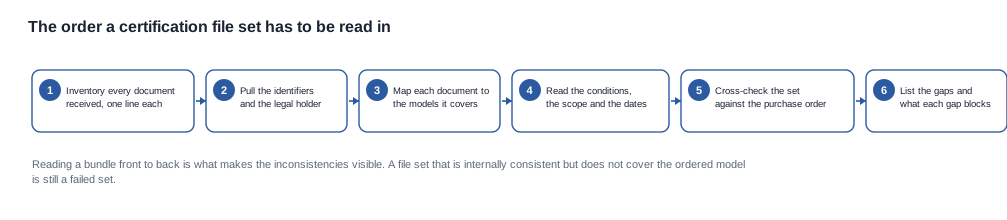
Smart glasses certification checklist: what a file set has to prove
The buyer and the decision in front of them
The reader is a procurement manager on the brand side, a channel buyer or an importer who has been sent a bundle of documents by a supplier and has to decide whether to release the order. The decision is not "is this supplier reputable". It is narrower and more practical: does this file set cover the model I am about to buy, for the market I am about to sell into, and does it hold together when the documents are read against each other.
Three things are usually being managed at once. The first is the border. A radio-equipped product entering a market without the documentation that market expects will be held, and the cost of a hold lands on the launch date rather than on the logistics budget. The second is the listing. A brand that has written a certification claim into its product page and cannot support it has created a consumer-law exposure that no factory document can cure. The third is the programme schedule, because in most of these orders the documentation route is on the critical path and is usually the link that is planned last and slips first.
The fear underneath the enquiry is a specific one: a file set that is complete in the sense of having many documents in it, and incomplete in the sense of not covering the configuration on the purchase order. That combination is invisible in a file listing and obvious in a model mapping, which is why the mapping step comes early.
There is also an internal cost to getting this wrong. A programme that released an order against a file set nobody read cannot be defended later to a colleague asking why the documentation route was not on the schedule. A verification note with dates and names on it is the only part of this work a buyer can produce unaided, and it is worth more than the bundle itself.
The documents that make up a set
The table below sets out the documents a file set for this category is normally expected to contain, the question each one answers, and the condition that makes it unusable. The third column is the one to read first, because most unusable documents are not obviously defective — they are simply about something else.
| Document in the set | The question it answers | What makes it unusable |
|---|---|---|
| Declaration of conformity | Who declares, and for which product | A holder that is not the contracting party |
| Technical file | What the manufacturer holds for this model | An empty file, or a generic one |
| EMC test report | Which immunity and emission limits were met | A report written for a different variant |
| Acoustic test report | Which acoustic limits were measured | A report for a different configuration |
| Battery transport test summary | How the cell is classified for transport | A summary for a different cell value |
| Material declaration | Which restricted substances are declared | A declaration covering no model in the order |
| Marking and label record | Which markings the shipped unit carries | A marking claim with no record behind it |
| Ingress test report | Which models were tested to IP54 | A marking with no report number |
Two rows in that table carry more weight than the others in this category, and both are worth explaining before the sequence starts.
The electromagnetic compatibility row is the one most often written incorrectly, and the error is in the document rather than the product. The EMC framework in the European market is Directive (EU) 2014/32/EU, and the harmonised standards supporting it are the EN 301 489 series. The radio equipment framework is a different instrument, Directive (EU) 2014/53/EU, and a buyer who writes the two numbers into the same sentence has a document that a competent reviewer will stop reading. A file set that names the radio directive in an EMC context is telling you the supplier's document control does not distinguish the instruments.
The ingress row is the one where this catalogue's published position has to be read carefully. The IP54 marking appears on two models in our range — the V06 and the S7 — as a catalogue annotation, and no third-party test report number is published against it. So the question to a supplier is specific: for a model that carries the marking, produce the report number; for a model that does not, do not claim the marking anywhere in the file set or in the listing.
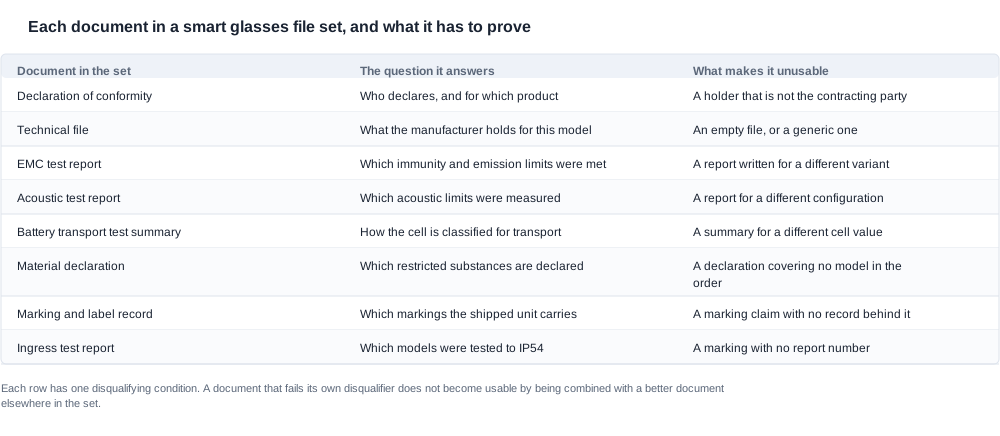

The eight checks, in the order a file set should be read
The sequence, and the completion test for each
- Take the inventory. One line per document received: what it is, what it covers, who issued it, what date it carries. It sounds administrative, and it is the step that makes the next seven possible, because a set that is incomplete in a way nobody noticed is the most common form this takes. Completion: a list, with nothing on it marked as "and related documents".
- Pull the identifiers. The authorisation number where one exists, the declaration reference, the test report reference, the declaration holder. These are the handles, and they are what makes the set checkable rather than assertable. Completion: every document on the inventory has an identifier or a stated reason for not having one.
- Map the models. For each document, list the models it covers, and compare that list against the purchase order. This is the step where most problems appear, and the step a buyer is most likely to skip because the documents arrived in a bundle with a cover note. Completion: a model list per document, and a written statement of which ordered models are not covered by anything.
- Read the conditions. The dates, the scopes, the exhibit lists and the notes. An authorisation has conditions, and a condition about the antenna, the enclosure or the end-use configuration is part of what was authorised. Completion: a note per document of every condition that narrows it.
- Check the scope. Whether the variants, the colours and the configurations intended to ship are inside what was tested. This is where the catalogue's published configuration options matter, because they define how many variants a model actually has: three colours on the V03 Pro and four on the V06, the L2 Utral published with either a 900 mAh or a 1400 mAh case, and four camera models whose charging method is not published at all. A document written for the base build does not automatically cover a different case.
- Check the issuer. The legal entity behind each document, and how it relates to the party being contracted with. A document held by a related entity is legitimate and disclosed; the same document held by an undisclosed entity is not. Completion: a holder named for every document, and an explanation for any holder that is not the contracting party.
- Date the set. When each document was issued and when it expires, if it does. A set assembled across two years is not a set, and the pieces may refer to different configurations of the same model. Completion: an issue date for every document, and an expiry date or a stated reason for having none.
- List the gaps. What is missing, and what each gap blocks. This is the output of the whole process, and it is the document sent back to the supplier as three or four specific questions rather than a general request for paperwork. Completion: a numbered list where each entry names the gap and the consequence of leaving it open.
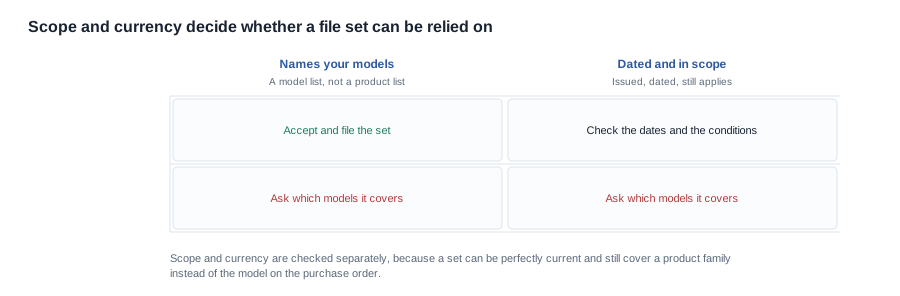
The check that catches the most: scope against the order
Steps three and five are where the real work is, and they are also the two that require the buyer to know what they are buying. A file set can be internally perfect and still be wrong for the order, and the usual way this happens is a scope that names a product family rather than a list of models.
The published configuration makes the scope question concrete. A model with three colours is three configurations. A model published with two case options is two configurations. A model whose charging method is not published in the catalogue is a model whose documentary scope is the one item a buyer cannot check against public data at all, which makes the supplier's own scope statement the only evidence available.
That is the general rule for this category: the more published the configuration, the more precisely the scope can be checked, and the less published, the more the check depends on the supplier's own statement. A buyer who knows which of their models sits in which category knows in advance how much of the verification depends on somebody else's description.

The three checks that need no supplier at all
What can be done before the first email
Steps two, three and seven are entirely in the buyer's hands. The identifiers are on the documents, the model list is on the documents, and the dates are printed on them. A buyer who does those three things before contacting the supplier asks a much better question than a buyer who asks for "the certificates" and receives a bundle.
That matters for the negotiation as much as for the verification. A supplier asked a specific question about a specific model answers it. A supplier asked for a general file set sends a file set, and a file set is an object to be read rather than a set of answers to be acted on.
Three practical habits make this routine rather than heroic. First, keep one spreadsheet with a row per document and a column per check, so the set is reviewed against the same structure every time rather than against whatever the supplier chose to send. Second, compare every document against the purchase order line by line, because the purchase order is the document that defines the obligation and it is the only one the buyer controls completely. Third, date every note, because a verification that cannot be dated cannot be shown to have happened before the order.
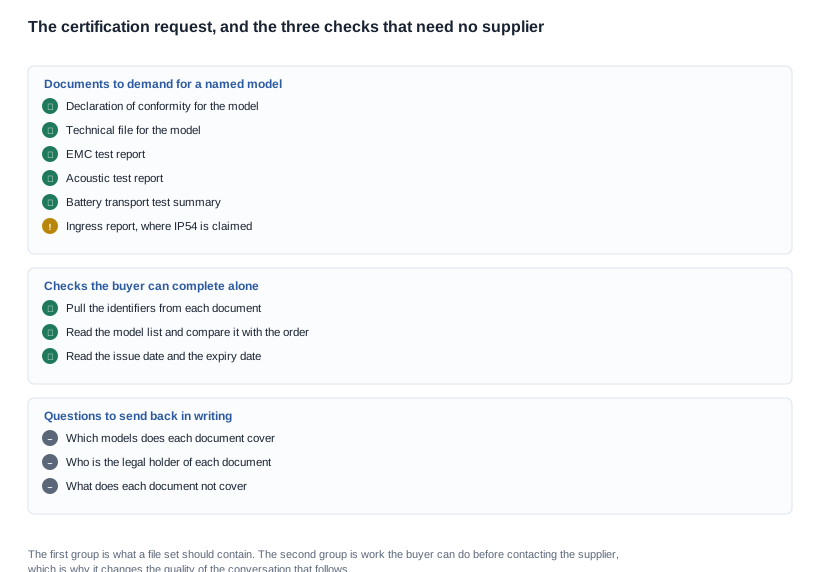
The questions that turn a request into a conversation
When the gaps are listed, they should be sent as questions with a completion test attached, because a question with a test produces an answer and a question without one produces another bundle.
- Which models does this document cover? Completion: a list of model designations, not a product family.
- Who is the legal holder of this document, and how does that relate to the entity we are contracting with? Completion: a named holder and a stated relationship.
- What does this document not cover? Completion: a statement of exclusions. A supplier that cannot name an exclusion has not read its own file.
- Is this document still in scope, and until when? Completion: a date or a stated reason.
- Which configuration variant was the test sample? Completion: the variant, and how it relates to what we are ordering.
- For the model carrying the IP54 marking, what is the report number? Completion: the number, or a clear statement that none is held.
The last question is worth a note of its own, because it tests something larger than the ingress row. A supplier that will not produce a report number for a marking it has published on two models is telling the buyer how its document control handles the difference between a catalogue claim and a tested claim — and that answer applies to every other row in the set.

Where a file set fails: scope, currency and the holder
The three failure shapes, and what each one costs
The set that covers a family. The symptom is a document that names a product line rather than the model designations. The cause is that the supplier's document control works at the product level and the buyer's order works at the configuration level. The control is the model mapping in step three, and the cost of missing it is a border query or a listing claim that cannot be supported.
The set assembled across two years. The symptom is documents that are individually valid and jointly incoherent, because the earlier one was written for a configuration the product no longer has. The cause is that no single date is being recorded. The control is step seven, and the cost of missing it is a technical file that cannot be relied on even though every page in it is genuine.
The set with a disclosed second holder. The symptom is a declaration held by an entity that is not the party on the purchase order, with no explanation. This one is often legitimate — a manufacturing entity and a brand entity frequently split this way — and the failure is not the split but the absence of the explanation. The control is step six, and the cost of missing it is a dispute about who is responsible for the product once something goes wrong.
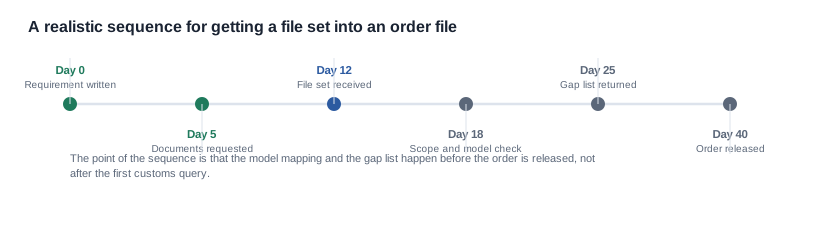
None of the three is a reason to change supplier. Each of them is a gap list with three or four questions in it, and each of those questions is cheaper to ask in week two than to answer at the border.
The sequencing point, and why it matters commercially
The sequence in the timeline is not a generic project plan. It places the model mapping and the gap list before the order release, because those are the two steps that produce information the buyer actually needs, and every week of delay in them is a week of a programme that could still be changed.
There is one commercially awkward aspect of the work that a buyer should decide about in advance rather than discover. Asking for a document set for a specific model is sometimes treated by a supplier as a request for a paid service. It is not, in the normal case, and a buyer who has asked once for the model-specific file set has usually got it. The awkwardness is different: the first request for a complete set often reveals that the supplier's set is not complete for that model, and that revelation is the point of the exercise. A supplier that responds to a model-specific request with a company-level capability statement has given an answer, and the answer is a finding.
A file set worked through, and where Cynrin stands
Nine certification documents, and the four that cover the configuration ordered
This is a worked scenario, not a client project. No customer is described and no order is claimed; the model, the quantity and the market are assumed so that the reasoning can be followed.
The scenario: a brand is buying a camera model with a charging case for a European market. The supplier has sent nine documents. The brand has a launch date in ten weeks and has not yet decided whether the configuration includes the larger case option.
Step one is the inventory. Nine documents, one line each, and immediately two questions arise: one document is undated, and one is a capability statement rather than a document with an identifier. Both go on the list with their status noted.
Step two is the identifiers. Seven of the nine produce a handle. The capability statement produces none, and the undated document produces one but no date. The inventory is now complete and the two weak documents are named.
Step three is the model mapping, and this is where the exercise earns its cost. The electromagnetic compatibility report covers a model designation that is not the ordered model, and the acoustic report covers the model but not the variant with the larger charging case. The ingress report is present and names the two models that carry the marking, neither of which is this one. The battery transport summary covers a different cell value from the one published for this model.
Step four and five are the reading of the conditions and the scope, and the scope result is already clear: of nine documents, four cover the ordered model and configuration, one covers the model but not the variant, two cover a different model, one is undated and one is a capability statement. The set is not empty and it is not adequate.
Step six is the holder. Every document that covers the ordered model names the same entity that will sign the contract. The capability statement names a different entity, which is the ordinary arrangement and is worth disclosing anyway.
Step seven is the dating. Seven documents are dated and inside their stated validity. The undated document is the one the brand would otherwise have relied on most, because it is the longest and the most technical.
Step eight produces a gap list of three items rather than a general request: the electromagnetic compatibility report for the ordered model designation, the acoustic report for the variant with the larger case, and the battery transport summary for the published cell value of this model. The undated document and the capability statement are recorded as items that do not support the claim being made for them.
The brand now has three questions rather than a vague concern, and ten weeks is enough time to get three answers. What it does not have is any basis for putting a certification claim into its own listing, because the only document that could have supported that was the one without a date.
What our file set contains, and what it must request
Here, we publish what our catalogue states and the gaps in it with equal clarity, and we will not print a number we cannot quote. We publish no model-specific identifier, the catalogue records nothing pending against any model, and the scope that applies to a model and a market is written material to be requested and filed before the order.
The rows we do not publish for this category are these: certificate numbers, validity dates, test report numbers, the scope of any conformity assessment, and the per-model certification status. The catalogue's front page carries a company-level export certification page whose content is images rather than text, and a page that states nothing in words cannot be turned into a model-specific authorisation by a reader or a buyer — which is exactly why the per-model rows in our published data are the ones a buyer should hold a supplier to.
What we can do is take a file set a buyer has received and mark it against the eight checks, and tell them which questions remain open on our side. The documents to request are in what documents to request, the verification sequence is in certification step by step, and the scope questions are in the certification advanced guide.
The action to take now. Send us the file set you have received, the model and configuration on the order, and the destination market, and we will mark it against the eight checks and return a numbered gap list with the three or four questions that will close it. The value of the exercise is entirely in the specificity of what comes back, so a bundle with no model named will get a bundle-shaped answer.
Related reading
- The documents to request — what documents to request
- The scope questions — certification advanced guide
- The verification sequence — certification step by step
Send us a file set and we will mark it against the eight checks.