

A smart glasses certification checklist is not a list of marks to find on a product page. It is a list of documents to request, and each document proves one specific thing — the declaration proves that a manufacturer has declared something, the test report proves that a laboratory tested something, the technical file proves that a design exists behind the declaration, and the ongoing production evidence proves that the line still makes the same product. Buyers lose money in this category when they treat the six as interchangeable, or when they assume that a document covering the sample also covers the fifth production run. This guide works through the document families one by one, states what each does and does not establish, marks what our own catalogue genuinely contains, and turns the whole set into a five-step check that can be run before an order is placed rather than after a shipment is stopped.
What documents to request to know about smart glasses certification checklist: the six that decide
The buying task behind a certification document request
The reader is a brand-side buyer, a channel buyer or an importer who has been told that a product is certified and now has to decide whether that statement is worth anything to them. The conversation usually starts too late — after the branding is designed, after the packaging artwork is drawn, sometimes after the first order is placed — because certification is treated as a formality that a supplier handles.
That treatment is the reason this document request matters more than its position suggests. A certification document is not a marketing asset; it is a legal position that somebody has taken on paper, and the party that takes it is usually the party that ends up carrying the obligation. For an importer putting its own brand on a pair of smart glasses, the practical question is not whether the product is certified somewhere. It is whether the document set names the model that will actually be shipped, whether it names the entity that will be responsible for it in the destination market, and whether it can be produced again for the next production run.
The commercial stakes are concrete. A shipment held at a border does not incur a fee; it incurs a demurrage clock, a storage clock and a missing launch. A product that turns out to need a different model designation costs artwork, tooling time and an approval cycle. A product whose certification evidence covers a configuration you no longer sell leaves a category of inventory that cannot be moved at all.
Why an unverifiable document settles nothing
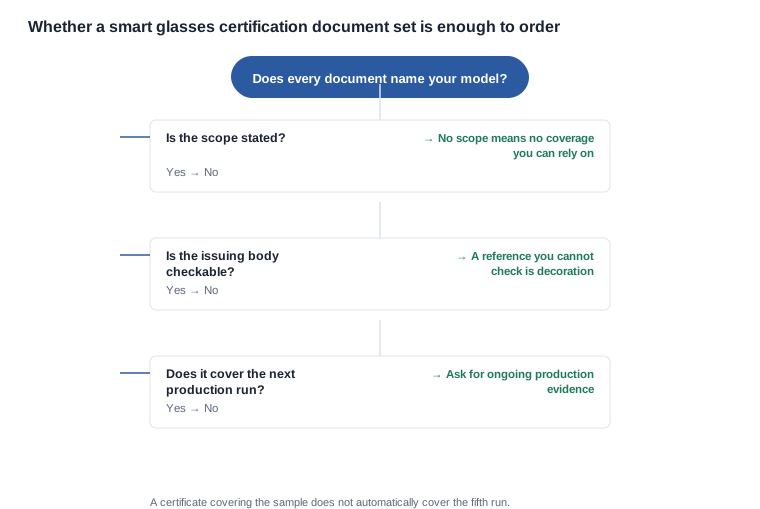
The test of a certification document is narrow and it has two halves: the document must be genuine, and it must be about your product. A supplier who sends a PDF that nobody can trace to a named laboratory and a named model has given you something that resembles evidence and functions as decoration.
Three questions separate the two. Who issued it, and can the issuing body's public record be checked against it? What exactly does it name — a model, a configuration, a component, or a production line? And how long is it valid, and what event invalidates it early?
The third question is the one most often skipped. Certification evidence is not a permanent property of a factory. It can be scoped to a production period, to a specific site, to a specific sub-supplier's component, or to a type examination that a change of design or firmware silently steps outside. A buyer who has asked for a document but not for its scope has a file rather than a position.
There is also a distinction worth holding onto throughout: a document is evidence of a process, not evidence of a unit. The unit in your carton is evidence of a build. Those two things have to be tied together, and the tie is usually a model designation and a production record — which is why the model designation, not the certificate, is the document that deserves the most attention in a procurement file.

The six document families and exactly what each one proves
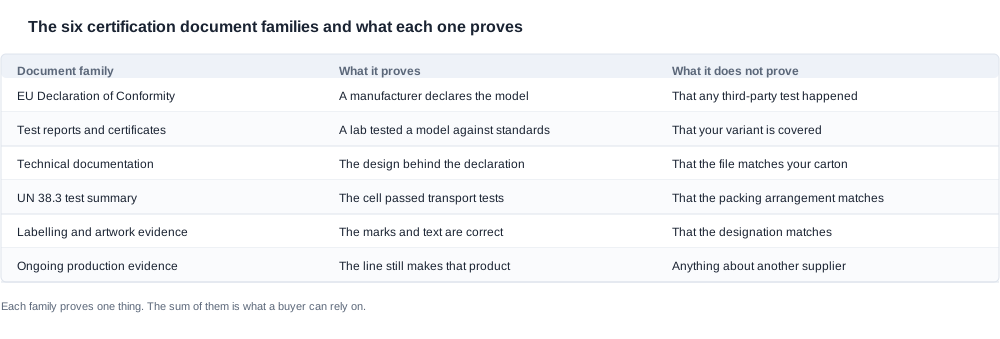
The six families, side by side
| Document family | What it proves | What it does not prove |
|---|---|---|
| EU Declaration of Conformity | The manufacturer declares the named model against named legislation | That any third-party test was performed |
| Test reports and certificates | A named laboratory tested a named model against named standards | That your colourway or case option is covered |
| Technical documentation | The design and risk assessment behind the declaration | That the file matches the units in your carton |
| UN 38.3 test summary | The cell passed the transport battery tests | That the packing arrangement matches it |
| Labelling and artwork evidence | The marks and text on the product are correct | That the model designation matches the certificate |
| Ongoing production evidence | The line still produces the assessed product | Anything about a supplier you have not audited |
How to tell a document about a model from a document about a product
The distinction that catches most buyers is between a document about a model and a document about a product. A model is a catalogue entry: a designation, a set of electrical rows and a configuration. A product is the thing you sell: a model, in a colourway, with a case option, a charger, a firmware version and an artwork. Every element of that list can change the scope of the evidence.
Take the camera tier as the concrete case. Eight of our camera models are published at 8 MP and three at 13 MP, and the resolution tier is part of the identity of the product rather than a cosmetic option. A test report covering a 13 MP configuration says very little about an 8 MP build with a different case option, because the sensor, the optics and the thermal behaviour of the unit are not the same. The same logic applies to the charging arrangement: magnetic charging on seventeen models and Type C on seven means the electrical configuration differs across the range, and four camera models publish no charging method at all — which is itself a document request rather than a detail.
The second practical test is the model designation itself. If the evidence names a designation that you do not control — because it is the supplier's internal code rather than yours — then every future change to your own packaging, label or market designation has to be checked back against it. If you can design your own designation and build the evidence around it, the scope question becomes tractable. If you cannot, then the supplier's designation controls your programme, and that is a sourcing risk rather than a paperwork detail.
The three layers a document sits in
Certification evidence is easier to request when it is understood as three separate layers, because buyers routinely ask for one and expect the other two.
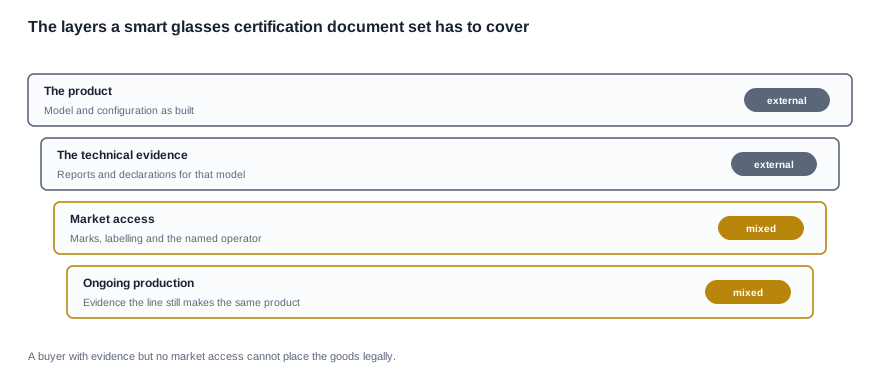
The first layer is the product: what is built and what is shipped. The second is the technical evidence: the reports and declarations that attach to that product. The third is market access: the marks on the product, the labelling, and the identity of the economic operator responsible in the destination market. A buyer with layer two and no layer three has a product that cannot be placed on the market; a buyer with layer three and no layer two has paperwork with nothing behind it.
The fourth layer is the one that is usually absent and the one that matters most over time: evidence that the line is still producing the assessed product. A programme that runs for two years will see a component supplier change, a firmware version advance and a production line move. None of those is visible on a certificate, and all of them can step outside its scope.
What our catalogue contains about certification, and what it does not
The export-certification page and the absent per-model rows
We should be exact about this, because the honest answer is more useful to a buyer than a reassurance. Our catalogue carries a company-level export-certification page — a page of design patent certificates, which relate to appearance rather than to radio or safety conformity. It carries no per-model certification row. The text of the catalogue contains no CE, no FCC and no RoHS marking, nor any equivalent declaration, and the catalogue is not a conformity document for any model on it.
That is worth stating plainly rather than leaving to a reassurance, because those three marks are the first items on almost every buyer's standard checklist in this category. They are the right things to ask a supplier about. They are simply not things our own documentation speaks to, and a company-level export-certification page is not the same as a per-model conformity record — which is the distinction a buyer needs to hold a supplier to, us included.
That means three things follow for a buyer, and all three are worth acting on.
First, the certification scope of any named model is a written request to the supplier rather than a search. Second, a supplier who shows you a certification page instead of a document set has not answered the question. Third, the most common mistake in this category — treating a company-level certification claim as if it were a per-model one — is the mistake to avoid, because the second implies coverage the first never granted.
The practical request that follows is short: for each model you intend to place, ask for the document set behind that model, and ask for the scope of each document at the same time. A supplier who can produce both at once has an answer. A supplier who produces documents and then has to think about the scope has a documentation problem, and you want to know that before the order rather than during it.
Turning an open row into a written request
An open row in a supplier's documentation is not a refusal; it is a task. The work is to convert it into a request specific enough to be answered without a meeting, because a request that requires interpretation comes back as a description rather than as evidence.

The structure of a good request has five parts: the model designation as you intend it to appear, the configuration elements that could affect scope, the destination market, the document family you need, and the question about scope that you want answered in writing alongside the document. That last part is what separates a procurement task from a document collection exercise.
Two of the document families need particular attention in the request itself. The transport battery evidence is issued against a specific cell and a specific test, and a test summary for one cell does not cover another, so name the cell configuration and the model it ships in. The market-access layer depends on which market the goods enter, and for the European Union that includes the radio equipment regime — the Radio Equipment Directive (EU) 2014/53/EU — alongside the general product safety regulation, Regulation (EU) 2023/988, which has applied since 13 December 2024 and carries traceability and economic-operator duties. Note that the electromagnetic compatibility requirements that appear in this area are usually cited as the harmonised standard series EN 301 489, which is a standard and not a directive number, and a file that mixes the two is a file to check.
Our own catalogue is not a special case of this rule. We do not publish certificate numbers, test report references or issuing-body details for any model, because we will not publish a reference we cannot evidence. The same request applies to us as to anybody else, and we would rather be asked for the documents than be assumed to hold them.

Collecting and checking certification documents before the order is placed
The five-step document check
The document check runs before the purchase order is placed, and it is short enough to complete in one working session once the documents arrive.
- Match every document to a model designation. Write the designation from each document next to the model and configuration you intend to order. Any document that cannot be matched to a row is a document for a different product, however recent it is.
- Read the scope, not just the title. Look for what the document is limited to: a site, a period, a component, a configuration, a production batch. A certificate with no stated scope is the most impressive and least useful document in the set.
- Check the chain. A declaration refers to a report; a report refers to a standard and a sample; the sample refers to a build. If any link in the chain is missing, the document proves less than its title suggests.
- Check the validity conditions and the dates. What invalidates this evidence early, and when does it expire. Where the validity is tied to a production period, the question becomes when the next period is covered.
- Decide, per document, what you will do if it disappears. Which document is on the critical path for customs clearance, which one you could re-request from a laboratory at a cost, and which one cannot be replaced at all.
The record you keep for each document
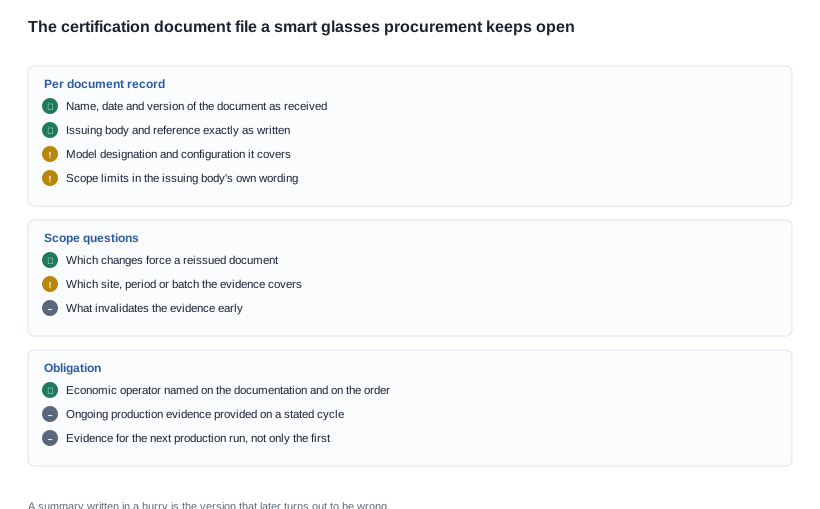
For each document, keep five fields and the file becomes usable a year later when nobody remembers who sent what. The document name and its date, which is often the only version marker you get. The issuing body and the reference, exactly as written, because a paraphrase is not a reference you can check. The model designation and configuration it covers. The scope limits, in the issuing body's own words rather than in a summary. And the date on which you received it, which starts the clock on anything with a validity period.
The reason to keep the issuing body's own wording rather than your summary of it is that scope is exactly where the two parties will later disagree. A summary written in a hurry is the version that survives in your file, and it is the version that will be found wanting.

Where certification programmes stall, and who carries the obligation
Three stalls and their causes
The stall at artwork freeze. The technical file or the label evidence depends on a model designation and a brand marking, and the designation only becomes final when the artwork is final. The symptom is a documentation workstream that starts the week after the print deadline. The control is to fix the designation and the operator information before the artwork is released, not after, and to treat the artwork itself as a certification deliverable rather than as a marketing one.
The stall at the variant nobody modelled. The programme adds a colourway, a case option or a firmware feature after the evidence was collected, and the supplier's answer is that the change is minor. Sometimes it is; often nobody can show which document would have to be reissued. The control is to ask the scope question in advance — which changes to the configuration require new evidence — and to get the answer in writing while the variant is still a proposal.
The stall at the second production run. The evidence covers the first batches, and nobody has established whether it still covers the fifth, because the supplier's own production has moved on. The symptom is a programme that cannot answer a customs query without a week of delay. The control is to put an ongoing production obligation into the agreement, in the form of evidence provided on a stated cycle.
The commercial terms around certification work
Certification work is one of the few areas in this category where the cost is genuinely unavoidable, and it is worth being clear about that because buyers who expect it to be quoted as a line item are usually disappointed.
What is negotiable is the sequencing and the scope, not the existence of the work. A test programme performed after the design is frozen may have to be repeated after the first change; the same programme performed before the freeze may not. That makes the moment at which the supplier is asked to start the work a commercial lever, and it is a bigger lever than the fee itself.
The second negotiation is about the sample that goes into the laboratory. A programme that supplies the certification sample from its own production line, at its own charge state and with its own configuration, keeps the evidence aligned with the product. A programme that supplies a specially prepared unit, or an early unit from a different configuration, produces evidence about something that will not be shipped.
The third is who carries the obligation. For an importer placing its own brand on the product, the declarations and the labelling duties usually attach to the party responsible for placing the product on the market in that jurisdiction. That is a structural consequence of the branding, not a negotiation, and the practical response is to make sure the entity named in the documentation and the entity on the purchase order are the same one, or that the responsibilities are stated explicitly. Discovering the mismatch after the artwork is printed is an expensive way to learn something that a single question at the start would have answered.
The questions to ask are consistent across all three stalls: what evidence is required for this model and this market, what has to be true before it starts, and who signs for the result.
A certification request worked through, and the limits of our own file
A purchase scenario reasoned through
The scenario below exists to carry an argument; it is not reported from a client engagement. No customer, order or engagement is described; the model, the market and the launch date are assumed so that the reasoning can be followed from the first request to the final record.
A brand-side buyer is preparing a launch into two markets and has shortlisted one supplier. The catalogue covers twenty-eight models, and the buyer's range runs across a camera model, an audio model and a sport model. The branding is new, the model designation has not been fixed, and the launch date is in the fourth month.
Step one is the designation, and it comes first because everything else depends on it. The buyer asks the supplier to confirm whether the evidence can be issued against a buyer-controlled designation and what changes to the configuration would force a reissue. The answer arrives with a list, and the list is short: the camera tier and the charging arrangement are named as scope-relevant, and the case option is named as relevant to one model. That list then becomes the configuration freeze for the range, which is a genuinely useful output — the buyer now knows which combinations are expensive and which are free.
Step two is the market split, which the buyer had not thought of as two workstreams. For one market the request runs against the radio equipment regime and the general product safety regulation, and for the other it runs against a different set of local requirements. Because the buyer has fixed the model designation already, the artwork can carry both operator identifications from the first print run rather than the second.
Step three is the transport battery evidence, requested against the specific cell of the specific model, and the supplier confirms in writing which cell ships in which configuration — which, for the four camera models where the catalogue publishes no charging method at all, is information the buyer would otherwise have had to discover at the forwarder.
Step four is the document check on receipt, which finds the thing the buyer is most exposed to: the report for the audio model covers the base configuration, while the buyer's range includes a variant with a different case option. The scope question, asked in writing at step one, resolves it in a day. The alternative — discovering it at artwork approval — would have cost a reprint.
Step five is the ongoing production obligation, which the buyer asks to be written into the agreement as evidence provided on a stated cycle rather than collected ad hoc when a customs query appears.
The catalogue as a product reference, not a conformity document
Our published catalogue is a product reference and not a conformity document, and we would rather say that clearly than let a company-level certification page be read as per-model cover. We publish the electrical rows, the camera tiers, the charging arrangements, the ingress marking where one exists, and the single weight figure we have measured. We do not publish certificate numbers, test report references, issuing-body details, capacity figures, minimum order quantities or defect rates, because we will not publish a reference we cannot evidence.
That is a limitation, stated plainly, and it is also the reason our documentation is usable as a baseline: every row a buyer can check is a row they can check against the units they receive. Where a row is not published, it is a written request, and it should be treated as one — with a model, a configuration, a market and a document family attached, so that the answer comes back as evidence rather than as description.
What we will do is take a model, a configuration and a target market, and tell you which documents have to exist for that combination, what we publish about it, and what has to come from the supplier in writing. We will also say plainly when the answer is that a particular document family is not something we hold, because a buyer who has to find that out later has found it at the worst possible moment.
How to start a certification document request with us
Send the models, the configurations, the destination markets and the launch window, and we will tell you what the published catalogue settles for that combination, which document families have to come from us in writing, and which questions to put to any supplier you are comparing us against — including us. The full checklist is on the certification checklist page.
Related reading
Send the models, the configurations and the destination markets, and we will show you which parts of a smart glasses certification checklist are settled by published data and which are written requests.


