

Smart glasses certification checklist: what a file has to cover
The answer a buyer can act on
Most certification disputes in this category are not about compliance. They are about scope. A technical file covers a defined set of models and a defined set of variants, and the question that decides whether a launch proceeds is a single one: is the model on the purchase order inside that set? Everything else — how good the testing was, which standards were applied, how thorough the assessment was — becomes irrelevant the moment the answer is no.
The reason this is worth an advanced treatment rather than a line in a starter checklist is that scope is harder to check than it looks. A file can cover a model and still not cover the variant, because a variant is a different bill of materials with the same product name. And the variant dimensions in this category are published, which means the buyer can enumerate them in advance rather than discovering them one dispute at a time.
The six scope questions below are the ones that close a file set. Each one has a document behind it, and each one either produces a match, produces a gap that has to be closed, or produces an honest answer that the file does not cover this configuration.
Who handles the technical file
The reader is a buyer who already has the basic list and now needs to deal with the file itself — a procurement manager, a channel buyer or an importer who has been handed a technical file and a purchase order and has to decide whether the two are talking about the same product. That is a more technical moment than the first round of a checklist, and it usually arrives later, when the commercial terms are agreed and the paperwork is the last thing standing between a purchase order and a launch date.
What is being managed is the launch window and the exposure that follows from it. A scope mismatch found while the order is still being negotiated costs a configuration change or an extension request. The same mismatch found after the goods are built costs a hold, a re-run and a delay, and the delay lands on a date that somebody has already promised.
The requirements themselves are public. Our own position against them is not published, and the end of this article is honest about that.

Reading a file set as a list of models and variants
What a file set actually contains
A file set is not a single document with a single scope. It is a set of documents that together cover a set of models, and each document has its own scope, its own date and its own revision. The most common structural error is treating the set as one thing, because a set whose coverage is uneven still looks like coverage when it is read as a whole.
So the first task is to take the set apart. For each document: what is its number, what is its date, which models does it list, and which revision is current. Then set the documents beside the purchase order and mark the models that appear on both sides. The result is normally a short list of models that are in the order and not in the file, and that list is the actual work.
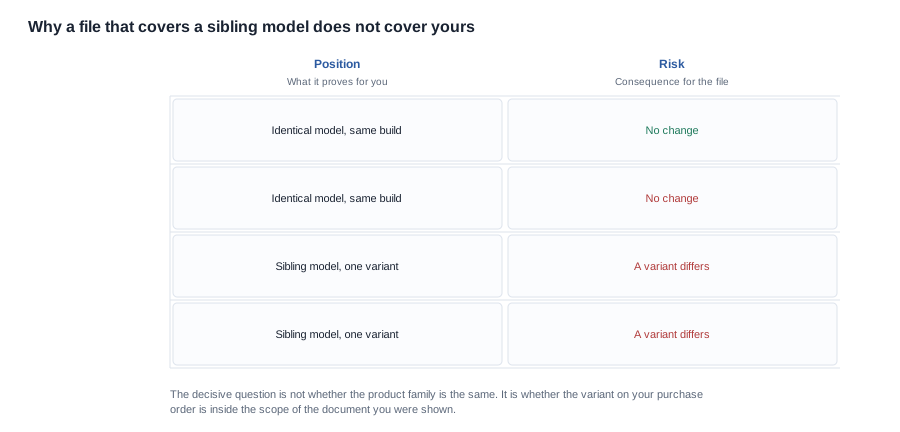
The matrix states the principle in one line: the decisive question is not whether the product family is the same, but whether the variant on the purchase order is inside the scope of the document that was shown.
Model code, variant, and the naming problem
The reason scope checking fails is usually a naming difference rather than a real gap. The catalogue code, the code in the test file, the code in the declaration and the code on the purchase order are four identifiers for what is often one product, and they drift. A model is renamed between the catalogue revision and the test file; a variant is given a suffix in one place and a bracket in another; a platform name appears where a model code should be.
The published variant dimensions give the buyer a way to cut through this. Across the range there are a small number of axes on which a build actually varies, and they are all visible in the published rows: the charging case option, where the L2 Utral exists in a 900 mAh or a 1400 mAh version; the presence of a case at all, where the V03 Pro has none and the KY06 and the MT5 have one of unpublished capacity; the lens, where the V03 Pro carries a photochromic option; the colourway, which differs per model rather than running across the range; the charging method, published on 24 of the 28 models and absent on the MT6 and the CY05, and the L1 Pro and the CY03; the Bluetooth version, published per model across the audio range and not published for the camera series; the pixel tier, with eight models at 8 MP and three at 13 MP; and the two IP54 markings, on the V06 and the S7.
That is the whole variant space. A buyer who enumerates the axis and value for each model on the order has, in effect, written the scope question, and can then ask the supplier to answer it rather than asking to see a document and hoping the scope is right.
The six scope questions that close a file set
The questions
- Which exact model codes appear inside the file, as distinct from the family or platform name?
- Which variant of each model is covered — the case option, the colourway, the lens?
- Which battery configuration is covered, including whether the charging case is in or out of scope?
- Which radio version is covered, and which firmware version?
- Who changed the scope, when, and against which revision of the product?
- Is the scope for the current build or for an earlier one that shared the product name?
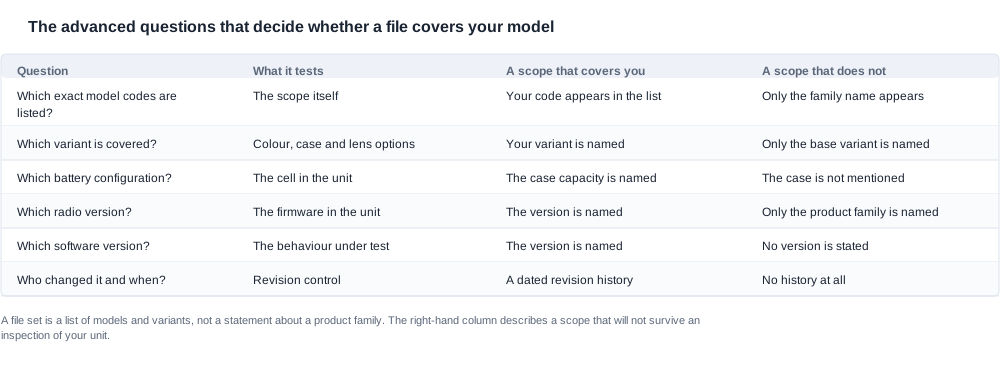
The table gives the six questions with what a scope that covers the buyer looks like and what one that does not looks like. The right-hand column is not a description of a bad supplier; it is the description of a scope that will not survive an inspection of the actual unit.
Eight questions that close a file set
The six above are the scope questions. These eight are the ones that sit just outside them and decide whether a scope answer can be trusted once it has been given.
- Which revision of the product was the assessment performed against, and what changed since?
- Is the file a single document or a set, and if it is a set, which document governs the model in question?
- Who is the custodian of the file, and can they produce it two years from now?
- Does the scope cover the configuration as shipped, or the configuration as described in the catalogue?
- If the scope is a platform rather than a model, what are the enumerated variants inside it?
- Does the scope cover the charging case, and does it cover both the case and the device together?
- Which document in the set is the most recent, and do the others need to be read alongside it?
- What is the procedure for extending the scope, and who initiates it?
Questions three and eight are the ones most often skipped, and they are the two that matter if anything goes wrong later. A scope answer with no custodian cannot be relied on when the question reappears at the border, and a scope with no extension procedure will be extended informally by whoever picks up the phone, which is the failure mode described below.
Why scope beats compliance in the argument
When a scope mismatch is discovered, the conversation it produces is usually unproductive because both parties are arguing about the quality of the compliance work when the actual point is a mismatch between two lists. Redirecting the conversation to the lists is usually enough to resolve it, because a scope mismatch has three possible resolutions and each of them is a commercial decision rather than a technical dispute.
The order on the file can be changed to a configuration that is covered. The scope can be extended, which costs time and sometimes money. The launch can be deferred. A fourth option, which is the one buyers reach for under pressure, is to ship anyway and hope nobody asks, and it is worth naming because it is the one that converts a document problem into a regulatory problem.
The useful thing a buyer can bring to that conversation is the enumeration. A supplier asked "does this file cover my model?" will often answer with a narrative. A supplier asked "does this file cover the CY03 with a 1400 mAh case in the box?" will have to answer with a yes or a no, and the second question is answerable in a day.

Extending a scope, and the three questions that decide the cost
The cost structure of an extension
An extension is a document with a new scope, not a note attached to an old one, and its cost has three parts that move independently. The testing that has to be run again is the largest part when the new variant differs in something the test measured. The assessment and the issue of the revised document is a fixed cost per document, and it is paid once per scope change. The delay is the part that usually decides whether an extension is worth doing, because it lands directly on the launch date.
Three questions therefore determine whether an extension is viable. What actually differs between the covered model and the new one, stated at the level of the variant axes? Which of those differences were inside the scope of the original testing? And how long will it take to issue the revised document, as opposed to how long it takes to run the tests?
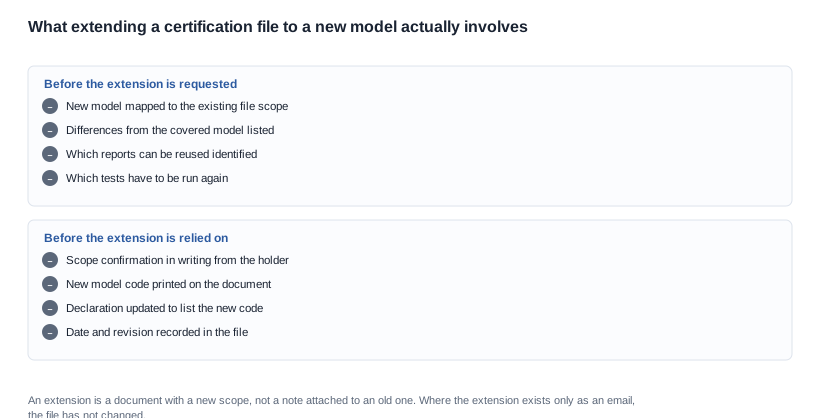
The checklist separates the two halves of the request. The first group is what the buyer has to establish before asking, because a request for an extension that does not say which differences matter cannot be priced. The second group is what has to be true before the extension can be relied on, and every line of it is a document the buyer should hold.
What can be reused and what cannot
The reuse question is technical and it is the one that determines the cost. A case option changes the cell that travels, the packaging, and in one case the form factor of the case itself — the MT6's 1200 mAh folding case is a different physical article from a fixed case, with a hinge and a different handling exposure. A colourway changes nothing that a test would normally measure. A lens option changes the optical path and does change what a test covering the optics would have to look at.
The published rows give a starting point for that analysis without giving a conclusion, and the conclusion has to come from whoever performed the original testing. That is the question to ask, and it is worth asking it early because a re-used report on a variant that actually needed retesting produces a file that is worse than one that was never extended — it looks complete and is not.
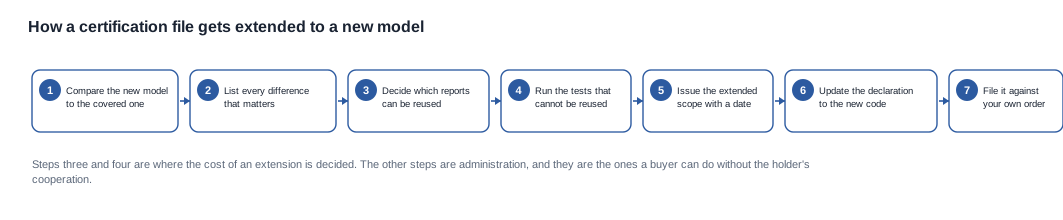
Steps three and four are where the cost of an extension is decided. The remaining steps are administration, and they are the ones a buyer can complete without the holder's cooperation.

Where the scope argument usually breaks
Three ways a scope breaks
The variant that appeared after the file was written. A colourway was added, a lens option was introduced, or a case option was added because the channel asked for it. The file was written for the original scope, and nobody revisited it because the change looked like a marketing decision. This is the most common break and the easiest to prevent, because the trigger is a decision the buyer usually knows about at the time.
The platform substitution. The product was rebuilt on a new platform or a new component generation, and the file was reissued for the new build with the same model code and the same scope language. The file looks untouched. The product underneath it is different, and the only way to know is to ask which revision of the product the assessment was performed against.
The extension that was only ever an email. Somebody at the supplier confirmed informally that the file covered the new variant, and nobody issued a revised document. This is the most dangerous of the three because the buyer's own file records the assurance, and the assurance has no custodian, no date and no revision. Where a scope question has been answered verbally, the answer has to be converted into a dated revision before the order, not after.
The chain from a variant change to a new file
The chain is worth tracing because it shows where the cost actually lands and which link a buyer can influence. A variant change alters a component, which alters the bill of materials, which may alter what the assessment was performed against, which requires a revised scope, which requires a revised document, which requires a revised declaration, which requires new artwork for the identifiers printed on the unit and the carton.
The links at the start of that chain are cheap and the links at the end are slow. A buyer who knows the chain can stop it early by asking the variant question at the moment the variant is proposed, rather than at the moment the artwork is submitted. The same chain also explains why a variant change late in a programme is disproportionately expensive: it is not the change that costs, it is the change with an artwork deadline behind it.
Running the scope check across two suppliers
The scope check is usually run against more than one supplier, and the comparison only works if the check is run identically for each. The temptation is to accept a broad answer from one supplier and a narrow answer from another and to compare the two as if they were the same kind of answer, which produces a comparison of disclosure rather than of coverage.
The discipline is to enumerate the variant axes for the models on the order first, and then to put the same written question to each supplier. The question is short, it is the same for both, and it is answerable with a list: for this model code, in this variant, with this case, in this colourway, is the model inside the scope of the file you hold, and which document is that?
A supplier who answers with the model list from the file has answered. A supplier who answers with a narrative has not, and the difference is worth pressing on, because a narrative answer usually contains a scope statement somewhere inside it that can be extracted. Where two suppliers both answer the question precisely, the comparison is then about the size of the scope each holds, which is a fact about the two programmes rather than about their compliance.
There is one asymmetry worth planning for. Scope that is broader than the buyer's current order is an asset, not a problem. A supplier whose file already covers three of the configurations the buyer might order next year has given the buyer something that reduces the cost of the next order. A buyer who only asks whether the current model is covered has not collected that, and the question is worth asking in a broader form for exactly that reason.
How far our own documentation reaches
The boundary of what we publish
Concretely, the published catalogue is the furthest our own documentation reaches publicly, and a buyer should hold us to it rather than to a general assurance. We publish the variant axes described above, because those axes are exactly what determines which configurations exist and therefore what a file has to be scoped against. We do not publish per-model certificate numbers or technical file contents, because the catalogue contains no per-model certification rows and we will not construct one by inference from a company-level export certification statement.
That leaves us with a specific and unusual position, which is worth stating plainly rather than apologising for. We can tell a buyer exactly what a scope has to cover, because the variant axes are published. We cannot tell a buyer whether a particular document covers a particular model, because we do not publish the documents. What we will do is name the variant axes for the models in question, so that the buyer can put a precise scope question to the supplier instead of a general one, and we will identify the rows where our own data is open — the charging method on four camera models, the Bluetooth version on the camera series, and the weight on twenty-seven of the 28 models — so that those rows are raised as questions rather than assumed.
The certification impact of customisation article covers what a change to the configuration does to a file, and OEM-ready platforms and certification coverage sets out how coverage is distributed across the platforms in this category. The general safety regulation reference covers the framework that applies to consumer-facing goods across the European Union.
The four inputs a compliance answer needs
Send the model codes, the option set, the destination market and the buyer, and we will tell you what our published rows settle about the scope, which axes are open on our side, and what has to be asked of the supplier in writing to close the file set.
- The starter version — certification checklist for buyers
- The checklist pillar — procurement certification checklist
Send the model codes and the option set, and we will tell you exactly which scope questions those models raise.


