

Smart glasses certification verification is an eight-step sequence, and the reason it works is that most of it is public information that a buyer can check without the supplier's involvement at all. The identifiers live in public registers, the conditions attached to them are printed on the records, and the model names are legible if somebody compares them carefully. The point of the sequence is that a buyer should never have to take a certification claim on trust, and the steps that genuinely require the supplier are the last two rather than the first two. Run in this order, the sequence closes most of the commercial risk before a deposit is committed, and every step has a completion test that does not depend on the supplier's goodwill.

Smart glasses certification checklist: why the verification sequence runs this way
The order is not chronological in the programme sense. It is ordered by how much of the answer the buyer can obtain alone. Steps one through six are closable with a purchase order, a public register and a spreadsheet. Step seven needs a document that the supplier holds. Step eight needs a determination that the buyer has to make.
That distribution matters more than it sounds, because the cost of a verification step rises steeply once the supplier is involved. A question the buyer can answer alone takes minutes. The same question sent as an email takes a day and produces an answer that has to be re-questioned when it is vague. A question that requires a decision takes a week and produces a scope. So the sequence front-loads everything that can be closed without asking anyone, and treats the supplier conversation as the last step rather than the first.
There is a second reason for the order, and it is about consequence. A model-scope mismatch found in step one is a line in a spreadsheet. The same mismatch found after artwork is approved is a reprint, a rebooking and a launch date that moves. The sequence is arranged so that the cheapest available check comes first and the most expensive one comes last, which is the opposite of how these programmes usually run in practice.
The two registers, and what each one can tell you
Two of the eight steps are searches in a public register, and they are different registers answering different questions, which is worth stating before the steps rather than inside them.
The equipment authorisation register is the market's own record. It shows the party that holds the authorisation, the product code it was granted for, the date it was granted, the exhibits and conditions attached to it, and the expiry. It is a public record because the market publishes it, and it is therefore the only part of the whole process where a buyer can verify without asking anyone for anything.
The qualification database is the industry's own record. It shows the listing for a product against a specification, and it answers a different question: whether the product as qualified matches what you are buying. The two records can disagree with each other, and they routinely do, because one is about market access and the other is about the radio protocol, and they are kept separately with different scopes.
The practical rule that comes out of this is that a supplier who gives you one identifier has not given you both. The radio authorisation and the qualification listing are two different instruments with two different identifiers, and a document set containing only one of them is incomplete rather than partial — it is missing an instrument that the other one does not replace. That is also why the logo on a datasheet is not a substitute for either of them: a logo is a mark of membership, not a record of scope.

The eight steps and their completion tests
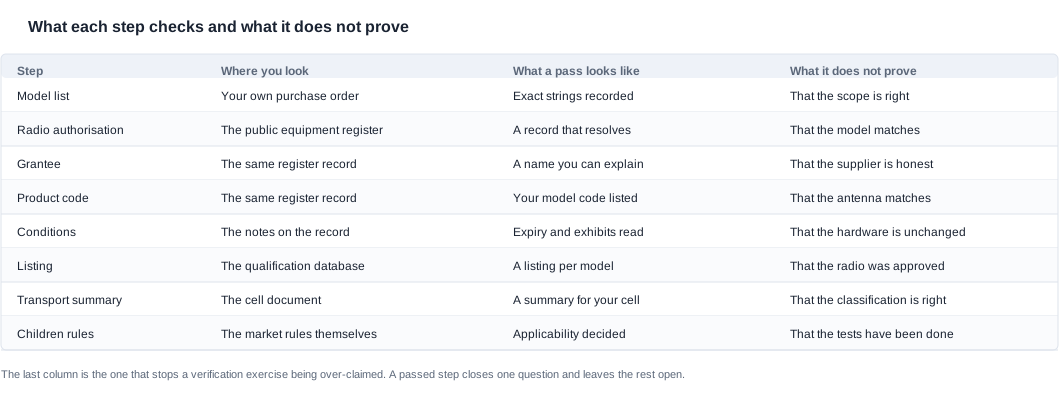
1. List the models. The exact designations on the purchase order, not the family, not the product page title. A certification covers a model, and the difference between a model and a family is where most of the trouble in this category lives. The completion test is a column of strings that can be compared character by character against anything else, which means a copy from the purchase order rather than a memory of it.
2. Find the radio authorisation. The identifier, searched for in the public equipment authorisation register. This is the step that removes the need for trust, and it takes two minutes. The completion test is a record that opens and shows a grantee and a product code, not a screenshot forwarded by somebody else.
3. Match the grantee. The name on the record against the entity you are contracting with. A mismatch is not necessarily a problem — a factory's own authorisation is a legitimate arrangement — but it is a fact you need, and it should be disclosed rather than discovered. The completion test is a sentence you could put in a contract describing who holds what.
4. Match the product code. The identifier against the exact model you are buying. A grant for one model does not cover a sibling with a different radio, a different antenna or different firmware that touches the radio. This is the step that catches a supplier offering an authorisation for a different product in the same family, and it is worth doing by hand rather than by eye, because the codes are similar by design.
5. Read the conditions. The date, the exhibit list and any notes attached to the record. Authorisations expire, and some carry conditions about the antenna, the enclosure or the end-use configuration. A record from several years ago may describe hardware that no longer exists. The completion test is that you can state the expiry date without opening a second document.
6. Find the qualification declaration. The identifier for the specific model in the qualification database. This is a separate instrument from the radio authorisation, and a product can hold one and not the other. The completion test is a listing that names your model, which is a stronger requirement than a listing that names the product family.
7. Check the battery document. The transport test summary, which has been a mandatory document since 2020-01-01. It is not a market-access document but it is a shipping document, and its absence stops a consignment. The completion test is a summary whose cell configuration matches what will be in the carton, including the case where one is shipped.
8. Check the children's rules. Whether the additional requirements for products intended for children apply to this product and this use. This is the last step and the one most often missed, because it only applies to some products — and missing it stops a launch rather than delaying it.
The three questions that only the supplier can answer
The sequence above answers most of it without the supplier. What is left is three things a buyer cannot find on a public register: which models are in the file set, whether the file set covers the specific configuration being quoted, and who signs the declaration in the destination market.
Those three are the ones to put in writing, and the answers to them are the ones that decide whether the order can be placed. The wording matters, because the difference between a usable answer and an unusable one is entirely in the precision of the question. "Which models do you have certificates for?" produces "our whole range". "Which model designations are printed on the declaration for this market, and which are listed on the radio authorisation for the same market?" produces an answer you can put in a spreadsheet.
- Which model designations are in the file set for this market? Ask for the list as printed on the documents, not as a description of the range. The completion test is that you can compare it character by character with the column from step one.
- Does the file set cover the specific configuration being quoted? The model, the cell configuration, the case, and the claims that will be printed. The completion test is that each of those four attributes has a row in the file, not only the model name.
- Who signs the declaration in the destination market? A named party with a role, and where the manufacturer sits outside the market, the economic operator who carries the obligation. The completion test is that the name appears on a document you hold rather than in an email.
The step that catches the most
If one step earns more attention than the others, it is step four, the product code match, and the reason is a property of this category rather than of the paperwork. Eleven of the twenty-eight designations in our range are camera models, and they share a family name, a tooling family and in several cases a case supplier with each other. A sibling in that group can differ in the radio module, in the antenna, or in the firmware that touches the radio, and any of those three differences puts it outside an authorisation granted for the model beside it.
The check is cheap and it is easy to do badly. The codes are similar, and a comparison done by eye will pass a pair that a character-by-character comparison would fail. The right method is to write the codes on two lines and compare them in the same order as the model designations — prefix, core, suffix — because the difference is almost always at one end rather than in the middle.
There is a second reason the step matters: it is the step that tells you whether the supplier's answer to step two is describing the same product you are quoting. A supplier who holds an authorisation for a sibling and presents it as covering your model has not made a mistake about paperwork; they have made a mistake about the product, and it is far cheaper to find that out before the order.
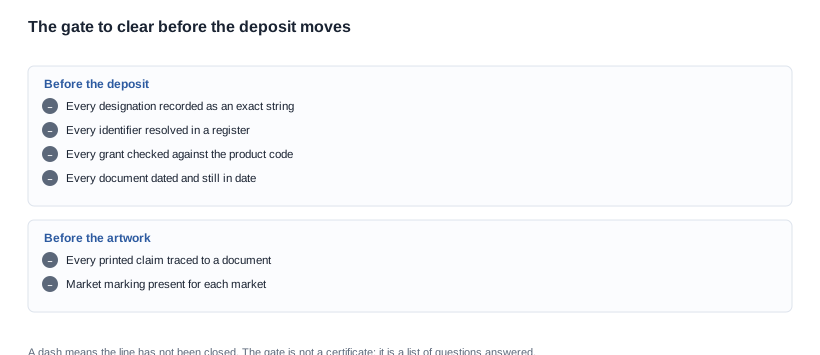

Routing a step that does not pass
A verification sequence is only useful if the failures are handled systematically, because a failed step left unresolved is how a buyer ends up with an order they cannot defend. There are three kinds of failure, and they have different owners and different remedies.
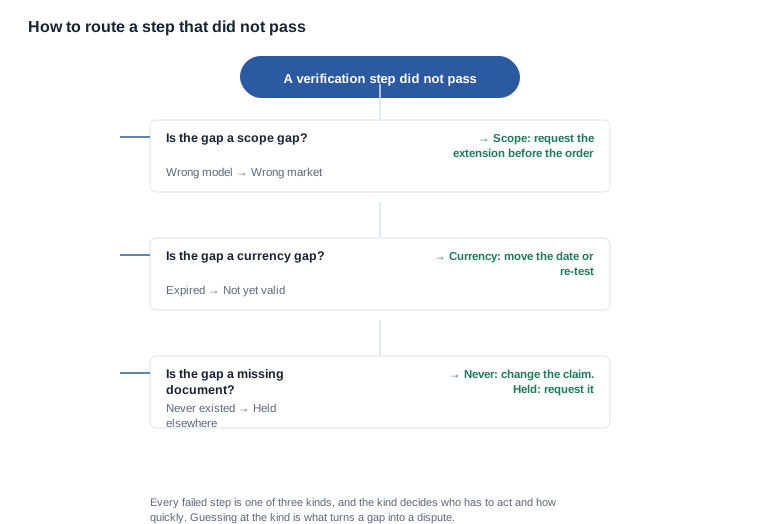
A scope gap is the most common. The authorisation exists but names a different model or a different market, or the declaration covers a model the buyer is not ordering. The remedy is an extension, requested in writing, and it is a normal commercial step rather than an exception. A currency gap is a document that has expired or is not yet valid. The remedy is either a re-test or a different launch date, and the decision is a scheduling one. A missing document is the hardest, because it splits into a document that exists and is held elsewhere — which is a request — and a document that was never produced for this configuration — which is a change of claim.
The reason to classify the failure before responding is that the three have completely different commercial shapes. A scope gap costs time and usually money. A currency gap costs schedule. A missing document may cost the claim itself, and the buyer has to decide whether the claim is worth re-testing, which is a question about the product rather than about the paperwork.
Scope gaps are the common case, and they are not failures
A scope gap resembles a failure from inside the verification sequence and is closer to a configuration task from outside it. The authorisation exists; it just does not cover the model and the market combination you are buying. Extending it is a normal commercial step — a family assessment that gains one model, a market that gains one product — and the only thing that makes it expensive is discovering it after the packaging is committed.
The instruction that keeps scope gaps cheap is to ask for the extension in the same request that identifies the gap. A buyer who asks "your record covers model X and I am buying model Y" gets an answer about model Y within a day, because the supplier has a defined scope and can extend it. A buyer who asks for "the certificate for our order" gets a document and a second round of questions. The difference is entirely in whether the request names the gap.
It is worth being explicit about the two scope questions separately, because they have different answers. A model scope gap is closed by adding a model to an existing assessment, which is usually quick and sometimes requires a re-test of the radio configuration. A market scope gap is closed by running the assessment for another market, which is slower, involves a separate holder and separate marking, and therefore has to enter the schedule rather than the inbox. Both are cheaper when found at step four than at stage five of the programme, which is the whole reason for the sequence.
What a passed sequence still leaves open
A completed eight-step sequence is a strong position and it is not a complete one, and the distinction is worth holding because a buyer who treats the sequence as a clearance will find the remaining risks later rather than earlier.
The sequence verifies the documents. It does not verify the product. A conforming sample and a non-conforming production run are entirely consistent with a perfect file, and the mechanism that catches the difference is a pre-shipment inspection against the sample, which is a different control and belongs in the purchase order. The sequence also does not verify the commercial claims. It verifies the radio, the safety and the electromagnetic behaviour; it says nothing about image quality, battery life in a customer's conditions, or unit weight — and in this range the only published unit weight is the MT6 glasses body at 158 g, including its 265 mAh battery and camera and excluding the 1200 mAh folding charging case, whose own weight is not published.
It also does not verify the future. A record describes hardware as it was on the assessment date, and in a range where eleven camera models share a product family, the question of what changed afterwards is answered by change control rather than by the register. The certification advanced guide takes that question further, and the coverage question sits in oem ready platforms certification coverage.
The verification record is worth more than the verification
The sequence produces a second output that is easy to overlook: a record. Every step leaves a line — the designation checked, the identifier resolved, the product code matched, the expiry noted, the date of the check — and that set of lines is more valuable than the pass or fail it produced, because it is the only thing that makes the next check cheap.
A buyer who has the record can re-run the sequence in an afternoon at the reorder, comparing the new state against the old one and asking only about the lines that changed. A buyer who has only a conclusion has nothing to compare, because "it was verified" is not a state that can be diffed. That difference is the difference between a compliance programme that costs a day a year and one that costs a month a year.
The record also travels. It is what a new buyer inherits when the person who ran the programme leaves, and it is what an auditor, a retailer or a market authority can be shown without reconstructing the sequence from email. And it is the document that turns a re-order from a re-verification into a confirmation, which is where most of the recurring cost in this category actually sits.
That last point is the one most programmes miss. The first verification is expensive because it establishes what is true. The second is expensive because it re-establishes it from scratch. The difference between those two costs is the whole of the verification record, and it is also the difference between a supplier relationship that gets calmer over time and one that gets more tense.
Pending Until the Company Confirms It
The working rule we apply: we publish what our catalogue states and the gaps in it with equal clarity, and we will not print a number we cannot quote. Concretely: the export-certification page in our catalogue carries ten patent certificates — eight appearance-design patents and two utility-model patents — and its content is images rather than text, the catalogue names no CE, FCC or RoHS marking, there is no per-model certification row anywhere, and we publish no model-specific certificate number and no conformity mark for any model. We publish no numbers on this page. The export certification page at the catalogue front page is a company-level page and it holds images rather than text, and we do not infer a per-model certification from it — which in particular means we do not claim a children's certification for the A05, the A06 or the A07, and we publish no ingress test report number behind the IP54 marking on the V06 and the S7.
What we can do is take a supplier's documentation set and mark each document as verified against a public record, consistent with our own published claims, or open. The wider context is under the certification verification checklist, and the documents themselves are listed in what documents to request.
Two limits on that offer are worth stating. First, the marking is only as good as the record it is matched against, so a supplier's identifier that does not resolve is marked open rather than resolved. Second, the sequence does not tell the buyer whether the product behind the documents is the product in the carton; that is a pre-shipment inspection question, and it is the one part of the process that has to happen in the factory rather than at a desk.
Send us a supplier's identifiers and we will tell you which of the eight steps they close and which of them they leave open.


