

Here is the thing that catches people: an ingress protection rating is not a certification. There is no authority that issues an IP rating, no certificate to obtain and no regulator to apply to. A rating is a laboratory result, and the requirements around it are about the evidence, the production process and the claim, not about a piece of paper. A buyer who expects a certificate will be disappointed, and a buyer who expects nothing will be exposed, so this article sets out what actually has to be true for an ingress claim to hold up.
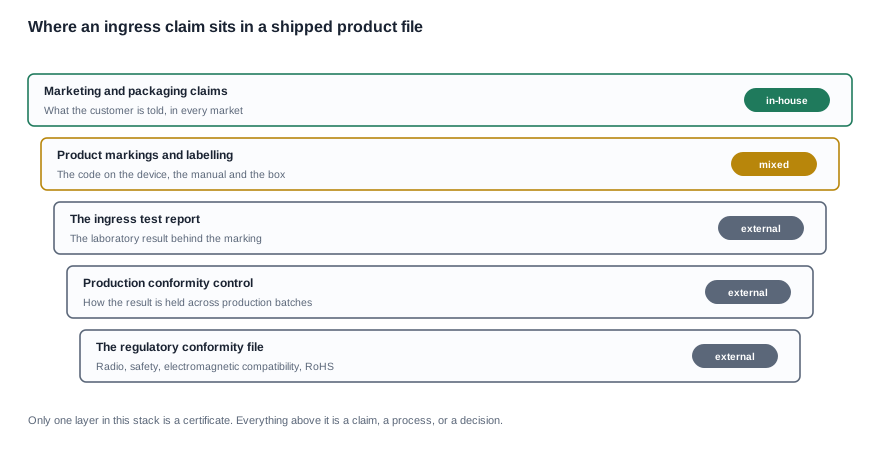
What a buyer who expects a certificate will miss
The rating comes from a test procedure, and the test procedure is public. It is the IEC 60529 standard for degrees of protection provided by enclosures, and it defines a dust test and a series of water tests. A laboratory applies it and issues a report. The report is the evidence, and it is what a buyer asks for.
What the rating is not is an approval. It does not appear on the EU declaration of conformity, because it is not a legislative requirement. It is a manufacturer's statement about its own product, supported by a report, and a buyer is free to rely on it or to ask for the report.
That distinction has a practical consequence that catches procurement teams out: the claims made around an ingress rating are the manufacturer's responsibility and, once they appear on your listing, the buyer's responsibility. If the claim is wrong, no authority caught it, because no authority was involved. The customer's recourse is the ordinary commercial one, which means the complaint comes to you rather than to a regulator. There is no regulator to defer to, which is exactly why the evidence has to be assembled before the artwork rather than after the dispute.
A second thing a certificate-minded buyer misses is the production side. A certificate, once issued, is a fact about a document. A test result is a fact about a sample, and it stays a fact about that sample until somebody establishes a production control that carries it forward. The obligations below are mostly about that transition.
IP rating: the seven obligations behind an ingress claim
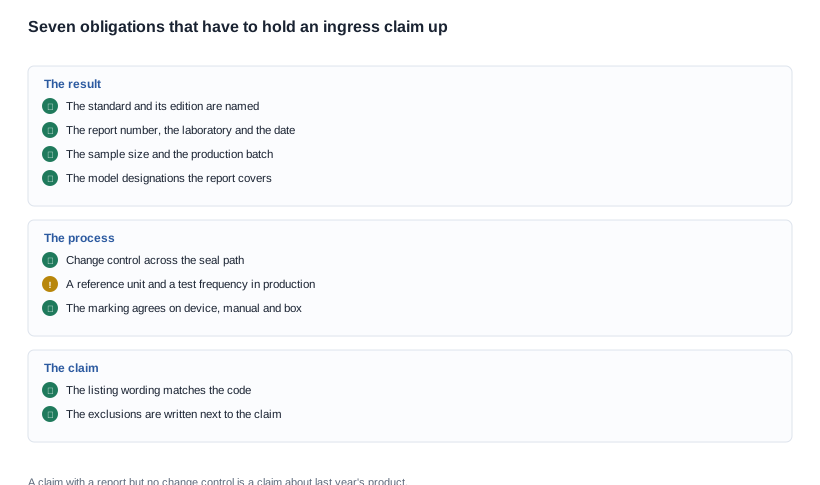
The rated configuration. Which product the result describes. This is the obligation that catches people, and it exists because a rating is attached to a specific assembly: a model code, a battery, a case, a firmware build. A product with a different case is a different assembly, and a rating measured on one does not describe the other.
The standard and the edition. The test method and the edition it was written in, because editions differ in detail. A rating with no edition named is a rating with a loose fit, and a loose fit is what a competitor's argument is made of.
The report. The evidence itself: the report number, the laboratory and its accreditation status, the date, and the sample size. A report that names an accredited laboratory and a date is what a retailer's technical team will accept, because those two elements are the ones they can check.
The production control. A rating measured on a sample describes the sample. Holding it across production needs a reference unit, a stated test frequency, and a process that compares each unit or each sample against that reference. Without it, the rating is a historical fact rather than a current property, and the difference shows up as an inconsistency between batches rather than as a failure.
The change control. The rule that says which changes trigger a re-assessment. A change of housing material, a change of case, a change of supplier for a component in the seal path, or a change of the production site are all changes that can move the result. The rule should be written, and it should name who approves a change that does not trigger one — because in the absence of a named approver, the change is approved by whoever happens to be making it.
The marking on the product. The physical evidence: the code on the device, in the documentation and on the packaging, and the three agreeing with each other. Inconsistent marking is more common than it should be, and it is the kind of thing a retailer's label check finds.
The claim in the listing. What the customer is told. The wording has to match the code, and it has to survive a customer who puts the product in a swimming pool. A listing that says waterproof next to an IP54 code has made a claim the report does not support, and the customer who acts on it is right to complain.
Who owns each obligation
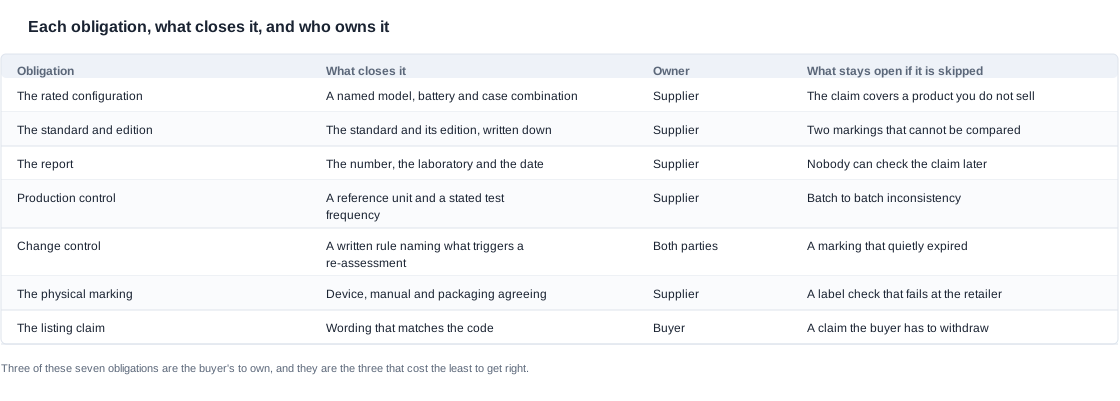
The seven obligations above are not evenly distributed, and that distribution decides how a programme is staffed. Four of them sit with the supplier, because they depend on documents and processes inside the factory: the rated configuration, the standard and edition, the report, and the production control. Two sit with the supplier but require a contract to make them stick: the change control and the physical marking, because both are ongoing commitments rather than one-time deliveries. And one sits entirely with the buyer — the claim in the listing.
That last one is the reason this article exists for a B2B audience. A buyer who delegates the whole conversation about ingress to the factory is delegating the only part of it that is theirs. The factory can supply a marking, a report and a change control rule. The buyer alone decides what the sentence on the product page says, and that sentence is the one a customer will test.
Turning the seven obligations into purchase order clauses
Obligations that are not written down are intentions, and the seven above are no different. The mapping from obligation to clause is mechanical, and it is worth doing before the purchase order is drafted rather than after the artwork is approved, because a clause added late is a clause a supplier will negotiate hard.
- The rated configuration becomes an attachment listing the model designation, the battery, the case and the interfaces as they will ship. The clause says the marking applies only to that configuration.
- The standard and the edition are named in the same attachment, so that a future reader does not have to reconstruct which procedure produced the marking.
- The report is supplied with the report number, the issuer, the laboratory, the accreditation status and the date. If no number can be supplied, that fact is written into the file rather than left as a silence.
- The production control becomes a stated reference unit and a stated test frequency, with the sample size that the production check uses. A frequency without a reference unit is not a control, so both appear or neither does.
- The change control becomes a notification obligation with named triggers — seal, port, contact, interface, housing material, case and production site — and a named approver for a change that does not trigger a re-assessment.
- The marking on the product becomes a packaging approval step, with the artwork proof checked against the marking that appears on the device.
- The claim in the listing becomes an agreed wording attached to the order, so that the artwork and the listing are working from the same sentence rather than from two different readings of the same code.
The commercial consequence of this mapping is worth stating, because it is what makes the work worthwhile. Three of the seven clauses cost nothing to obtain, one of them is a document that already exists somewhere in the factory, and one of them — the agreed claim wording — is the only one that changes what the buyer publishes. The remaining two, the production control and the change control, are the ones that determine whether the marking is still true in year three.

The conformity file the claim has to sit inside
The ingress rating is one element of a product file, and the elements around it are regulatory while the rating is not. For a product placed on the European market, the Radio Equipment Directive 2014/53/EU covers the radio, the safety and the electromagnetic compatibility, and the cybersecurity requirements of that directive became a mandatory part of CE marking on 1 August 2025, described by the EN 18031 series of harmonised standards. The General Product Safety Regulation, which has applied since 13 December 2024, adds the product safety file, the traceability and the identification of the responsible party, and it is a separate obligation rather than part of the CE assessment. Where a product contains a lithium cell, the transport documentation is needed before it can move at all.
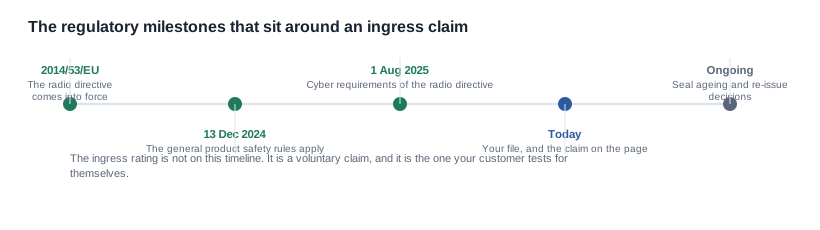
An ingress rating is a claim about a property, sitting alongside all of that, and it is the one that a customer is most likely to test for themselves. That is worth stating plainly to a procurement team, because it inverts the usual priority. The regulatory elements have a defined authority, a defined procedure and a defined remedy. The ingress claim has none of the three — it has a laboratory, a document and a customer.
There is also a transport dimension that sits oddly with an ingress claim, and the relationship is not intuitive. A lithium cell inside a product that is claimed to be splash-protected may be described in the transport documentation as protected from damage by a sealed enclosure, and the two statements are not the same statement. Transport documentation is written for handling and shipping conditions; an ingress rating is written for a use condition. Neither should be quoted as evidence for the other, and a buyer who does so will find that the cell documentation and the product claim disagree in front of a customer.
The regulatory milestones around it
The milestones matter to a procurement team in one specific way: they set the dates on which a file has to be re-examined, whether or not the product itself has changed. A new edition of a harmonised standard, a new application date for a regulation, or a change in the transport requirements for a cell all create work that is triggered by the calendar rather than by the product. A file with no review date is a file that will be wrong at the worst possible moment, and a buyer who knows the dates can schedule the review into the normal planning cycle instead of discovering it during a listing review.
The document set for a shipped product is set out in our certification checklist, and the codes and what each one permits are covered under IP ratings.

Questions that reveal whether a supplier understands the distinction
The questions below are worth asking in writing, because the answers separate a supplier who manages compliance from one who relays a component sheet. Ask them as a list with a response date.
- Is the rating tested on the exact configuration I am buying? Which battery, which case, which model code, which hardware revision.
- Can I see the report, with the standard, the edition, the laboratory, the accreditation status and the date?
- How is the rating held in production, and at what frequency is it checked against the reference unit?
- What change triggers a re-assessment, and who approves a change that does not trigger one?
- Is the code on the device, in the documentation and on the packaging, and do the three agree?
- What does the listing actually claim, and is the wording supported by the code?
Two of the six carry most of the information. Question three is the one that tells you whether the rating is a maintained property or a historical one, and most suppliers have never been asked it, which is why the answer is often a pause. Question four tells you whether the supplier has a change control process at all, and the answer usually arrives with a list of changes that were made without one, which is more useful than a list of changes that were not.
A supplier who answers all six has a documentation habit, and that habit is worth more than any single document they send. A supplier who answers two has told you something you need before the deposit.

A hypothetical European launch with an unevidenced marking
This is a worked case rather than a customer case. It is included so order shows.
Assume a brand launching a camera model into three European markets with a fixed listing date. The product has a charging case, a lithium cell and a radio, so the regulatory file is substantial and mostly complete. The catalogue entry for the model carries an IP54 annotation with no report number behind it, and the brand's compliance reviewer has asked the obvious question: what happens if a customer in a consumer market disputes the claim.
Step one, the file is mapped. The brand separates the file into what is regulatory and what is voluntary. The radio, the safety, the electromagnetic compatibility and the RoHS material declarations are regulatory, and they are handled through the normal conformity process. The ingress marking is voluntary, which means nobody in the chain will validate it for the brand. The brand therefore assigns it explicitly rather than letting it sit in the specification sheet where nobody owns it.
Step two, the evidence request goes out. It asks for the report number, the standard and edition, the tested configuration, the production control and the change control. The supplier returns a description of the sealing and an undertaking to obtain the report, but no number, and the brand's reviewer makes the decision that the marking is currently unevidenced.
Step three, the claim is rewritten rather than dropped. The brand keeps the code on the packaging because the code is on the product and the product is what it is, and it publishes the wording that the code supports — protection against splashing water from any direction — with the exclusion printed beside it. It does not publish "waterproof", it does not publish a beach or swimming claim, and it makes sure the manual and the support script say the same thing. The charging case is named separately as a part that does not carry a marking.
Step four, the schedule is written around the open item. The brand asks for the document set that would close the file, and it records the review date in its own file alongside the other regulatory review dates, so that the request is repeated on a calendar rather than depending on somebody remembering.
Step five, the contractual position is set. The change notification clause goes into the purchase order, so that a future change of seal, port, contact or interface is a notified event rather than a surprise, and the agreed claim wording is attached to the order so that the artwork cannot outrun it.
The result is a launch in which the voluntary claim is narrower than the factory's catalogue annotation, the regulatory file is unaffected, and the one open item is visible, dated and owned. The decisive step was the separation of voluntary from regulatory, because it moved the ingress claim out of the file where it would have been assumed to be covered and into the file where it had to be earned.
What our own documentation publishes, and why the absence is published too
The short answer: we will publish an ingress marking exactly as the catalogue states it and will not present it as a tested specification when it is not one. In our catalogue the IP54 marking appears on the V06 and the S7, as an annotation, with no third-party test report number, no standard, no test condition, no sample size and no laboratory behind it, because the company has not confirmed those. No other model among the twenty-eight catalogue entries carries a published ingress rating, and the Bluetooth audio family carries none at all.
We are telling you this in an article about certification requirements, because our own position is the clearest example of the distinction: we publish a marking, we do not publish a certificate, and there is no certificate to obtain. The same is true of the CE, FCC and RoHS claims across our range — the claims are recorded as made, and the certificate numbers behind them are not published here.
Publishing the absence is not a disclosure of weakness. It is the only position from which a buyer can make a defensible decision, because the alternative is a marking with an implied document behind it, and a buyer who discovers later that the implied document does not exist has been told something the catalogue never said.
What we will do for a specific model
We will take a specific model and tell you exactly what we can evidence for it. We will say clearly what would have to come from the testing programme before the claim could be described as tested — the document set, the configuration the sample has to be, and the decision points in the schedule — and we will say which parts of the current file are regulatory and which are a voluntary claim that the buyer owns.
The codes and what each one permits are set out under IP ratings, the evidence behind a marking is covered in reading an ingress datasheet, the process that keeps a rating true is described under quality control and ingress, and the document set for a shipped product is in the certification checklist.
Tell us the model and the claim, and we will say what we can evidence and what is still open.


