

IP rating: need by exposure, not by channel
You need an IP rating when the product is sold into an environment where water and dust are normal, and you need it in a form you can publish — a rating with a third-party test report behind it. A rating without a report is not a rating you can publish, and in our own documentation the IP54 marking on the V06 and the S7 is exactly that: a catalogue marking with no third-party test report number published behind it. So the answer for a buyer is conditional and has two parts. If the use case is dry, indoor or office-based, an ingress rating is a cost with no commercial return and you should spend the money elsewhere. If the use case involves rain, sweat, dust or handling, then the rating is not optional — but the first thing to establish is whether the marking you have can legally and truthfully be published, because a retailer, a reviewer or a customer who asks for the report will be told there is not one, and that is a worse position than having said nothing.
The buying task behind this article. The reader is a brand buyer, a product manager or a channel buyer deciding whether a protection rating belongs in the specification of a product they are about to place an order for. The specific problem is that the rating is one of the few figures in this category that buyers treat as self-evident, and it is the one where the interpretation gap does the most commercial damage: a customer who reads "IP54" as "rainproof" will be disappointed by rain, and the complaint arrives as a defect rather than as a misunderstanding. The buyer's task is to decide whether the protection claim is part of the product's commercial proposition, and if it is, to make sure the claim underneath it can be defended.
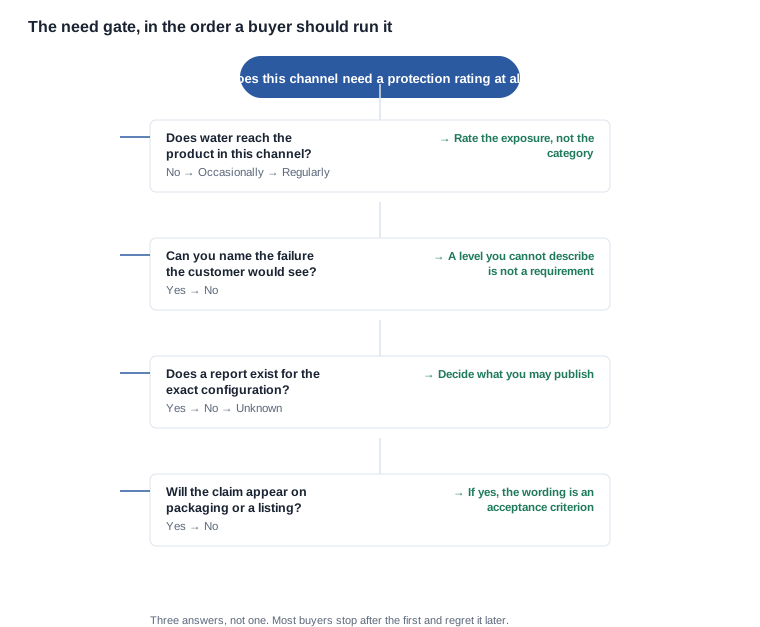
The decision starts with where the product goes. The environment, not the parameter table, is what makes a rating worth paying for.
| Where the product is sold | Is a rating commercially necessary | What to specify instead |
|---|---|---|
| Office, retail counter, home | No | Battery, runtime, charging interface and fit |
| Calls in a warehouse or a site | Yes, and the report matters | The rating, with the test report number and the issuing body |
| Outdoor sport in variable weather | Yes, and the interpretation matters | The rating, the second digit's meaning, and what the listing may say |
| Swimming, pool, shower, sea | A consumer IP rating is not enough | Keep the product out of these environments, or scope a different certification |
| Children, schools, clinics | Often a customer requirement | The rating with a report, plus the target market's own requirements |
The second question: can you publish what you have? There are three positions a buyer can take, and only the first is defensible without a report.
- You can state the marking as a marking. "IP54" as a catalogue attribute, describing what it refers to, is a factual statement.
- You cannot state it as a tested result. "IP54 waterproof", "IP54 tested", "sweatproof and rainproof" all assert something the documentation does not support.
- And the interpretation matters as much as the number. A customer who reads "IP54" as "rainproof" will be disappointed by rain, and the complaint arrives as a defect rather than as a misunderstanding.
The third question: what does the rating cost, and what does it buy? Near water, in a pool, in a shower, in the sea, no consumer rating in the IP system is enough. IP54 covers splashing water; IP67 and IPX7 cover immersion. And even an IP67 rating is a laboratory result rather than a swimming recommendation, because immersion time, water chemistry and the condition of the seals all vary. The specific traps in the standard are set out in our IP rating guidance, and the standard in full is there as well.
What the second digit actually covers for the sport family. IP54's second digit refers to protection against splashing water — not immersion, not sustained rain. The first digit, a 5, is a dust protection level rather than a full dust-tight seal. The models carrying the marking are at sport smart glasses, and the difference between the two sport camera models is at the V06 against the S7. The category questions buyers ask about the sport family are collected at sport family questions.

Three positions a buyer can take when the document is thin
Most suppliers in this category publish a marking without a resolvable document behind it, and a buyer who is handed one of those markings has three defensible positions. Choosing between them is a decision about what you are willing to publish, and it should be made before the artwork rather than after it.
Position one: publish the marking as an attribute, and nothing more. The listing says the model carries IP54. The listing does not say the model is tested to IP54, does not say waterproof, and does not say rain-ready. This position costs nothing, requires no document, and is entirely honest. Its weakness is that it is less persuasive than a competitor's listing that says something stronger, and a buyer in this position sometimes loses the comparison on the page while being right on the substance.
Position two: commission the document. You ask for the report number, the standard and edition, the tested configuration and the sample identity, and you hold the report before you write the copy. This is the strongest position and the most expensive in schedule, because the laboratory queue is not compressible. Its weakness is that it is a cost you may have committed to a product whose channel never exercises the exposure in the first place.
Position three: publish a narrower claim without a rating at all. You describe the protection in your own words, in plain language, tied to the use case rather than to a code. This is a legitimate commercial position, and it is often the right one for a channel where the product is used carefully. Its weakness is that it is difficult to defend in a technical review, because a reviewer's first question is "what is it tested to" and the honest answer is "nothing in particular".
Which of the three is right depends on a single variable: what the channel will do with the claim. If the channel's buyers are technical — a facilities contractor, a reseller's engineering team, a marketplace with a technical review queue — position two is the only one that survives. If the channel's buyers are consumers reading a listing, position one or three usually performs as well and costs less.
The question to ask a supplier when you are in this position. Not "do you have an IP rating", which every supplier answers yes to, but the four questions to ask are: what is the report number, which standard and edition was it made to, which configuration was tested, and what was on the sample. A supplier who answers all four has a document. A supplier who answers two has a catalogue.
The need gate: which channels never reach a rating requirement
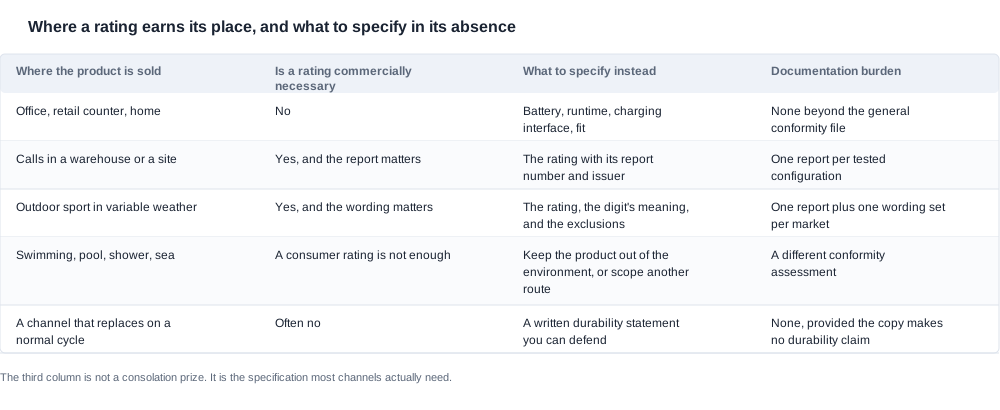
The need gate is short, and it exists because a rating specification has a lead time that does not compress. Running the gate late means the artwork waits for the laboratory.
Step one: does water reach the product at all in this channel? Dry retail, an office desk, a home, a classroom — the answer is no, and the gate stops here. You have saved the entire cost and the entire schedule.
Step two: if water does reach it, what kind of water? Splash from a direction, a jet from a nozzle, a sustained soak, or a chemical. These map to different levels and to different conformity routes. "It gets wet" is not an answer a supplier can scope.
Step three: can you name the failure the customer would see? Not the mechanism — the outcome. "Water inside the unit and the camera stops working" is a failure a customer can describe and a returns team can code. "Water ingress" is a mechanism, and it is the kind of description that produces a support ticket rather than a classified failure.
Step four: what is the documentation status of the marking you already hold? If there is a report number and a configuration, you have a specification. If there is a marking and nothing else, you have a label and a choice between the three positions above.
Step five: what will the listing say? This is where the gate either closes or opens. A product going into a channel where the marking appears on the box needs a level that the channel's technical reviewer will accept, and a product going into a channel where the marking appears nowhere can proceed with any position you can defend.
The gate also has a second gate inside it: the case. A charging case is a separate object with its own electronics, contacts, lid and opening. If a case is in the box, decide whether it carries a claim at all. Deciding is what matters — drifting is what costs you, because the case inherits the frame's claim by default in the customer's mind even when it does not in the documentation.
Why the gate runs first, in schedule terms. The exposure takes an afternoon to write down. The level, the scope and the laboratory slot take a season. The claim wording, the artwork and the packaging wait at the end of that chain, so a gate decision made after the artwork has been approved costs a reprint rather than a decision. A buyer who runs the gate in week one can tell the designer what to leave space for; a buyer who runs it in week twelve can only tell them what to change.
What the gate is not. It is not a technical test, and it is not a way of avoiding the question. A buyer who runs the gate and reaches "yes, a rating is required" has a specification requirement with a lead time attached. A buyer who runs the gate and reaches "no rating required" has saved a cost and a quarter of the programme. Both are outcomes; the gate is the thing that distinguishes a decision from a habit.

What the requirement must contain once the answer is yes
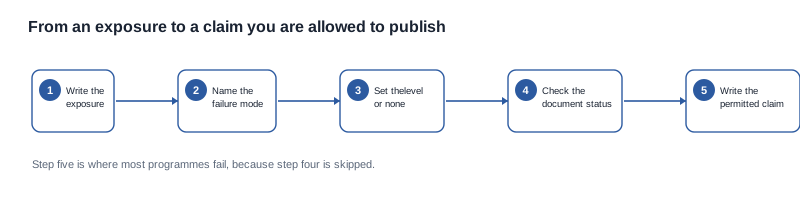
Once the gate opens, the requirement has to be written precisely enough that a supplier can quote against it and that a technical reviewer can approve it. Five parts, and each one is a question to ask rather than a phrase to hope for.
The exposure. In the terms the supplier's engineers will recognise, per channel. "Rain and sweat on the temples during a two-hour ride, and a dusty bag" is a scoping input. "Sport-grade" is not.
The level, with its digit read out. "Second digit 4 — protection against splashing water from any direction under defined volume, pressure and duration; first digit 5 — limited dust ingress permitted, not dust tight." A requirement written as "IP54" alone will be met by a marking on a catalogue rather than by a tested configuration.
The four report items as acceptance criteria. Report number with the issuing body and validity dates. The standard and the edition. The configuration actually tested, given by its connector layout, its contact set and the interfaces it exposes. The sample identity — batch, build and unit count. These become conditions of the purchase order, not requests in an email.
The parts that were tested. The product as sold, or the electronics bare. This is the single most useful question in the qualification, because it changes the answer considerably and because the answer is often not what the buyer assumed.
The claim, in words, with its exclusions. The sentence that will appear on the packaging and the listing, the sentence that will appear in the technical file, and the explicit statement of what the rating does not cover. Three documents, one wording, agreed before the artwork.
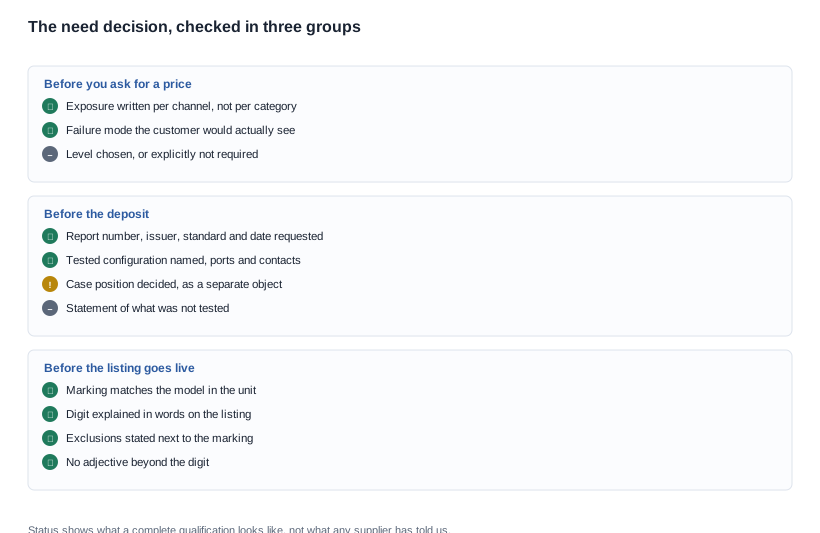
Documents to request before a deposit. The IP test report with the number, the issuing body, the standard and the date, or an explicit written statement that no report exists. The model designation table, the certificate register, the packaging artwork proof with the marking shown as it will appear, the agreed incoming inspection criteria, and the battery transport documentation at battery transport. Nothing here is proprietary: the wording behind these terms is at contract terms, and the commercial make-up of a first order at pricing.
The checklist to run against a sample. Compare the ports, contacts and interfaces on the unit against the tested configuration on the report. Look at the seal area and the charging contacts for the ingress paths that actually matter in a wearable. Confirm the unit is the production configuration, using the procedure at sample evaluation. Confirm the model designation on the unit against the paperwork, checking the certificate register in the same way as every other claim at certification checklist.

A dry-goods channel, a rain channel and a poolside channel, side by side
Read the scenario that follows as an illustration of the gate, not as a report. We have not carried out this programme and no customer is named; what it sets out is the sequence a buyer applies when the question is whether to specify a rating at all.
Take one brand with three channels running on a single hardware platform: a retail counter in a department store, a cycling line sold through a marketplace, and a coastal hotel group that supplies rooms and asks whether the glasses can be used at the pool.
Channel one, the retail counter. The exposure is handling, pocket abrasion and an occasional splash from a coffee cup. The gate stops at step one. There is no ingress rating, and the specification is battery, runtime, charging interface and warranty response. The brand saves the entire qualification cost, and the listing makes no durability claim at all.
Channel two, the cycling line. The exposure is sweat on the temples, road spray and rain during a two-hour ride. The gate opens at step two, and the exposure maps to the second digit of IP54 rather than to anything higher. The brand takes the sport platform that already carries the marking, and it asks for the four report items. The answer is that the marking is a catalogue annotation with no report number published, which puts the brand in position one or three, and it chooses position one: the listing states the marking as an attribute and explains the digit in words, with the exclusions printed next to it.
Channel three, the coastal hotel group. The exposure is salt water, sand and a customer who will absolutely put the glasses in the pool. The gate reaches step two and the answer is that no consumer ingress rating covers this use. The brand's procurement team is asked to decide between keeping the product out of the water with an explicit care instruction, and scoping a different conformity route. The hotel group, whose own technical buyer asks for documents, takes the first option, because the second one is a programme the brand cannot complete inside the season.
What the three channels produce. One platform, three specification lines, two of which have no ingress rating at all. The commercial result is that the brand bought a rating once, for the channel that needed it, and did not buy two more ratings it would never have used.
The mistake this scenario is designed to prevent. A single rating applied to the whole range because it was easier. The exposure differs by channel, and so does the requirement, and the moment one rating is applied to everything you have either overpaid for two channels or under-covered the third.
The limits of what we can tell you about whether you need one
We list IP54 as a feature of the V06 and the S7 and record plainly that no third-party test report number is published behind it. We will not state that any product in our range is tested to IP54, because no test report is published for it. We will not extend those markings to the camera or audio families that do not carry one, where no rating is published at all. And we will not present a marking as covering immersion, sustained rain or a specific durability class, because the standard does not.
What we cannot tell you, and why it matters that we say so. We cannot tell you what a rating would cost to obtain on a model that does not carry one, because the answer depends on the engineering change, the configuration count and the laboratory, and a number without those three is not a price. We cannot tell you whether a model would pass at a level it has not been tested to, because that is a prediction about a seal and a fixture. And we cannot tell you how our models age, because we publish no ageing data and will not estimate a service life for something we have not measured.
For a buyer, this means the marking in our documentation is a screen and a starting point for a conversation with the factory — and the question to ask is not "does it have an IP rating" but "is there a report number I can put on a product page, and what does its second digit actually permit me to write".
Related reading
- The standard, the digits and the traps — IP rating guidance
- The models that carry the marking — sport smart glasses
- The difference between the two sport camera models — the V06 against the S7
- The questions buyers ask about the family — sport family questions
Tell us where the product is sold and what it has to survive, and we will say whether a rating is commercially necessary and what we can publish today.


