

Which ingress rating a use case needs is a question with a narrow published answer, and the narrowness is itself the useful part. IP rating smart glasses for different use cases is decided by the exposure the product will actually meet, not by a tier list — and in our range the answer for most channels is that no ingress rating is needed at all, which is a legitimate and cheaper position than buying a marking nobody puts to use.
Our range carries an ingress marking on two models, the marking is IP54, and it appears in the catalogue without a third-party test report number behind it. Every other model in the range has no ingress marking at all, and no charging case in the range has one either.
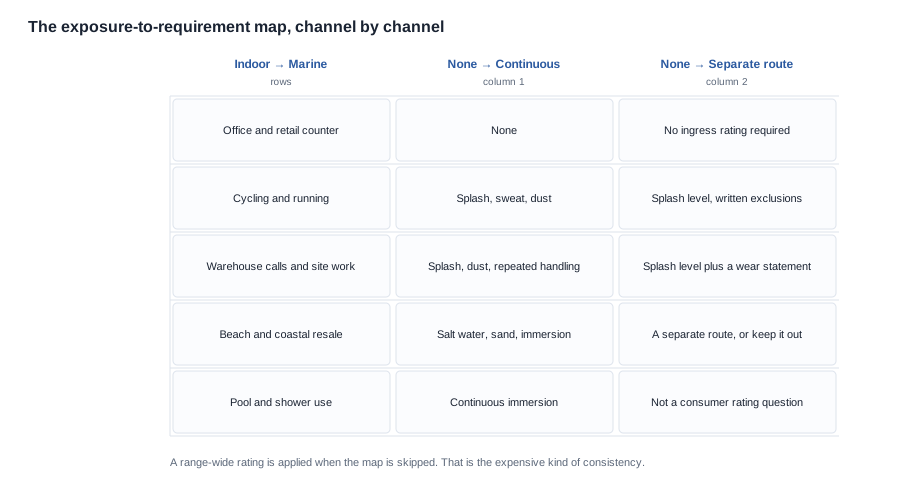
IP rating: the exposure-to-requirement map, channel by channel
The short answer, for a buyer who is short of time
IP rating smart glasses for different use cases is answered by writing the exposure, not the rating. "Spraying water at a car wash" and "rain on a cycle" are exposures a supplier can respond to; "IP67" is a conclusion you have already reached, and it narrows the answers you get back. For most indoor, office, retail and classroom channels the honest answer is that no ingress rating is required, and that is the cheapest and least risky position available.
What is already on the desk when the mapping starts
A buyer working through this is usually qualifying a product for a channel, or building a range and deciding where the ingress budget goes, and holds a channel plan, a target price, a competitive set and a set of samples. What they will not hold is the mapping from exposure to requirement, because the mapping is not published and has to be reasoned out.
The reasoning is not hard, and it is worth doing before the quotation rather than after it. An exposure has a severity and a duration, and the requirement follows from the two together. A channel that produces occasional splash has a low requirement; a channel that produces sustained water has a high one; and a channel that produces neither has no requirement at all.
The three ways the mapping goes wrong
Paying for a marking the channel never puts to use. A rating for a channel that produces no water is a cost with no customer-visible return, and it adds a per-variant, per-market documentation obligation that somebody has to keep up for as long as the SKU ships.
A claim the marketing makes and the marking cannot support. If your marketing material says waterproof, it is making a claim that IP54 does not support, whether or not the marking is in the catalogue.
A rating on the frame that is read as a rating on the case and the lens. A charging case is a separate object with its own electronics, contacts and opening, and a rating on the frame does not cover them.
A per-channel specification that quietly becomes a range-wide specification. The exposure differs by channel, and so does the requirement, and the moment a single rating is applied to everything you have either overpaid or under-covered.
Reading the map
Each row of that map is a channel and each column is a dimension of the decision. Three things are worth noticing about its shape.
First, the top row is empty on both sides, and that is the most commercially valuable row in the table. A channel that produces no water needs no ingress rating, and the correct answer for it is a specification that spends the budget on the things the customer actually notices — battery, runtime, the charging interface, and a warranty with a stated response time.
Second, the bottom two rows do not resolve into a level at all. Continuous immersion and sustained salt water sit outside the scope the consumer ingress system is meant to cover, and the honest response to a channel that demands them is either a different conformity route or a decision to keep the product out of that environment. A catalogue that quietly declines to answer those two rows is more useful to a buyer than one that answers them with a number.
Third, the middle row is the one most brands actually face, and it is also the one where the language on the packaging does most of the commercial work. A splash exposure is covered by the second digit of IP54, but only a customer who has been told what that digit permits will read the box correctly.

Why one rating across a range is the most expensive kind of consistency
There is a kind of consistency in sourcing that reads like discipline and behaves like waste, and it is the practice of applying one ingress rating to every SKU in a range because it was easier to administer than to reason about.
Why it happens. A rating is a single cell in a specification sheet, and a specification sheet that says the same thing in every row is a sheet that can be produced quickly, reviewed once and reused across a catalogue. The cost of the practice is invisible at the point of adoption and visible two quarters later, when the question "does this channel need this?" has no answer.
What it actually costs. Three charges, none of which appears on the invoice. The first is the qualification cost of a level the low-exposure channels will never put to use. The second is the ongoing documentation burden, because a rating on a SKU is a per-SKU, per-market obligation that someone has to keep up for as long as the SKU ships. The third, and the largest, is the under-coverage risk: the channel that genuinely needed a higher level has been quietly given the same lower level as everyone else, and the failure will surface in returns rather than in a review.
The counter-argument, and why it does not hold. A buyer sometimes argues that a single rating simplifies the story for the customer and for the sales team. It does simplify the story, at the cost of making it wrong in at least one channel, because a single number cannot describe four different exposures. The simplification that actually works is a single sentence per channel, not a single number across the range.
The trade-off to make consciously. If the range is small and the channels are similar, one rating is a reasonable administrative choice. If the range spans retail, outdoor and industrial channels, it is not a choice at all — it is a default that has been inherited from whichever SKU was specified first, and the specification sheet is the place where it should be caught.
Turning the map into a per-channel specification
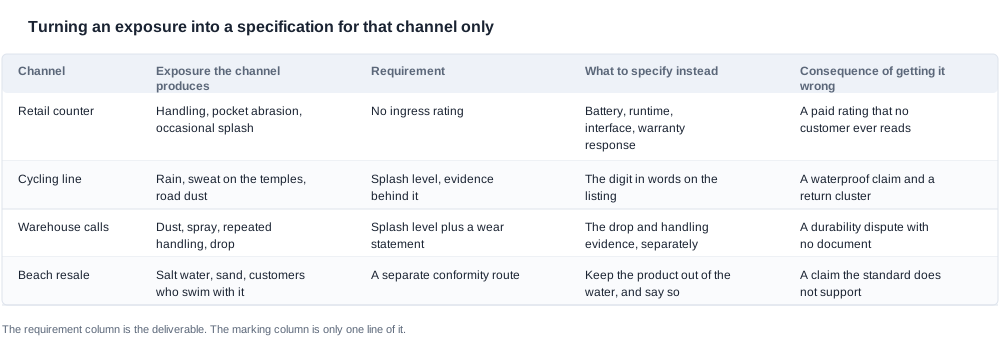
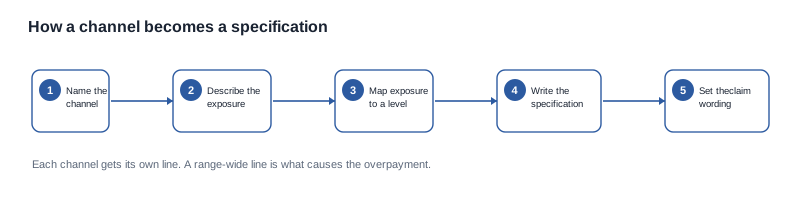
The map is a working document, not an article. Its output is a specification line per channel, and a specification line has four fields.
Field one: the exposure, in the supplier's language. "Rain on the temples during a two-hour ride, sweat on the skin contact surfaces, road spray at the lower rim, and a dusty bag on a rack." A field that says "outdoor use" cannot be quoted against, and a field that says "IP54 required" has already skipped the reasoning that the map exists to supply.
Field two: the requirement that follows. The level, written with its digit read out — "second digit 4, protection against splashing water from any direction under defined volume, pressure and duration; first digit 5, limited dust ingress permitted, not dust tight". Where the answer is no rating, write "no ingress rating required" rather than leaving the cell blank, because a blank cell is read as an oversight and a written decision is read as a decision.
Field three: the evidence that has to exist. The report number with the issuing body, the standard and edition, the tested configuration with its ports, contacts and interfaces, and the sample identity. These four become conditions of acceptance in the purchase order, not requests in an email, because a criterion that lives in an email is not binding and a criterion in the purchase order is an acceptance standard that a lot can be refused against.
Field four: the permitted wording. The sentence that may appear on the packaging and the listing, and the sentence that may not. For a splash-level marking the permitted sentence is "protected against splashing water from any direction", and the prohibited sentence is "waterproof". This field is the one that most often gets skipped and the one that most often generates the return.
What to ask a supplier for each channel line. Send the same request for every channel, in the same format, so the answers are comparable.
- Which level does this quotation cover, and which solids level?
- Which changes to the product are required to reach it — seal, interface, port, button, material?
- Which specific configurations does the marking cover? List them one by one.
- Was the article under test the retail unit, or the electronics on their own?
- Which standard, and which edition of it, was the procedure taken from?
- What is the rule for variants, and what kind of change forces a re-validation?
- Which documents are we sent, and when in the schedule do they arrive?
- What is the total cost of the line, broken into engineering, testing, documentation per market and per-variant exposure?
Two red flags in the answers. A channel line answered with a range rather than a configuration, and a channel line answered without a document. Either one means the line is not yet a specification, and it is better to find that out at the quotation stage than at the artwork stage.
Who owns the map, and when it gets reviewed
A mapping document that nobody keeps current becomes wrong quietly, which is worse than not having one, because the specification sheet still points at it.
The owner is a procurement or product role, not a design role. The map sits next to the variant list, the market list and the artwork approval, because it is the same kind of artefact: a statement about what ships where, on which basis a claim may be made. It should have a name against it and a review date.
The checklist to run at each review.
- Has any channel been added, retired or re-scoped since the last review?
- Has any variant been added that touches the enclosure, the seal or the interface?
- Has the tested configuration changed on any model that carries a marking?
- Has a new market been opened, and does the label set for that market exist?
- Has any claim on the packaging or the listing drifted away from the digit it rests on?
- Have the temperature or chemistry assumptions for a channel changed since the qualification?
When the review is triggered. The natural triggers are a new market opening, a variant being added to the range, a supplier engineering change, and a returns trend that the failure mode does not explain. Running the map review on a fixed calendar as well is worthwhile, because the fifth item on that list — a claim drifting away from its digit — happens through small copy edits rather than through decisions, and copy edits are not engineering change events.
What changes when an answer to one of those six is "yes". Usually the claim, occasionally the specification, and rarely the hardware. That ordering matters, because it means the expensive part of the map is the part you write once, and the part you keep current is the part you can adjust without going back to the factory. Before you order the next variant, run the checklist rather than the instinct: the instinct says the change is cosmetic, and the checklist is what finds the one that was not.

The temperature and chemistry questions the code does not answer
An ingress code is written around water and solids. Two dimensions of the environment that a buyer frequently forgets fall entirely outside it, and both of them are commercially significant in the channels where an ingress rating is most often bought.
Temperature. A product used in a hot car or a cold street is a different product thermally, and both the seal behaviour and the material behaviour move with temperature. A marking established at laboratory temperature describes a condition that may not exist in the field the product actually ships into. The question to ask is not a question about the code — the code does not change — it is a question about the operating envelope: over what temperature range was the product qualified, and what happens to the protection outside it. Suppliers frequently have no answer for this at all, and "not tested" is a legitimate and useful answer that belongs in the file.
Chemistry. Salt water is not water. It carries dissolved solids that change what a seal does over time and what a corroded contact becomes, and a product sold into a coastal or marine channel will meet a chemical exposure that no ingress rating addresses. The questions to ask here are specific: which ageing standards were applied, for how long, and at what concentration — salt spray, ultraviolet ageing, chemical resistance — rather than a general statement that the product is "corrosion resistant".
UV and sunlight. A high-sun market introduces a third exposure class: long-duration ultraviolet radiation on polymers and coatings. It is invisible in a returns report until it is not, and the question to ask is whether any ageing standard was applied to the frame material and the lens coating, and under what conditions.
Why this matters in a range. If the same SKU goes into a cycling line, a coastal retail line and a site-work line, then one ingress rating covers all three only if the rating was established for a range of conditions that include all three. The map has to carry these dimensions too, and the specification line has to state them — otherwise the temperature and chemistry rows are empty in the file in exactly the way that becomes expensive later.
The commercial framing. These dimensions do not change the ingress level, so they are frequently treated as free. They are not free: a separate set of tests is a separate set of documents, and a separate set of documents is a separate set of cost lines. The question to ask is whether they were done, and if not, whether the channel can live with the absence being written down.

Mapping four channels: warehouse calls, cycling, coastal resale, construction site
What follows is a constructed exercise — four channels, one platform, a requirement written for each. It describes no client project, and it is included so that the mapping method can be followed from the exposure through to the specification line.
Take one brand that sells the same hardware into four channels and has been quoting a single ingress marking across all of them because the specification sheet had one cell for it.
Channel one, warehouse calls. Staff carry the glasses on a site with racking, machinery, dust and occasional spray. The exposure is dust and splash, plus the thing nobody puts in an ingress specification, which is that the product is dropped when it is knocked off a lanyard. The requirement is a splash level with evidence, plus a separate abrasion and drop statement, because the failures in this channel are more often drops than water.
Channel two, cycling. The exposure is rain, sweat on the temples and road spray, for rides of up to a couple of hours. The requirement is a splash level, with the digit written out on the packaging and the exclusions printed next to it. The temperature dimension is real in this channel — a summer ride in a hot market is a different thermal condition from the laboratory — but the exposure is not immersion, so the channel does not need a higher level.
Channel three, coastal resale. The exposure is salt water, sand, and customers who will absolutely put the glasses in the sea. The requirement is not an ingress level at all: the channel needs either a decision that the product stays out of the water, with an explicit handling instruction, or a different conformity route that the brand has not scoped. This channel is where the range-wide marking was doing the most damage, because a splash code on a beach product is a claim waiting for a customer to test it in the sea.
Channel four, construction site. The exposure is dust, rain, a pressure wash at the end of a shift, and a high drop rate. The requirement is a jet level rather than a splash level, because the pressure wash is routine, plus the ageing standards for the chemical exposure that a site environment produces.
What the map produces. Four specification lines, one platform, two of them with an ingress requirement, one with an abrasion requirement, and one that resolves to a documented decision not to sell into the water. The commercial result is a qualification that is scoped twice rather than four times, and a catalogue that makes four different claims rather than one claim that is wrong in three channels.
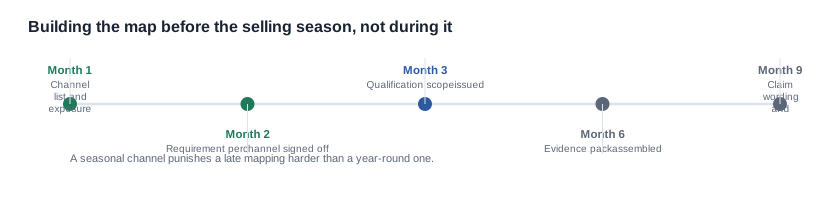
The seasonal trap. A coastal or outdoor channel punishes a late mapping harder than a year-round one, because the season arrives whether or not the qualification is finished. A mapping started a season early is a routine piece of work; a mapping started a season late is a commercial incident.
How the map applies to our own range
The IP54 marking in our catalogue belongs to the two models that carry it — the V06 and the S7 — and we will not extend it to any other model, and we will not describe it as a waterproof rating, because it is not one. We will also say plainly that no third-party test report number is published behind the marking, so a buyer who needs evidence rather than a catalogue line should ask for it as part of the qualification.
The other half of our position is that the exposure mapping matters more than the marking, and that "no ingress rating required" is a legitimate answer with a cost attached to it. A buyer who arrives with a channel plan and a list of exposures will get a better answer from us than one who arrives with a code.
Working the mapping with you is something we can do, and we will tell you which of our models already carry a marking and what the qualification would involve for the ones that do not. The background is under IP ratings and durability, the document contents are in IP rating key specifications, the case question is in does the rating cover the charging case, and the need question is in do you need an IP rating.
Where the use-case mapping comes from
Give us the channel and the exposure, and we will tell you what the requirement has to say.


