

The vocabulary in this category is small, and every term in it is used loosely somewhere. IP rating smart glasses glossary is therefore a working list rather than a dictionary: what each term means, which terms are codes and which are adjectives, and which row is usually missing from a supplier's documentation. A buyer who can separate the codes from the adjectives can also separate a rating from a claim, which is the distinction that costs the most money when it is missed.
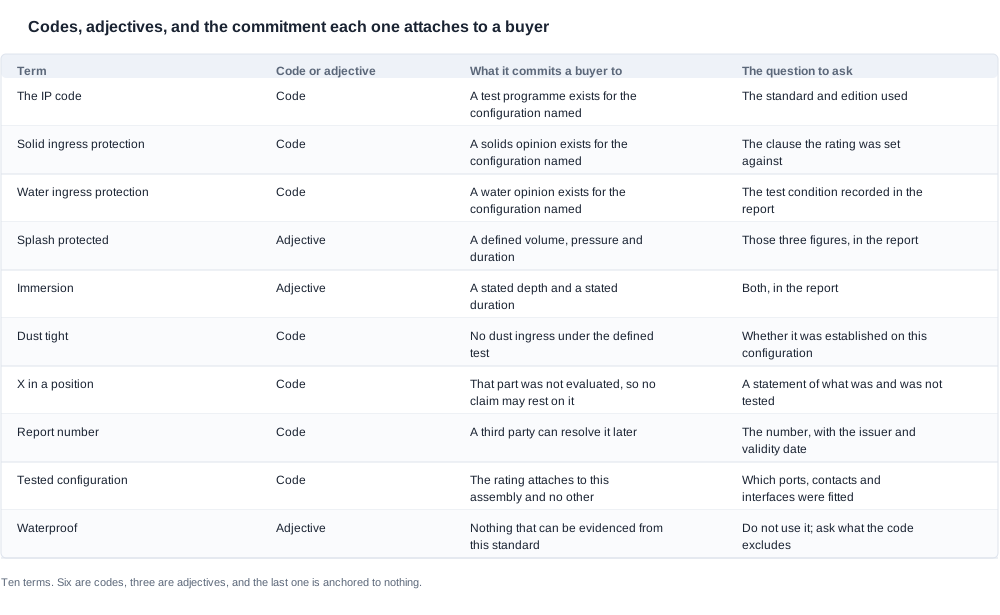
IP rating: codes, adjectives and the missing row
Why a vocabulary is a procurement artefact
IP rating smart glasses glossary is used for one purpose: deciding whether a sentence in a product listing is a claim the supplier can evidence or an adjective that will be tested by a customer. The practical discipline is simple — use the code, and explain the code in plain language, rather than reaching for an adjective. A product marked IP54 can honestly be described as protected against splashing water from any direction; it cannot honestly be described as waterproof, rain-proof or suitable for swimming.
The documents that arrive with a supplier's wording
A buyer building a listing, reviewing a supplier's copy, or writing a specification will meet the same vocabulary in the same places, and the vocabulary is where the ambiguity lives. The same two characters are used for a laboratory result, a marketing shorthand and a supplier's own approximation, and nothing on the page distinguishes them.
That is why the terminology matters commercially rather than academically. A document uses "IP54" and means a test programme. A listing uses "IP54" and means whatever the reader infers. The gap between those two meanings is where the returns, the complaints and the regulatory correspondence live.
What loose vocabulary costs a brand
Treating a code as a synonym for a marketing claim. The code is precise and the claim is not, and the code is what the supplier can evidence.
Reading an X as a low score. An X in either position means that part was not evaluated, which is an absence of opinion rather than a poor one.
Copying a phrase from a supplier's page without checking what it excludes. "Splash proof", "water resistant" and "splash protected" are not interchangeable, and only one of them is anchored to a defined condition.
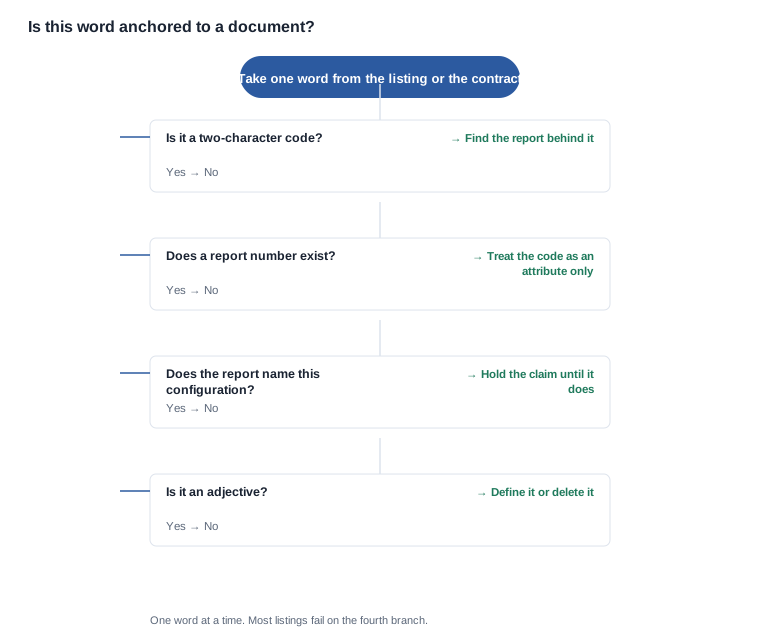
The row that is missing. Almost every supplier document states the code and stops. The row it omits is the tested configuration — which ports, contacts and interfaces were fitted — and that row is what turns a marking into a specification that can be checked against a unit.
Nine terms that get used interchangeably, and what each one commits you to
| Term | Code or adjective | What it commits a buyer to | The question to ask |
|---|---|---|---|
| The IP code | Code | A test programme exists for the configuration named | The standard and edition used |
| Solid ingress protection | Code | A solids opinion exists for the configuration named | The clause the rating was established against |
| Water ingress protection | Code | A water opinion exists for the configuration named | The test condition recorded in the report |
| Splash protected | Adjective | A defined volume, pressure and duration | Those three figures, in the report |
| Immersion | Adjective | A stated depth and a stated duration | Both, in the report |
| X in a position | Code | That part was not evaluated, so no claim may rest on it | A statement of what was and was not tested |
| Dust tight | Code | No dust ingress under the defined test | Whether it was established on this configuration |
| Report number | Code | A third party can resolve it later | The number, with the issuer and validity date |
| Tested configuration | Code | The rating attaches to this assembly and no other | Which ports, contacts and interfaces were fitted |
| Waterproof | Adjective | Nothing that can be evidenced from this standard | Do not use it; ask what the code excludes |
Why the code-and-adjective distinction is the one to hold. A code is a reference to a procedure and a set of conditions. An adjective is a promise about a product. When a supplier's listing uses an adjective where a code belongs, the buyer inherits a promise that no document in the file supports — and inherits it in the place where it is hardest to withdraw, because it is already printed and photographed.
Why "waterproof" is the most dangerous term in the set. It is the only term in this category with no anchor in the standard, and it is the term customers read most often. A product that is genuinely protected against immersion under stated conditions is not "waterproof" either, because the standard's highest consumer level still describes conditions rather than a general property.
The three questions to ask a supplier about any term they use. What does the term mean in your document? Which document establishes it? Which configuration does it attach to? A supplier who can answer all three is describing a test. A supplier who answers the first one only is describing a position, and the position is theirs to defend, not yours.
Turning the vocabulary into defined contract terms
A vocabulary that is borrowed rather than defined will mean something different in every document it appears in. The specification says "splash protected", the label says "water resistant", the packaging says "IP54", and the supplier's internal document says "passes IP54". Four sentences, four meanings, and a dispute at the end in which everyone was technically correct about their own document.
The fix is to attach the definitions to the purchase order. Not to a marketing brief, not to an email thread, and not to a clause that says "the product shall comply with applicable standards" — that sentence is what allows four meanings to coexist in the first place.
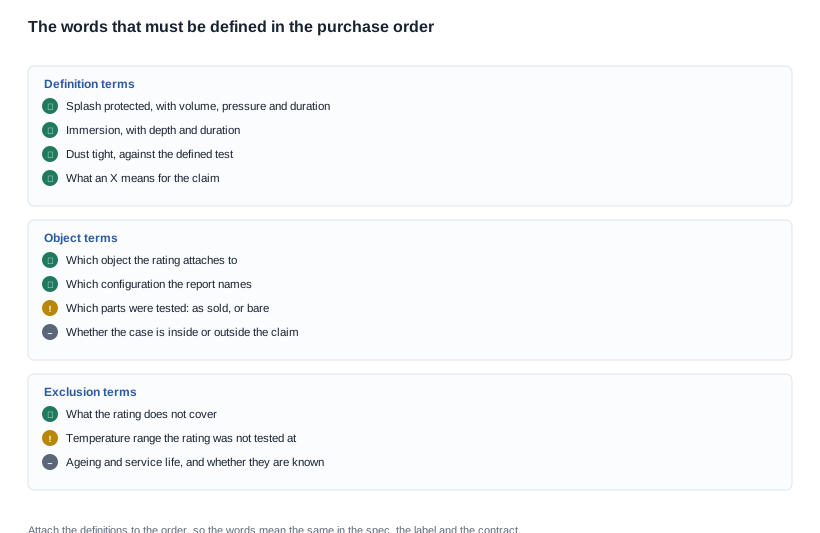
The definition block, in the order it should appear.
- The code and its reading. "IP54" means the first digit rates protection against solid foreign objects and the second rates protection against water, both as defined in the named standard and edition.
- The exposure each term covers. "Splash protected" means protection against water striking the enclosure from any direction, under the volume, pressure and duration recorded in the report named below.
- The conditions that are not covered. Immersion, water jets, sustained liquid contact at temperature, and any condition outside the stated test.
- The object the rating attaches to. The frame, in the configuration named, and not the charging case, the lens, the accessories or any variant not listed.
- The parts that were tested. The product as sold, or the electronics bare, stated explicitly.
- The meaning of an X. That part of the rating was not evaluated and that no claim rests on it.
- The ageing position. What is known about the seal over its service life, and what is not published.
Why item four is the one that is most often left out. The case is the object that most reliably causes a dispute, because it is the object most likely to be wet while the glasses are dry, and it is the object most likely to have inherited the frame's claim in the customer's mind without anyone having made that claim deliberately. We publish no ingress rating for any charging case in our range, and that sentence belongs in the definition block of any contract that covers a case.
For the legal reviewer, ask this. Not "is this enforceable", which they will answer abstractly, but "which of these seven definitions would be enforceable if the claim were challenged" — which is a question about the document set, and it gets a useful answer.
Four red flags in a definitions block
A definition that describes a product rather than a procedure. "Waterproof" defined as "resistant to water" is not a definition; it is the adjective restated in a longer sentence, and it commits nobody to anything checkable.
A definition that omits the conditions. "Splash protected" with no volume, pressure or duration attached sounds precise and establishes nothing, because the whole content of the term is in the three numbers.
A definition that names the family rather than the configuration. "All our products are IP54" is a definition of nothing, because it does not say which product, which variant, or which build.
A definition that is correct but unreachable. The block defines the rating precisely while leaving the case, the lens and the accessories outside it without saying so. The gap between what the block covers and what the customer assumes the block covers is where the dispute lives.
Why these four and not others. Each of them is a definition that survives a read-through and fails an audit. They are the shapes that ambiguity takes when someone is being careful, which is precisely why they survive.
The trade-off inside the definitions block. A longer definitions block costs a little more of the supplier's legal time and a little more of the buyer's, and it buys the ability to refuse a lot that does not match the evidence. For a product where the claim appears on the packaging and the listing, that trade is worth making; for a product with no claim on the outside of the box, the same block can be shorter. The criterion to use is whether a customer can read a claim, not whether a buyer has to write one.
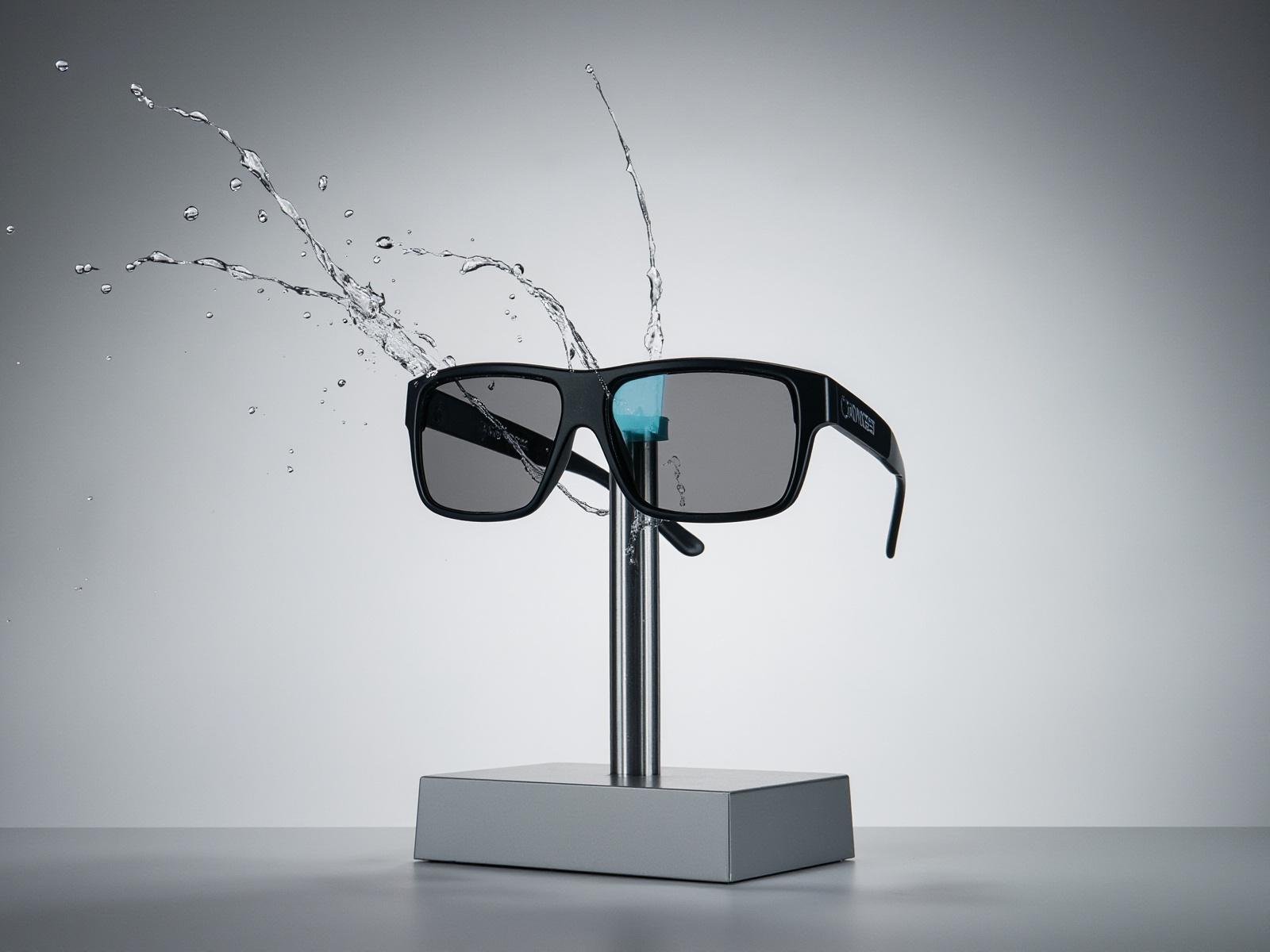
Auditing a supplier's ingress wording line by line
Copy review of ingress language is quick, and it catches more than most buyers expect. The method is to take every sentence in the supplier's material that contains a code or an adjective, and put it through the same three checks.
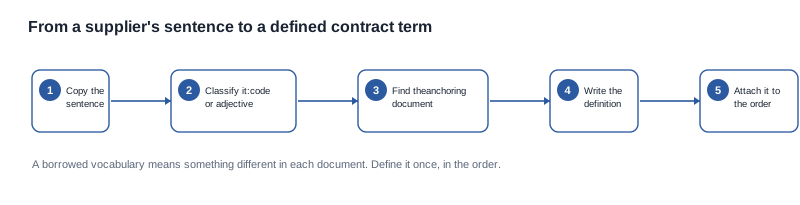
Check one: is there a code or an adjective, and which is it? A code points to a document. An adjective points to nothing. Every adjective in the sentence either gets a definition attached to it or gets deleted.
Check two: does the sentence survive at the level of the code? Replace the code with its plain-language reading and read the sentence again. "Protected against splashing water from any direction" survives. "IP54-rated" survives. "Waterproof to IP54 standards" does not, because the adjective is doing work the code cannot support.
Check three: does the sentence describe the object the rating covers? If the sentence says "the glasses and charging case are IP54", the claim is false on its face, because the case is a separate enclosure. If it says "the frame is IP54", it is defensible subject to the evidence.
The four most common sentences that fail the audit.
- "Waterproof to IP54 standards" — an adjective attached to a splash code.
- "Tested to IP54" — a tested claim without a report.
- "The device and accessories are IP54 rated" — a product-level claim covering an object with its own openings.
- "IP54 rated, suitable for swimming" — a code followed by a use case the code does not address.
Repairing the sentence. Replace the sentence rather than deleting it, because the underlying fact is usually true and it is worth saying. "Waterproof to IP54 standards" becomes "protected against splashing water from any direction, IP54". "Suitable for swimming" becomes "not designed for immersion" — which is a sentence that answers the customer's actual question and protects the brand at the same time.
Who signs this off. The supplier's copy is drafted for a brochure, and the brochure is written by someone who was not in the qualification. The sign-off therefore belongs with the person who holds the report, not with whoever received the file. This is a small procedural point that produces a disproportionate number of avoided claims.
When a term cannot be resolved on the spot
Vocabulary disputes are slow because people argue about meaning instead of asking for evidence. A fixed list of questions turns the argument into a document request, and it settles the term in one exchange.
- Does the term appear in a document you hold, and which one?
- If it does, is the term defined in that document or used loosely in it?
- Which configuration does the term attach to, and is that configuration the one we would order?
- Which model designation is written on the document beside the term?
- What is the report number, and does it resolve in the issuing body's register?
- Does the term describe a condition, a procedure, or a product property?
- If it is a product property, which document establishes it?
- What wording do we publish instead, and does that wording survive the code?
How to score the answers. Any answer that does not name a document is not an answer to the question; it is a restatement of the term. Collect the answers that name a document and treat the rest as open items. Open items are not a blocker for most copy — most copy can be narrowed to what the evidence does support — but an open item that appears on the packaging is a blocker for the packaging.
When the list is worth running. Before the copy is written, not after. The list is fast when the wording is still in a draft and slow when the artwork is already at the printer, because at that point every unresolved term becomes a reprint rather than an edit.
The total cost of leaving a term unresolved. It is not the cost of the qualification; it is the cost of the claim being withdrawn after publication, which arrives as a reprint, a listing amendment, a response to the customer who tested it, and a record in the returns data that will be read later as a quality signal rather than a copy error. That total cost is what the list of eight questions is protecting, and it is the reason this is a procurement task rather than an editorial one.

A copy review: five adjectives that outrun a splash rating
The following five adjectives appear in ingress copy with some regularity, and each one makes a claim that a splash-level marking does not support. They are listed here because the list is short enough to memorise and because the question "does this word outrun the code" is faster to answer than the question "is this word acceptable".
Waterproof. The anchor case. It has no defined condition in the ingress standard, at any level, and it is the term most likely to be read as an unlimited promise. The code-supported alternative for a splash product is "protected against splashing water from any direction".
Rain-proof and rain-ready. These sit between the code and the promise. A splash rating does cover a rain exposure of a kind — water striking the enclosure from any direction is close to what rain does — but it does not cover sustained rain pooling on the lower rim, and it says nothing about water running down into an open port. The wording that is safe is the digit's own reading, which is unambiguous and needs no interpretation.
Sweatproof. This one is subtler than it looks, because the standard's splash condition is a water condition and sweat is a warm liquid with dissolved salts. A splash rating does not establish anything about warm liquid contact, and the buyer who publishes "sweatproof" on a splash code is making a chemical claim, not a water claim. The honest version is "suitable for use in a sweaty environment, with the ingress marking applying to splashing water".
Shower-proof and immersion-safe. Both describe an exposure class that a consumer ingress marking does not address for a wearable with open interfaces. If the channel requires this, the requirement is not a copy problem — it is a product problem, and the answer is a different conformity route rather than a better sentence.
Suitable for swimming. As above, with the additional risk that a swimming claim on a device that also carries a camera raises expectations about the camera's seal that the device may not meet.
The check that catches all five in one pass. Take the copy, remove every code and every adjective, and read what is left. If the remaining sentence still makes a durability promise, the adjective is doing the work and the code is decoration.
How we use these words in our own catalogue, and where we stop
Our catalogue carries an IP54 marking on the V06 and the S7, and no ingress rating for any other model because none is stated. The marking is a catalogue annotation: we do not publish a third-party test report number, the standard, the test condition, the sample size or the laboratory behind it, because the company has not confirmed them. We are telling you this in a glossary about terminology, which is the right place for it, because the terminology is exactly where the ambiguity lives.
Nor will we extend the marking to any model it does not cover, and we will not describe a splash-protected product as waterproof. A product marked IP54 can honestly be described as protected against splashing water from any direction, and that sentence is the whole of what we will let you publish on the strength of the marking.
Where our own vocabulary stops. We do not publish the seal material, the seal service life, the ageing behaviour of any seal, the test conditions behind our marking, the certificate numbers for any model, or the cost of reaching a level we do not hold. We would rather show an empty field than a plausible-looking one, because the whole argument of this glossary is that a vocabulary without a document behind it is a liability, and that rule applies to us as well.
How we handle a term. If you send us a supplier's ingress wording, we will tell you which terms it uses, which of them are anchored to a document, and which are anchored to nothing — and, where the term is anchored but the configuration is not, we will tell you that too. The background is under IP ratings and durability, the document contents are in IP rating key specifications, and the range is sport smart glasses.
Where the vocabulary comes from
Give us a supplier's ingress wording and we will tell you which of these terms it uses and which of them are anchored to a document.


