

An ingress marking is not on the critical path until the day somebody asks for the report behind it, and from that day it is on the critical path for the whole programme. IP rating smart glasses lead time factors is therefore about four things: the conditions that put a marking on a schedule at all, the questions that reveal where in the queue it sits, the commercial terms that can absorb a queue, and the decisions that are cheaper to make before the design is frozen than after.
The unglamorous truth is that a marking is a laboratory booking wearing the costume of a datasheet row. Nobody books a laboratory slot for a line in a spec table, so a programme discovers the queue late — usually after the design freeze and the first article, which is the worst possible moment to learn that the unit you tested is not the unit you are building. The good news is that most of the schedule exposure in this category is created by the buyer's own sequencing, not by the factory's capacity, and it can be pulled forward for the cost of one email.
IP rating: a qualification queue has a position
The short answer, and the one question that decides it
The whole of IP rating smart glasses lead time factors reduces to a single question: is there an existing report for this exact configuration? If there is, the marking is a document retrieval and the schedule impact is small — hours, not weeks. If there is not, the marking is a laboratory queue, and a laboratory queue is not compressible by asking more politely or by paying more. The programme risk sits entirely in the answer to that first question, and the answer costs one line in one email to obtain.
Four consequences follow, and each one changes what a buyer does next. First, the queue is per configuration, so a range that commits to three configurations has three queues rather than one, and they can be booked in parallel or in series depending on whether the configurations share a test programme. Second, the queue runs on the factory's sample availability, which means the tested unit cannot exist before the first article, which means the whole chain hangs off a manufacturing milestone rather than off a paperwork milestone. Third, the queue sits between the design freeze and the artwork approval, which means the artwork cannot be finalised until the evidence exists, which is why an unqualified programme sometimes ends up with packaging ordered and a claim deleted from it. Fourth, a change to the enclosure after the test does not merely slow the programme down; it restarts the chain at the beginning.
In our own catalogue the position is unusually clear about the gap. The IP54 marking appears on two models, the V06 and the S7, with no third-party test report number published behind either. Every other model in the range publishes no ingress marking, and no charging case in the range carries one either. So for a buyer who needs the document rather than the code, the marking on our current range is a queue rather than a fact, and we say so rather than letting the catalogue row imply otherwise.
The buyer working backwards from a launch date
The person managing this problem is usually planning backwards from a fixed external date — a trade-show stand, a retail roll-out, a marketplace campaign start — and holds a design that is roughly settled, a target landed cost, a market list and a factory schedule that was itself quoted without much reference to ingress.
What they will not hold is the marking's position on that schedule, because a marking looks like a specification rather than a booking. The consequence is a discovery sequence that runs in the wrong order: the exposure is never written down, the requirement is never issued, the supplier is asked for a price rather than for a booking, and the queue appears as a surprise at first-article stage.
The fear that drives most of this is not, interestingly, a late delivery. It is a late change. A programme that discovers the queue after the design freeze has two bad options and no good one: absorb a re-test and a re-tool, or remove the claim and reprint the packaging that already exists. Both outcomes are more expensive than booking the slot three months earlier, and both of them are avoidable with information that is free.

What an ingress marking actually adds to a launch calendar
Four costs, and only one of them is visible on a quotation
An ingress qualification adds four things to a programme, and they behave differently enough that they need to be separated before anyone can plan around them.
The first is the seal and interface design work. Sealing a frame means changing geometry, adding material and adding process, and that work has to happen before a sample can exist. A supplier who will not name the specific items they will change is telling you the work has not been scoped, and unscoped work does not have a duration. The second is the laboratory programme itself: a fee per configuration and a queue whose length is set by the laboratory rather than by your order size. The third is the documentation chain, which includes the declaration, the technical file, the model list and the per-market label set, and which is the part that quietly multiplies when a programme has several models and several markets. The fourth is the variant tax: every colour, logo and private-label derivative is a configuration question, and any change that touches the enclosure or the interface can put an established marking out of scope.
The unit price in a quotation reflects almost none of this. Two suppliers quoting identical electronics can differ by a wide margin on the whole programme because one has already established the configuration and the other has not, and the quotations are being compared as if they were the same thing. That is the central commercial fact of this category, and it is why a unit-price comparison is the wrong tool for choosing between a supplier with an existing report and one without.
The dependency chain, and where the buyer has control
The chain runs like this: the exposure is described, the requirement is written, the design is frozen, the first article is built, the laboratory slot is used, the report is issued, the model list is confirmed, the artwork is approved. Each link depends on the one before it, and the whole chain is serial from the design freeze onward.
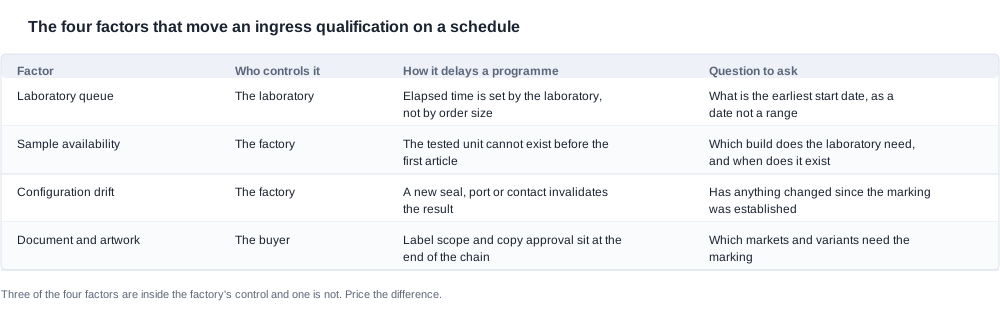
Three of those links are inside the factory's control and one is not. The laboratory's queue is the one that is not, and pressing on it produces nothing. The first article, the configuration and the date the tested unit becomes available are all factory-side and all worth planning, because they are the three that determine when the laboratory slot is actually usable. And the first link in the chain — the exposure description — sits with the buyer, where it is normally left unwritten.
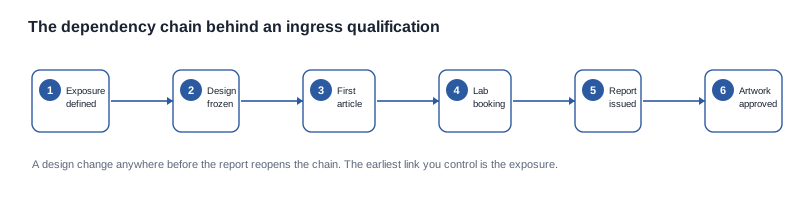
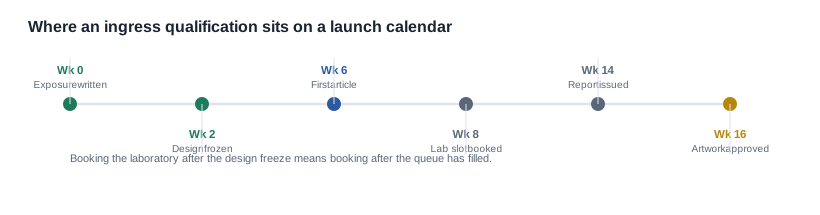
The practical consequence is that the single highest-leverage action in this entire category costs nothing: writing the exposure down before the design freeze. It shortens nothing on its own, but it converts an undefined qualification into a bookable one, and it is the difference between a factory that quotes a queue and a factory that quotes a date.
Four factors that put an ingress marking on the critical path
The factors, their owners, and the question that resolves each
The table below is the schedule request. The right-hand column separates a supplier who can place a booking from one who will only quote a fee for it.
| Factor | Who controls it | How it delays a programme | The question that resolves it |
|---|---|---|---|
| The laboratory queue | The laboratory | Elapsed time is set by the laboratory, not by your order size | What is the earliest start date, given as a date rather than a range |
| Sample availability | The factory | The tested unit cannot exist before the first article | Which build does the laboratory need, and when does it exist |
| Configuration drift | The factory | A new seal, port or contact invalidates the result | What has changed since the marking was established |
| Document and artwork | The buyer | Label scope and copy approval sit at the end of the chain | Which markets and which variants need the marking |
The thresholds, in operational terms
There are four states, and the schedule question is answered differently in each. The first is an existing report covering the exact configuration: the marking is a retrieval, the elapsed time is internal, and the programme risk on this dimension is close to zero. The second is an existing report covering a related configuration: the work is a delta, and the question becomes whether the delta is a document difference or a hardware difference, because only the second one costs a test.
The third state is no report at all. Here the chain is a full laboratory programme, and the schedule is the first article plus the queue plus the report. The single most important sub-question in this state is the sample specification: whether the laboratory needs one unit or several, whether it needs a unit from a production build or accepts a pre-production sample, and whether the unit can be built before or after the first article milestone. A supplier who cannot answer that question cannot give you a date.
The fourth state is a configuration that has changed since a marking was established. This is the one that catches people, because the marking still appears on the catalogue and the programme still feels like a document retrieval. The reality is that a new temple geometry, a different charging interface, a different port or a different material all invalidate the result, because a rating applies to a specific enclosure.
The market question, which is not a timing question
Markets are usually treated as a single item with a date change attached, and that treatment is what produces the schedule surprise. Different markets require different evidence, and evidence obtained for one market is not automatically accepted in another. A programme that ships to several markets therefore has several evidence programmes, and they do not necessarily run in parallel — a single laboratory can only hold one queue position per configuration per programme.
The practical rule is to list the markets and their evidence requirements separately, in a single table, before the quotation. Where a market turns out not to require the ingress evidence at all, the cheapest result in this category is that finding: it removes a queue, a seal design question and a label set in one decision. The alternative is buying an expensive qualification for a market that never asked for it and paying for it again in artwork time when the label turns out to be wrong.

Reading a factory's schedule answer before the design freeze
How to verify a schedule answer before the design freeze
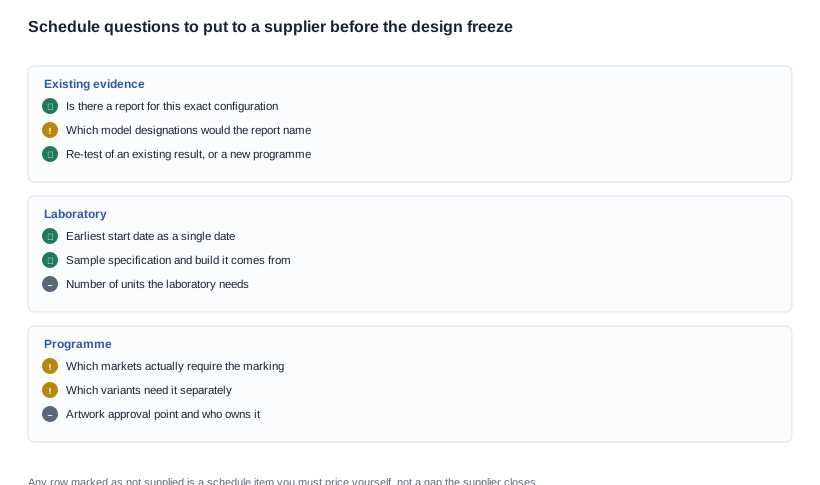
The verification here is a set of questions asked in a particular order, and each one has a completion test that tells you whether the answer is usable. The criteria below are the ones that separate a bookable programme from an open-ended one, and what to ask is the same in every case: the date, the build, and the scope.
The first question is whether an existing report covers the exact configuration, and the completion test is a model list rather than a yes. The second is whether the work is a re-test or a new programme, and the completion test is a statement of what the difference does to the queue. The third is what sample the laboratory needs and when it can exist, and the completion test is a build identity and a date relative to the first article. The fourth is the earliest start date, and the completion test is a single date; a range is an admission that the answer is an estimate. The fifth is whether the marking is required in each destination market, and the completion test is a per-market statement rather than a general assurance.
If the answer to the first question is that a new programme is needed, the next action is to book the slot, and to book it before the design freeze. A booking made after the design freeze is a booking made after the queue has filled, and the difference is often the difference between a programme and a missed season.
Aligning the tested sample with the first article
The second verification question is the one most often skipped: is the tested unit the production unit? A sample from a pre-production build and a production unit that differ in a port are different enclosures, and the report is for the wrong one. The alignment is a scheduling instruction as much as a quality instruction, because a sample built too early will not match, and a sample built too late will not meet the laboratory slot.
The workable arrangement is to treat the first article as a qualified sample rather than as a display unit. That means the laboratory sample specification is obtained before the first article is built, and the build is checked against it. Where the laboratory needs more than one unit, the additional units come from the same build, because a unit from a different build reopens the question.
Separating the marking's date from the shipment's date
A supplier that quotes one date for both is being helpful, not accurate. The marking's date is the date the document exists. The shipment's date is the date the goods leave. Conflating them is how a programme slips by a month, because the artwork, the label scope and the market launch are all downstream of the document rather than of the goods.
Ask for the two dates separately, and ask for the milestone between them. Where the answer is a single combined date, the supplier is telling you that the evidence sits behind the goods, and that is a programme structure with a fixed problem in it.

Where the schedule breaks when the marking was treated as a datasheet row
The programme discovers the queue after the design freeze. The symptom is a launch date that cannot be met, or a claim quietly dropped from a product that has already been engineered for it. The root cause is that the marking was treated as a catalogue row rather than as a laboratory booking, so nobody reserved anything. The prevention is to ask the schedule questions before the design freeze and to book the slot in the same conversation.
The report names a configuration the production unit does not match. The symptom is a document that arrives but cannot be used, usually discovered when the first article and the tested sample are laid side by side. The root cause is that the sample came from a pre-production build. The prevention is to align the tested sample with the first article and to check the configuration on receipt rather than on trust.
The claim is dropped from the packaging after the artwork is approved. The symptom is a reprint, a delivery delay and a product whose only visible difference is a line missing from the box. The root cause is that nobody decided the claim's status before the packaging was ordered. The prevention is to treat the claim as a variable with a decision point, and to place that decision before artwork approval rather than after.
The seal is specified after the test. The symptom is a tested unit that is not the unit that ships, with the discovery arriving as a re-test request. The root cause is that the seal was treated as a test output rather than as a design input. The prevention is to ask for the seal material and its expected service life in the same conversation as the schedule, because the seal is what the schedule is actually protecting.
A second market needs evidence the first market did not. The symptom is a second queue discovered once the first has been booked and paid for. The root cause is that the market list was treated as one market with a date change. The prevention is to list the markets and their evidence requirements separately at the quotation stage, and to price the difference into the schedule rather than discovering it in the artwork stage.
Buying schedule certainty, and the questions our own catalogue cannot answer
The commercial terms that can absorb a queue
The term most worth negotiating in this category is delivery splitting against a documentation milestone. It is granted more easily than a price concession, because it moves the risk onto the schedule where the risk actually lives, and in a category where the binding constraint is a laboratory queue, that is the whole of the commercial negotiation. The number of units per variant is negotiable, and more so on a repeat order than on a first. The per-variant cost of a documentation-only change is usually negotiable as well, because no hardware is touched and the labour involved is small.
Payment structure is the other lever worth pulling. A deposit, a balance on inspection before shipment, and a retention held against the documentation package all protect the buyer on the failure that costs most in this category, which is a product that arrives with a marking nobody can evidence. On a programme where the evidence is on the critical path, that retention is worth more than a unit-price concession.
What is not negotiable is the certification cost and the certification time. An ingress test is a per-configuration cost and the elapsed time is set by the laboratory, and no commercial term moves it. Spread across the first order as a one-off charge, the tooling line leaves two halves to the question: the volume the amortisation runs over, and whether the tooling and the sealing tooling are still needed if the programme stops. And the seal is not negotiable either: a supplier who will not change the seal material, the seal geometry or the port design is telling you that the ingress performance is fixed, and therefore the schedule is fixed too.
A worked scenario: a spring-window launch with one dated queue
This is a hypothetical case rather than a client project, and it is here to show how the sequence of questions changes a launch plan.
Assume a channel buyer preparing a sport line for a spring retail window, with two suppliers quoting, one at a lower unit price with no published ingress document and one at a higher unit price whose documentation covers more of the range. The binding constraint is the retail window, which is fixed, and the buyer's supervisor wants a single delivery date rather than a split.
The first move is to ask the schedule question rather than the price question, and the answer is decisive: for the configuration the buyer actually wants, no report exists, so this is a full laboratory programme. The second move is to ask which markets require the evidence at all, and the answer is that only one of the three destination markets requires it, because the other two are dry-climate and indoor channels. That single finding removes two label sets and narrows the evidence programme to one market.
The third move is to request the laboratory sample specification, which turns out to require a unit from a production build rather than a pre-production sample. That is good news rather than bad, because it means the tested unit can be the same unit as the first article and the chain does not need a separate sample build. The fourth move is to book the slot against the date the first article will exist, and to tell the factory that the artwork approval depends on the report.
The fifth move is the commercial one. The buyer restructures the order as a split delivery, with the balance and the retention tied to the documentation package, and accepts a higher unit price for the lower-risk schedule. The outcome is a programme with one dated queue and one narrow evidence scope, instead of a single combined delivery date and two unnecessary label sets. Every decisive question was asked before the purchase order was signed, and none of them was about unit price.
What our own catalogue does and does not answer
The boundary we hold: the schedule risk and the documentation risk are the same risk, and we will not present a marking without the document behind it as though it carried no schedule consequence.
In our catalogue the IP54 marking appears on the V06 and the S7 as an annotation, with no third-party test report number, no standard, no test condition, no sample size and no laboratory published behind either. For a buyer who needs the document, that means the marking is a queue rather than a fact, and we would rather say so than let the catalogue row imply a readiness we cannot evidence. No other model in the range carries an ingress marking, and no charging case in the range carries one either, so a programme built around the charging-case variant of either model is starting from a different configuration and needs its own qualification.
We will also be clear about the part that is not ours to compress. The laboratory's schedule is not the factory's to compress, and no commercial term moves it. What the factory controls is the sample, the configuration and the date the tested unit becomes available, and those three are worth planning because they determine when a booking is actually usable.
We publish no production capacity, no lead time figure and no queue position for our own factory, because the company has not confirmed them to us and a published number we cannot stand behind is worse than no number at all.
Four requests to make before the design freeze
Ask the schedule question as a list rather than as a chat, so that the answer arrives in writing: is there an existing report for this configuration, is the work a re-test or a new programme, what sample does the laboratory need and when does it exist, and what is the earliest start date given as a single date. The acceptance criteria to write before you order are the earliest start date, the sample build and the configuration scope, and none of the three is negotiable once the booking is made.
Ask which markets actually require the evidence, per market, and treat a market that does not as a removal rather than as a delay.
Align the laboratory sample with the first article, and obtain the sample specification before the first article is built rather than after it exists.
Send us the configuration and the target launch date and we will tell you whether the marking on our range is a document or a queue. The background is under IP ratings and durability, the supplier questions are in IP rating supplier verification, the engineering context is in durability engineering for sports and cycling brands, and the process timing is in development process timeline.
Where the schedule method comes from
Send us the configuration and the launch date and we will tell you whether the marking is a document or a queue.


